Why buy more clothes when you can just rotate? 👽 First outfit from @botter.world and last from @waltervanbeirendonckofficial - - - - - - - #fashion #virtualinfluencer #art #streetart #illusion #ia #fashionweek #couture #paris #fashiondesigner
Why buy more clothes when you can just rotate? 👽 First outfit from @botter.world and last from @waltervanbeirendonckofficial - - - - - - - #fashion #virtualinfluencer #art #streetart #illusion #ia #fashionweek #couture #paris #fashiondesigner
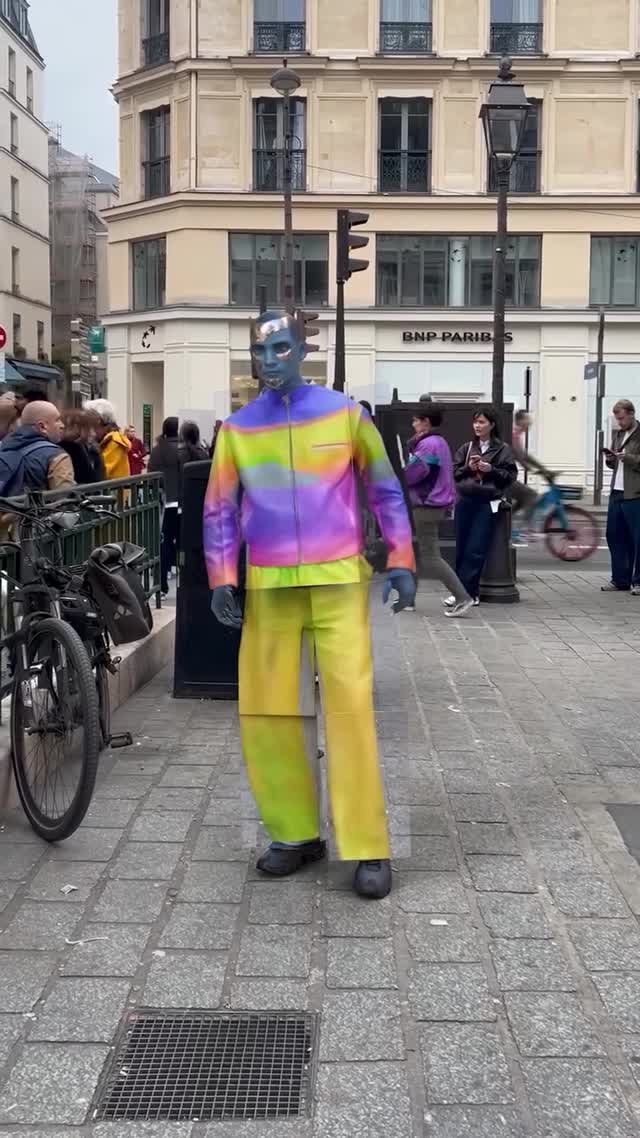
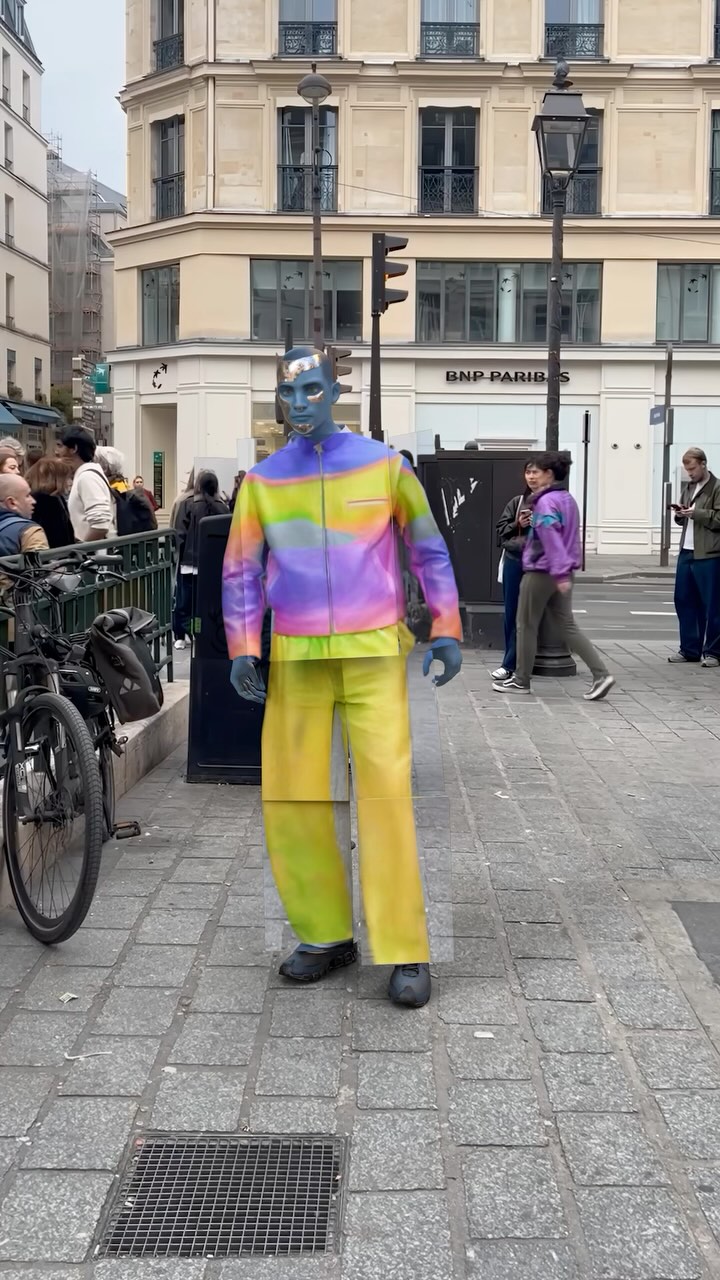
This image hits fast because it looks like a normal city moment, then immediately breaks expectations. You see a real street, real pedestrians, real architecture. And then the subject: a blue, avatar-like face paired with a loud rainbow jacket and almost neon-yellow trousers. The contrast is so strong that your brain has to pause for a beat. That pause is the scroll-stopper.
But the real win is the concept behind the caption: “Why buy more clothes when you can just rotate?” The visual matches that idea perfectly. The outfit feels like a skin you can swap, not a purchase you own. When a picture and a sentence describe the same world, people save it, share it, and comment because it feels like a complete thought, not just a pretty photo.
If you are a small creator, you do not need a huge set or a complex scene to get this effect. You need one strong “this should not be here” element, placed inside a familiar environment, with a caption that makes the weirdness feel purposeful.
This frame is basically a cheat code for clarity. The environment is neutral: gray paving stones, beige building, black street fixtures. That neutrality makes the subject’s palette explode. When your subject’s color story is that dominant, you do not have to fight for attention with extra props or complicated composition.
It also borrows credibility from reality. The background looks like a real intersection with people going about their day, which makes the “virtual” vibe feel more impressive. Instead of floating in a synthetic studio, the character is tested in the real world. That increases trust and makes viewers think: “How did they do that?”
| Signal | Evidence (from this image) | Mechanism | Replication Action |
|---|---|---|---|
| Reality Anchor | Real street, pedestrians, readable storefront signage | Realism makes the surreal element feel stronger and more shareable | Place one surreal subject inside a believable everyday location |
| Palette Dominance | Rainbow jacket + bright yellow trousers against neutral city tones | High contrast improves thumbnail impact and stop rate | Limit background colors; push subject saturation intentionally |
| Concept-Visual Alignment | “Rotate outfits” caption matches the avatar/skin vibe | Coherence increases saves because it feels like a complete idea | Write a caption that explains the visual in one line of meaning |
| One-Subject Readability | Single centered subject; everything else is supporting context | Low cognitive load keeps attention on the hook | Keep one hero subject and demote everything else to background |
Keep: neutral city background + centered full-body framing + overcast daylight.
Change: the “impossible” element (skin/material/outfit).
Slot template (EN): "{surreal subject} standing in {real city scene}, wearing {signature outfit}, overcast daylight"
Keep: one dominant palette on the subject.
Change: the environment class (market, metro entrance, museum steps).
Slot template (EN): "single subject with {dominant palette} against {neutral environment}, street photo realism"
Keep: concept-first caption alignment.
Change: the social theme (identity, consumerism, “skins,” remix culture).
Slot template (EN): "{visual hook} that illustrates: {one-sentence idea}"
The aesthetic is not “pretty.” It is “cleanly disruptive.” The frame uses everyday realism as a stage: natural perspective, deep-ish focus, and documentary street texture. That realism matters because it makes the subject’s design feel bolder. The blue face and hands read as a deliberate layer, like a wearable filter brought into the real world. Then the outfit does the second hit: a rainbow banded jacket plus bright yellow trousers. The colors are loud, but they are organized. The jacket’s stripes feel intentional, and the pants act like a single, high-saturation block. That organization keeps the image from becoming messy.
Composition supports the message. The subject is centered and fully visible, so the viewer gets the silhouette instantly. Background people are present but not competing. The mood is also important: overcast light removes harsh shadows, which keeps attention on color and shape rather than drama. If you want to recreate this, treat the environment as a neutral canvas and the subject as the only place where you spend visual “budget.”
| Observed | Recreate | Why it matters |
|---|---|---|
| Centered full-body subject | Use a vertical full-body street portrait crop | Maximizes readability and silhouette recognition |
| Neutral city palette | Keep environment gray/beige/black with low saturation | Allows the subject colors to dominate |
| Single dominant color story | Choose one subject palette with clear blocks (not random colors) | Boosts thumbnail impact and memorability |
| Soft overcast lighting | Use diffuse daylight, minimal shadows | Prevents background drama from stealing attention |
| Prompt chunk | What it controls | Swap ideas (EN, 2-3 options) |
|---|---|---|
| subject identity layer | The “impossible” hook (avatar vs human) | "blue avatar skin" / "chrome mannequin face" / "pixelated mask texture" |
| wardrobe palette blocks | Thumbnail impact and brand signature | "rainbow stripe jacket + yellow pants" / "all-white with one neon accent" / "monochrome suit with holographic gloves" |
| environment neutrality | How much the background competes | "neutral European street" / "subway entrance" / "museum steps" |
| camera realism | Believability of the “real-world” anchor | "phone street photo, 28mm" / "documentary still" / "handheld candid framing" |
| crowd as texture | Social proof without distraction | "few pedestrians blurred" / "light crowd" / "single cyclist passing" |
Baseline Lock: centered full-body framing, neutral city background, and diffuse overcast lighting.
One-change rule: change only 1-2 knobs per run so you can tell what actually improves saves.