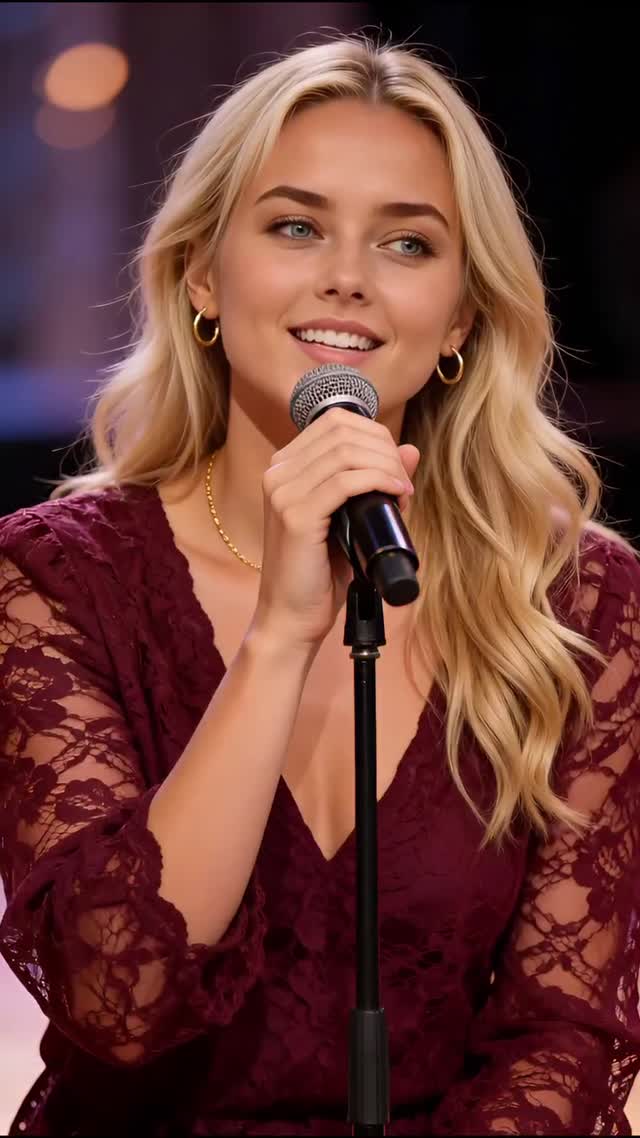
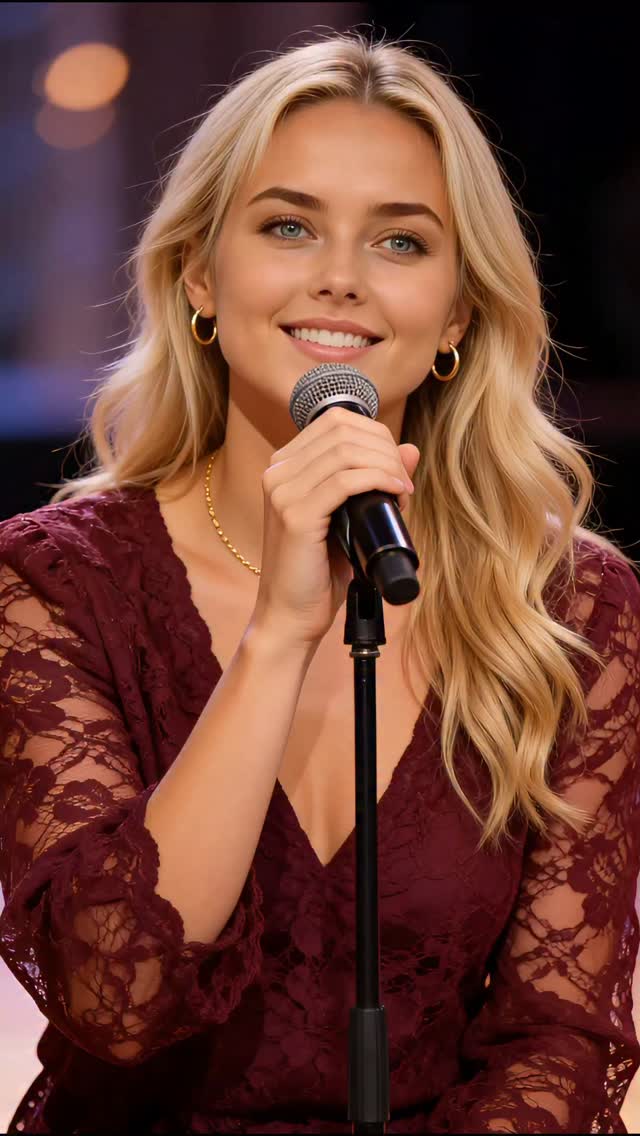
Feeling every emotion in “Callin’ U (Tamally Maak)” 💫 This beautiful Arabic love song, originally written by Mahmoud El Esseily and famously performed by Elyanna, carries so much longing and softness. I couldn’t resist bringing my own feeling into this moment. 🎧 This video is a lip sync using the original song.
How millasofiafin Made This Callin’ U (Tamally Maak) AI Lip Sync
Not every music visual needs dramatic effects to perform. This frame works because it feels honest and polished at the same time. The singer’s smile is relaxed, the microphone confirms live context, and the burgundy lace outfit adds enough texture to look premium without feeling overproduced.
The strongest decision here is emotional accessibility. Many performance thumbnails push intensity too hard, but this one chooses warmth. That choice broadens audience appeal: casual viewers are less intimidated, and fans still get a clear artist identity.
The image is also structurally clean. One subject, one prop, one color anchor. In feed environments, this simplicity improves comprehension speed, which supports better hold and save behavior.
Signal Table
Signal
Evidence (from this image)
Mechanism
Replication Action
Approachable emotion
Natural smile and soft gaze
Lower social distance encourages engagement
Prompt for “warm, relaxed expression” instead of high-drama face
Role certainty
Microphone centered near mouth
Instantly communicates “singer/performance”
Keep one clear role-defining object in foreground
Texture richness
Lace sleeves with visible pattern
Micro-detail increases perceived quality
Use one detailed fabric element and preserve sharpness on it
Palette coherence
Burgundy outfit + warm bokeh + dark background
Consistent color story improves memorability
Lock one hero color and reduce competing hues
Best-Fit Scenarios
Artist introduction posts: Ideal for building first-impression trust.
Acoustic cover thumbnails: Works when emotional clarity matters more than spectacle.
Playlist promo visuals: Clean enough to layer title text later if needed.
Weekly performance series: Easy to repeat with color or outfit variations.
Multi-artist collaborations that require wider composition.
Tech demos where gear details are the main story.
Transfers (exactly 3)
Golden acoustic transfer Keep: smile-first expression and centered mic geometry Change: burgundy to cream wardrobe, increase amber ambience Template:{warm vocalist portrait} {center mic} {single hero outfit color} {soft bokeh stage}
Cool-night transfer Keep: composition and approachable expression Change: warm bokeh to blue-purple backlights Template:{singer medium close-up} {microphone foreground} {cool stage lights} {clean background}
Minimal monochrome transfer Keep: role clarity and texture emphasis
Change: color grade to monochrome and keep lace contrast
Template:{black-and-white singer portrait} {lace texture detail} {soft smile} {mic-centered frame}
Aesthetic Read
The visual center is a triangle: eyes, smile, microphone grille. This triangle keeps attention stable and makes the frame easy to process on small screens. The burgundy lace creates secondary detail that rewards longer viewing, especially in sleeves where texture density is highest.
Lighting is intentionally gentle. Instead of dramatic shadow carving, the image uses soft key light to keep skin tones luminous and inviting. Background bokeh is present but restrained, giving atmosphere without narrative noise.
Prompt Technique Breakdown
Prompt chunk
What it controls
Swap ideas (EN, 2-3 options)
Expression block
Audience warmth perception
“gentle smile while singing”, “calm joyful expression”, “soft friendly gaze”