Feelin’ 🔵 I need better outfit ideas… wanna help? ⬇️⬇️ #aibaddie
Feelin’ 🔵 I need better outfit ideas… wanna help? ⬇️⬇️ #aibaddie
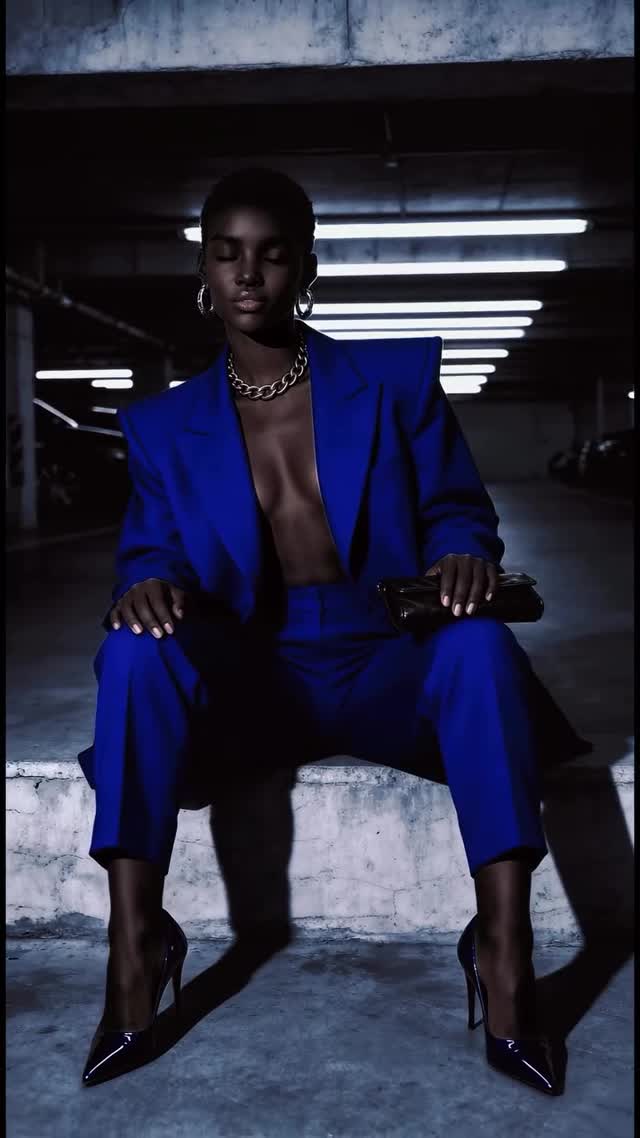
This frame wins by combining two worlds that usually do not coexist: raw industrial space and precision luxury styling. The garage is rough, dark, and functional. The suit is saturated, tailored, and expensive-looking. That tension creates instant visual drama and gives the post a clear identity without any text.
The creator also uses hierarchy perfectly. The model is centered, full-body, and dominant. Nothing distracts from the silhouette. Even the overhead fluorescent lights are not random; they become directional lines that point directly into the subject. This improves scroll-stop performance because the eye has a clear path.
Most importantly, the color strategy is disciplined. Nearly the entire scene is charcoal and black, then one electric-blue wardrobe block carries all emotional intensity. That single-color dominance is highly reproducible for smaller creators: you can swap the hero color while keeping the same structure and still maintain strong results.
| Signal | Evidence (from this image) | Mechanism | Replication Action |
|---|---|---|---|
| Controlled color shock | Cobalt suit against dark concrete | One dominant color creates immediate memory | Use one hero color and suppress all competing hues |
| Power posture | Centered seated stance with legs planted | Body language communicates authority and confidence | Direct model into grounded, symmetrical poses |
| Industrial contrast | Parking garage lights + luxury tailoring | Tension between space and styling increases intrigue | Pair premium wardrobe with rough architecture |
| Line guidance | Receding fluorescent tubes | Leading lines hold viewer attention on subject | Choose backgrounds with directional geometry |
{industrial location} {single bold suit color} {power pose} {high-contrast editorial light}{garage geometry} {monochrome tailoring} {statement jewelry} {cinematic shadow}{night urban scene} {duo styling} {one hero color} {center-weighted composition}The frame uses “tonal subtraction” to increase impact. By removing bright environment colors, the creator gives the suit near-total visual ownership. The result is a clean hierarchy: face and torso first, then lapels and silhouette, then shoes and jewelry reflections. This sequence is important for mobile feeds where attention is fragmented.
The garage is not just background texture; it provides architectural rhythm. Ceiling lights create depth and directional force, while concrete surfaces anchor the model in a believable, grounded world. The image feels expensive because styling, pose, and lighting all agree on one message: controlled power.
| Prompt chunk | What it controls | Swap ideas (EN, 2-3 options) |
|---|---|---|
| Hero color block | Primary visual memory cue | “electric blue suit”, “deep red tailoring”, “emerald monochrome set” |
| Pose directive | Energy and authority | “seated power stance”, “standing square shoulders”, “leaning forward command pose” |
| Location class | Mood base layer | “underground garage”, “industrial loading dock”, “concrete corridor” |
| Light source definition | Shadow character and realism | “fluorescent practicals”, “sodium-vapor night light”, “single overhead strip light” |
| Accessory control | Luxury signal density | “hoop earrings + chain”, “minimal studs only”, “statement cuff + clutch” |
| Camera framing | Outfit readability | “full-body vertical”, “three-quarter fashion crop”, “low-angle full stance” |
Baseline lock: (1) industrial dark environment, (2) one dominant wardrobe color, (3) centered authority pose.
This sequence helps you scale a recognizable aesthetic while staying causally clear about what improved performance.