How fantasoner Made This Demon Slayer Daki Gyutaro Modern AU AI Portrait -- and How to Recreate It
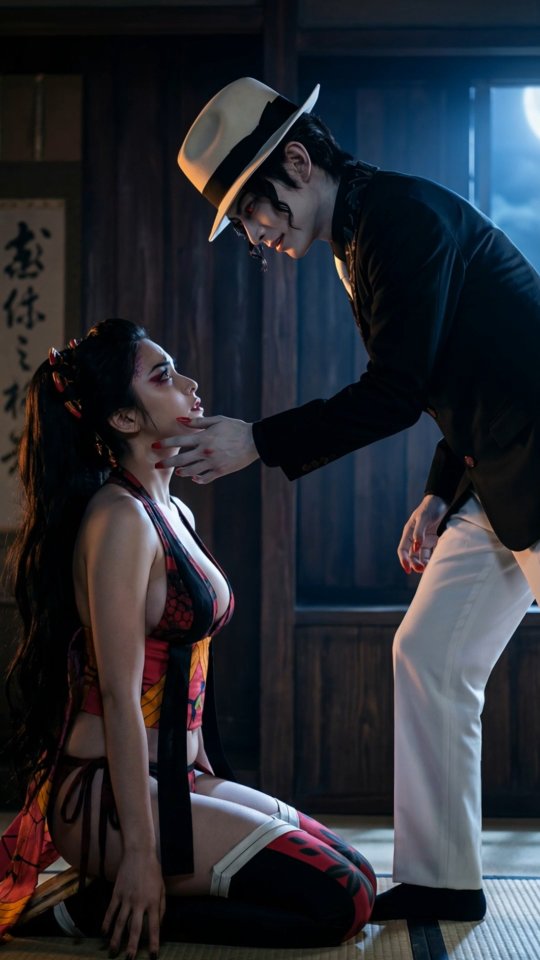
This image works because it is built around a single, highly concentrated power dynamic. The scene is not busy. There is no action burst, no crowd, no dramatic explosion of effects. Instead, everything depends on posture, gaze, touch, and proximity. A man leans over a seated woman and holds her chin while they lock into a tense exchange. That focus on one relational gesture is what gives the image its intensity. It feels dangerous because it is intimate.
The male character’s styling is a major part of that effect. His white hat, black jacket, and white trousers create an immediate silhouette that feels theatrical and slightly old-world. He reads like a gangster, a cabaret villain, or a modern noir antihero. This matters because it brings a new visual vocabulary into an anime-inspired scene. Instead of defaulting to fantasy armor or obvious battle wear, the image uses tailored clothing and restraint to generate menace. That makes the threat feel cooler and more sophisticated.
His posture is equally important. He is not lunging or shouting. He leans in with control. One hand lifts the woman’s chin, and the rest of his body remains measured. This composure is what makes him unsettling. A chaotic figure would be easier to dismiss as loud or unstable. A calm figure who invades someone’s space with precision feels much more dangerous. The image understands that and builds its tension around controlled intrusion.
The woman’s role in the scene is also strong because she is not reduced to a passive body. She is seated lower, which creates a visible hierarchy, but her face remains lifted and expressive. She appears caught within the power structure of the moment while still holding onto a sense of self. That complexity is crucial. If she looked only submissive, the image would flatten emotionally. Instead, there is resistance in her gaze and poise, which makes the interaction more layered and more dramatic.
Her costume supports that layered reading. The red-and-black styling, ribboned details, exposed skin, and patterned fabric evoke danger and seduction at the same time. The outfit feels inspired by courtesan and demon-aesthetic traditions, but it is filtered through a modern fashion lens. That keeps the image from becoming simple cosplay imitation. The design feels translated, not copied. It preserves the theatrical femininity of the source inspiration while making it fit the darker, more cinematic AU setting.
The room itself is a strong supporting actor in the composition. Wood walls, sliding-panel architecture, scroll-like details, and controlled emptiness create a chamber drama atmosphere. The setting feels private, old, and enclosed. That enclosure matters because it intensifies the relationship between the two figures. There is nowhere else for the viewer’s attention to go. The room holds the scene the way a stage set holds a performance.
Lighting is one of the image’s biggest strengths. Warm interior tones meet cool moonlit blue from the side, creating a split emotional temperature across the characters. This is more than aesthetic. It reinforces the tension between closeness and threat, between sensuality and danger. Warm light alone would make the scene too romantic. Cool light alone would make it too distant. The mixture creates ambiguity, and ambiguity is what makes the image feel alive.
Another reason the portrait lands is that it avoids explicit overstatement. The image clearly contains menace, but it does not over-explain the story. We do not know exactly what happened before or what will happen after. That incompleteness is useful. It allows the frame to function like a moment from a larger dramatic narrative. The viewer senses history, motive, and emotional stakes without being handed exposition. That is a hallmark of strong character stills.
From a compositional standpoint, the height difference between the standing man and seated woman gives the image immediate structure. He occupies the upper-right descending diagonal, while she anchors the lower-left. Their bodies create a triangular tension zone in the center where the hand-to-chin gesture occurs. This is good visual storytelling. The emotional center and the geometric center are nearly the same place, which makes the scene feel focused and inevitable.
The portrait also succeeds because it modernizes familiar archetypes without losing their emotional charge. The title may point toward anime source material, but the image does not require the viewer to know that source in detail. Even without the reference, the scene still works as a dark intimate tableau about glamour, control, and danger. That broader readability makes the artwork stronger and more flexible.
For creators, the lesson is valuable: tension often becomes more powerful when you reduce motion and increase relational precision. A hand on the chin, a lowered gaze, a measured lean, and a room full of controlled light can say more than a full action sequence. This image understands that economy. It uses stillness like a weapon.
That is why this modern-AU villain portrait holds attention. It is seductive without relaxing into romance, threatening without exploding into violence, and stylish without losing emotional sharpness. The image creates a complete dramatic atmosphere from a single act of contact, and that concentration is what makes it so compelling.