How imma.gram Made This Pink Bob Space Station Spokesperson Video - and How to Recreate It
This reference stands out because it takes a format that is normally short and disposable, the AI talking-head clip, and stretches it into a sustained branded monologue without losing visual identity. The video keeps one synthetic presenter on screen for more than two minutes, yet it still holds attention because the environment, costume, and message all reinforce the same futuristic idea. Instead of feeling repetitive, the repetition becomes part of the brand language.
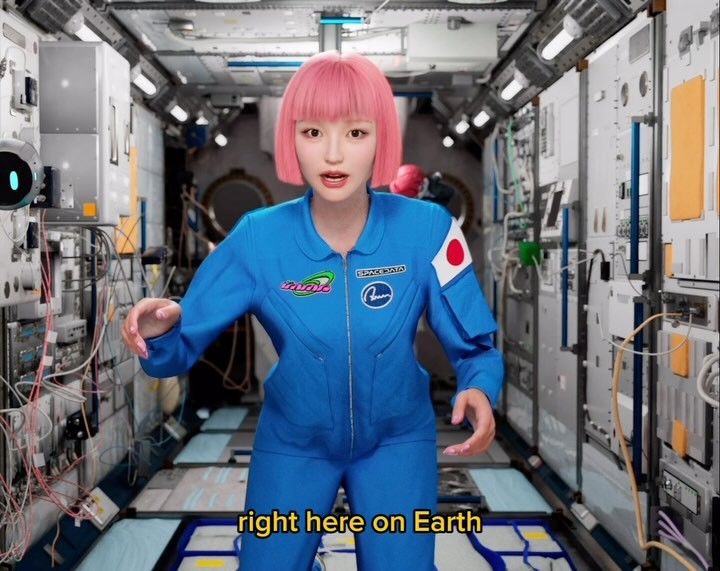
The setup is unusually strong. A pink-bob virtual human speaks from inside a spacecraft-like corridor while wearing a blue astronaut-style jumpsuit covered in mission patches. That immediately creates a memorable contrast: soft fashion-avatar styling inside a hard technical environment. The set communicates technology and ambition, while the presenter keeps the content approachable. For creators studying AI presenters, that balance is the real lesson.
Visual strategy and scene design
The corridor acts like a tunnel that pushes attention toward the speaker. Because the walls are lined with panels, cables, lights, and circular hatches, the frame already has depth before the presenter even speaks. A slow push from full body to medium close-up gives the monologue structure without needing any cuts. The camera language stays simple, but the viewer still feels progression because the speaker gradually occupies more of the frame.
Wardrobe also does important narrative work. The bright blue suit signals mission, collaboration, and applied technology, while the pink hair preserves the instantly recognizable Imma silhouette. That combination keeps the video legible both as a character piece and as a futuristic promo. If the character had generic styling, the long runtime would feel much flatter. Here, the subject remains graphically memorable from start to finish.
Another notable detail is the way props and background cues are handled. A small pink mascot-like object, the robot face on the side wall, and the crowded spacecraft interior all add texture without stealing the spotlight. This is useful for prompt writers: rich environments work best when they create context, not competition. The presenter must still read clearly as the primary subject in every beat.
Speech and message design
The dialogue appears to move through three layers. First, the presenter introduces herself as a virtual human. Second, she expands the idea into a broader reflection on virtual worlds and reality. Third, she connects that philosophy to collaboration and a near-future application, likely framed around partnership and innovation. This arc is effective because it starts personal, becomes conceptual, and ends concrete.
That structure is worth copying. Many AI spokesperson videos fail because they speak in a flat informational tone from beginning to end. This one keeps momentum by widening the scope of the message over time. The viewer is first anchored by the identity of the speaker, then invited into a bigger idea, then shown why the idea matters now. Even if the exact wording changes, that sequence gives the monologue emotional shape.
The subtitles are also doing real work. Since the video is long by social standards, burnt-in captions help maintain comprehension in muted autoplay situations and reinforce pacing. For prompt reconstruction, it is smart to explicitly mention subtitle placement, phrase-by-phrase updates, and a clean close-mic speaking style. Those details affect how the output feels just as much as wardrobe or lighting.
Prompting lessons creators can reuse
If you want to recreate this format, begin by locking three things: identity, environment, and message arc. Identity means exact hair shape, facial styling, wardrobe, and expression range. Environment means one clearly defined spaceship corridor with repeatable lighting and recognizable technical detail. Message arc means the speech should evolve from self-introduction to future-facing concept to partnership-driven conclusion. Without those three anchors, a generator will often drift into generic sci-fi filler.
It is also important to control movement. The subject should not wander around the set or switch into exaggerated gestures. A long one-shot works here because the body motion remains compact and purposeful. Hands rise, float, and settle. The torso subtly sways. The camera advances slowly. Those are enough to keep energy in the frame without breaking realism.
Creators making AI keynote intros, tech brand reels, synthetic host explainers, metaverse promos, and virtual influencer campaigns can all learn from this example. It shows how to make a digital human carry a longer message without needing multiple scenes or flashy edits. For SEO pages, this adds practical value because it demonstrates not just what an AI presenter looks like, but how to structure a convincing extended-performance prompt.
Best use cases for this reference
This format is especially useful when a creator wants a futuristic spokesperson that feels more premium than a normal green-screen explainer. The space-station environment immediately elevates the concept, while the single-take structure keeps production logic simple. That makes it adaptable for partnership announcements, AI product launches, concept films, digital-human brand storytelling, and speculative future-of-tech content.
Most importantly, this video teaches that duration alone is not the problem. A long AI clip can still work if visual identity is stable, the monologue has internal progression, and the frame keeps gently evolving. That is why this reference is more than just a cool sci-fi portrait. It is a practical template for creators who want to build sustained synthetic-presenter videos that still feel platform-native and easy to understand.