みなさん、宇宙に行きたいですか?
近々、宇宙行かなくても体験できるかも!?
ということで、AwwとSPACEDATAが提携発表し、バーチャルヒューマンとデジタルツインの融合を加速させていくとのことですっ🚀
これは未来をまたひとつ新しくするかもしれません。
今後の活動楽しみにしていてくださいっ🚀🌏
Do you all want to go to space? ✨
Not everyone can go, but what if we can experience something similar on Earth?
The fusion of a virtual human like me and a digital twin—this could be another step toward a new future🧠
Stay tuned for what’s coming next! 🚀🌏
How imma.gram Made This Digital Twin Partnership AI Portrait — and How to Recreate It
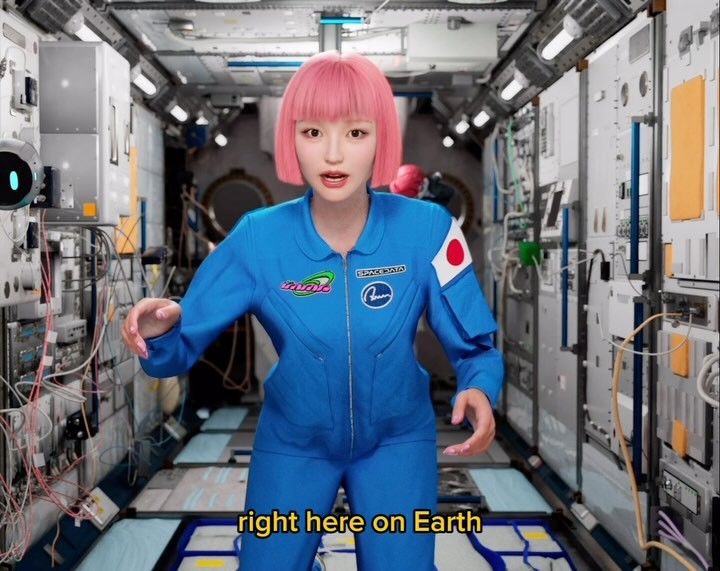
This frame translates a technical partnership story into an approachable experience. Instead of abstract diagrams, it uses one speaking character inside a believable space module to make digital-twin innovation emotionally understandable.
Why this post style performs for innovation storytelling
The biggest strength is concept translation. "Digital twin" and "virtual-human integration" are complex ideas, but the image turns them into a concrete scene: a recognizable character speaking from a space-like module while still referencing Earth. That bridge between imagination and familiarity reduces cognitive load for mainstream audiences.
Second, the character is not posed as a distant mascot. She is mid-gesture, mid-sentence, and looking directly at the viewer. This creates conversational framing, which often improves retention because audiences feel addressed rather than advertised to. In growth terms, this increases comment intent and watch completion for companion video clips.
Third, the production design uses trust signals effectively. Branded mission patches, realistic corridor hardware, and controlled subtitle framing together create credibility without losing creative energy. The post does not ask users to believe a claim blindly; it gives visual evidence of a coherent world where the claim makes sense.
Signal
Evidence (from this image)
Mechanism
Replication Action
Concept-to-Scene Translation
Digital-future message embodied inside a space-module setting
Visual concreteness makes abstract innovation easier to grasp
Turn one technical claim into one physical scene with clear context cues
Direct Conversational Framing
Subject gestures toward camera with speaking expression
Addressed-viewer effect improves attention and relatability
Use mid-speech body language instead of static hero pose
Credibility Markers
Flight suit patches, technical wall equipment, subtitle line
Specific details reduce "pure fantasy" skepticism
Add 2-3 grounded realism markers tied to your announcement theme
Color Discipline
Blue suit + pink hair against neutral metallic corridor
Clear hierarchy increases readability on mobile
Reserve saturated color for character identity, keep background neutral
Best-fit scenarios and transfer strategy
Best-fit scenarios
Tech partnership announcements: Excellent when launching collaborations that need both excitement and clarity.
Product vision storytelling: Works for "future experience" messaging before full product release.
Education-forward social posts: Useful when explaining advanced concepts to non-technical audiences.
Virtual-human world building: Strong for extending character universe with believable mission contexts.
Not ideal scenarios
Minimalist luxury campaigns: Dense technical background may conflict with pure luxury aesthetic language.
Spec-sheet communication: Emotional scene storytelling cannot replace explicit technical documentation.
High-frequency promo posts: This style is concept-heavy and should be used for milestone moments.
Transfers (exactly 3)
Medical Innovation Variant
Keep: direct speaking pose, one human-like guide character, high-detail environment.
Change: spacecraft corridor to advanced clinic simulation module.
Keep: gesture-led explanation and identity color anchor.
Change: interior module to digital twin control room.
Slot template (EN):{character spokesperson} in {control hub} showing {future city scenario}
Climate Tech Variant
Keep: documentary subtitle feel and practical realism markers.
Change: mission suit patches to sustainability mission labels.
Slot template (EN):{digital ambassador} demonstrating {earth-focused solution} from {mission interior}
Aesthetic read: why this frame feels believable and forward-looking
The composition uses corridor symmetry to create immediate sci-tech context. Side walls packed with equipment lead the eye to the centered subject, making her both guide and anchor. Lighting is practical and neutral, closer to operational documentation than cinematic fantasy, which helps trust. The blue jumpsuit establishes mission intent while pink hair preserves signature character identity, avoiding generic astronaut imagery. Subtitle placement at the bottom reinforces spoken-message continuity and turns a still into a perceived clip moment.
Observed
Concrete evidence
Recreate move
Symmetry-led depth
Parallel corridor lines converging behind subject
Place subject dead center in a narrow technical corridor
Operational lighting
Even cool practical lights on walls and suit
Avoid dramatic film lighting; emulate functional overhead fixtures
Identity + mission dual coding
Pink bob plus blue mission jumpsuit with patches
Combine one recurring persona cue with one role-specific uniform cue
Speech continuity cue
Bottom subtitle line in frame
Add one concise subtitle-like text line for narrative continuity
Prompt technique breakdown
Prompt chunk
What it controls
Swap ideas (EN, 2-3 options)
"single virtual-human spokesperson centered in technical corridor"