How kakudrop Made This Polyphonic Contours AI Art
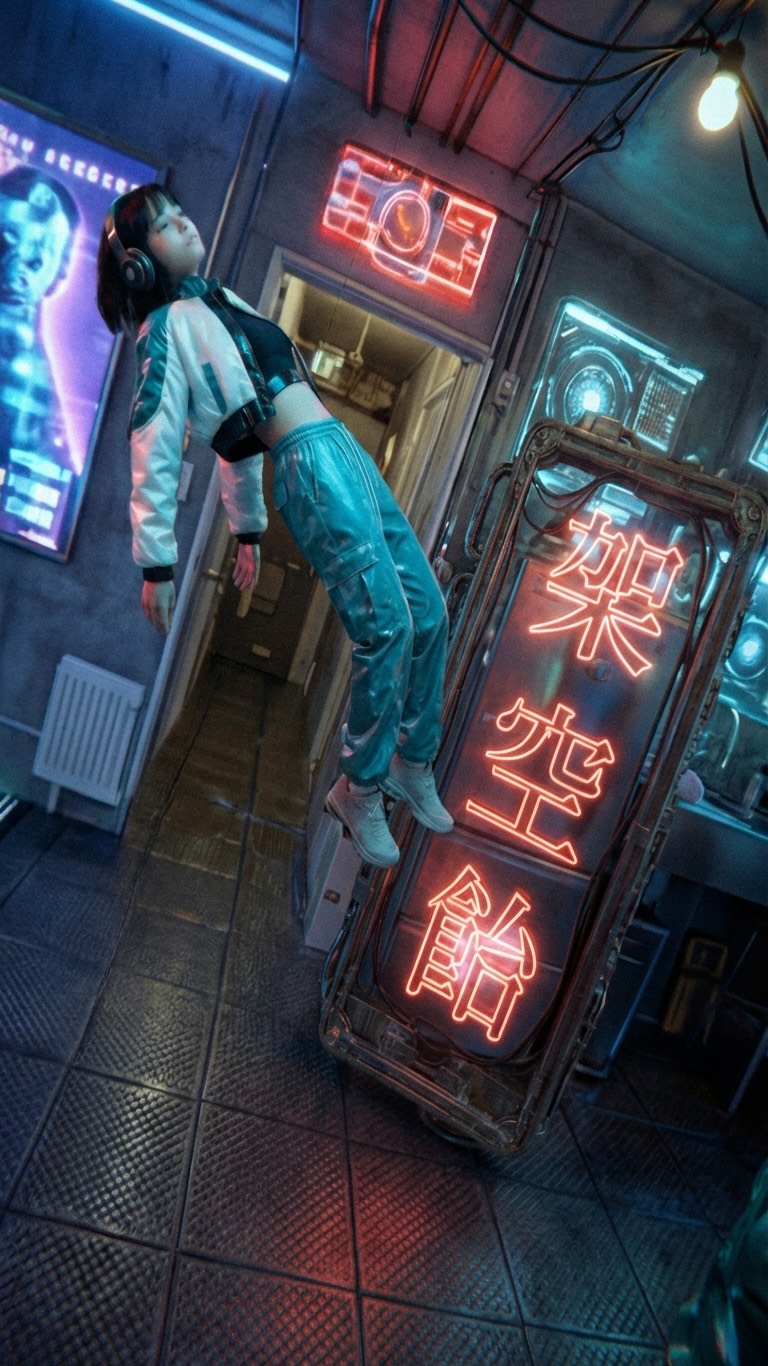
This image succeeds because it fuses movement illusion with a strong world design. The subject appears suspended mid-flow, while neon signage and cable-heavy architecture make the environment feel alive. Viewers are not just looking at a person; they are entering a visual system where motion, sound, and identity feel intertwined.
The caption theme “Polyphonic Contours” fits perfectly: multiple directional cues compete and harmonize at once. Camera tilt, diagonal body line, and dual-color neon push the eye to keep moving. That is exactly the kind of frame that performs well in feeds and short-form covers, because it rewards both first glance and second look.
Signal Table
| Signal |
Evidence (from this image) |
Mechanism |
Replication Action |
| Dynamic motion illusion |
Sideways floating body pose with relaxed limbs |
Breaks expected gravity cues and increases stop rate |
Use one impossible but readable body orientation as the frame’s core hook |
| Color-duality tension |
Cyan environment wash vs red-orange neon typography |
Complementary contrast creates high visual charge |
Lock two opposing light colors and avoid adding a third dominant hue |
| World-building density |
Exposed cables, signage, doorway, interface screens |
Context depth raises perceived production value |
Add 3-4 environment anchors (wires, sign, panel, reflective floor) |
| Audio-visual character cue |
Visible over-ear headphones on subject |
Suggests rhythm and internal narrative without text explanation |
Use one wearable prop to imply soundtrack or subculture identity |
Use Cases and Transfers
Best-fit scenarios
- Music-related visual campaigns and track teaser art.
- AI motion-control demo posts that need directional energy.
- Futuristic fashion/editorial creator branding.
- Short-form cover images where immediate visual shock matters.
Not ideal
- Minimalist product ads requiring white-space clarity.
- Corporate educational posts where legibility beats atmosphere.
- Family/lifestyle storytelling that depends on warm realism.
Transfer recipes (exactly 3)
-
Keep: floating diagonal pose + dual neon color contrast.
Change: signage language/style and wardrobe silhouette.
{subject_pose_diagonal} in {neon_set}, dual color lights {color_a}/{color_b}, wearable cue {prop}
-
Keep: dutch-angle camera and reflective floor.
Change: environment from alley-tech to lab-corridor or metro bay.
dutch-angle cyber scene, reflective floor, one dominant vertical sign, cinematic neon bloom
-
Keep: one-subject clarity and practical light motivation.
Change: emotional tone (calm trance to aggressive motion).
single subject, practical neon sources, mood={tone}, high-energy spatial composition
Aesthetic Read
The frame’s aesthetic power comes from vector control. Nearly every element points or leans: body angle, sign axis, cable direction, and camera cant. This makes the image feel sonically charged, even though it is a still. The viewer senses rhythm because the composition is built on directional conflict rather than static symmetry.
Material contrast also matters: matte skin and jacket against glossy pants and reflective tiles. Combined with neon bloom, these texture differences create depth and tactile richness. For creators, this is highly useful when building a distinct futuristic signature style without requiring fully 3D environments.
| Observed |
How to Recreate |
| Diagonal body line drives motion in a still frame |
Prompt explicit off-gravity pose and anchor it with nearby vertical objects |
| Two-color neon hierarchy (cyan + red-orange) |
Assign one ambient cool wash and one warm sign-based key accent |
| Industrial detail density supports world credibility |
Include cables, panels, door frame, and textured floor as fixed set anchors |
| Wearable audio prop implies narrative layer |
Add headphones or earpiece as a character identity token |
Prompt Technique Breakdown
| Prompt chunk |
What it controls |
Swap ideas (EN, 2-3 options) |
| single subject in sideways levitation pose |
Primary hook and kinetic illusion |
"forward lunge freeze" / "backward fall freeze" / "spin mid-air pause" |
| headphones + athleisure cyber wardrobe |
Character identity and genre fit |
"visor + tactical jacket" / "hood + metallic corset" / "minimal techwear" |
| industrial neon interior with vertical sign |
World-building and visual authority |
"metro platform" / "arcade alley" / "server corridor" |
| dutch-angle 3:4 composition |
Tension and directional energy |
"mild tilt" / "extreme cant" / "straight camera for contrast" |
| cyan ambient + red-orange practical light split |
Mood and brand-recognizable palette |
"teal/magenta" / "violet/amber" / "green/pink" |
Remix Steps
Baseline lock
- Lock one impossible pose as the central visual event.
- Lock dual neon color hierarchy and practical light motivation.
- Lock one dominant vertical signage element for structural balance.
One-change iteration sequence
- Run 1: Baseline pose + original cyan/red lighting.
- Run 2: Change only camera tilt intensity.
- Run 3: Keep composition fixed, change only signage style.
- Run 4: Keep all fixed, adjust only wardrobe reflectivity.
This sequence isolates whether attention lift comes from pose, angle, or lighting contrast.