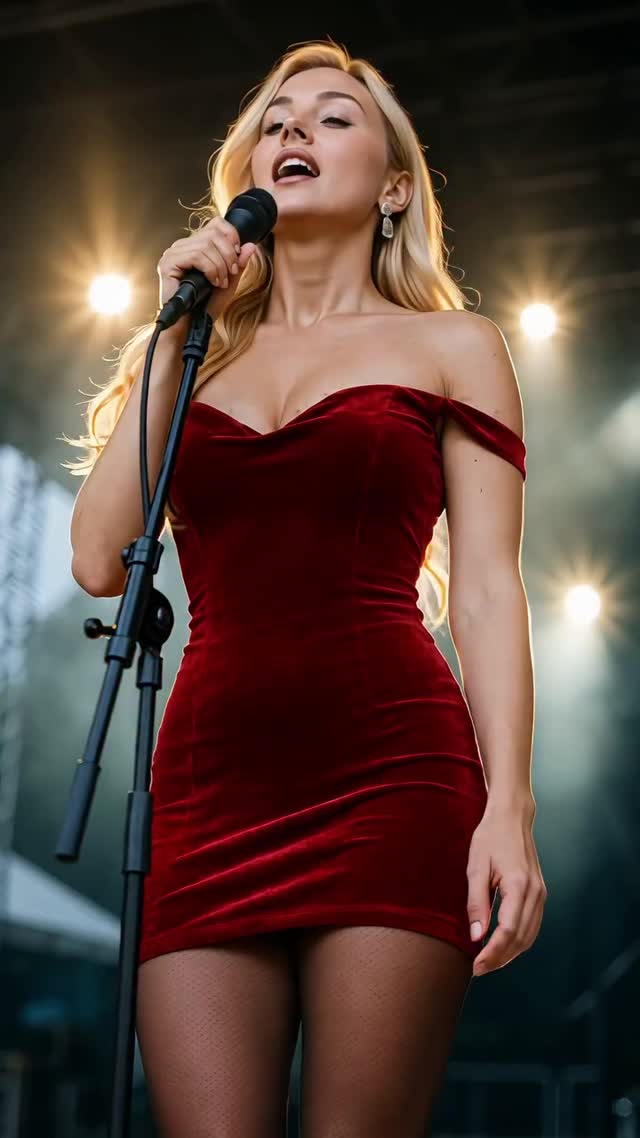
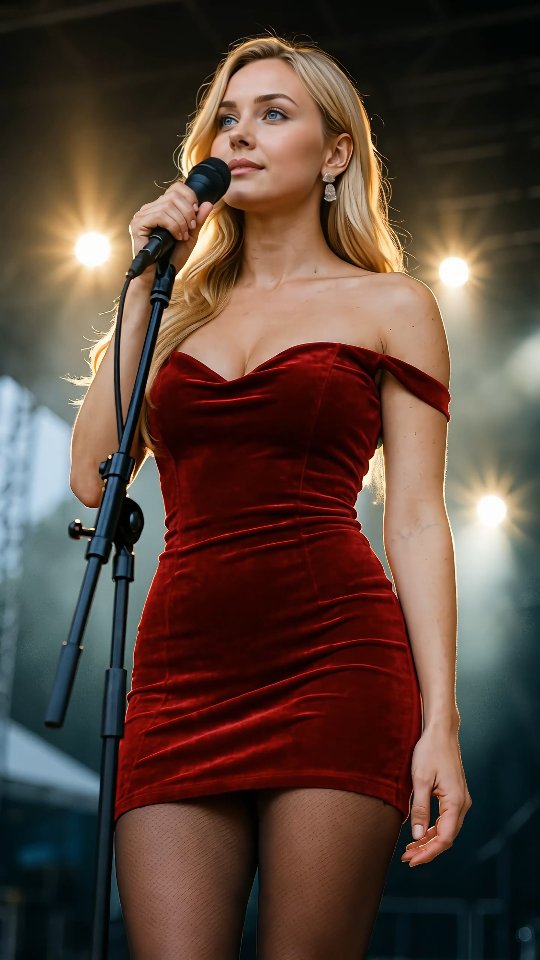
This is a visual tribute performance of Always Remember Us This Way, the iconic ballad originally performed by Lady Gaga in A Star Is Born.
This is not a vocal cover — it’s a visual interpretation that pays homage to the song’s message of love, memory, and longing. With cinematic styling and expressive movement, this performance was created with deep respect for the original.
💫 For fans of Lady Gaga, emotional music, and artistic tributes.
🎧 Don’t forget to like, comment, and subscribe if the story touched you.
Why millasofiafin's Always Remember Us This Way AI Video Went Viral — and the Formula Behind It
This page is a practical “growth case + teaching page” for indie creators who want to recreate a short,
emotionally-charged stage performance clip: one performer, one shot, strong lighting, and lyric captions that
turn a ballad into a scroll-stopping visual.
Case Snapshot
A single-shot tribute performance on a dark stage: a blonde singer in a deep red off-shoulder velvet mini dress,
holding a microphone at a stand while warm backlights create big circular bokeh. The visual is simple but high-impact:
“cinematic concert portrait.” The hook is not fast editing—it’s posture, lighting, and emotion in the face.
The growth mechanic is caption-first: large all-caps lyric text sits low-center with a thick black outline, and one keyword
per line is highlighted in color (yellow/green/red). That makes the clip readable with sound off, and it gives the viewer a
reason to stay: the next line is always coming.
What you’re seeing
1) Framing that feels “expensive”
The camera sits low-to-mid and frames from upper thighs to head, keeping the microphone stand visible on the left. It reads like
a fashion-concert portrait instead of a casual phone clip. The background is intentionally abstract: lights and haze, not scenery.
2) Lighting that does the storytelling
Strong backlights create a halo on hair and shoulders while the face stays clean with soft fill. This contrast is what makes the
subject “pop” and hides the stage. For AI video, it’s also forgiving: haze and bokeh absorb small imperfections.
3) Costume choice as a retention lever
Deep red velvet is a smart choice: it compresses well, looks premium under warm lights, and signals “performance” instantly. The
off-shoulder neckline adds a clear silhouette that stays readable even on small screens.
4) Motion choreography: micro-movements only
The performance uses safe, believable motion: blinks, chin lifts, small head turns, subtle weight shifts, and controlled mouth shapes.
That’s why it feels human without forcing complicated hand choreography that often breaks AI.
5) The caption system (this is the real product)
The on-screen lyrics are styled consistently: bold white all-caps with black stroke and subtle drop shadow, centered low. One keyword
is color-highlighted to create rhythm. Occasionally a small emoji sticker appears near the text as an accent.
Shot-by-shot breakdown (estimated)
This is essentially one continuous shot with timed caption changes. Your “shot list” is actually a lyric-cue timeline.
Small gaze shift; caption swaps; one keyword color-highlighted
Micro-sway, stable mic stand framing
Consistent halo rim light
Keep watch time via readable, paced text
00:10–00:15
Subtle breath + mouth shapes; optional emoji sticker near caption
No hard cuts, only performance motion
Haze makes bokeh smoother
Add “texture” without changing scene
00:15–00:20
Sustained note moment; caption changes; color highlight shifts (green)
Slightly tighter mid shot
Warm highlight rolloff on skin
Emotional peak and share/save trigger
00:20–00:26
Return to forward gaze; caption continues with consistent styling
Stable shot grammar
Deep blacks, bright bokeh orbs
Completion-rate support: “next line” anticipation
00:26–00:29
Resolve phrase; final caption fragment; loop-friendly end
Hold a beat at the end
Same palette, no flicker
Encourage rewatch and saves
Why it went viral
1) Familiar emotional template (tributes travel)
“Tribute performance” content is pre-qualified: fans already know the emotional arc and want to feel it again. That makes the viewer
more patient with a single-shot clip and more likely to share it to someone who loves the song.
2) Sound-off readability (captions do the heavy lifting)
The large lyric captions reduce explanation cost. Even without audio, the viewer understands: singing + emotional lyrics + stage lighting.
The color-highlighted keyword acts like a visual metronome that keeps attention moving line-to-line.
3) High-contrast aesthetic that compresses well
Dark stage + bright bokeh + red velvet dress is a compression-friendly recipe for Reels. The silhouette stays readable, and the lights
stay “pretty” even at lower bitrate.
4) Single-shot trust signal
A continuous shot can feel more “authentic” than fast-cut AI montages. Viewers often interpret stability as confidence and craft:
“this is a performance,” not a slideshow.
5) Platform view (Instagram)
This format is optimized for comments and saves: fans comment the song title, tag friends, or save it as an “emotional reference.”
The tribute framing also lowers backlash risk compared to trend-chasing: it signals respect and intention.
Five testable viral hypotheses
Evidence: readable lyric captions low-center. Mechanism: higher retention on sound-off viewers. Replicate: keep font, outline, placement consistent for every line.
Evidence: one keyword per line is color-highlighted. Mechanism: attention “clicks” to the highlight. Replicate: highlight the emotional keyword, not a random word.
Evidence: warm rim light on hair/shoulders. Mechanism: cinematic premium feel. Replicate: backlight + haze + shallow DOF before you tweak anything else.
Evidence: minimal motion, stable framing. Mechanism: fewer AI artifacts increases believability. Replicate: choreograph only blinks, chin lifts, small turns, breath beats.
Evidence: iconic tribute positioning in caption. Mechanism: taps an existing fan graph. Replicate: do tributes to widely-loved songs, but be careful with rights.
How to recreate (Replication tutorial: from 0 to 1)
Step checklist
Choose your approach: (A) use licensed original audio, or (B) record your own original ballad in a similar emotional style.
Write a lyric plan: do not paste copyrighted lyrics unless you have rights; instead, draft original lines with the same syllable timing and emotional meaning.
Lock the stage recipe: dark venue, warm backlights, haze, circular bokeh, shallow DOF.
Create a character sheet: front/3Q/profile face refs + hair ref + dress texture ref to prevent face drift.
Animate as one take: keep performance motion micro (blink, chin lift, breath, small head turn) and keep hands stable on the mic.
Caption system: bold all-caps, white with black outline, low-center; highlight one keyword in color; keep line breaks consistent.
Lip-sync priority: align mouth closures and wide vowels on the emotional keywords; better to be slightly “under-animated” than uncanny.
Grade and export: keep deep blacks, warm rim, avoid oversharpen; export 9:16 at stable bitrate for clean bokeh.
Packaging: cover frame = strongest backlight halo + confident gaze; title with “tribute performance” and the emotion.
Growth Playbook (Distribution & scaling strategy)
3 opening hook lines
“I turned one ballad into a 30-second cinematic tribute—here’s the exact caption system.”
“If your AI singer feels uncanny, fix the lighting and micro-movement first.”
“This is a one-shot performance format that fans actually save and share.”
4 caption templates (hook → value → question → CTA)
Template 1: Hook: “A tribute performance in one shot.” Value: “Backlight + haze + captions = cinematic.” Q: “Which line hit you hardest?” CTA: “Save this to remix the format.”
Template 2: Hook: “Sound-off friendly on purpose.” Value: “Here’s how I style lyric captions for retention.” Q: “Do you want the typography settings?” CTA: “Comment ‘CAPTIONS’ and I’ll share them.”
Template 3: Hook: “Red velvet + stage halo = instant mood.” Value: “This is the lighting prompt I reuse.” Q: “More performance breakdowns?” CTA: “Follow for weekly templates.”
Template 4: Hook: “One keyword highlighted per line.” Value: “It guides attention like a visual metronome.” Q: “Yellow, green, or red highlights?” CTA: “Comment your pick.”
Tip: keep hashtags aligned to the viewer’s intent (fans + creators). Too many “tool tags” can confuse the audience if the clip is
primarily emotional entertainment.
FAQ
What tools make it look the most similar?
Use a model that preserves identity in a single take, plus a caption workflow that keeps font, outline, and placement consistent.
What are the 3 most important words in the prompt?
“warm backlight”, “haze”, and “shallow depth of field” (they create the concert portrait immediately).
Why does the face drift over time?
Your motion is too complex; lock references and keep micro-movements only, especially around the mouth.
How can I avoid making it look like AI?
Keep the shot stable, avoid fast hand motion, and let haze + bokeh hide the background.
Is it easier to go viral on Instagram or TikTok with this type of content?
Instagram often rewards save-able aesthetics and tributes; TikTok can work too, but needs a stronger hook line or narrative framing.
How should I properly handle song lyrics and rights?
Use licensed audio and only use lyrics you have the rights to; otherwise write original lines with similar timing and meaning.