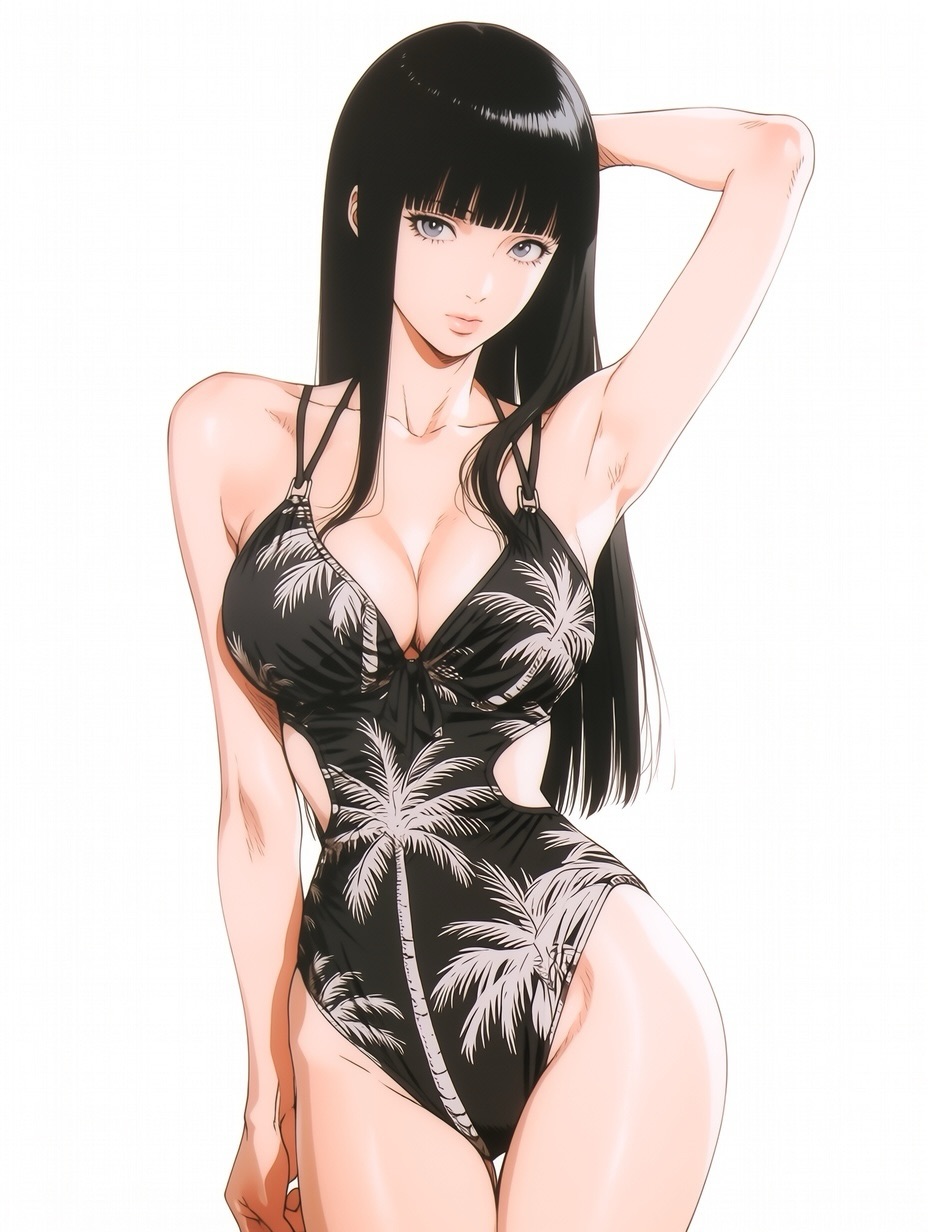
A lot of fashion-focused AI images try to look premium by adding more: more background, more props, more shine, more color, more attitude. This one does the opposite. It removes almost everything except the subject, the silhouette, and the outfit print. That subtraction is what makes the image work. A plain white backdrop, black hair, and a black palm-print swimsuit create a controlled frame where every line reads immediately.
The post feels strong because it is easy to understand in a second. You see the hair shape, the raised arm, the side cutouts, and the high-cut one-piece before your brain starts naming details. That kind of fast readability is one of the most reliable advantages in social imagery. When a viewer can summarize the image instantly, the post has a better chance of being remembered, saved, or reused as inspiration.
For creators, this image is useful because it shows how minimalism can still feel styled. It is not blank in a lazy way. It is blank in a disciplined way. The white background is doing a real job: it turns the swimsuit print into a focal element and lets the body line carry the composition without distraction.
The first reason is silhouette precision. The long straight hair creates one clear dark shape from head to hip, while the monokini cutouts break up the torso just enough to keep the body line visually interesting. The raised arm adds lift and asymmetry. That is a very efficient formula. The pose looks composed, but it does not feel stiff. The body reads as editorial rather than casual.
The second reason is graphic contrast. Black against white is already powerful, but the swimsuit print adds one extra layer of design without muddying the image. Palm trees suggest a resort or summer mood, yet the image never becomes a beach scene. That is a useful trick. It allows the clothing to carry the theme rather than forcing the background to explain it.
The third reason is emotional restraint. The face is attractive, but not loud. The expression is calm. There is no exaggerated smile, no wink, no dramatic attitude pose. That quietness makes the image easier to project onto. Viewers can treat it as fashion reference, hairstyle reference, swimsuit reference, or character reference depending on what they came for.
| Signal | Evidence (from this image) | Mechanism | Replication Action |
|---|---|---|---|
| Fast visual readability | Pure white background and one centered subject | Low clutter lets the outfit and pose register instantly | Strip the set to a seamless backdrop when the garment silhouette is strong enough |
| Graphic fashion identity | Black swimsuit with pale palm-tree print | Print adds theme without requiring extra scenery | Use one memorable textile motif instead of a complicated environment |
| Elegant asymmetry | One arm behind the head, torso slightly tilted, hips offset | Subtle pose imbalance creates editorial energy | Lock one lifted arm and one hip shift before iterating facial details |
| Cross-audience flexibility | Neutral expression and clean styling | The image can function as fashion art, character art, or inspiration content | Keep expression calm and avoid over-directing the mood into a single niche |
The smartest thing about this image is that it treats the swimsuit like a design object, not just clothing. The palm-tree print is repeated across the body in a way that gives the garment personality. Because the background is empty, the viewer has no choice but to notice the print, the cutout geometry, and the body contour. This is a reminder that if the fashion element is strong enough, you do not need an entire setting to support it.
The hair also plays a larger role than it first appears. Long black hair against white background functions like a compositional frame. It gives vertical weight to the upper half and balances the exposed skin of the shoulders, waist, and thighs. That balance is a major part of why the image feels polished instead of sparse.
Another useful point is the surface treatment. The rendering stays soft and refined rather than hyper-shiny or aggressively detailed. That matters because minimal images become cheap-looking very quickly if the materials are over-rendered. Here, the illustration keeps enough smoothness to feel modern and enough structure to feel intentional.
| Observed | Why it matters | How to recreate it |
|---|---|---|
| Long uninterrupted black hair shape | Anchors the composition and boosts contrast | Use one dominant dark shape when the background is mostly white |
| High-cut one-piece with side cutouts | Makes the silhouette more memorable than a generic swimsuit | Specify garment structure, not just garment category |
| Palm-tree print confined to the outfit | Adds theme without adding scene clutter | Push concept into the textile pattern instead of the background |
| Calm direct gaze | Keeps the portrait usable across multiple aesthetics | Choose a quiet expression when you want broad save appeal |
| White seamless backdrop | Forces the viewer to focus on pose and fashion design | Remove all environmental story when subject clarity is the goal |
This approach fits swimsuit prompt examples, clean fashion illustrations, beauty-editorial character sheets, hairstyle-focused posts, and minimal aesthetic feeds that want polish without noise. It is especially effective for creators who want their content to look premium and adaptable. Because the image is so uncluttered, it can easily become a template for many variations.
It is less ideal for narrative fantasy scenes, high-energy action posts, or viewers who expect environmental immersion. This image is about editability and clarity. Once you try to make it tell too much story, its strongest advantage starts to disappear.
{hair length} {one-piece structure} {print motif} {pose cue} {expression}{clean backdrop} {garment silhouette} {textile pattern} {body angle} {mood}{dominant dark shape} {single garment} {minimal palette} {pose asymmetry} {finish level}If you want to recreate this kind of image, the key is to break it into controllable parts. First lock the hair length and bangs. Then lock the one-piece structure and cutouts. Then define the print. Only after that should you tune pose and expression. Too many creators start with abstract mood terms like elegant or chic and then wonder why the model gives them a generic woman in generic fashionwear.
| Prompt chunk | What it controls | Swap ideas (EN, 2-3 options) |
|---|---|---|
| young woman with very long straight black hair and blunt bangs | Core portrait identity and contrast shape | sleek jet-black hair; long ink-black hair; straight raven hair with full fringe |
| black monokini with side cutouts and high-cut legs | Garment silhouette and body rhythm | cutout one-piece swimsuit; asymmetrical monokini; high-leg resort suit |
| pale palm-tree print across the fabric | Theme and textile personality | tropical leaf motif; monochrome botanical print; silver resort pattern |
| one arm lifted behind the head, hip tilted | Editorial asymmetry and movement | raised-arm pose; relaxed fashion stretch; soft S-curve stance |
| pure seamless white background | Minimalism and focal control | clean studio white; empty white cyclorama; blank fashion backdrop |
| soft even beauty lighting | Refined presentation and skin smoothness | diffuse studio light; clean frontal soft light; gentle editorial glow |
Start by getting the silhouette right. If the hair, arm position, and swimsuit structure are not working, ignore everything else. Once the pose feels elegant, solve the print. Only after the textile reads clearly should you refine face and skin finish. This sequence matters because minimal images have nowhere to hide. Weak structure becomes obvious fast.
A practical four-step iteration path would be: first generate the subject with plain black swimsuit and white background. Second, tune the body pose and hair until the frame feels editorial. Third, add the palm-tree print and make sure it follows the fabric correctly. Fourth, refine the expression, skin tone, and subtle lighting polish. That order gives you a much cleaner result than trying to prompt the final image in one overloaded sentence.
The larger lesson is simple. Minimal fashion imagery does not become strong by accident. It becomes strong when the creator chooses one subject, one garment, one controlled pose, and one clean field of contrast, then refuses to dilute that structure with unnecessary extras.