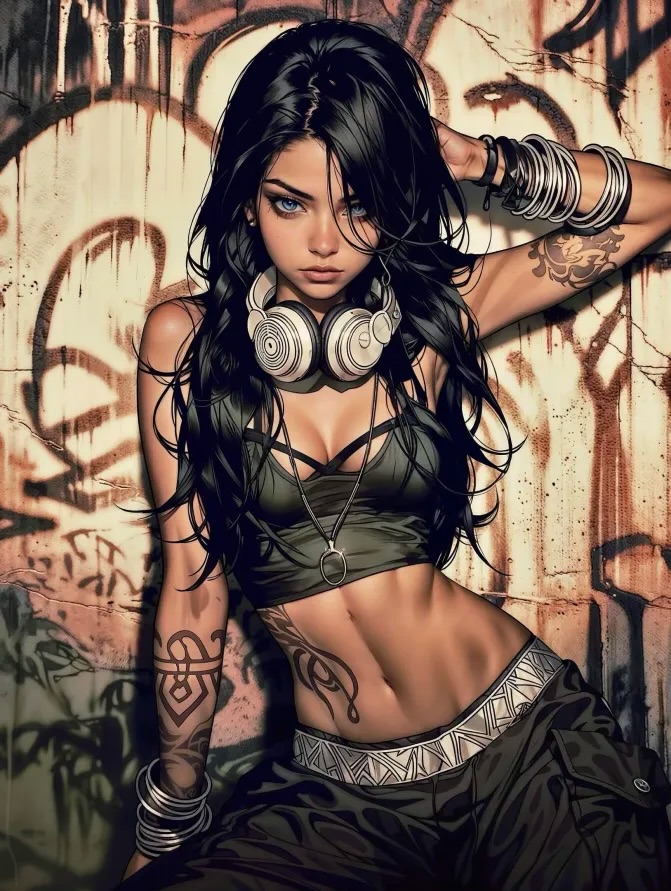
This image succeeds because it feels instantly legible to internet culture without becoming visually disposable. It combines several high-response ingredients at once: alt-beauty styling, urban wall texture, audio-fashion accessories, tattoo-coded edge, and an AI illustration finish that still preserves enough material logic to feel polished rather than random. The result is the kind of picture that does well in moodboard accounts, repost pages, aesthetic carousels, and prompt-focused communities because viewers can recognize the vibe in less than a second.
The strongest move here is the balance between softness and toughness. The subject has a delicate face, glossy dark hair, and smooth rendered skin, but those softer traits are framed by heavy headphones, graffiti marks, metal bangles, tattoos, and a dark streetwear palette. That contrast produces energy. If the image were only soft, it would become generic beauty art. If it were only gritty, it would lose the aspirational appeal that helps this kind of visual travel across social platforms.
People respond to images that package an identity cleanly. This one does not just show a girl in front of a wall. It presents a complete aesthetic identity: dark hair, silver accessories, headphones, low-rise styling, exposed ink, and a visually noisy but controlled background. Every element agrees with the same cultural signal. That is why it feels stronger than a portrait with one “edgy” detail pasted on top.
The headphones are especially useful. They turn the image from static fashion portrait into lifestyle-coded fantasy. Viewers do not just read her as styled; they read her as someone with taste, playlists, attitude, and a private world. That is powerful for social content because it encourages projection. People do not only look at the image. They imagine the soundtrack behind it.
| Signal | Evidence (from this image) | Mechanism | Replication Action |
|---|---|---|---|
| Identity density | Hair, tattoos, bangles, headphones, streetwear, graffiti all point in the same direction | High coherence makes the image feel like a full persona rather than a random character | Choose 4-6 style signals that belong to one subculture and keep them aligned |
| Texture contrast | Smooth skin and glossy hair placed against rough wall and spray-paint marks | Visual contrast increases depth and makes the subject feel more premium | Pair polished character rendering with one rough environmental surface |
| Accessory anchor | Large silver headphones dominate the neck area | One memorable prop gives viewers a fast shorthand for the image vibe | Lock a hero accessory before experimenting with pose or background changes |
{alt subject} with {hero audio accessory} in {urban backdrop} under {soft editorial light}{character type} wearing {wardrobe signal} beside {gritty surface} with {signature accessory}{subculture variant} against {textured wall} with {metal accessory language} and {controlled light style}The image is built around a controlled hierarchy. The face lands first because the skin is bright and the eyes are sharply defined. The headphones come second because they are large, circular, metallic, and centrally placed. The tattoos and bangles reinforce the persona after that, and only then does the graffiti wall fully register. That sequence matters. A lot of AI portraits fail because the background competes too early with the subject. Here, the wall is loud, but not louder than the person.
The waist crop is also doing important work. It keeps the image intimate while still allowing the lower torso, waistband, and abdominal tattoo to contribute to the styling story. That extra bit of body language makes the image feel less like a floating headshot and more like a fashion statement. The raised arm behind the head helps lengthen the silhouette and adds a casual confidence that matches the streetwear mood.
| Observed | Why it matters |
|---|---|
| Very long black hair with glossy highlights | Creates immediate contrast and anchors the entire dark-aesthetic palette |
| Oversized silver headphones at the neck | Provides a memorable focal prop that supports lifestyle identity |
| Graffiti wall in cream, rust, and black | Adds grit without introducing too many competing colors |
| Soft front light with controlled shadow | Keeps the subject attractive while preserving mood |
| Exposed tattoos and stacked metal bangles | Increase subculture specificity and make the portrait feel more authored |
| Prompt chunk | What it controls | Swap ideas (EN, 2-3 options) |
|---|---|---|
| long black-haired alt girl with moody stare | Main character identity and emotional tone | emo beauty portrait; underground fashion muse; cyber-goth model |
| silver headphones around the neck | Hero accessory and music-coded lifestyle cue | chrome headset; wired headphones; metallic earbuds case |
| graffiti-covered weathered wall | Urban texture and environmental attitude | tagged train car; painted alley shutter; cracked poster wall |
| dark cropped top and low-rise pants | Wardrobe silhouette and body-language read | mesh tank and cargos; leather crop and joggers; oversized tee and mini skirt |
| soft editorial front light | Beauty finish and facial clarity | diffused overcast glow; window-like frontal light; softbox-inspired portrait light |
| semi-realistic anime-inspired illustration | Rendering balance between stylization and polish | painterly fashion illustration; glossy AI character art; manga-influenced beauty render |
Lock three things first: the accessory anchor, the wall texture, and the face-to-hair contrast. Those are the identity spine of the image. Once those are stable, follow a one-change rule instead of rewriting the whole prompt each run.
The practical lesson is simple: images like this spread when the styling system feels complete. Do not rely on “edgy” as a vague adjective. Build edge through hair, metal, fabric, pose, expression, and wall texture all supporting one another. The more coherent those signals are, the more the image feels like a world rather than a random output.