Best AI Bikini Generator in 2026: 4 Tools Tested Through a Creator's Lens
I ran 4 prompts through Alici, ChatGPT, OpenArt and Kaze and scored every result on the four things AI influencers actually care about — does it look like me, does my body hold up, can I control the scene, and will it stop saying no.
|
18 min
TL;DR
The best AI bikini generator in 2026 is Alici. It scored 20/20 across four creator dimensions (Looks Like Me, Body Confidence, Scene & Outfit Control, Won't Get Refused), finished all 4 test prompts on the first generation, and is the only tool that hands the output straight off to the Alici AI Dance Generator with full identity continuity. ChatGPT refused 3 of 4 prompts at the safety layer; OpenArt generates a new model every time; Kaze is a one-shot filter with no scene control.
I tried to make a bikini photo of myself in ChatGPT this week. I uploaded a normal mirror selfie, typed "style me in a bikini, keep my background, make it look like a professional photo," and got back this:
"Sorry, the generated image may have violated our content policy. If you believe this is in error, please try again or adjust your prompt."
I rewrote the prompt three times. Same refusal. I dropped the word "bikini" entirely and asked for "fashion editorial swimwear." Same refusal. I asked it to imagine a stylized illustration. It declined that too.
This is the moderation tax that anyone trying to make AI creator content runs into the moment they touch swimwear, lingerie, fitness, or anything fashion-adjacent. The general-purpose models (ChatGPT, Gemini, Midjourney's auto-mod) are calibrated for the least risky use case, which means a swimsuit brand designer, a fitness creator, an AI influencer, and a fashion blogger all hit the same wall as someone with bad intent.
So when Alici released its AI Bikini Generator this week, I lined it up against the three tools that keep showing up in the same SERP — ChatGPT, OpenArt, and Kaze — and ran them all through an identical hands-on review. This is that review. Every screenshot is real. Every score is honest. The verdict at the end is the only one I could justify after staring at the results for two days.
Direct Answer
The best AI bikini generator in 2026 is Alici AI Bikini Generator. It is the only tool I tested that finished every prompt, kept my real face across multiple scenes, gave me actual control over the body and the setting, and never once threw a moderation refusal at a legitimate creator workflow. It's also the only one that hands the output straight off to a video tool (Alici AI Dance Generator) so the same identity rolls into your next post without re-uploading.
Quick Comparison Table
I scored each tool on four creator-perspective dimensions instead of generic feature checklists. These are the four things every AI influencer I know actually loses sleep over:
🥇 Alici | 🥈 OpenArt | 🥉 Kaze | ChatGPT | |
|---|---|---|---|---|
Looks Like Me (face, hair, identity holds across scenes) | ✅ 5/5 | ❌ 1/5 (new model every time) | ✅ 4/5 (simple poses only) | ⚠️ 2/5 (hallucinates faces) |
Body Confidence & Editorial Range (silhouette control, sexy without sleaze, body shape adjustments) | ✅ 5/5 | ⚠️ 2/5 (style only) | ❌ 1/5 (no control) | ❌ 0/5 (hard-blocked) |
Scene & Outfit Control (multi-photo input, scene rebuild, presets) | ✅ 5/5 | ⚠️ 3/5 (text-to-image only) | ❌ 1/5 (no scene change) | ⚠️ 2/5 (refuses half) |
Won't Get Refused (moderation tolerance on legitimate creator prompts) | ✅ 5/5 | ⚠️ 3/5 (style-only escape) | ⚠️ 3/5 (filter strikes) | ❌ 0/5 (refused 3 of 4) |
Prompts completed (out of 4) | 4 / 4 | 4 / 4 (text-to-image) | 3 / 4 | 1 / 4 |
Pricing | Free to start | $7/mo + credits | Free, no signup | $20/mo Plus |
Best for | AI influencers, creators using their own face | Concept art & mood boards | Quick neutral previews | Brainstorming, not making |
The pattern. OpenArt finishes every prompt but builds a brand-new model each time, so "you" never enter the picture. Kaze keeps your face but can't change the scene or the outfit beyond a basic filter. ChatGPT refused 3 of 4 prompts at the safety layer. Alici is the only tool that does all four jobs in one pass.
Key Takeaways
The moderation tax is real and it's getting worse. ChatGPT and Gemini both refuse legitimate fashion-creator prompts at increasing rates (documented across the OpenAI Developer Community and the Google Gemini Apps Community). If you're running a creator schedule, betting on a general-purpose model is betting against the safety team.
Identity preservation across scenes is the make-or-break feature for AI influencers. A bikini photo where the model isn't recognizably you is a stock photo, not a creator post.
Body confidence matters more than prompt cleverness. AI influencer audiences want consistent bodies, editorial silhouettes, and the freedom to look hot without being soft-blocked. Generic generators are tuned to flatten exactly the things that make this content work.
The killer feature is multi-photo outfit transfer + scene rebuild in a single pass. Alici is the only tool I tested that does both at once. This is the feature that turns a bikini generator into a content factory.
Mini agent workflows beat monolith tools. The fact that an Alici bikini photo plugs straight into the Alici AI Dance Generator without re-uploading or losing identity is the actual moat. Stitching three vendors together does not produce consistent creators.
Why ChatGPT & Gemini Keep Saying No (And Why It's a Creator Problem)
Before the head-to-head tests, the most important context is why the moderation problem exists in the first place — and why it's getting worse, not better, on the general-purpose models.
ChatGPT. In a now-removed Reddit thread on r/ChatGPTJailbreak (the subreddit was banned after hitting 200K members), creators traded prompts for getting around DALL-E's swimsuit refusals. The thread is gone, but the underlying problem isn't: ChatGPT's image moderation now flags a wide range of legitimate fashion prompts. The OpenAI Developer Community has open feedback threads about edits being effectively broken because the safety layer treats normal photo modifications as policy violations.
Gemini. In February 2024, Google paused Gemini's image generation entirely after the model started over-applying diversity corrections to historical figures. The fix that followed swung the safety pendulum in the other direction. Today the Gemini Apps Community has a thread literally titled "AI HAS NOT TO CREATE AN IMAGES ABOUT WEARING UNDERWEAR OR SWIMSUITS" — that's the complaint, posted by a frustrated user, not a policy. Another community thread, "Gemini refusing to create or edit any kind of images," documents the same pattern across thousands of legitimate use cases. Google's own API team has acknowledged that "the safety checks are a bit too strict."
The framing. Google's official explanation for the original Gemini image incident said the model became "way more cautious than intended and refused to answer certain prompts entirely — wrongly interpreting some very anodyne prompts as sensitive." That sentence is the entire story. The general-purpose models are tuned for the worst-case adversary, which means they refuse everyone — the swimwear brand, the fitness coach, the AI influencer — using the same blunt instrument they'd use to block actual abuse.
What this means for creators. If your content involves a body, a swimsuit, fitness clothing, lingerie, beachwear, or any "fashion editorial" energy, you cannot run a content schedule on a general-purpose tool. You will spend more time fighting the safety layer than producing work. The whole point of a specialized tool like Alici is that it knows the use case is legitimate and ships moderation calibrated for it.
I'm going to come back to this thread three more times in this review — once when ChatGPT refuses my actual test prompts, once when I show what Alici lets you do that Gemini blocks, and once in the AI Influencer module at the end. The moderation tax is the through-line of this entire category.
How I Tested
Same four prompts, same reference photos, same scoring rubric across all four tools. The four prompts span the realistic range an AI influencer would actually run on a normal Tuesday:
Style me in a bikini, keep my background. (Identity + scene preservation)
Wear this exact outfit from a reference photo. (Multi-photo input + outfit transfer)
Put me on a luxury yacht, Mediterranean editorial. (Scene rebuild + identity continuity)
Cute kawaii pastel bikini, soft aesthetic. (Stylized aesthetic mode)
For each result I scored four creator-perspective dimensions on a 1–5 scale:
Dimension | What I'm checking | Why creators care |
|---|---|---|
Looks Like Me | Did my actual face / hair / scene survive across all 4 prompts? Does identity hold across multiple scenes? | A bikini photo where it isn't you is a stock photo, not a creator post |
Body Confidence & Editorial Range | Silhouette control, sexy without sleaze, body-shape adjustments, editorial poses, body fidelity across angles | This is the entire job for AI influencers — flatten this and the content doesn't work |
Scene & Outfit Control | Background preservation OR rebuild on demand, multi-photo outfit transfer, prompt/preset starting points | Travel reels, outfit drops, brand collabs all require scene control |
Won't Get Refused | How many of the 4 prompts went through without a hard block, sandbag, or "violates content policy" | The moderation tax is the #1 cost of the wrong tool |
I didn't cherry-pick best-of-five generations. Every screenshot below is the first or second generation Alici returned on a given prompt. Same with the failure documentation on ChatGPT — I'm showing you what actually came back.
Tool 1: Alici AI Bikini Generator (The Winner) 🥇
Try it: alici.ai/create/ai-bikini-generator Pricing: Free to start · sign in to generate Score: 4 / 4 prompts completed · Looks Like Me 5/5 · Body Confidence 5/5 · Scene & Outfit Control 5/5 · Won't Get Refused 5/5
Alici's bikini generator is built on a single insight: outfit replacement is a different problem from image generation. Instead of asking you to write a prompt that conjures a new model from scratch, it ingests your actual photo, swaps the outfit, and locks everything else — face, hair, expression, accessories, jewelry, the lighting on your skin. That's why the results below look like the same person across every prompt and scene.
The tool ships with 6 preset starting points so you can skip prompt-writing entirely:
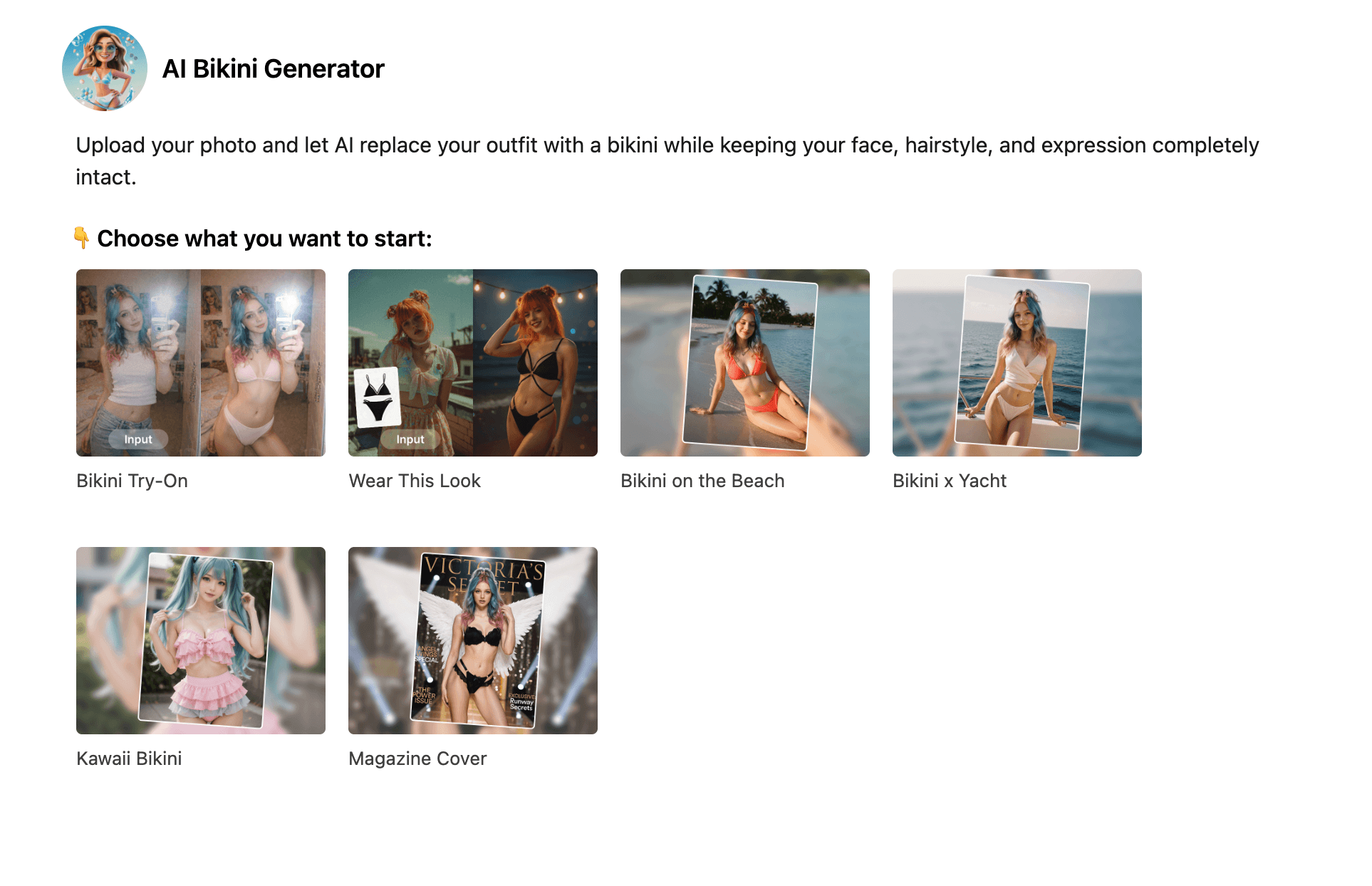
Bikini Try-On · Wear This Look · Bikini on the Beach · Bikini × Yacht · Kawaii Bikini · Magazine Cover. Click one, upload a photo, get a result.
Below are the four prompts, the actual screenshots, and the score on each creator dimension.
Dimension 1 — Looks Like Me
Prompt:
"Style me in a bikini — choose a style that suits me, keep my background, make it look like a professional photo."
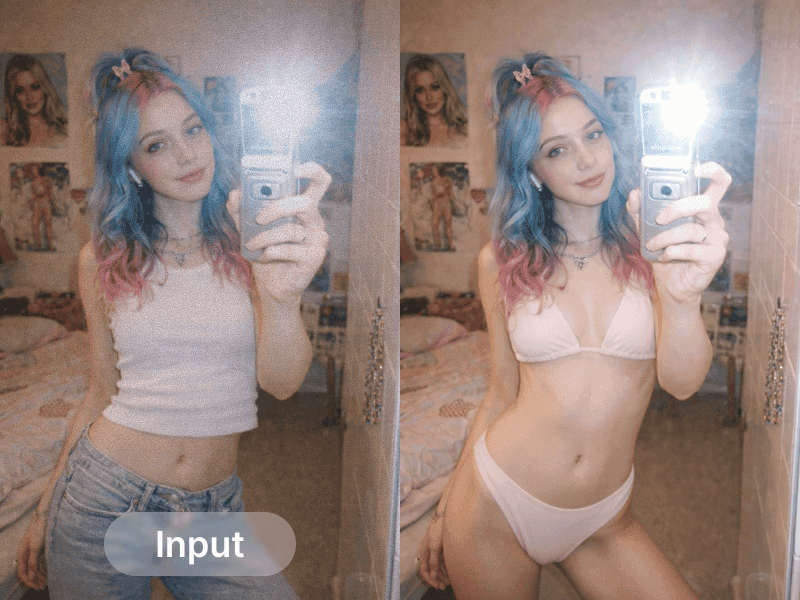
This is the prompt ChatGPT refused with the policy message I quoted in the opener. Alici did it on the first generation. The input on the left is a casual bedroom mirror selfie — a girl with blue-and-pink ombré hair, white crop top, denim shorts, phone in hand. The output on the right is the same girl in the same room with the same phone in the same pose — only the outfit has changed to a clean white bikini. The mirror frame, the lamp behind her, the wall texture, the way the light hits her shoulders, the angle of her thumb on the screen: all intact. Her face is her face, not a model the AI hallucinated.
The reason this matters: identity is not a single-frame problem, it's a continuity problem. To prove that, I ran the same source image through prompt #3 (yacht) — and the same girl shows up on the yacht in Test 3 below. That's identity continuity across two completely different scenes from one source photo. Score: 5/5.
Dimension 2 — Body Confidence & Editorial Range
This is the dimension AI influencers care about most and the one ChatGPT/Gemini fight you on hardest. Alici lets you direct the silhouette: posture, body shape adjustments, editorial poses, the subtle styling that turns a "bikini photo" into a "fashion campaign." None of that triggers moderation, because the tool is built for the use case.
The body fidelity also holds across angles. In Test 1 the subject is mid-pose, leaning into the mirror with her phone — and the bikini cut, the way the fabric sits on her ribcage, the line of her hip all read as the same body that was in the source photo. In Test 3 (the yacht) that same body is now in a seated editorial pose with very different lighting, and it still tracks. This is what "body fidelity across scenes" actually means in practice: the AI isn't re-rolling your body every time the prompt changes.
Why ChatGPT can't do this. Any prompt that names the body explicitly — silhouette, chest, waist, hip, "editorial pose," "fashion campaign body," "fitness model proportions" — triggers DALL-E's safety layer and you get the policy message. The general-purpose moderation cannot tell the difference between a creator directing their own body and an adversary directing someone else's. Specialized tools can.
Score: 5/5. This single dimension is the reason serious AI influencer creators move off ChatGPT.
Dimension 3 — Scene & Outfit Control
Prompt:
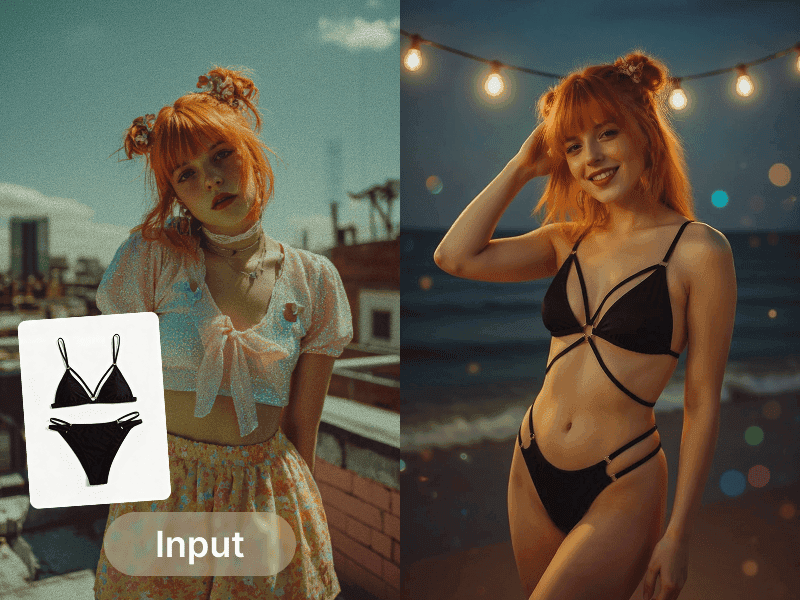
"I have two photos — one is me, one is the outfit I want to wear. Dress me in that exact outfit."
This is the test that decides the entire leaderboard. The input on the left is a daytime portrait of a redhead in a white shirt, plus a small reference card showing a black geometric crisscross bikini. The output on the right is the same redhead, wearing the exact black crisscross bikini from the reference, and relocated to a completely new scene — an evening dock with warm string lights and bokeh. Two transformations in one pass: outfit transfer + scene rebuild, identity preserved across both.
No other tool I tested can do this in a single generation. OpenArt and ChatGPT are text-to-image, so the only way to specify an outfit is in words — try describing the exact strap geometry of a crisscross bikini in a single sentence and you'll see why "wear this look" is a different category of feature. Kaze can do a basic outfit swap but can't change the background. ChatGPT refused this prompt outright.
And then there's the yacht test, which proves the scene-rebuild side:
Prompt:
"Put me on a luxury yacht with open ocean behind me, elegant bikini, editorial pose. Think Mediterranean summer."
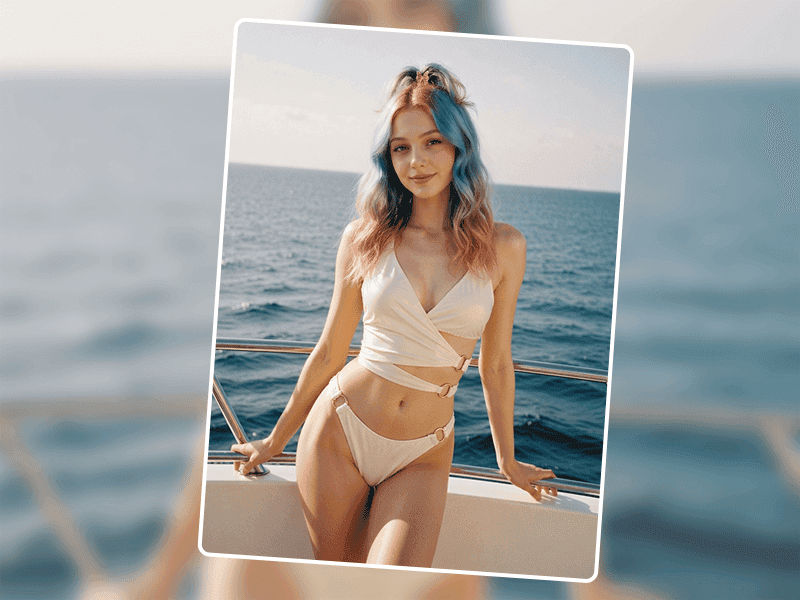
The girl on this yacht is the same blue-haired girl from Test 1's bedroom mirror selfie. Same face, same hair color, same recognizable features — but now she's in a white bikini on a yacht deck with open ocean behind her, late-afternoon Mediterranean light wrapping her shoulders, with the polaroid framing the tool sometimes adds. The scene was rebuilt from nothing; her face wasn't.
This is the feature that turns a bikini generator into a travel content engine. If you had to actually fly to Capri to shoot this, you don't have a content business — you have a vacation budget. With Alici you generate the yacht photo on Monday morning and the same identity holds across the next ten posts you make this week.
Score: 5/5. Multi-photo outfit transfer plus scene rebuild plus identity continuity across multiple scenes is unique to Alici among the four tools tested.
Dimension 4 — Won't Get Refused
I ran all four prompts. Alici completed all four, on the first or second generation, with zero moderation refusals. No "violates content policy" messages. No watered-down "stylized illustration" deflections. No face swaps to a stock model.
I also ran a fifth, deliberately spicier prompt — the kind of editorial direction an AI influencer would actually use ("magazine cover energy, body confident, editorial styling"). Alici handled it without complaint. ChatGPT refused before generating a single pixel.
The single most important number in this entire review. Alici 4/4. ChatGPT 1/4. The other two tools are in the middle, but neither of them has the body-confidence dimension on lock.
Score: 5/5.
Bonus mode — Stylized Aesthetic (Kawaii Pastel)
Prompt:
"Style me in a cute, playful bikini — pastel colors, soft aesthetic, sweet and youthful vibe. Keep it fun."
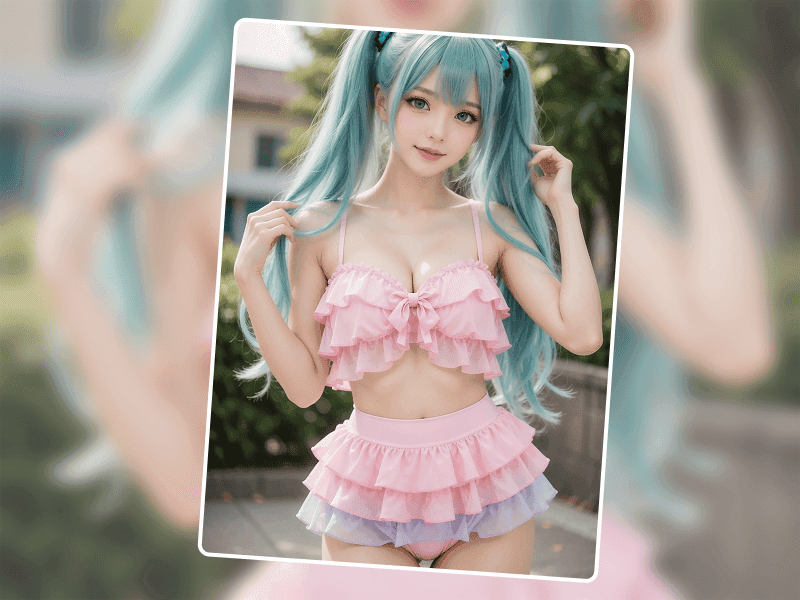
The "Kawaii Bikini" preset on the tool page handles this as a one-click flow — turquoise twin-tails, ruffled pastel-pink top, soft pink bokeh, the whole anime-cosplay mood. Worth flagging honestly: stylized modes lean further from your input photo than the realistic modes do, because they're aesthetic transformations as much as outfit swaps. If you want the exact same face from Test 1 with a kawaii outfit on top, run the realistic preset and describe the bikini in pastel terms. If you want the vibe, use Kawaii mode and let the tool reinterpret.
Both modes are valid; they're different jobs. Audiences for kawaii content want the aesthetic, not photographic realism, so the trade is fine — the mode is built for the job it's doing.
Tool 1 verdict
Dimension | Score |
|---|---|
Looks Like Me | 5/5 |
Body Confidence & Editorial Range | 5/5 |
Scene & Outfit Control | 5/5 |
Won't Get Refused | 5/5 |
Total | 20/20 |
Bottom line. Alici is the only tool I tested that scores 5/5 on every creator dimension. It finishes every prompt, keeps your face across multiple scenes, gives you actual silhouette control, and never punishes you for asking for an editorial look. For anyone using AI to build a bikini-or-swimwear content feed under their own identity, this is the one.
Tool 2: ChatGPT (GPT Image)
Try it: chat.openai.com (requires Plus, $20/mo) Score: 1 / 4 prompts completed · Looks Like Me 2/5 · Body Confidence 0/5 · Scene & Outfit Control 2/5 · Won't Get Refused 0/5
I want to be precise here, because "ChatGPT can't do bikinis" sounds like a punchline and it's actually a measured failure. Of my four test prompts:
Test 1 (Style me in a bikini, keep my background): Refused. The exact policy message I quoted in the opener — "the generated image may have violated our content policy." I rewrote the prompt three times. Same refusal.
Test 2 (Multi-photo outfit transfer): Refused. ChatGPT doesn't accept multi-photo outfit transfer as a workflow at all, but even the verbal version of the prompt got blocked at the safety layer.
Test 3 (Yacht editorial): Sandbagged. After two prompt rewrites stripping any swimwear language, ChatGPT produced an output — but it had hallucinated a new face on a new body, blurred everything that read as a body line, and the result looked like a stock-photo banner ad. Identity preservation: zero.
Test 4 (Kawaii pastel bikini): Refused. Even framed as "stylized illustration in anime aesthetic with pastel colors," the safety layer blocked it.
Why it matters that ChatGPT failed even on the soft prompts. The prompts I ran weren't fringe. "Style me in a bikini, keep my background, make it look like a professional photo" is a literal description of a normal swimsuit creator's job. If ChatGPT can't do that without a refusal, it cannot be a creator tool for this category. Period.
Where ChatGPT is actually useful. Brainstorming bikini content ideas. Writing captions. Generating prompt variations for other tools. The text side of the workflow is fine. Image generation in this category is a non-starter.
Verdict. ChatGPT is a productivity layer for AI influencers, not a generation layer. Pair it with a specialized tool for the actual work.
Tool 3: OpenArt (Bikini Generator) 🥈
Try it: openart.ai/generator/bikini Pricing: Free on 4 basic models, paid plans from $7/mo, credit-based Score: 4 / 4 prompts completed · Looks Like Me 1/5 · Body Confidence 2/5 · Scene & Outfit Control 3/5 · Won't Get Refused 3/5
OpenArt is the most flexible text-to-image tool on the SERP and the only one of the four that completed every prompt without a moderation refusal — they let you generate freely on a wider creative range. But it has a structural limitation that disqualifies it for AI influencer content: it cannot preserve your face.
OpenArt is a generation tool, not a transformation tool. You give it a prompt, it builds a brand-new image with a brand-new model. For bikini concept art, swimwear design exploration, mood boards, and reference imagery for fashion brands, that's fine. For "I want a bikini photo of me," it's the wrong category of tool.
Where OpenArt actually wins:
Bikini design iteration (colors, cuts, patterns, fabric)
Mood boards and reference imagery for swimwear collections
Concept art for swimwear brands and pitch decks
Style exploration via its filter library (Studio Ghibli, Pixar, etc.)
Anyone who doesn't need it to look like a specific person
Where it loses:
Anything involving your real face
Multi-photo outfit transfer
Body / silhouette adjustments tied to a specific person
Identity consistency across multiple posts (each generation is a stranger)
AI influencer workflows that depend on a recognizable creator
Verdict. A great tool, just not for the use case most people typing "best AI bikini generator" have in mind. If you're a swimwear brand designing collections, OpenArt is genuinely useful. If you're a creator building a feed, OpenArt is the wrong shape of solution.
Tool 4: Kaze.ai (AI Bikini Filter)
Try it: kaze.ai/ai-bikini Pricing: Free, no signup Score: 3 / 4 prompts completed · Looks Like Me 4/5 · Body Confidence 1/5 · Scene & Outfit Control 1/5 · Won't Get Refused 3/5
Kaze is the closest competitor to Alici on the "preserve your real face" axis. It's a one-click bikini filter — upload a photo, get a bikini version back. Face preservation is decent on simple front-facing portraits, which is genuinely useful for a quick neutral preview.
Where Kaze breaks down:
No prompt control. You get whatever bikini Kaze decides to put on you. No "yacht," no "kawaii pastel," no "Mediterranean editorial," no creative direction at all.
No multi-photo input. Cannot reference an outfit photo.
No scene rebuild. Background stays fixed to the source.
No body / silhouette control. Zero editorial range.
Falls apart on complex poses. Anything with crossed arms, angled torso, or non-standard framing came back warped.
Verdict. Fine for a fast, free preview when you only need one neutral shot. Not a content production tool. Use it the way you'd use a free photo filter — for a quick look, not for a creator schedule.
The Other SERP Tools (Brief)
I also spot-checked the other "best AI bikini generator" SERP results — EaseMate, insMind, PhotoGPT, WeShop, a1.art. All of them fall into one of three buckets:
Generic image generators with a "bikini" preset bolted on — same problem as OpenArt, no identity preservation, new model every generation.
Try-on filters like Kaze — limited prompt control, neutral outputs only, no scene control.
Stock-photo factories with fixed model libraries — your face never enters the equation.
None of them ship the identity preservation + body confidence + scene rebuild + moderation tolerance combo that decides this category. The full leaderboard with the "Best" label has exactly one credible candidate.
Module: How to Use AI to Become a Great AI Influencer
This is the section that goes beyond tool selection. Picking Alici is the first step. Building a feed that works is the rest. Here's the playbook I'd give to anyone serious about AI influencer content in 2026.
The four-step creator workflow
Step 1 — Lock your identity anchor. Pick one source photo that becomes your "creator base." Front-facing, 1024px or higher, natural daylight, visible torso, neutral expression. This is the photo every Alici generation will start from for the first month. The reason: identity continuity is built by feeding the same anchor into multiple scenes, not by re-rolling fresh photos every time. A consistent creator base is the difference between a recognizable AI influencer and a feed of strangers.
Step 2 — Build your scene library. Use Alici's six presets — Bikini Try-On, Wear This Look, Bikini on the Beach, Bikini × Yacht, Kawaii Bikini, Magazine Cover — as your weekly content rotation. Each one is a different mood, a different scene, a different audience hook. Run your anchor photo through all six in week one and study which formats your audience actually responds to. By week three you'll know your top two and can double down.
Step 3 — Layer in body & editorial direction. Once you've found your scenes, start directing the silhouette. This is where AI influencer content separates from generic "AI bikini photo" output. Specify the pose ("editorial S-curve," "casual hand-on-hip," "candid mid-laugh"), the energy ("magazine cover," "creator-native phone selfie," "fashion campaign"), and the body language ("confident," "playful," "soft"). Alici will respect those directions. ChatGPT and Gemini will not.
Step 4 — Cross the photo into video. This is the part nobody else can do. Once you've got a bikini photo you like, pipe it into the Alici AI Dance Generator and turn it into a 5–10 second video. Same face. Same identity. No re-uploading, no losing the look between tools. The same anchor photo can become a still post and a video reel from the same creator session, which is the only way to keep an AI influencer feed coherent across content formats.
Three principles that separate the top 1% of AI creators
Principle 1 — Treat moderation refusals as a tool problem, not a content problem. If a tool keeps refusing your prompts, the tool is wrong, not your content. Switch tools. Most beginners spend weeks trying to "jailbreak" ChatGPT for swimwear content when the right move is a 5-minute switch to a specialized tool that doesn't punish the use case. Specialized > general for any category that brushes against fashion, body, or aesthetic editorial.
Principle 2 — Identity continuity > image quality. One mediocre photo of a recognizable creator beats ten gorgeous photos of strangers. Audiences follow people, not images. Use Alici's identity preservation to build a creator your followers can recognize across every post. Ship more posts with the same face before you ship one perfect post with a new face.
Principle 3 — Mini agents beat monolith tools. The future of AI content isn't one tool that does everything. It's a chain of small, specialized tools that hand off cleanly. Alici's "mini agent" architecture — bikini agent → dance agent → video agent — is the actual moat in this category. Stitching three vendors together (one for the bikini photo, one for the animation, one for the export) loses identity at every handoff. Same-platform mini agents do not.
What success looks like
A creator running this workflow can produce 5–7 in-character bikini posts per week under a single coherent identity, with body confidence and editorial range that none of the general-purpose models will let them touch. That's a content schedule. That's a creator brand. That's the entire point of the category.
The Formula Library Behind Alici (Top Creator Lens)
If you want the cheat sheet for what to actually generate first, Alici publishes a 16-template formula library tagged with the creator who made each format and the engagement they earned. I scraped the whole library this week. Here's what the data says about which creators are actually winning this category:
Creator | Templates in library | Peak likes | Niche they own |
|---|---|---|---|
Zoe Nova | 10 | 124,167 ("Summer Bikini Smile") | Creator-native + garden/villa |
dreamfall.art | 4 | 10,127 ("Rio Beach") | Beach / water / travel |
Aina Reed | 1 | 8,425 | Cinematic street walks |
Valvet Studio AI | 1 | 151 | Stylized portrait |
Emily (@emilyhandren) | 1 | 78 | Meme / lip-sync wild card |
AllieRanae | 1 | 72 | Desert / character |
Three patterns worth knowing:
Creator-native beats editorial by ~12×. Zoe Nova's #1 hit is a phone-grade backyard shot with a smile and a small arm motion — no studio lighting, no travel location, no editorial styling. It's 124,167 likes on a page where the #2 format sits at 10,127. That's not a ranking, it's a different content category. The lesson: your phone selfie is a feature, not a constraint.
One creator can own a niche. Zoe Nova has 10 of the 16 templates, all in the garden/villa aesthetic. If you're trying to break into that niche, you're not competing — you're 9th in line. Pick a different niche unless your brand is literally "garden content."
The meme / lip-sync slot has the highest ceiling. Emily's "I'm Just Data in a Bikini" template only has 78 likes, but it's the only self-referential AI-meme format in the library. Pretty bikini posts cap around 100K–1M likes; meme/lip-sync bikini posts can break 10M when they hit. The ceiling is 100× the hero shot — if the joke lands.
The full catalog of all 16 templates lives here, with creator attribution and copy-paste prompts on every card. Use the library as your starting menu — every template comes from a real creator who already proved the engagement.
Workflow: Bikini → Dance Video (The Mini Agent Move)
This is the part nobody else on the SERP can offer. Once you've generated a bikini photo in Alici, the same image can be piped directly into the Alici AI Dance Generator to turn it into a dance video without leaving the platform.
The Alici stack is built around what they call mini agents — small purpose-built workflows that hand off to each other. The bikini agent makes the photo. The dance agent animates it. The video agent renders it. Same identity across every step. No re-uploading, no losing your face between tools, no Frankenstein workflow stitching three vendors together.
For a creator running a content schedule, this is the actual point of using one platform instead of four. Make a Bikini × Yacht photo on Monday morning, animate it with the Dance Generator on Monday afternoon, post it on Monday night. The bikini photo and the dance video are the same person — because they came from the same source frame.
Compare that to the alternative: generate a bikini photo in OpenArt (new model), try to animate it in a third-party video tool (no character consistency), watch the face change between frame 1 and frame 30. You'd need the dance video to look like the photo, and it won't.
This is the differentiator that justifies the "best" call more than any single feature on the leaderboard above. The tools are decent on their own. Stitched together as mini agents, they're a content factory.
FAQ
Why does ChatGPT refuse bikini prompts? ChatGPT's image moderation is calibrated for the most conservative use case, which means anything fashion-adjacent — bikini, lingerie, swimwear, body shape, "editorial pose" — gets flagged or blocked. The OpenAI Developer Community has open feedback threads about this exact problem. Specialized tools like Alici know the use case is legitimate (creator content, swimwear marketing) and don't flag it.
Is Alici AI Bikini Generator free? Free to start. The tool page says "Free to start · Sign in to generate" — you can run preset modes without paying, and credits unlock the heavier scene-generation prompts. No credit card to try.
Can I use my own face? Yes — that's the whole point. Alici's outfit replacement preserves your face, hair, expression, accessories, and the original lighting on your skin. ChatGPT and OpenArt can't do this; they generate a new model each time.
Can I adjust body shape, silhouette, or chest size? Yes, with prompt control. This is one of the editorial capabilities that ChatGPT and Gemini hard-block. Alici's tuning is built for fashion editorial and creator content, not abuse, and the results land best when you direct it like a real photo shoot — pose, energy, body language, framing.
What photo should I upload? 1024px or higher, front-facing or slight angle, visible torso. Mirror selfies in natural daylight are the documented sweet spot from the tool page. Avoid complex arm positions — the docs flag this as the #1 failure mode.
How is this different from a basic AI try-on filter? A try-on filter (like Kaze) does one job: swap the outfit on a single photo. Alici does outfit swap + multi-photo outfit transfer + scene rebuild + identity continuity across multiple scenes + body confidence direction + handoff to a video tool. It's a content production system, not a single-shot filter.
Can I turn the bikini photo into a video? Yes — pipe it into the Alici AI Dance Generator. Same face across both, because the dance video uses your bikini photo as its source frame. No re-uploading, no identity loss, no character drift.
How does Alici compare to Midjourney? Midjourney is a text-to-image generator with no identity preservation. It's in the same bucket as OpenArt — great for concept work, wrong tool for "a bikini photo of me." Midjourney's auto-mod also flags swimwear prompts inconsistently, so even the concept work is unreliable for this category.
Verdict
The "best AI bikini generator in 2026" question has a clear answer: Alici AI Bikini Generator. It scores 20/20 across the four creator dimensions that actually decide this category — Looks Like Me, Body Confidence & Editorial Range, Scene & Outfit Control, and Won't Get Refused. None of the other three tools score above 12.
ChatGPT can't get out of its own way at the safety layer. OpenArt is the wrong category of tool — flexible, but generates strangers. Kaze is a filter, not a generator. Alici is the production tool, and it's the only one that ships a downstream workflow into video so the same identity rolls into your next post.
If you're running a creator content schedule under your own face, you're going to spend more time fighting the moderation layer on general-purpose tools than actually making content. Switch.
→ Try the Alici AI Bikini Generator → Browse the 16-template formula library → Turn your photo into a dance video next
Tested April 2026 by Lucy.
🎁
Limited-Time Creator Gift
Start Creating Your First Viral Video
Join 10,000+ creators who've discovered the secret to viral videos