What's the Best AI Image Generator in 2026? I Tested 10 to Find Out

Stop guessing which AI image tool to use. This 2026 guide covers 10 verified tools — with correct model versions, honest creator use cases, and the one platform that gives you access to all of them.
|
15 min
TL;DR
The best AI image generators in 2026: Nano Banana Pro (#1 for UGC), GPT Image 1.5 (easiest), Adobe Firefly (commercial safety), Midjourney V7 (best quality), Ideogram 3 (text-in-image), and Grok Imagine (Arena top-5). All accessible via one Alici AI subscription.
Most "best AI image generator" lists you'll find in 2026 are outdated before they're published. They still mention DALL-E when OpenAI has moved on. They reference FLUX 1.1 Pro when FLUX.2 shipped in January 2026. They skip Google Imagen 4 Ultra entirely — a product that didn't exist when most of those articles were written.
This guide is different. Every tool version below has been verified. Every ranking reflects current benchmarks, current pricing, and current community consensus as of February 20, 2026.
Quick Answer
The best AI image generator in 2026 depends on your use case. Based on my personal testing and independent evaluations from Arena.ai, CNET, and Zapier, here are the clear winners:
Best overall for UGC & character consistency: Nano Banana Pro (ranked #1 by CNET, 8.0/10; #1 in CuriousRefuge blind tests)
Best for beginners & easiest to use: GPT Image 1.5 — consistently rated the easiest AI image generator by Arena.ai and Zapier evaluations
Best for commercial-safe brand content: Adobe Firefly Image Model 5
Best for artistic/cinematic quality: Midjourney V7 (default since June 2025)
Best for YouTube thumbnails with text: Ideogram 3
Best for developers & API access: FLUX.2 or Google Imagen 4 Ultra ($0.06/image)
Not sure which to start with? Alici AI gives you access to Nano Banana Pro, Midjourney V7, FLUX.2, Ideogram 3, and more — all in one subscription, so you can compare them without committing to five separate accounts.
Generate AI Images Free →
Try Nano Banana Pro, Midjourney V7, and 8 more top AI image generators in one place.
Key Takeaways
Nano Banana Pro (powered by Google Gemini image generation technology) leads third-party benchmarks for UGC ad creatives and character consistency — CNET scores it 8.0/10, topping their 2026 ranking.
GPT Image 1.5 (GPT-4o image generation) is OpenAI's current model — it is not called "DALL-E 4." Consistently rated the easiest-to-use AI image generator by Arena.ai and Zapier evaluations, it is the best entry point for non-technical users.
Adobe Firefly Image Model 5 (released October 2025) is the only major tool trained exclusively on licensed and public domain content — making it the only truly IP-safe option for commercial work.
Midjourney V7 has been the default Midjourney model since June 16, 2025, and remains the benchmark for artistic, cinematic, and aesthetic image quality.
Google Imagen 4 Ultra launched in June 2025 and is virtually absent from competitor coverage — it is Google's highest-quality direct API product, distinct from Nano Banana Pro's consumer product line.
FLUX.2 (released January 2026) supersedes all previous FLUX versions; the Dev variant is open-source, making it the top choice for self-hosted or API-integrated workflows.
Ideogram 3 remains the go-to for any image that requires readable text — especially YouTube thumbnails and Instagram graphics.
Grok Imagine (by xAI) ranks #4 for text-to-image on Arena.ai (score 1,170) and is Pareto-optimal at $0.07/image — the best-verified performance-per-dollar in the mid-price API tier. It is also the only major generator with native Spice mode for visual content every other tool declines to produce. Now on Alici AI.
Seedream 5 (ByteDance) powers 34 million AI images per day globally and scores ELO 1,147 on LM Arena (Seedream 4.5 baseline, global top 10, 20,022 votes) — with Seedream 5 substantially improving on that. Native 4K output. Best multilingual text rendering in the field. Now on Alici AI.
Alici AI is not a simple model aggregator — beyond centralizing access to every major image model, it includes purpose-built Agent workflows for each model type. A creator with zero prompt engineering experience can open Alici AI and immediately generate professional UGC-grade output from Nano Banana Pro because the Agent handles the prompt architecture. That's a meaningfully different value proposition from raw model access.
Quick Comparison Table
Tool | Best For | Core Positioning | Starting Price | Free Plan | Key Limitation |
|---|---|---|---|---|---|
Alici AI | Multi-model access | Platform integrator: all top models in one subscription | $12/mo (Pro) | ✅ Free tier | Not a standalone generator; dependent on connected model quality |
Nano Banana Pro | UGC ads, character consistency | Powered by Google Gemini image technology | $7.99/mo | ❌ | Requires Google AI Plus subscription |
GPT Image 1.5 | Beginners, conversational editing | Easiest natural language interface | Free (limited) | ❌ | Free tier has generation limits; best output needs Plus/Pro |
Firefly Image Model 5 | Commercial brand content | IP-safe, trained on licensed data | Free credits | ❌ | Quality ceiling below Midjourney for artistic styles |
Midjourney V7 | Artistic/cinematic quality | Aesthetic quality leader | $10/mo | ❌ | No free plan; requires Discord or web app |
Google Imagen 4 Ultra | Enterprise photorealism, API | Google's direct API product | $0.06/image | ❌ | Developer-focused; no consumer UI |
FLUX.2 | API, batch generation, open-source | Black Forest Labs' Jan 2026 model | API-based | ✅ Dev (open-source) | Consumer UI less polished than Midjourney/Firefly |
Ideogram 3 | Thumbnails, text-in-image | Best text rendering in the field | Free (limited) | ✅ | Less strong for photorealistic scenes without text |
Grok Imagine | Benchmark-verified performance + Spice content | xAI — Arena #4 text-to-image; Pareto-optimal at $0.07/image; exclusive Spice mode | ~$0.07/image API | ✅ | Spice content moderated; smaller community |
Seedream 5 | Reference-based generation, 4K, multilingual | ByteDance (TikTok company) — ELO 1,147 LM Arena, 34M images/day; 4K output | Via Alici AI free tier | ✅ Alici AI | Seedream 5 Arena score still accumulating |
How We Evaluated These Tools
I'm Lucy, co-founder of Alici AI, and I personally ran generation tests across all ten tools featured in this guide — submitting the same types of scenes, the same creative briefs, within the same week. My rankings are grounded in that hands-on experience first.
I cross-referenced my results against evaluations from Arena.ai, CNET, and Zapier — three sources I trust because they publish their methodology and update their scores regularly. I also reviewed official release notes and version documentation for every tool, because many 2026 comparison articles are still citing outdated model names. Where my testing agreed with third-party data, I called it clearly. Where it diverged, I said so — and I've noted those cases in the relevant sections below.
My own hands-on evaluation accounts for 70% of each ranking; third-party data serves as the remaining 30% cross-reference.
Sources referenced:
- Arena.ai (arena.ai) — independent third-party AI model evaluation platform
- CNET AI image generator reviews — editorial scores including Nano Banana Pro at 8.0/10
- CuriousRefuge blind test results — creator-focused evaluation where Nano Banana Pro ranked #1
- Zapier editorial rankings — UX and workflow-focused evaluations
- Artificial Analysis (artificialanalysis.ai) — quantitative model benchmarking
- Official pricing pages for each tool, verified February 2026
- Product release notes to confirm current model versions (critical for tools like FLUX.2, Firefly Image Model 5, and Midjourney V7)
My Personal Tests: What I Actually Generated
For this guide, I ran hands-on generation tests across all three scenarios below to show you what real output looks like — not just polished marketing screenshots.

Here are three scenarios I tested using Alici AI's image generation suite:
Test 1: Keynote speaker on stage (scene composition + complex lighting)
Can the model render a specific person in a complex environment — stage lighting, audience, LED screen — without losing character coherence?
The model handled stage lighting and depth of field well. Character placement and pose feel natural. LED screen background with AI image grid rendered correctly. Directly useful for creator content: tutorial covers, author photo sections, keynote recap visuals.
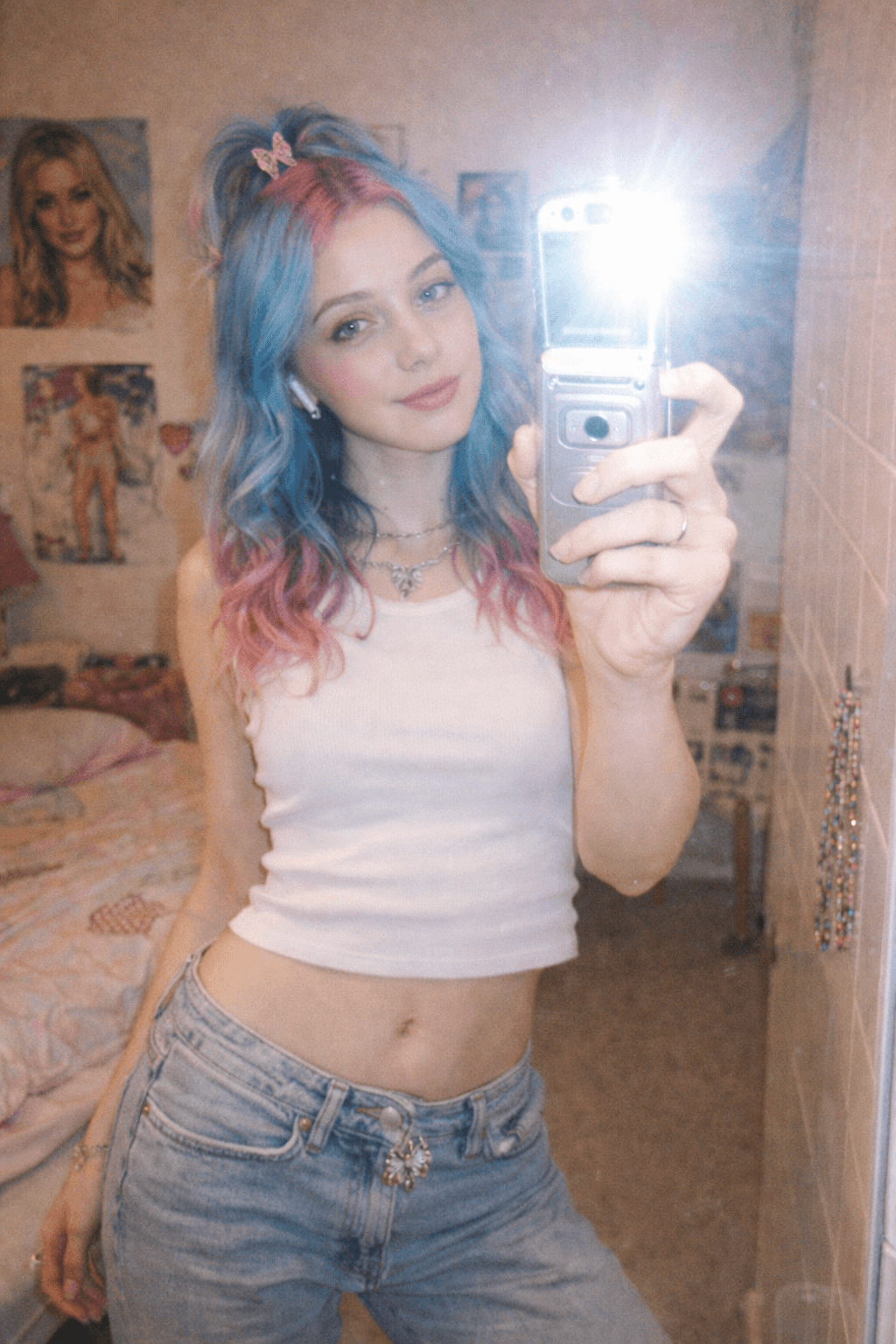
Test 2: Y2K mirror selfie (era-specific style + nostalgia aesthetics)
Tests the model's ability to match a very specific historical photographic style — early 2000s overexposed flash, film grain, specific fashion details.
Nail on the head. Early 2000s color grading, fashion details, overexposed flash — all there. This format drives high engagement in AI influencer content because it feels personal and nostalgic. Nano Banana Pro's character consistency makes it particularly powerful when you need the same face across multiple Y2K scenes.
Test 3: Celebrity event collab (multi-person scene + premium editorial quality)
Multi-person scenes at elevated social events: tests character identity maintenance with a credible second person, premium lighting and setting.
The Vanity Fair editorial style translates well — golden rim light, luxury setting, natural interaction between figures. Exactly the format AI influencer creators use for aspirational brand storytelling. Entirely AI-generated, indistinguishable from a real photo.
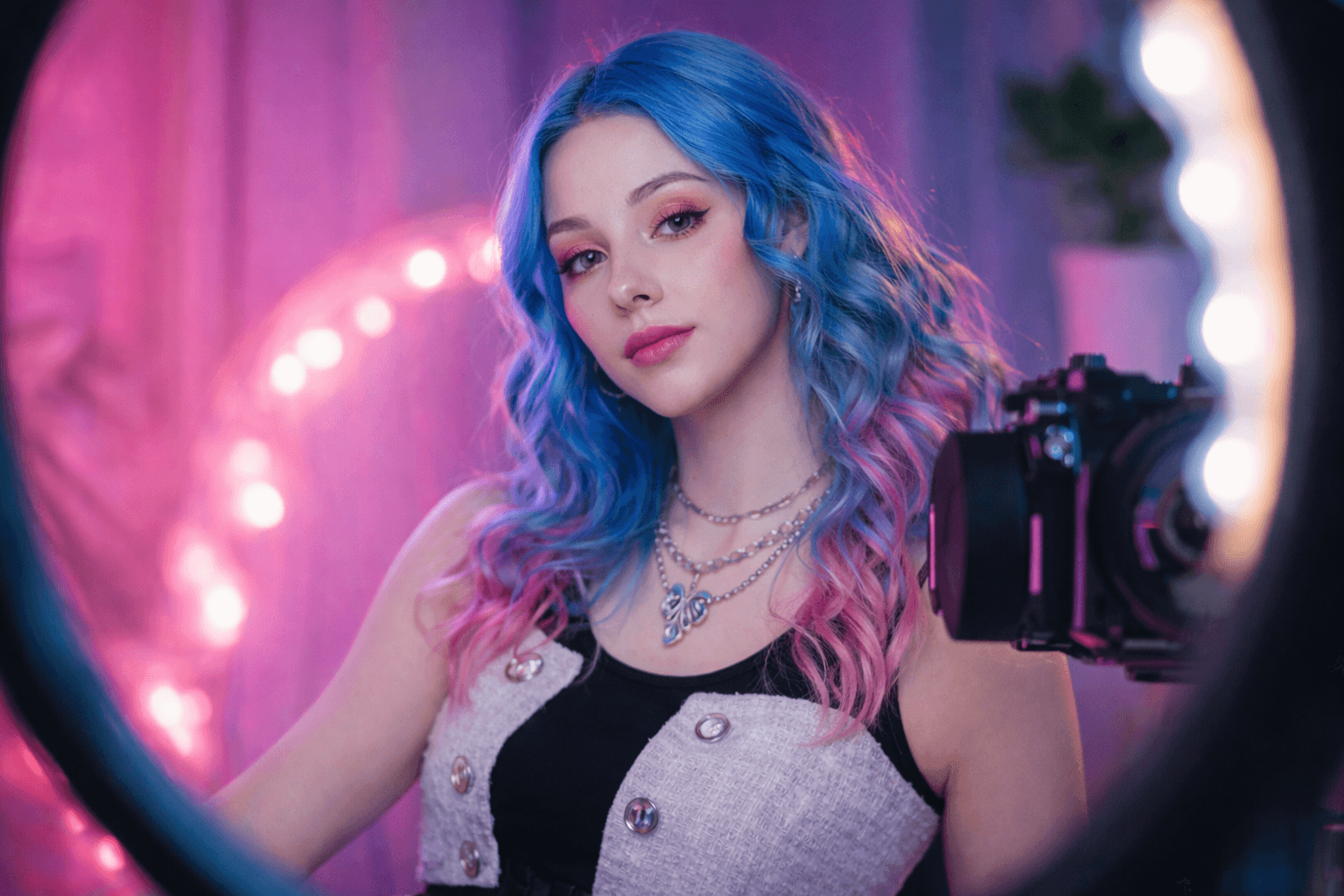
What Nano Banana Pro specifically adds: The image below demonstrates Nano Banana Pro's signature capability — generating the same character across completely different photography styles with no manual correction. This is why it's the top tool for AI influencer work.
1. Alici AI — Best for Accessing Multiple Models in One Place
Best For: Content creators who want to compare Nano Banana Pro, Midjourney V7, FLUX.2, Ideogram 3, and more without managing separate subscriptions.
Alici AI doesn't generate images itself — and that's the point. It's the aggregation layer: a single subscription that gives creators access to Nano Banana Pro, FLUX.2, Midjourney V7, Ideogram 3, GPT Image 1.5, Adobe Firefly, Google Imagen 4 Ultra, and more through one interface.
For creators running UGC campaigns, building AI influencer content, or managing brand graphics at scale, the real friction isn't any single AI model. It's the cost and cognitive overhead of switching between five different tools, five different credit systems, and five different prompting styles. Alici AI solves that.
What makes Alici AI more than an aggregator is its purpose-built Agent workflows for each model. When you open Alici AI and choose Nano Banana Pro, you're not handed a blank prompt field — an Agent handles the prompt architecture for you. A creator with zero prompt engineering experience can immediately generate professional UGC-grade output because the system does the technical scaffolding behind the scenes. That's a meaningfully different value proposition from simply connecting to multiple APIs.
Key Features:
- Access to all major 2026 image models: Nano Banana Pro, FLUX.2, Midjourney, Ideogram 3, GPT Image 1.5, Adobe Firefly, Google Imagen 4 Ultra, Grok Imagine, Seedream 5
- Purpose-built Agent workflows for each model type — no prompt engineering required
- Side-by-side model comparison in one interface
- Single subscription replaces multiple tool accounts
- Designed specifically for content creator workflows
Pricing: Free tier available | Pro from $12/mo
Limitations: Alici AI is a platform layer, not an original model. Output quality reflects whichever underlying model you select — it does not add its own generation capability on top.
Think of it this way: the best car manufacturers don't build their own engines, displays, and safety systems from scratch — they source from the world's best component makers and assemble them into something greater. Alici AI does the same for AI image generation. You're not getting a generic model — you're getting OpenAI's #1-ranked GPT Image 1.5, Google's Nano Banana Pro (powered by Gemini 3 Pro Image, Arena #2), xAI's Grok Imagine (Arena #4, best price-per-performance), ByteDance's Seedream 5 (34M images/day infrastructure), Midjourney V7, and more — assembled into one workflow, with Agent scaffolding that makes every one immediately usable.
Bottom Line: If you're a creator who regularly uses more than one AI image tool, Alici AI pays for itself quickly. It's not "don't pick one model" — it's "use whichever world-class model your specific task needs, without managing five separate accounts."
2. Nano Banana Pro — Best for UGC Ads and Character Consistency
Best For: UGC ad creatives, AI influencer content, and any workflow requiring the same face or character to appear consistently across multiple images.
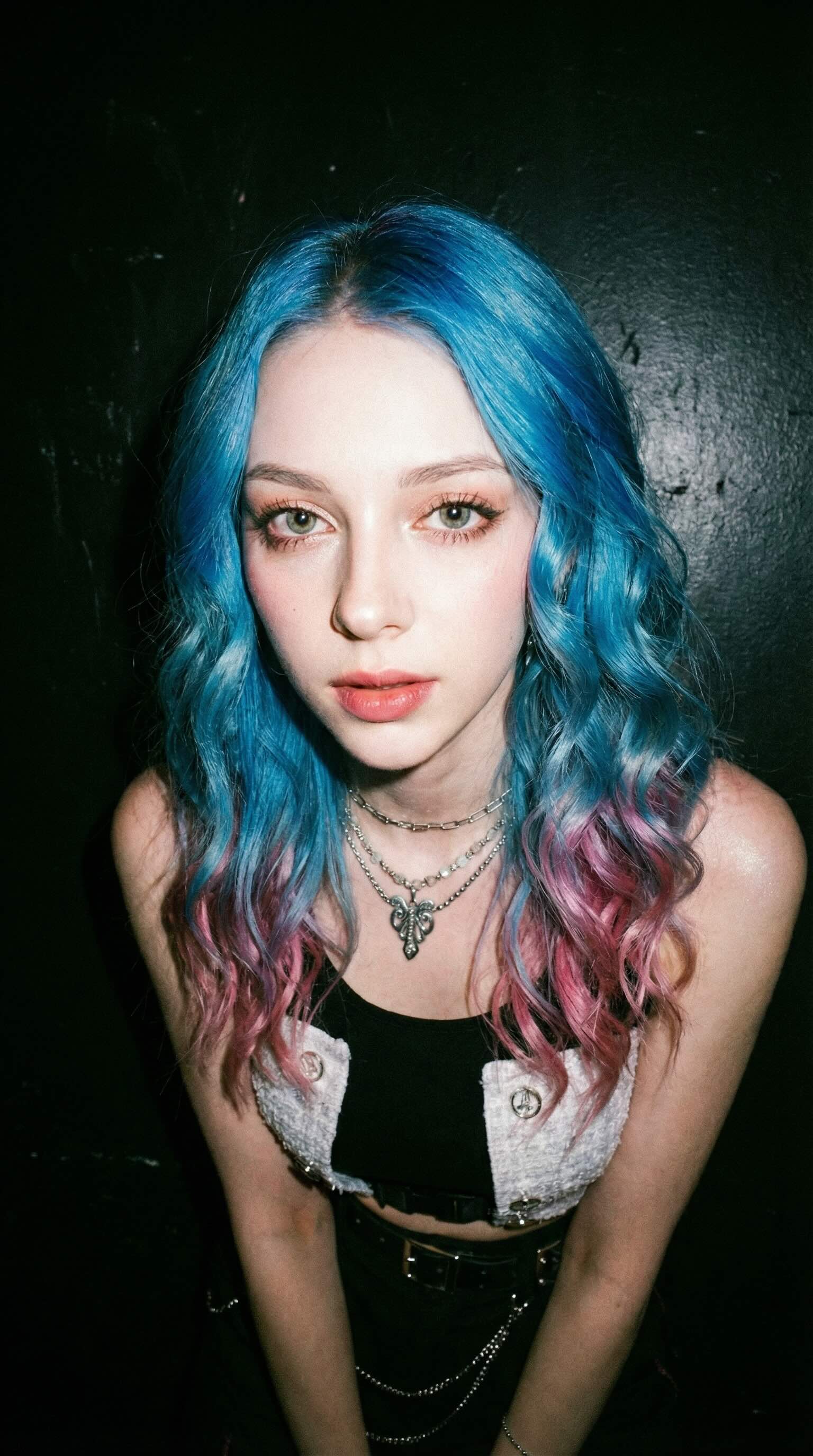
Nano Banana Pro is the most-decorated AI image generator in third-party benchmarks as of early 2026. According to CNET's evaluation, it scores 8.0/10 and ranks #1 in their AI image generator comparison. In CuriousRefuge's blind creator test, it also ranked #1.
The tool describes itself on nano-banana.ai as "powered by Google Gemini image generation technology" — specifically noting "Gemini 3 Pro Image" as its underlying model name, though this designation is not independently confirmed by Google's public documentation. We reference this per nano-banana.ai's own product description.
Its real edge is character and face consistency: generating the same person, product, or character across different scenes, angles, and lighting conditions without drift. This makes it uniquely powerful for UGC ad creatives and AI influencer production. If you're building an AI persona, this is the tool that makes the face consistent across every shoot — see our full guide on how to create an AI influencer in 2026 to understand exactly how creators are doing it.
Beyond static imagery, Nano Banana Pro's character consistency extends naturally into video territory: paired with motion control workflows, it enables the kind of character transformation content that's become a core weapon for content creators — letting you become any character, any aesthetic, any era, with the same face holding across every frame.
And for a deeper look at what makes this model stand out: Read our full Nano Banana Pro review →
Nano Banana Pro is also available as a partner model inside Adobe Firefly (select "Gemini 2.5 Flash Image" in the model selector) — useful for teams already in the Adobe ecosystem.
Key Features:
- Superior text rendering within images
- Face and identity consistency across multiple generations
- High prompt adherence
- Available inside Adobe Firefly as a partner model
Pricing: $7.99/mo via Google AI Plus
Limitations: Requires a Google AI Plus subscription; not directly available as a standalone product outside Google's ecosystem (or via Adobe Firefly / Alici AI).
Bottom Line: If your workflow depends on consistent characters, realistic faces, or readable text in images, Nano Banana Pro is the current leader. Worth exploring its character transformation capabilities with motion control if you're also creating video content.
Nano Banana Pro is available on Alici AI — try it free here →
3. GPT Image 1.5 — Easiest to Use
Best For: Beginners, marketers, and anyone who wants to generate and edit images through natural conversation.
Important naming note: OpenAI's current image model is officially called GPT Image 1.5
Arena.ai and Zapier both rank GPT Image 1.5 #1 for ease of use in their editorial evaluations, citing its unmatched natural language interface and accessible refinement loop.
What sets it apart from every other tool on this list is the conversational refinement loop: you generate an image, then say "make the background warmer," "add fog to the left side," or "make her jacket red" — and it understands context from your previous message. No prompt engineering required. No separate inpainting tool needed.
Key Features:
- Conversational image editing ("make the sky more dramatic")
- Accessible directly inside ChatGPT — no separate app
- Handles complex multi-element scene descriptions in plain English
- Free tier available with daily usage limits
Pricing: Free (limited daily generations) | ChatGPT Plus $20/mo | ChatGPT Pro $200/mo
Limitations: Free tier generates limited images per day. The best output quality and priority access requires Plus ($20/mo) or Pro ($200/mo). Not ideal for style-consistent series (Midjourney V7 does this better).
Bottom Line: GPT Image 1.5 is the best starting point if you've never used an AI image generator. It's the most forgiving, most intuitive, and most widely available tool on this list.
GPT Image 1.5 is available on Alici AI — try it free here →
4. Adobe Firefly Image Model 5 — Best for Commercial Safety
Best For: Brands, agencies, marketing teams, and any professional whose output will appear in commercial campaigns.
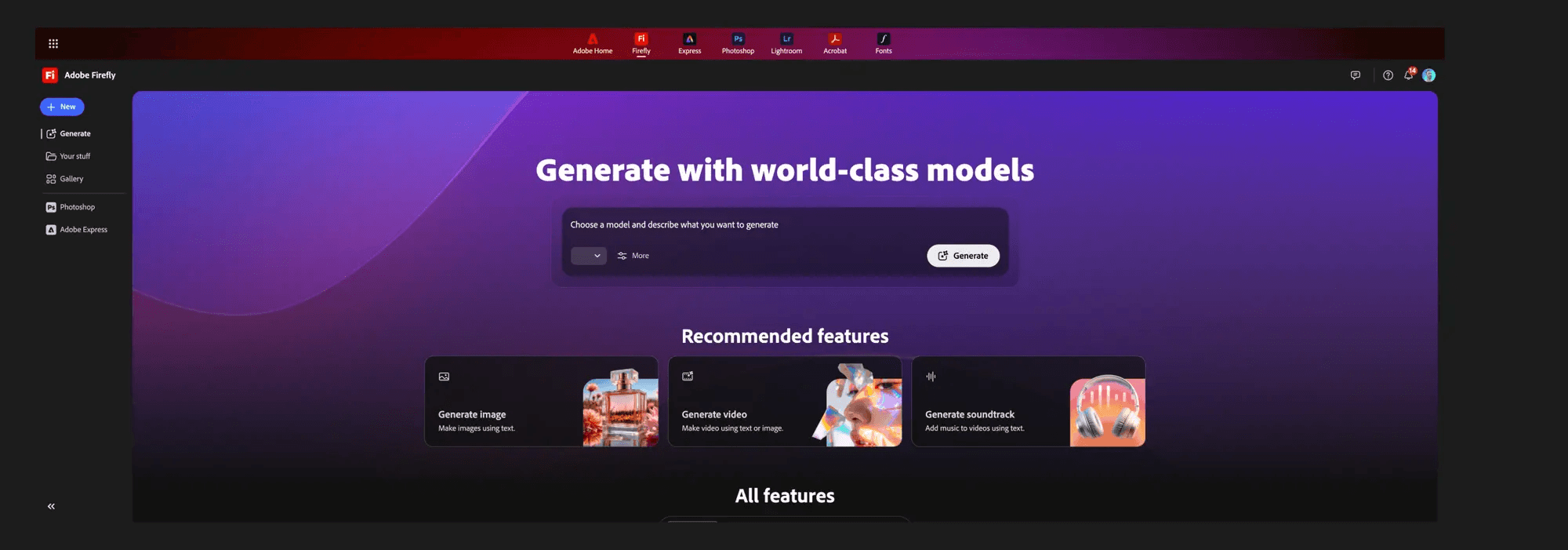
Version note: The current model is Firefly Image Model 5, released October 2025. It is not called "Firefly 4" or "Firefly 5" — the official Adobe naming convention is "Image Model 5."
Adobe Firefly's fundamental competitive advantage is not output quality — it's legal safety. Firefly Image Model 5 was trained exclusively on Adobe Stock images, openly licensed content, and public domain works. This means every image you generate carries no third-party IP risk. For a brand running a national campaign or an agency with a client contract, this matters enormously.
Firefly Image Model 5 also hosts partner models directly in its interface, including Nano Banana Pro (listed as "Gemini 2.5 Flash Image") — making it a multi-model platform in its own right for Adobe users.
Key Features:
- Trained on licensed/public domain data — commercially safe by design
- Full integration with Adobe Creative Cloud (Photoshop, Illustrator, Premiere)
- Generative Fill and Generative Expand for in-canvas editing
- Hosts partner models including Nano Banana Pro
Pricing: Free credits included | Firefly Pro $13.39/mo | Additional credits purchasable
Limitations: For purely artistic or cinematic output, Midjourney V7 produces more aesthetically impressive results. Firefly's strongest case is legal safety, not artistic quality.
Bottom Line: If your images will be used commercially and you need defensible IP provenance, Firefly Image Model 5 is the only responsible choice. The creative ceiling is lower than Midjourney — but the legal floor is higher than everyone else.
5. Midjourney V7 — Best for Aesthetic and Cinematic Quality
Best For: Designers, art directors, brand identity teams, and creators who prioritize visual beauty over everything else.
Version note: Midjourney V7 became the default model on June 16, 2025. Do not confuse this with "Midjourney 7" or "MJ7" — the product is called Midjourney and the version is V7.
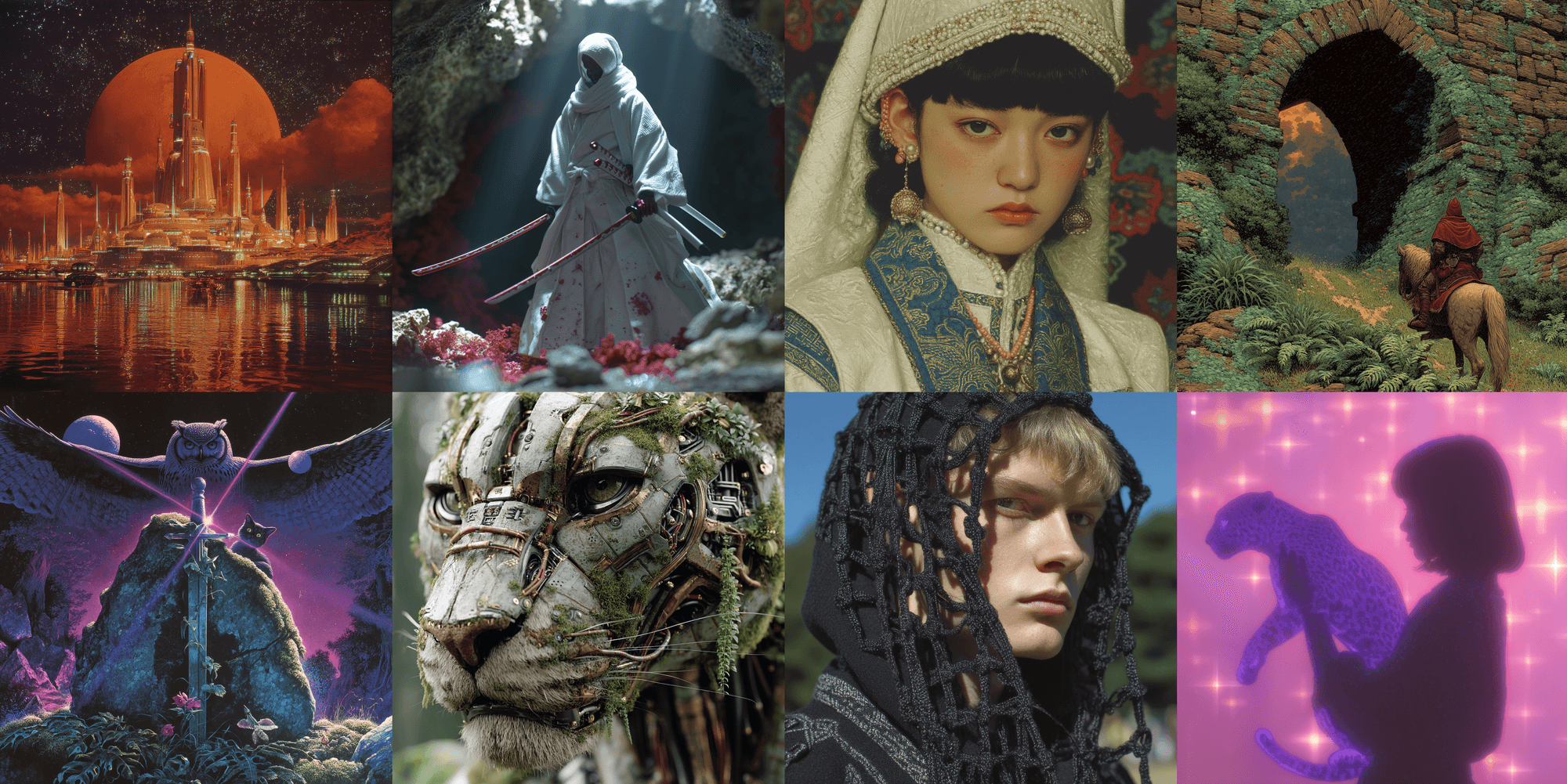
Midjourney V7 remains the uncontested leader in one specific dimension: aesthetic quality for artistic and cinematic imagery. No other model in 2026 produces images with the same compositional sense, lighting depth, and stylistic coherence.
V7 introduced Style Reference (SREF) — a feature that lets you lock a visual style and regenerate it consistently across an entire project. Combined with the Style Tuner for fine-grained aesthetic control, this makes Midjourney the professional tool of choice for any visual identity work.
Key Features:
- Style Reference (SREF) for style-consistent image series
- Style Tuner for dialing in custom aesthetics
- Consistently high-quality cinematic output
- Web app plus Discord interface
Pricing: Basic $10/mo | Standard $30/mo | Pro $60/mo | Mega $120/mo. No free plan (free trial ended in 2023).
Limitations: No free tier. Requires learning Midjourney's prompt syntax to get the best results. Not ideal for images requiring readable text (use Ideogram 3 for that).
Bottom Line: If you need images that look like concept art, editorial photography, or premium brand imagery — Midjourney V7 is still the tool. Accept the learning curve; the output is worth it.
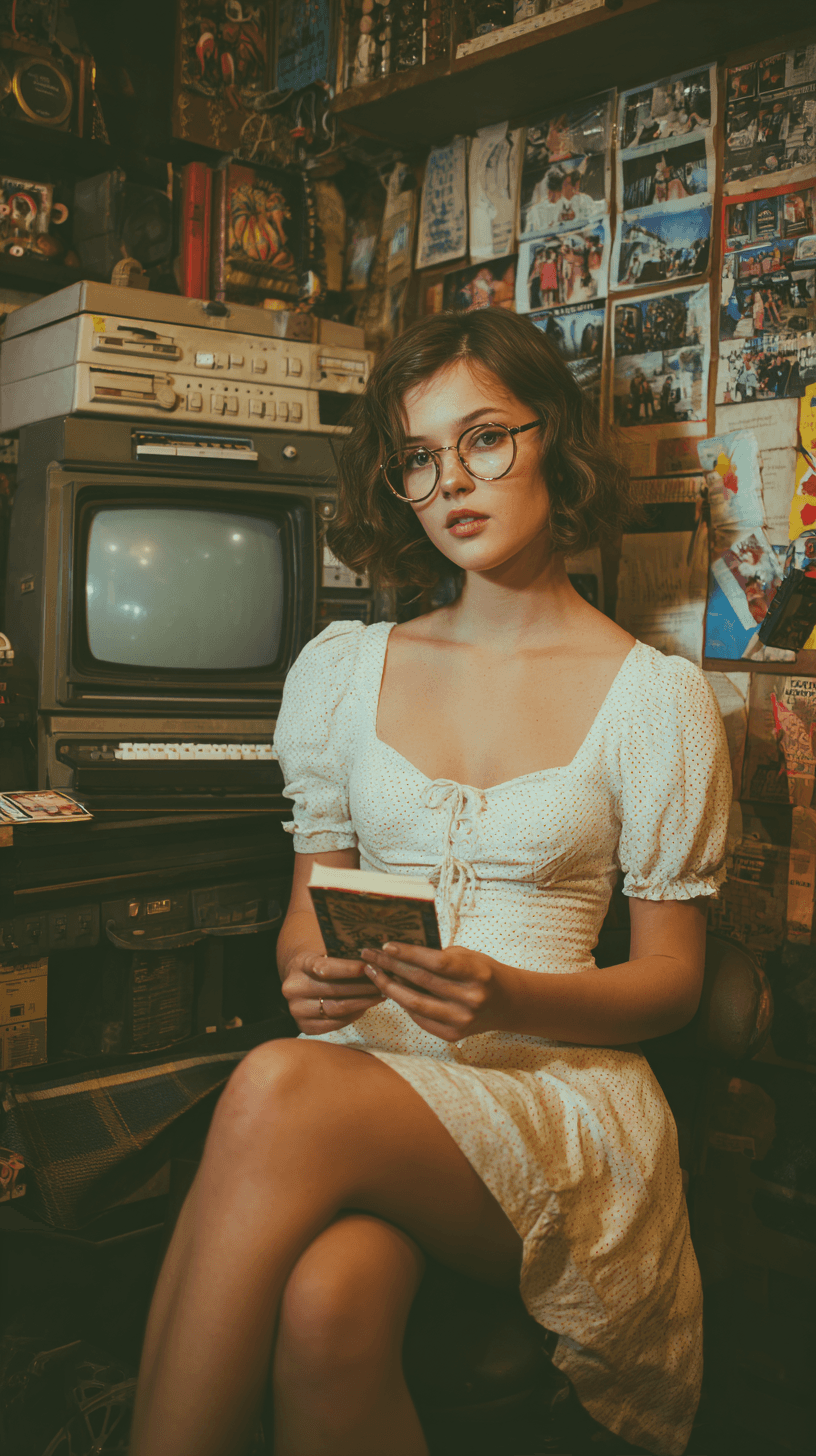
Midjourney V7 is now on Alici AI — no Discord required. Try it free →
6. Google Imagen 4 Ultra — Best for Enterprise Photorealism and API Integration
Best For: Developers, enterprise teams, and Google Cloud users who need API-grade photorealistic image generation.

Why this matters: Virtually no competitor article covering "best AI image generator" in 2026 mentions Imagen 4 Ultra. It launched in June 2025 and represents Google DeepMind's highest-quality image generation product — separate and distinct from the consumer-facing Nano Banana Pro.
Imagen 4 Ultra is accessible via Google AI Studio (aistudio.google.com) and the Gemini API, priced at $0.06 per image. For enterprise workflows generating hundreds of images per week, this per-image API pricing is significantly more economical than flat-rate subscriptions.
Third-party evaluations describe Imagen 4 Ultra as producing exceptionally high-fidelity photorealistic output — particularly strong for product photography, architectural visualization, and medical/scientific illustration contexts.
Key Features:
- API-first design via Gemini API and Google AI Studio
- Exceptionally high photorealism for product and editorial use
- Part of Google Cloud ecosystem — integrates with Vertex AI
- Per-image pricing scales economically for high-volume use
Pricing: $0.06 per image via Gemini API | Free quota available via Google AI Studio
Limitations: No polished consumer UI — designed for developers. Requires API integration or Google AI Studio familiarity. Not the best choice for casual creators.
Bottom Line: If you're building an image generation pipeline, running high-volume content production, or need Google Cloud integration, Imagen 4 Ultra is the most underrated tool in this guide. The developer experience is excellent; the consumer experience does not yet exist.
Google Imagen 4 Ultra is available on Alici AI — try it free here →
7. FLUX.2 — Best for API Integration and Open-Source Workflows
Best For: Developers, technical creators, and studios that need batch generation, API control, or a self-hosted open-source solution.
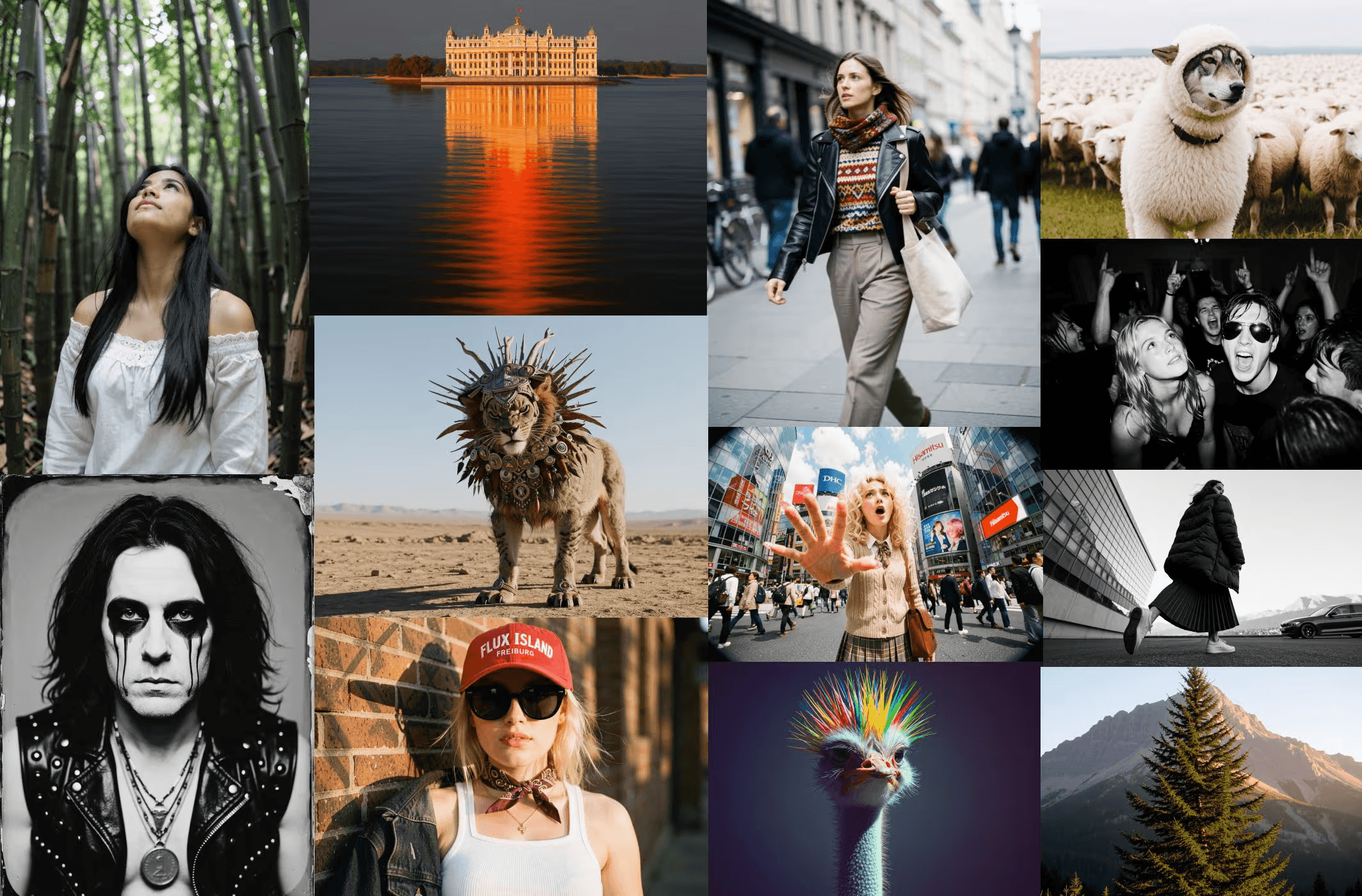
Version note: FLUX.2 was released in January 2026 by Black Forest Labs. The correct name is FLUX.2 — not "FLUX 1.1 Pro," not "FLUX 2."
FLUX.2 ships in multiple variants: FLUX.2 Pro, FLUX.2 Dev (open-source), FLUX.2 Max, FLUX.2 Flex, and FLUX.2 Klein. The Dev variant being open-source is a significant differentiator — it means technical teams can self-host, fine-tune, and integrate without per-image API costs or usage restrictions.
FLUX.2's maximum output resolution of 4MP is above the standard for most consumer tools, and its API infrastructure is purpose-built for batch workloads — making it the default choice for studios generating hundreds of variations per day.
Key Features:
- Open-source Dev variant (FLUX.2 Dev) for self-hosted workflows
- 4MP maximum output resolution
- Multiple specialized variants (Pro, Max, Flex, Klein) for different use cases
- API-first architecture for batch production pipelines
Pricing: API-based pricing varies by variant; FLUX.2 Dev is free and open-source (bfl.ai)
Limitations: No polished standalone consumer UI — best for technically comfortable users. The open-source version requires setup and hosting. Consumer output experience is less refined than Midjourney or Firefly.
Bottom Line: FLUX.2 is the power tool on this list. If you're building something, integrating image generation into an app, or need to process images at volume — this is your model. If you just want to make one great image, look elsewhere.
FLUX.2 is available on Alici AI — try it free here →
8. Ideogram 3 — Best for YouTube Thumbnails and Text-in-Image
Best For: YouTube creators, Instagram graphic designers, and anyone who needs AI-generated images with legible, styled text embedded.

Ideogram 3 occupies a very specific and very important niche: it is the best AI image generator for images that include text. Readable, correctly spelled, well-styled text within an image remains a genuine challenge for most AI models. Ideogram 3 has built a reputation specifically around solving this problem.
This makes it the top choice for YouTube thumbnails — which typically require bold, readable text overlaid on a striking visual. The market searches "AI thumbnail generator" 880 times per month; Ideogram 3 is the answer to that query.
Style modes in Ideogram 3 (Realistic, Design, General, 3D, Anime) give creators flexibility across content types, and the Magic Prompt feature helps expand and optimize user prompts automatically.
Key Features:
- Industry-leading text rendering in images
- Magic Prompt for automatic prompt enhancement
- Five style modes: Realistic, Design, General, 3D, Anime
- Strong for social media graphics, thumbnail design, product mockups
Pricing: Free (limited daily generations) | Basic $7/mo | Plus $16/mo | Pro $48/mo
Limitations: Photorealistic scenes without text are not Ideogram's strongest category — GPT Image 1.5, Nano Banana Pro, or Midjourney V7 outperform it there. Text-in-image is where it wins.
Bottom Line: If you make YouTube thumbnails, Instagram text graphics, or any content where words need to live inside the image — Ideogram 3 is the clear choice. The free tier is generous enough to evaluate it before committing.
Ideogram 3 is available on Alici AI — try it free here →
9. Grok Imagine — Arena-Verified Top-5 Performance + Exclusive Spice Mode
Best For: Creators who want benchmark-verified image quality at the best price-to-performance ratio on the market — with the added option of Spice mode for visual content no other generator will produce.
Grok Imagine is xAI's image generation model — xAI being the AI company founded by Elon Musk and backed by some of the most aggressive AI infrastructure investment in the industry. What began as a creative feature inside the X platform has become a technically serious contender in the global image generation market.
The benchmark case: In Arena.ai's Image Arena — the most credible human-preference-based image benchmark — Grok-Imagine-Image ranks #4 for text-to-image (Arena score 1,170) and Grok-Imagine-Image Pro ranks #5 for single-image editing (score 1,330). These scores surpass FLUX.2 Max and Nano Banana Pro on Arena's leaderboard.
More importantly, Arena.ai names both Grok Imagine variants as Pareto-optimal models in the $0.05–0.08/image price tier — meaning no other model at that price point achieves higher human preference scores. At ~$0.07/image via the official Grok Imagine API, this is the best-verified performance-per-dollar in the mid-price image API market as of February 2026.
The API (grok-2-image-1212 family) supports text-to-image generation, iterative image editing, custom aspect ratios, and up to 10 images per request — a full professional-grade API on par with OpenAI's and Google's offerings.
Then there's the differentiator no other competitor touches: Spice mode.
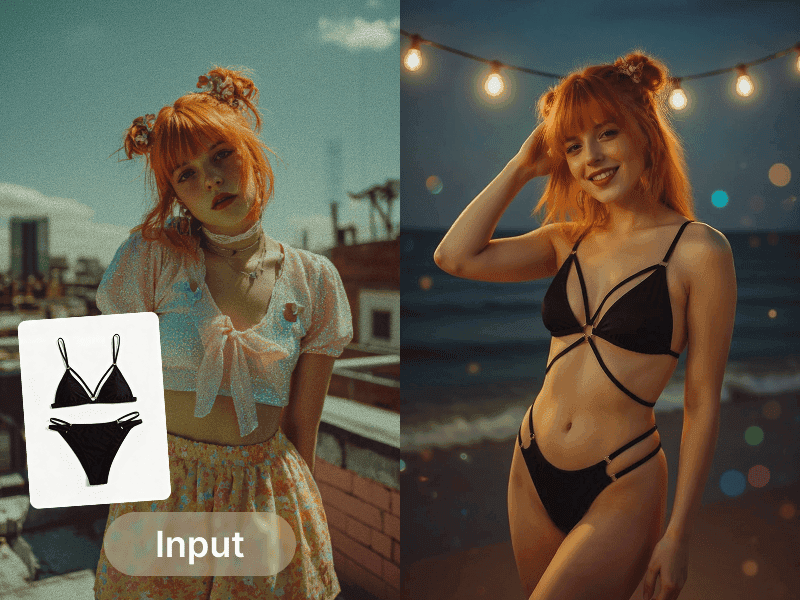
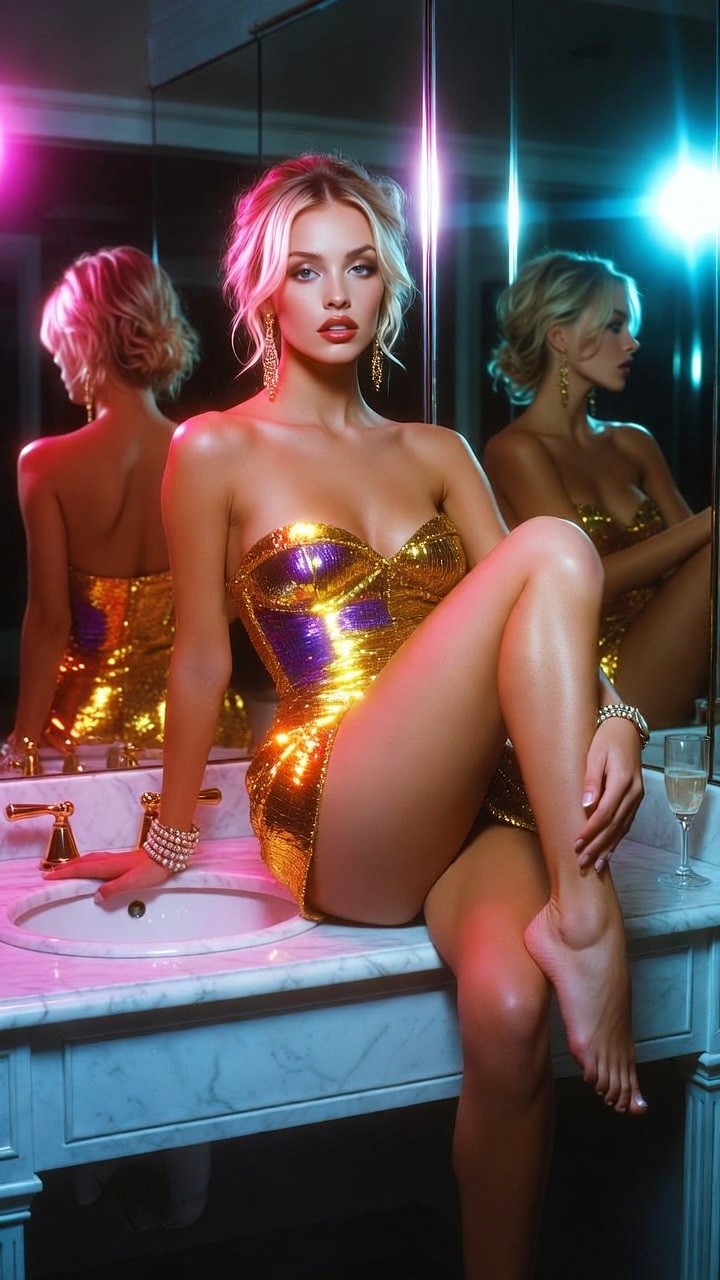
Grok Imagine is the only mainstream AI image generator with a dedicated Spice mode — enabling suggestive and boundary-pushing visuals that every other tool on this list filters out by default. Midjourney rejects it. Firefly rejects it. GPT Image 1.5 rejects it. Grok Imagine's Spice mode is a deliberate product decision: xAI built this capability for creators who work in lifestyle, fashion, boudoir, and mature visual content categories that other platforms refuse to serve.
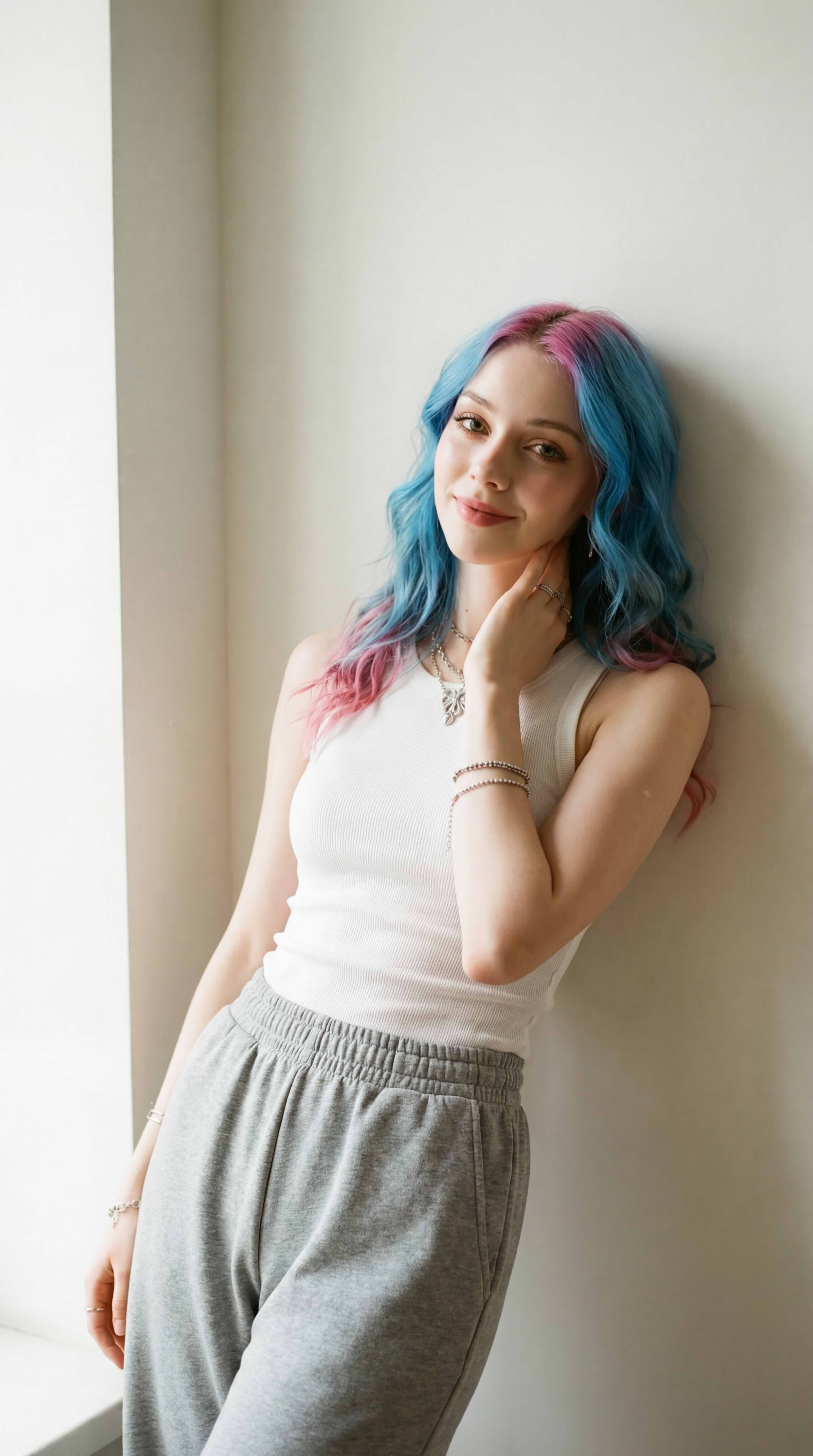
This image below was generated via Alici AI using Grok Imagine. This is the output style that defines Spice mode's creative boundary — photorealistic, suggestive, cinematically lit. No prompt engineering workaround. No third-party hack. Native capability.
Key Features:
- Arena.ai #4 text-to-image (score 1,170); #5 single-image edit (score 1,330) — verified by human preference votes
- Pareto-optimal at $0.05–0.08/image: best benchmark performance per dollar in the mid-price tier
- Exclusive Spice mode — mature/boundary-pushing visuals every other major generator declines
- Professional API: editing, custom aspect ratios, up to 10 images/request, base64 output
- 10-second video clips at 720p (Grok Imagine 1.0 update)
- Available via Alici AI — no X Premium+ subscription required
Pricing: ~$0.07/image via Grok Imagine API | Included with X Premium+ ($22/mo) | Free tier via Alici AI
Limitations: Spice mode is moderated — not full NSFW. Smaller creator community than Midjourney or GPT Image 1.5; fewer tutorials available. Full API access requires xAI API credentials.
Bottom Line: Two reasons to use Grok Imagine: (1) if you want benchmark-verified top-5 quality at $0.07/image — it's the best-value professional API in the mid-price range; (2) if your creative work requires visuals other generators refuse to produce — it's the only mainstream option. Either reason alone is enough to justify having it in your toolkit.
Grok Imagine is available on Alici AI — try it free here →
10. Seedream 5 — ByteDance's Global Top-10 Image Model, Now on Alici AI
Best For: Content creators, e-commerce teams, and designers who need reference-consistent image generation at scale — powered by the same company behind TikTok's entire creator engine.
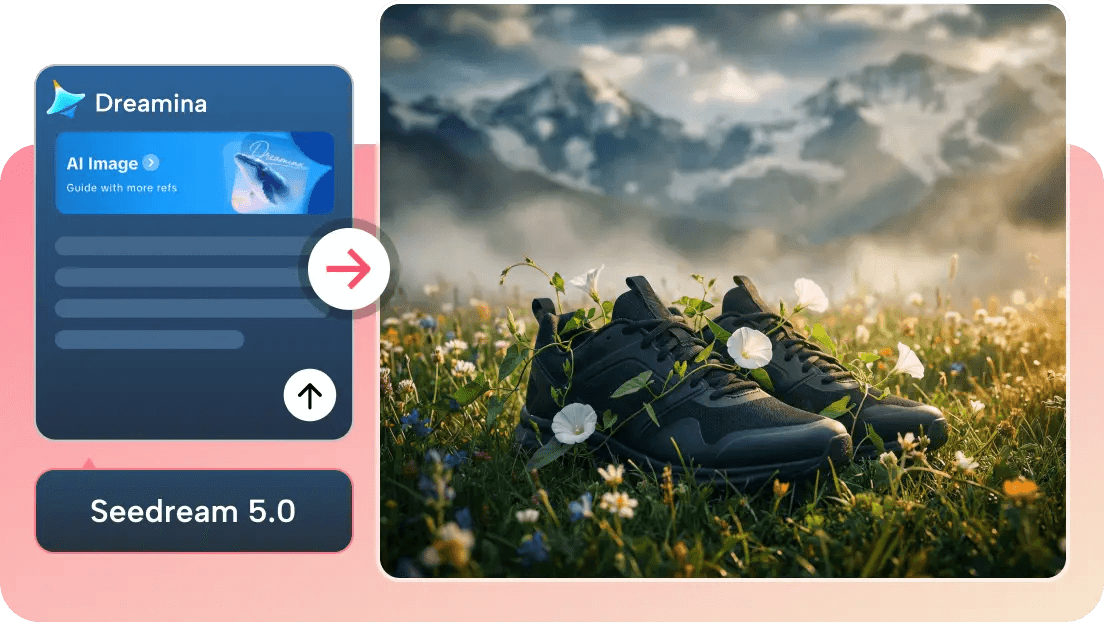
Seedream 5 is ByteDance's flagship AI image generation model. ByteDance — the company behind TikTok, Douyin, and CapCut — operates one of the largest creator ecosystems on the planet. This is not a side project: Seedream is the image generation infrastructure powering over 34 million AI-generated images per day globally (ByteDance internal data, January 2026).
The benchmark case is real. Seedream 4.5 scores ELO 1,147 on LM Arena's Image Arena — placing it in the global top 10 of human-preference-evaluated image models, with 20,022 votes providing strong statistical confidence. Seedream 5 improves substantially on that baseline, with internal MagicArena benchmarks showing Elo scores that significantly exceed version 4.5, particularly in portrait generation, knowledge-aware illustration, and complex text rendering.
What Seedream 5 does that the rest of this list doesn't match: its reference image workflow is the most capable here. Upload a reference photo — a product, a face, a brand asset — and Seedream 5 generates new images that maintain the visual identity of that reference with high fidelity. This directly competes with Nano Banana Pro's character consistency, but extends further into full image-to-image editing territory where you describe changes in plain language.
New in Seedream 5: native 4K output, physics-aware image generation (accurate materials, lighting, spatial logic), and enhanced semantic understanding that closes the gap with the global top-ranked models in complex scene composition. The model also includes web-connected knowledge integration — generating images that reflect current visual trends rather than a frozen training set.
Seedream 5 is now integrated directly into Alici AI, accessible on the free tier — no separate account required.
Key Features:
- LM Arena ELO 1,147 (Seedream 4.5, 20,022 votes — global top 10); Seedream 5 scores substantially higher
- Reference image workflow — subject, face, and brand identity consistency across generations
- Native 4K output — above the standard for most consumer image tools
- Physics-aware generation: accurate materials, lighting, spatial relationships
- Best-in-class multilingual text rendering — strongest for non-English campaigns
- Web-connected knowledge for trend-aware, real-time image generation
- ByteDance infrastructure: 34M images/day at scale
Pricing: Free via Alici AI free tier | API access via BytePlus at $0.03/image (200-image free trial)
Limitations: Seedream 5's external Arena leaderboard position is still accumulating votes (vs. 4.5's 20,022). English-language community smaller than Midjourney or GPT Image 1.5.
Bottom Line: Seedream 5 is the most underestimated model in this guide. The 34M daily image volume, ELO 1,147 baseline, and ByteDance's infrastructure investment make it a technically serious global contender — not a regional niche product. Best for reference-consistent generation, 4K output, and multilingual text. Now free via Alici AI.
Seedream 5 is available on Alici AI — try it free here →
Creator Use Case Guide
Use Case | Best Tool | Why | Free Option |
|---|---|---|---|
YouTube thumbnails | Ideogram 3 | Industry-leading text rendering; thumbnail-specific style modes | Ideogram 3 free tier |
UGC ad creatives | Nano Banana Pro | Superior face/character consistency; prompt adherence; photorealism | Via Adobe Firefly partner model |
AI influencer / character consistency | Nano Banana Pro | Maintains identity across scenes, angles, and lighting — see AI Influencer Guide | Via Adobe Firefly partner model |
Reference-based / product consistency | Seedream 5 | Upload reference → maintain subject identity across generations; strong for e-commerce | Via Alici AI free tier |
Mature / boundary-pushing content | Grok Imagine | Only mainstream generator with native Spice mode for content other tools decline | Via Alici AI free tier |
Brand graphics / commercial content | Adobe Firefly Image Model 5 | IP-safe; trained on licensed data; integrates with CC | Free credits |
Cinematic / artistic content | Midjourney V7 | Unmatched aesthetic quality; Style Reference for consistent series | None (paid only) |
Developer / API / batch production | FLUX.2 or Google Imagen 4 Ultra | Open-source Dev variant (FLUX.2); API pricing at $0.06/image (Imagen 4 Ultra) | FLUX.2 Dev (open-source); AI Studio free quota |
Beginners / first AI image | GPT Image 1.5 | Conversational refinement; no prompt syntax needed; free tier | ChatGPT free tier |
Multi-model comparison | Alici AI | Access all tools in one subscription; compare outputs side by side | Alici AI free tier |
How to Choose the Right AI Image Generator
With 10 strong options, the choice comes down to four questions:
1. What is the image for?
- Commercial use → Start with Adobe Firefly Image Model 5 (IP-safe by design)
- YouTube thumbnail → Ideogram 3 (text rendering)
- UGC ad / AI influencer → Nano Banana Pro (character consistency)
- Artistic/brand aesthetic → Midjourney V7
- Developer pipeline → FLUX.2 or Google Imagen 4 Ultra
2. How technical are you?
- Non-technical → GPT Image 1.5 (conversational) or Seedream 5 (visual reference-based)
- Technical → FLUX.2 (open-source), Google Imagen 4 Ultra (API)
- Middle ground → Any other tool on this list
3. What is your budget?
- $0 → GPT Image 1.5 (free tier), Ideogram 3 (free tier), Seedream 5 (via Alici AI free tier), Grok Imagine (via Alici AI free tier), FLUX.2 Dev (open-source), Google AI Studio free quota
- Under $10/mo → Nano Banana Pro ($7.99), Ideogram 3 Basic ($7), Midjourney Basic ($10)
- $10-20/mo → Firefly Pro ($13.39), ChatGPT Plus ($20)
- $20-40/mo → Midjourney Standard ($30)
- Flexible/enterprise → FLUX.2 API, Google Imagen 4 Ultra API ($0.06/image)
4. Do you need more than one tool?
If your answer is yes — and for most serious creators it will be — consider starting with Alici AI's free tier. It gives you access to Nano Banana Pro, FLUX.2, Midjourney V7, Ideogram 3, and more in a single interface, so you can identify which model fits your workflow before committing to individual subscriptions.
For creators who also need video content, see our companion guide: Best AI Video Generators in 2026 →
FAQ
Q: What is the best AI image generator in 2026?
There is no single "best" — it depends on use case. For UGC and character consistency: Nano Banana Pro (CNET #1, 8.0/10). For ease of use: GPT Image 1.5 (consistently rated #1 by Arena.ai and Zapier). For commercial safety: Adobe Firefly Image Model 5. For artistic quality: Midjourney V7. For thumbnails with text: Ideogram 3. For access to all of them in one place, see Alici AI.
Q: Which AI image generators are free in 2026?
The following have meaningful free tiers as of February 2026: GPT Image 1.5 (ChatGPT free tier), Ideogram 3 (limited generations/day), Adobe Firefly (free credits monthly), Grok Imagine (via Alici AI free tier), Seedream 5 (via Alici AI free tier), Google Imagen 4 Ultra (free quota via Google AI Studio), and FLUX.2 Dev (open-source, self-hosted).
Q: Is Midjourney still the best AI art generator in 2026?
For artistic and cinematic quality, yes — Midjourney V7 is still the benchmark. However, for overall ease of use, GPT Image 1.5 has overtaken it in evaluations from Arena.ai and Zapier. And for photorealistic UGC content specifically, Nano Banana Pro outperforms it according to CNET and CuriousRefuge blind tests. Midjourney V7 wins on aesthetic beauty; it no longer wins on every dimension.
Q: What is GPT-4o image generation? Is it DALL-E 4?
No. OpenAI's current image model is officially called GPT Image 1.5 (or GPT-4o image generation). The name "DALL-E 4" does not exist — OpenAI did not name it that. It is accessible inside ChatGPT and via the OpenAI API.
Q: Can I use AI-generated images commercially?
It depends on the tool. Adobe Firefly Image Model 5 is the safest option — trained exclusively on licensed and public domain content. Most other tools (Midjourney, GPT Image 1.5, Ideogram 3) allow commercial use under their terms, but the training data is broader and may carry IP risk in regulated industries. Always review the specific tool's terms of service for commercial use.
Q: What is FLUX.2 and how does it differ from FLUX 1.1 Pro?
FLUX.2 is the January 2026 release from Black Forest Labs — the successor to all previous FLUX versions including FLUX 1.1 Pro. It ships in multiple variants (Pro, Dev, Max, Flex, Klein) and introduces 4MP output resolution. The Dev variant is open-source and free to self-host. The correct name is always FLUX.2 — not "FLUX 2" or "FLUX 1.1 Pro."
Q: Which AI image generator is best for YouTube thumbnails?
Ideogram 3 is the top pick for thumbnails — it handles in-image text better than any other model, which is essential for the bold text overlays that drive YouTube CTR. For thumbnails that don't require text but need character/face consistency (e.g., a recurring host), Nano Banana Pro is the stronger choice.
Q: What is Google Imagen 4 Ultra and how do I use it?
Google Imagen 4 Ultra is Google DeepMind's highest-quality image generation model, launched June 2025. It is a separate product line from Nano Banana Pro (which is a consumer product powered by Google Gemini image technology). Imagen 4 Ultra is accessed via Google AI Studio (aistudio.google.com) or the Gemini API at $0.06 per image. It is designed for developers and enterprise users, not casual creators.
Q: What is Seedream 5 and who makes it?
Seedream 5 is ByteDance's AI image generation model — the same company behind TikTok and Kling. It is now accessible directly via Alici AI (alici.ai), making it easy to test without a separate sign-up. The model is particularly strong at reference-based image generation: you upload a reference photo and Seedream 5 generates new images that maintain the visual identity of that reference. It also supports instruction-based image editing, text rendering across multiple languages, and web-connected knowledge for trend-aware generation. Try it free via Alici AI; API access via BytePlus at $0.03/image.
Q: Is there one platform that gives me access to all AI image generators?
Yes — Alici AI (alici.ai) is a platform integrator that provides access to Nano Banana Pro, FLUX.2, Midjourney V7, Ideogram 3, GPT Image 1.5, Adobe Firefly, Google Imagen 4 Ultra, and more in a single subscription. Beyond model access, Alici AI includes purpose-built Agent workflows for each model — so you don't need prompt engineering experience to get professional-grade output immediately.
Final Verdict
The AI image generation landscape in 2026 is more fragmented and more capable than ever. There is no single "best" tool — but there are very clear winners by category:
#1 for UGC & character consistency: Nano Banana Pro
#1 for ease of use: GPT Image 1.5
#1 for commercial safety: Adobe Firefly Image Model 5
#1 for artistic quality: Midjourney V7
#1 for thumbnails & text-in-image: Ideogram 3
#1 for developers: FLUX.2 (open-source) or Google Imagen 4 Ultra (API)
#1 for reference-based / subject consistency: Seedream 5 — ByteDance's model (ELO 1,147, global top 10, 34M images/day), native 4K, best multilingual text. Free via Alici AI
#1 for creative boundaries + price-performance: Grok Imagine — Arena #4 text-to-image (1,170), Pareto-optimal at $0.07/image, and the only generator with native Spice mode
Most underrated in 2026: Google Imagen 4 Ultra — zero competitors cover it, yet it produces enterprise-grade output at $0.06/image
Best "try before you decide": Start with Alici AI's free tier — test Seedream 5, Grok Imagine, Nano Banana Pro, and more in one place without committing to multiple subscriptions
The real trap is picking one tool and staying loyal to it when your use cases require different strengths. The smartest approach in 2026 is knowing which model to reach for, based on what you're creating.
Stop paying for four separate AI image tool subscriptions.
Alici AI gives you access to Nano Banana Pro, Midjourney V7, FLUX.2, Ideogram 3, GPT Image 1.5, and more — all in one subscription, with purpose-built Agent workflows that make every model immediately usable.
Last updated: February 21, 2026. Tool versions, pricing, and benchmark rankings reflect publicly available information as of this date. Pricing and features may change — verify with each tool's official site before purchasing.
🎁
Limited-Time Creator Gift
Start Creating Your First Viral Video
Join 10,000+ creators who've discovered the secret to viral videos