How feedthekittys Made This Black Haired Red Jacket Portrait — and How to Recreate It
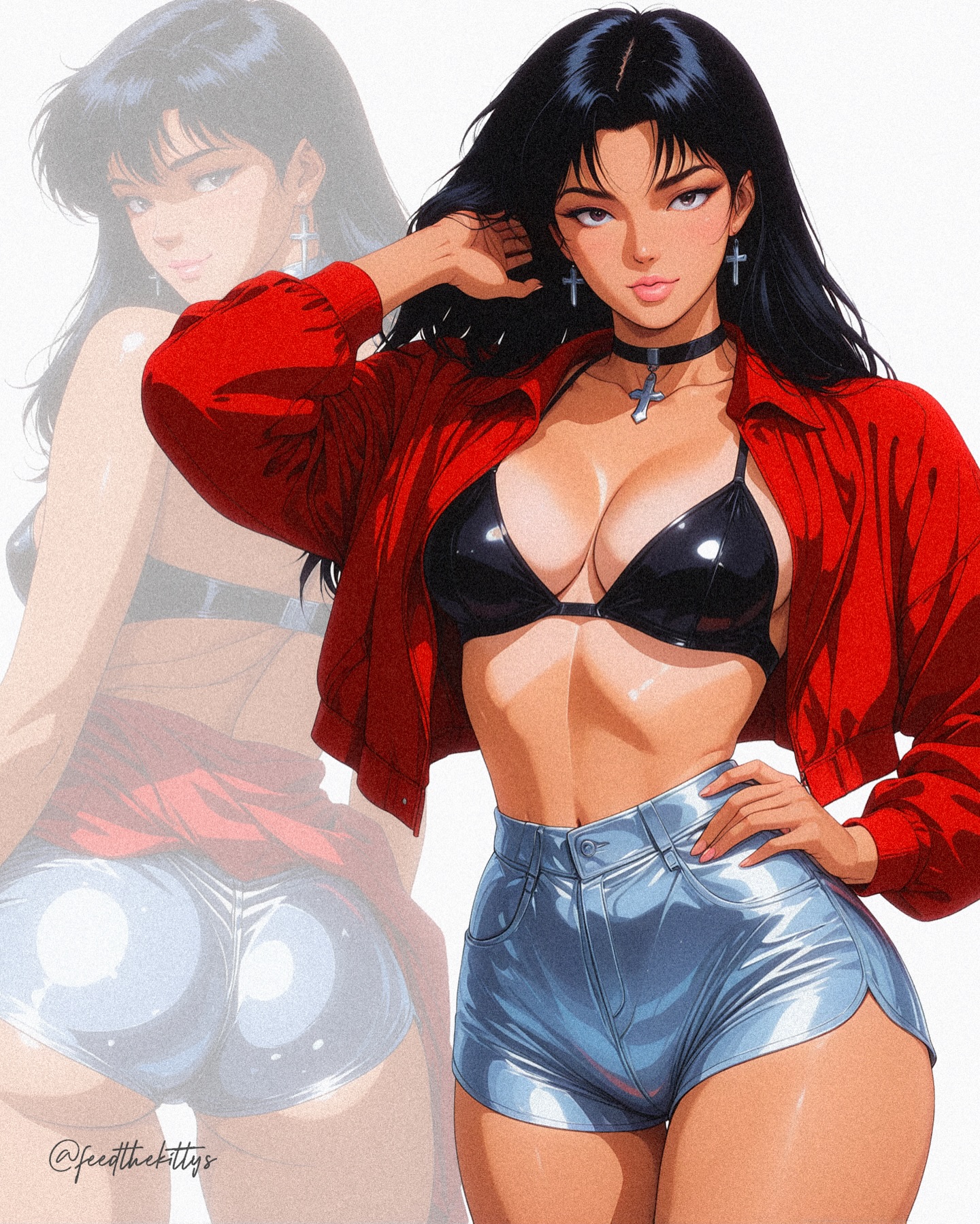
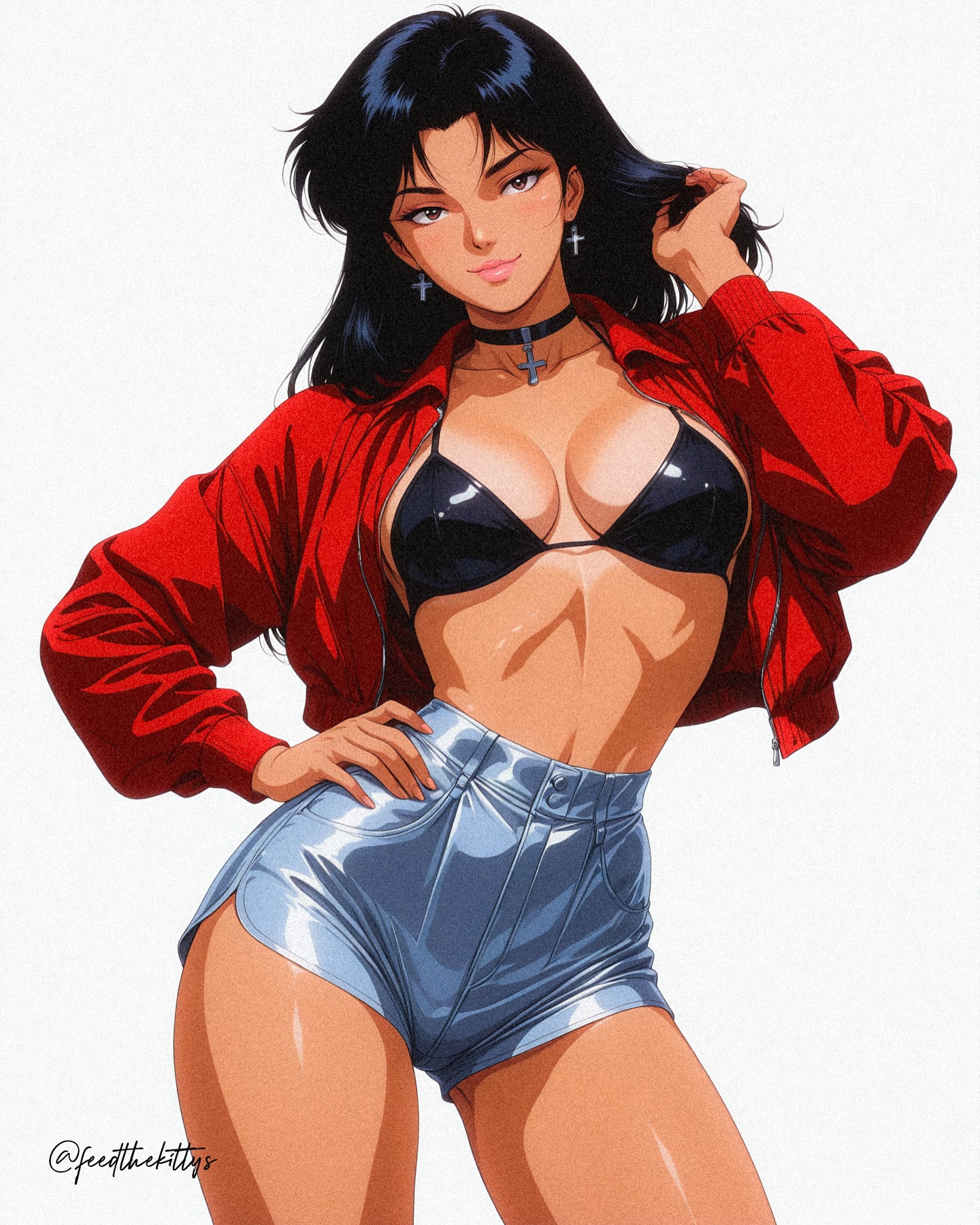
This poster works because it treats character styling and print composition as equally important. The black-haired woman in the foreground is already visually strong: red cropped jacket, glossy black top, metallic pale-blue shorts, cross jewelry, and a poised, self-assured pose. But what elevates the image beyond a normal character portrait is the faded duplicate figure behind her. That layered background treatment turns the piece into a designed poster instead of a simple fashion illustration. The result feels closer to a 1990s anime print, beauty campaign insert, or collectible poster than a basic full-body character render.
The image is effective because every major signal is doing two jobs at once. The red jacket is both a style choice and a compositional accent. The metallic shorts are both wardrobe and material contrast. The white background is both negative space and a framing device. The ghosted duplicate is both echo and structure. This kind of multi-function design is what makes a poster feel premium. There is no waste in the image. Each element contributes to visual identity, layout balance, and aesthetic tone simultaneously.
Another reason the piece works is that it understands restraint. There is no environment clutter, no complicated scenery, and no action sequence trying to justify the character’s presence. Instead, the poster lets styling, pose, and graphic repetition carry the image. That is a very effective strategy in glamour-oriented anime design. A print can feel expensive not because it contains more, but because it arranges a few strong ingredients with confidence.
Why the Ghosted Duplicate Figure Is So Important
The faded background figure is not decorative filler. It is the core layout move that transforms the image into poster design. Without it, the composition would still present a stylish character, but it would feel much flatter and more expected. With it, the image gains hierarchy, rhythm, and a sense of print intelligence. The viewer sees the character twice in two visual modes: once as the primary presentational pose, and once as a softer compositional shadow. That creates the illusion of graphic sophistication without needing extra props or scenery.
This approach works particularly well in fashion-poster style images because it mimics editorial print language. Magazine covers, promo cards, and retro advertisements often use echoes, repeats, tinted overlays, or alternate-angle portraits to make a single subject feel more designed. In prompt terms, asking for a faded oversized duplicate of the same character is a very efficient way to create that feeling. It adds interest without splitting focus.
The duplicate also supports the emotional tone of the poster. Because it is softly faded and placed in the background, it reads like a memory, a print shadow, or a designer’s compositional layer rather than a separate person. That distinction matters. If the second figure were too sharp, it would compete with the main subject. The success of this image depends on preserving the duplicate as a supportive echo rather than as a second character.
| Layout decision | Visual effect | Prompt advantage |
|---|
| Ghosted duplicate portrait | Adds depth and layered print energy | Makes the image feel designed rather than merely posed |
| White negative space | Creates room for styling and silhouette to breathe | Prevents the poster from becoming visually crowded |
| Large faded scale on background figure | Creates hierarchy between foreground and echo | Keeps the focus on the main subject |
| Rear three-quarter alternate angle | Introduces variation without adding a new character | Expands the sense of design complexity efficiently |
How the Color Palette Creates Immediate Impact
The red, black, and icy metallic blue palette is one of the strongest features of the poster. These colors do not fight one another. Instead, they form a compact visual identity. The red cropped jacket gives the image heat and motion. The black top and hair anchor the figure and prevent the palette from becoming too bright. The pale metallic shorts add a synthetic sheen that pushes the design toward retro glam. Because the background remains white and uncluttered, the palette stays crisp and highly legible.
This kind of limited palette is a powerful prompt lesson. Many weak glamour illustrations try to achieve energy by stacking too many saturated colors. That usually makes the result feel noisy or directionless. Here, the palette works because each color has a clear function. Red is the accent. Black is the structure. Metallic blue is the stylized finish. White is the clean frame. When each color has a job, the image feels deliberate.
The metallic shorts are especially important because they prevent the character from feeling like a standard red-and-black outfit study. The reflective blue adds a subtle futuristic pop and introduces a different surface response to light. That change in material behavior keeps the lower half of the character visually active. It also helps the image read as glam print rather than as everyday fashion.
Fashion Identity and Character Styling
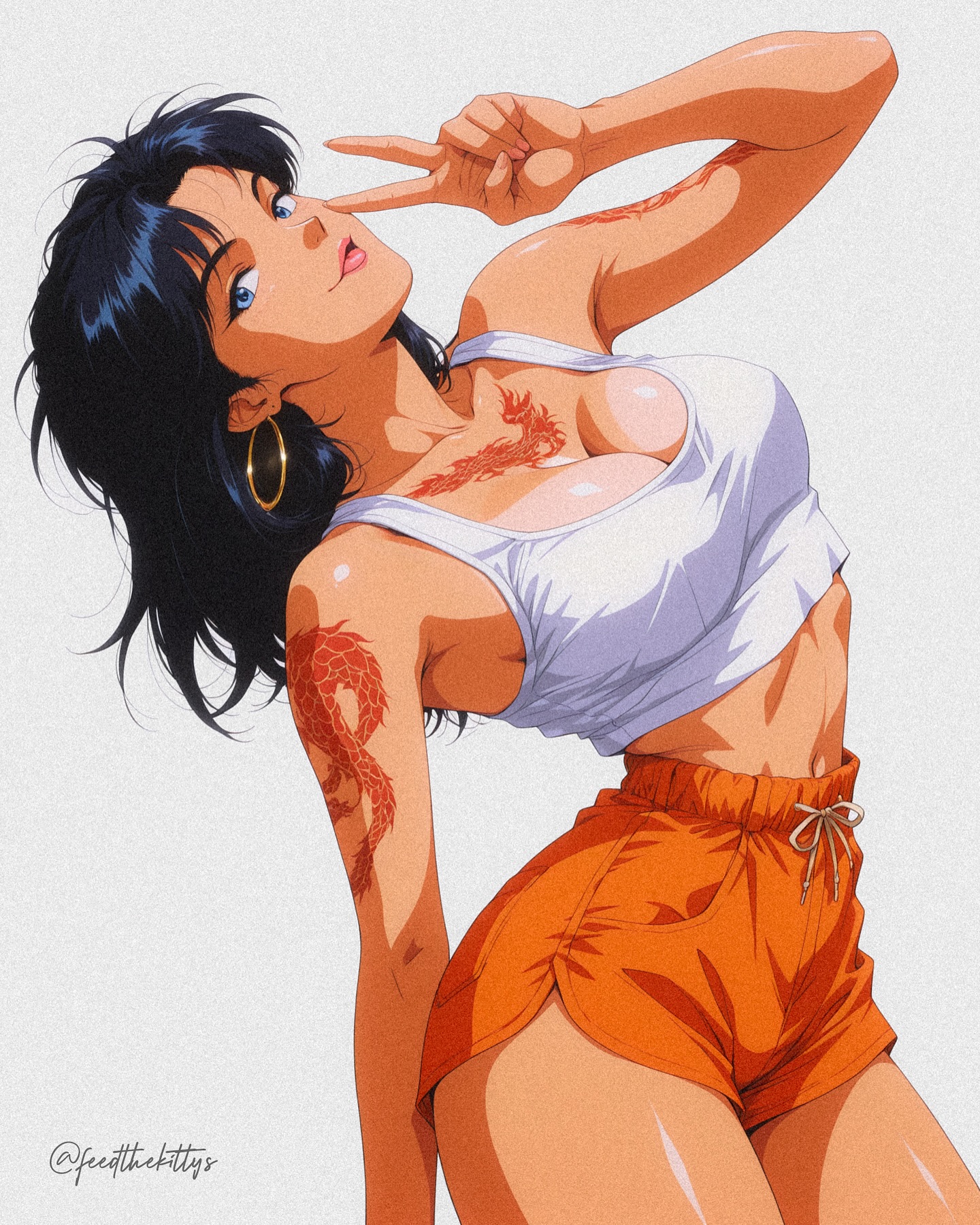
The character styling is memorable because it combines recognizable glamour cues with a touch of attitude. Long black hair, smoky eye makeup, cross jewelry, and a cropped jacket create a strong identity without overloading the frame. The styling feels specific enough to be iconic, but not so detailed that the composition loses clarity. This is exactly the right balance for poster work.
The cross earrings and choker are also doing more than accessorizing. They create recurring motifs that bind the image together. Repetition of shapes and symbols is one of the easiest ways to strengthen design coherence. By echoing the cross form in multiple places, the image gains a stronger visual personality. This is useful for prompt writers to remember: recurring motif details can make a character feel branded without needing elaborate costume complexity.
The pose supports the styling well. One hand resting at the hip and the other near the hairline creates a silhouette that feels fashion-aware and lightly performative, but not stiff. That kind of pose belongs naturally to print culture. It suggests self-possession rather than action. In a poster built around visual identity, that is usually much more valuable than dramatic movement.
| Styling cue | What it adds | Why it helps the poster |
|---|
| Long glossy black hair | Adds shape and elegance around the face | Balances the bold clothing colors with softness |
| Cross jewelry | Creates motif repetition and attitude | Makes the character feel more iconic and branded |
| Red cropped jacket | Supplies a dominant fashion accent | Gives the composition visual energy immediately |
| Metallic pale-blue shorts | Introduce futuristic glamour and reflective interest | Prevent the lower half from becoming visually flat |
Why the White Background Matters
It is easy to underestimate the role of the white background, but it is fundamental to the success of the poster. White negative space turns the entire composition into a print object. It gives the subject room to stand clearly, allows the faded duplicate to remain readable, and prevents the styling from drowning in unnecessary context. This is how the image achieves clarity. The background does not tell a story. It creates a stage.
In prompt design, clean white poster backgrounds are especially useful when the goal is to showcase outfit, linework, and composition. They shift the emphasis away from environmental realism and toward design logic. This can be very effective for poster-oriented assets, because it makes the result look polished and reproducible. It also mirrors the look of collectible print media, character promo cards, and magazine inserts.
The white backdrop also gives the metallic shorts and glossy black top more impact. Reflective materials often need a clean tonal field around them to read clearly. If the background were busy, the highlights would become harder to interpret. By keeping the background minimal, the poster makes every garment finish easier to see and appreciate.
Prompt Design Lessons from This Image
This image teaches several durable prompt lessons. First, character styling and layout design should be written separately. One controls what the subject is, the other controls how the subject is presented. Second, a duplicate figure can create sophistication when used as a soft echo rather than a competing subject. Third, limited palettes feel stronger when each color has a defined function. Fourth, a white background can be a deliberate design choice rather than a lack of imagination. These lessons are especially useful for creators building prompt-share posters, anime fashion art, and visual branding assets.
Another important lesson is that glamour works best when it remains readable. Every element here is clear at a glance: jacket, top, shorts, jewelry, pose, duplicate figure. There are no ambiguous costume layers and no unnecessary scene details. This readability is why the image feels professional. It does not ask the viewer to decode chaos. It offers a focused visual idea and executes it cleanly.
- Describe the subject styling and the poster layout as separate parts of the prompt.
- Use a ghosted background duplicate to create print depth without splitting attention.
- Keep the palette limited and assign each color a clear role.
- Use recurring motifs such as jewelry shapes to strengthen the character identity.
- Reserve white negative space so the composition feels collectible and polished.
- Direct the pose toward fashion confidence rather than exaggerated motion.
Why This Works as a Prompt Share Reference
As a reference piece, this poster is valuable because it shows how a single character can carry an entire print design through layout logic alone. There is no need for a cityscape, a fantasy battle, or a large cast. The image builds poster quality from repetition, contrast, and controlled styling. That makes it an excellent example for creators who want to learn how to make character art feel premium without relying on oversized environments.
It also demonstrates the difference between illustration and presentation. A character drawing can be attractive on its own, but a poster requires hierarchy, rhythm, and design intention. The faded duplicate, white space, and restricted palette are what push this piece into poster territory. That distinction is useful for prompt writers who want to create assets that feel publishable rather than merely decorative.
Ultimately, the image works because it knows what it wants to be. It is not trying to tell a big narrative or build a world. It is trying to present a memorable, stylish anime character in a retro glam print format. Every decision supports that aim. That kind of coherence is one of the clearest signs of strong prompt design.