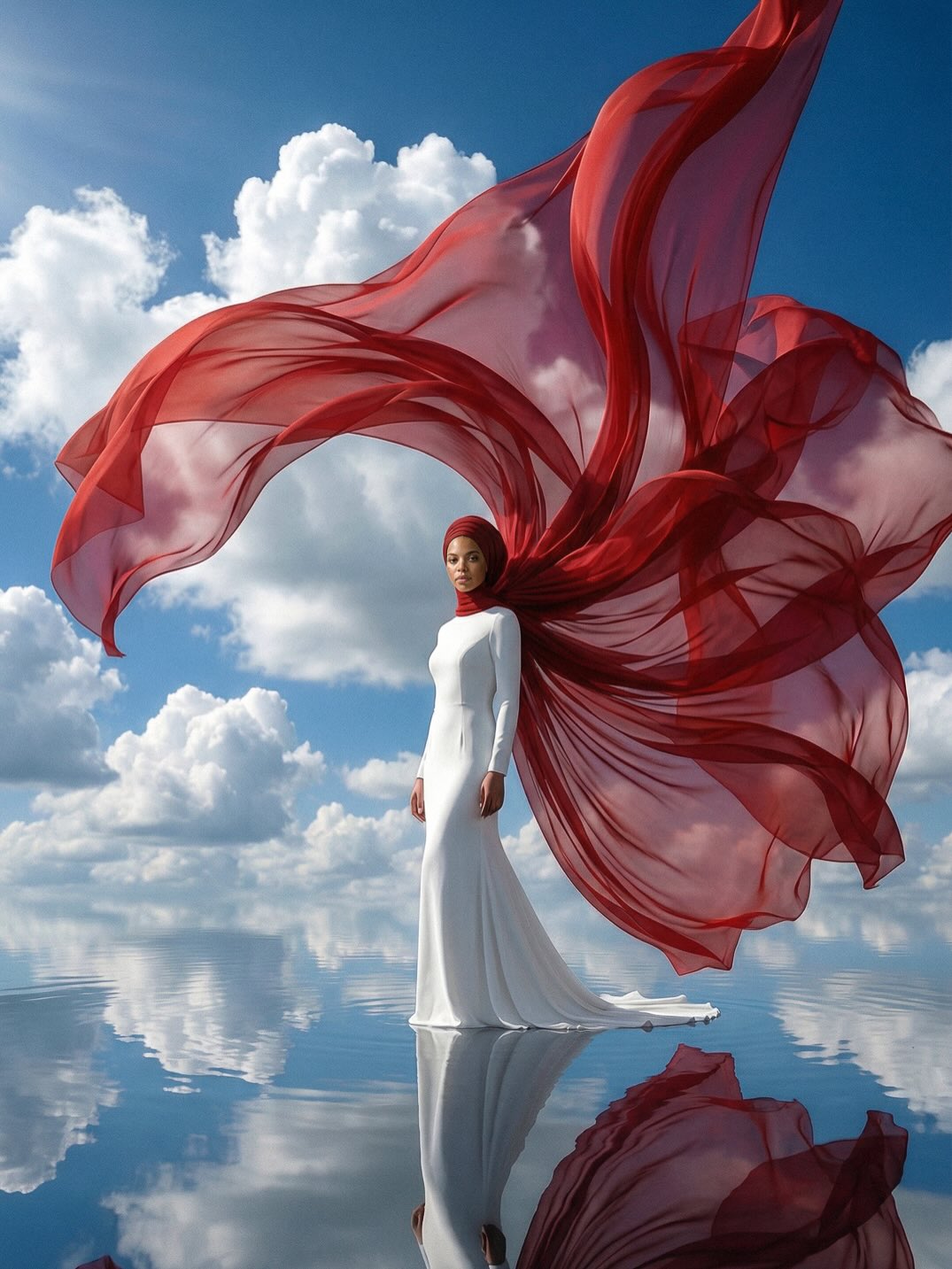
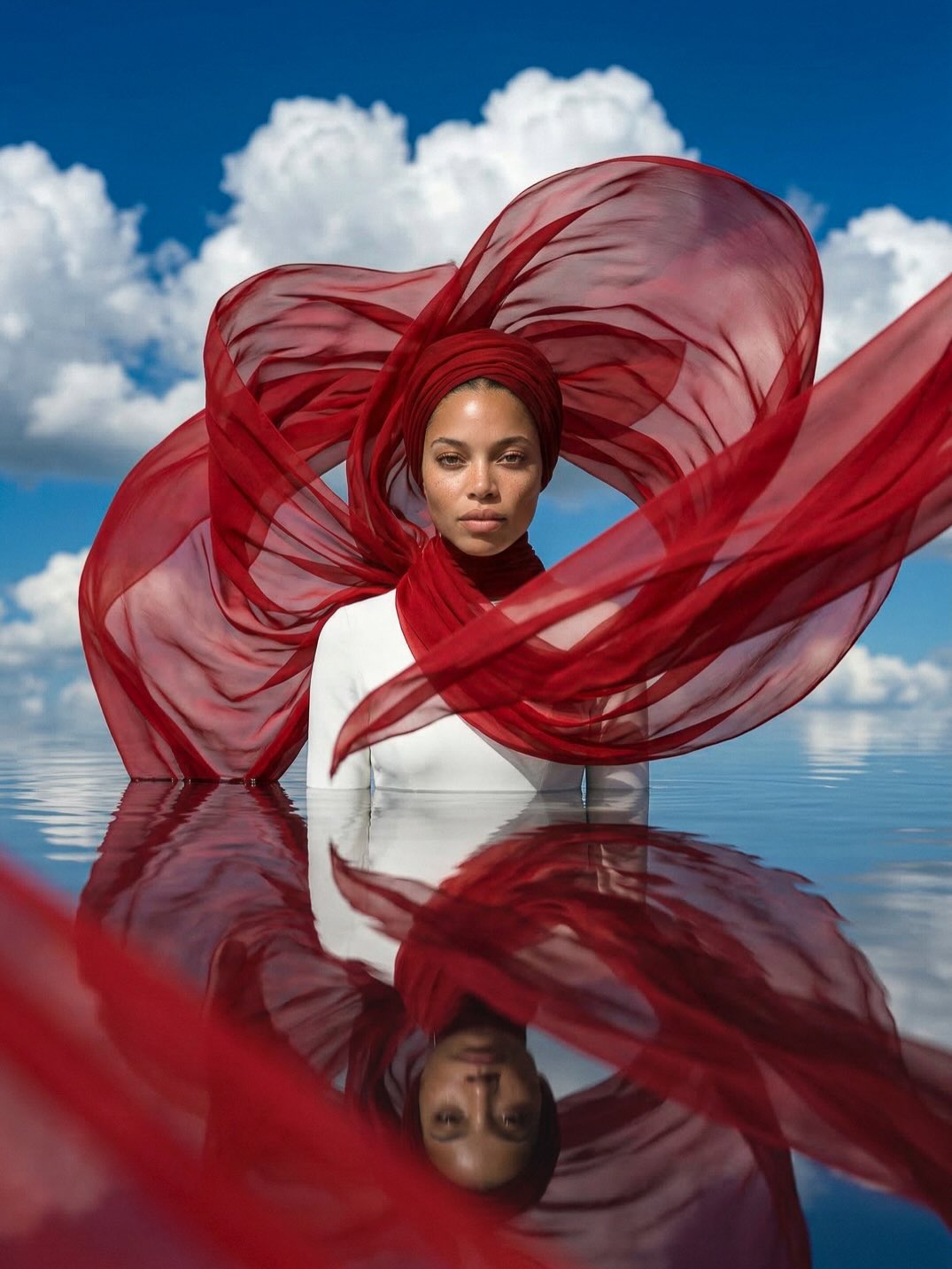
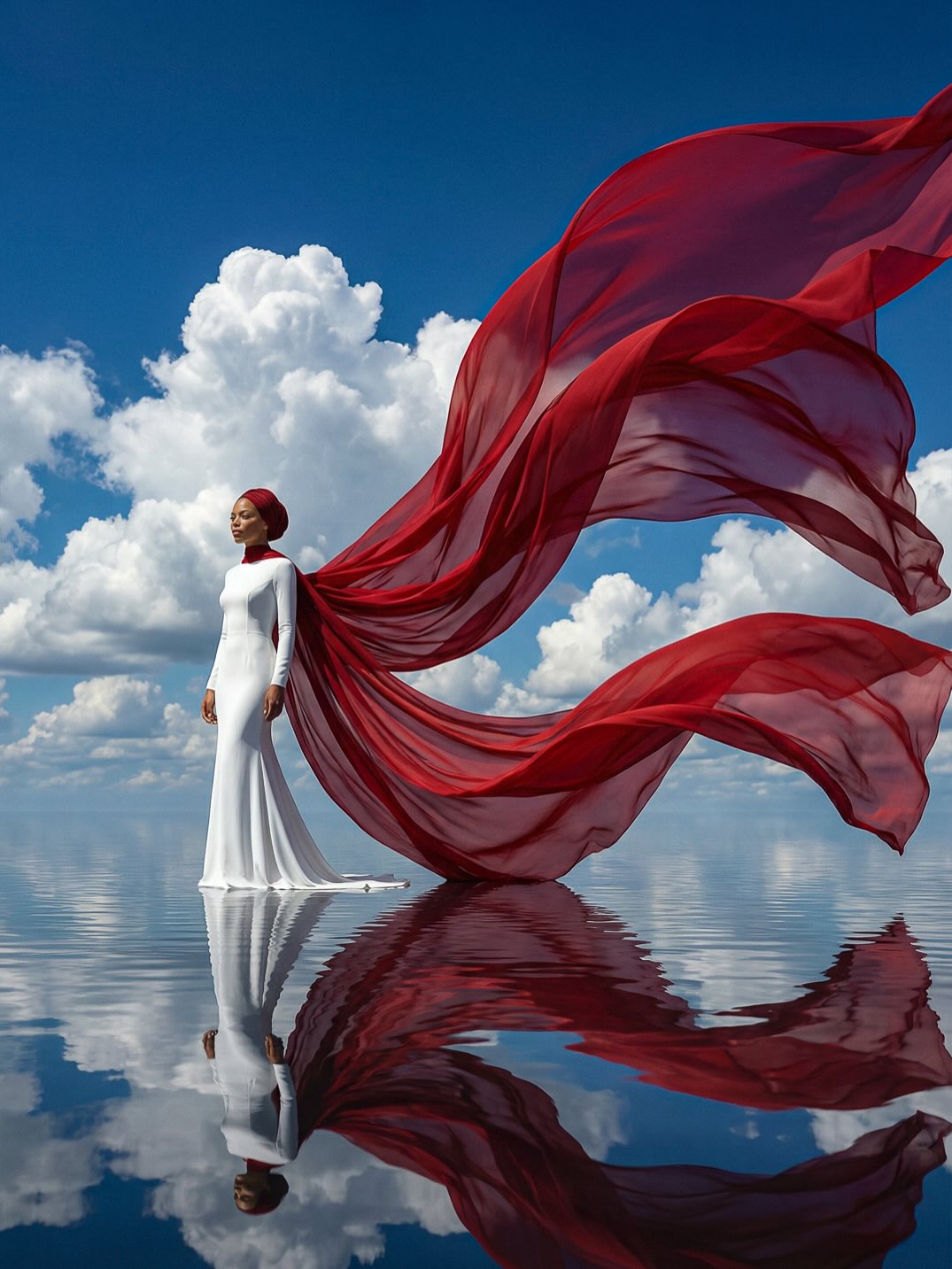
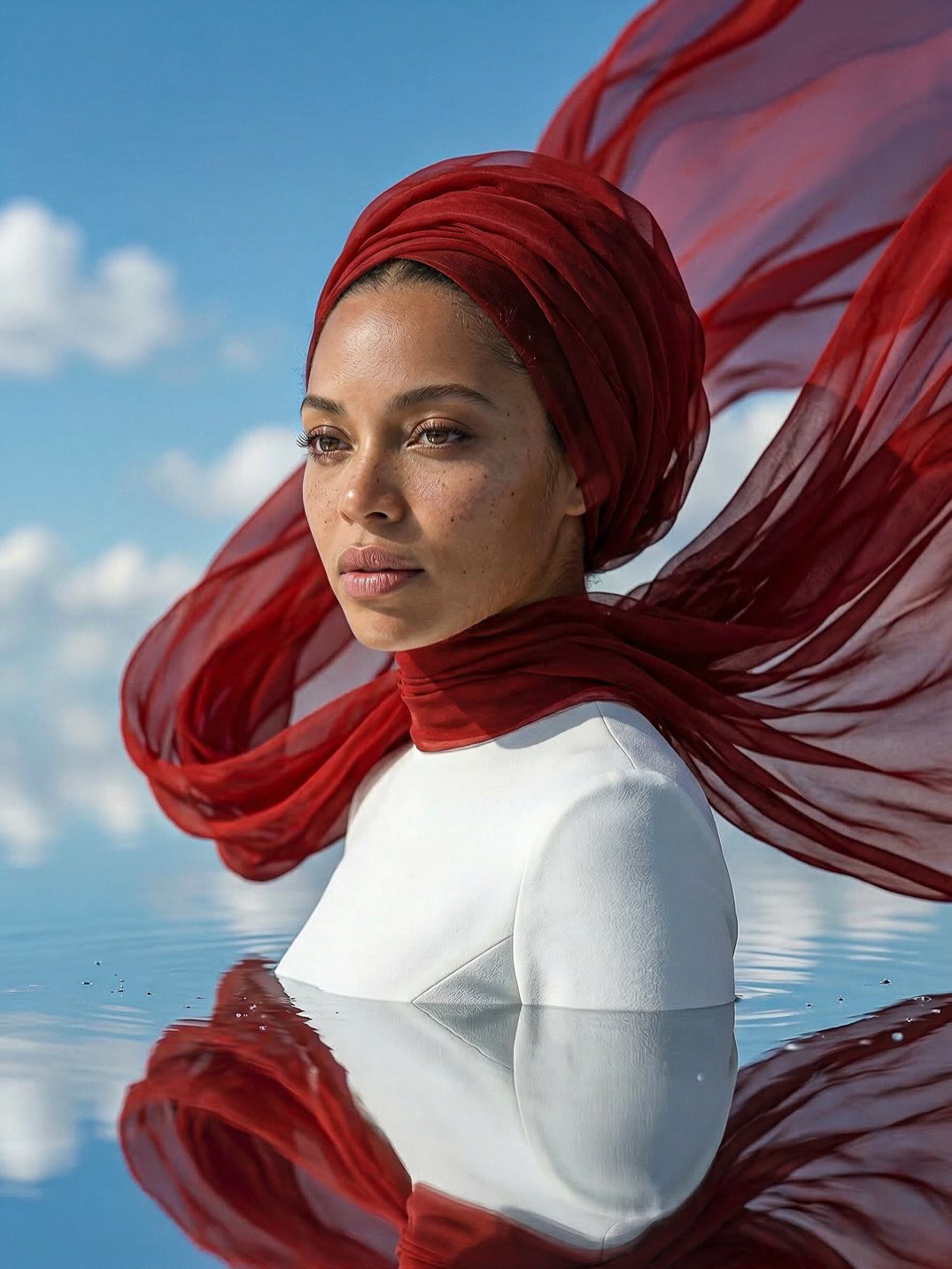
67/365 Salt flat fashion without the mess. It’s amazing how far we have come with Ai video in two years. To imagine that we will actually shoot something like this in five years seems sadly very unlikely. I hate that Ai is destroying an industry I spent my entire life climbing the career mountain only to find a ski lift at the top. Why do I use Ai if it’s so bad, I just don’t see a pathway forward where Ai does not consume production. My suggestion is that all creatives find a way to amplify their vision and process with Ai or risk being consumed by its power. There is no way to put the genie back in the bottle…
How timtadder Made This Mirror Water Fashion Editorial AI Art -- and How to Recreate It
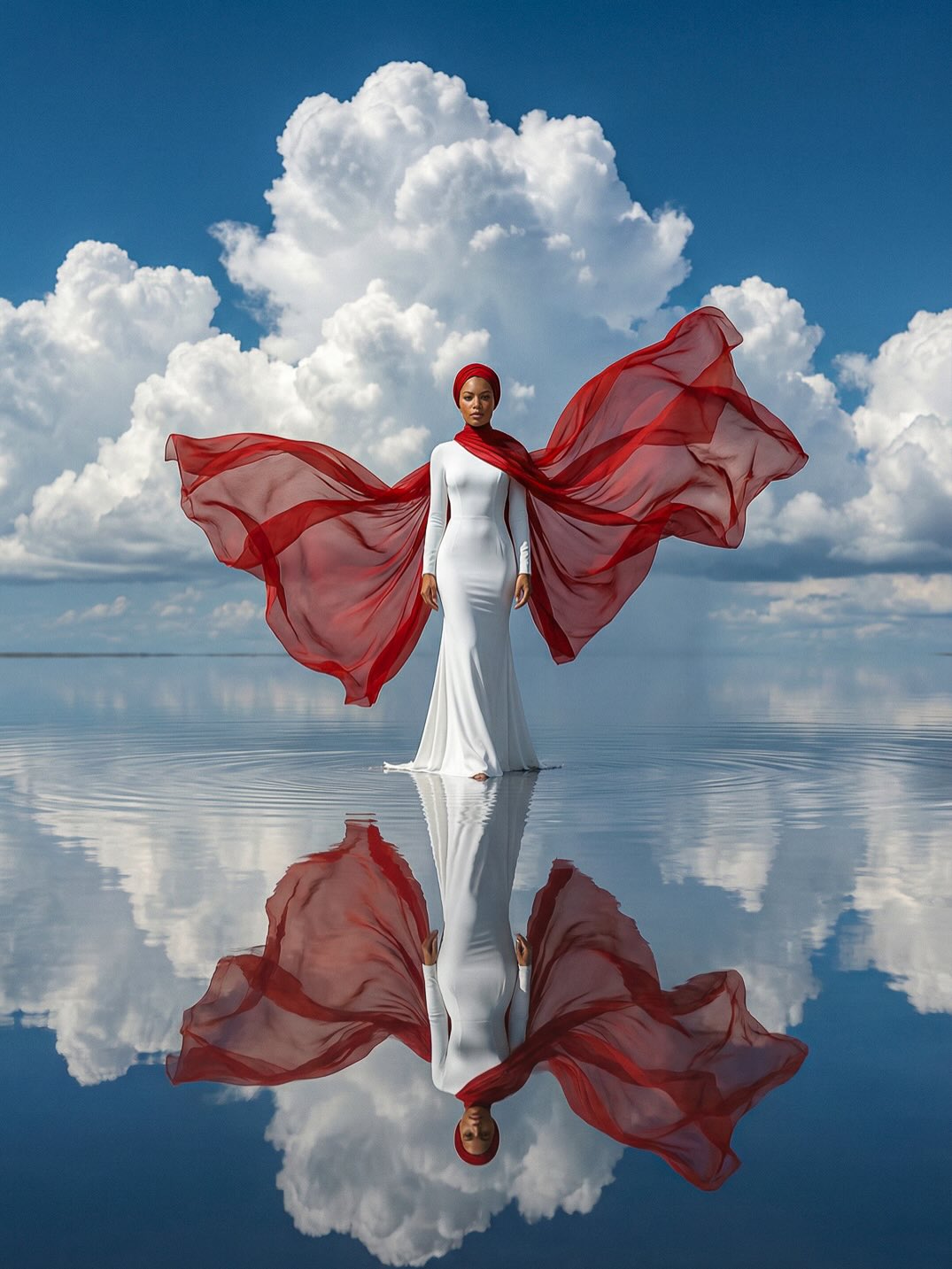
This image works because it makes restraint look expensive. There is no crowd, no prop stack, no overloaded styling brief. Instead, it bets everything on a few perfectly chosen signals: a white column dress, a red translucent textile, a body held still, and a reflection so clean it feels almost unreal. The result is the kind of frame that reads instantly at thumbnail size and then keeps paying off as you stare longer.
What really gives it traction is the balance between calm and spectacle. The subject is almost motionless, but the chiffon behaves like a burst of movement. The color system is brutally simple, but the scale of the clouds turns that simplicity into theater. This is one of the strongest growth lessons in visual creation: you do not always need more ingredients. Sometimes you need fewer ingredients with much stronger visual jobs.
Why it catches people so fast
The first hook is graphic clarity. White dress in the center, red fabric breaking outward, blue sky above, mirrored sky below. That is a read anyone can process in a split second. The second hook is controlled unreality. The image looks photographic, yet the still water, the perfect cloud massing, and the wing-like fabric spread all nudge it into dream space. That combination creates the “wait, hold on” effect that drives pauses and repeat looks.
The third hook is emotional ambiguity. The frame is not smiling, busy, or loudly narrative. It feels ceremonial, almost sacred. That gives viewers room to project their own meaning onto it. Some will read it as fashion. Some will read it as spirituality. Some will read it as pure design. Images that leave interpretive room often travel further because more people can attach their own language to them in comments and shares.
Signal
Evidence (from this image)
Mechanism
Replication Action
Graphic simplicity
One centered figure, one white dress, one red fabric gesture, one clean sky-water split
The eye understands the concept immediately, which is critical for feed performance
Reduce your image to 2-3 dominant visual shapes and make each one high contrast
Controlled surrealism
Mirror-flat water and nearly perfect full reflection under monumental clouds
Photographic realism mixed with impossible cleanliness creates rewatch value
Use one believable world plus one over-perfected environmental behavior such as reflections or symmetry
Color discipline
Red textile against white dress, blue sky, and neutral skin tones
Limited palette makes the frame memorable and premium rather than noisy
Lock one accent color and let the rest of the scene stay quiet
Stillness versus motion
The subject remains statuesque while the chiffon expands outward like wings
Tension between body stillness and fabric movement adds elegance without chaos
Keep the body pose simple and let only one garment element perform the movement
Best-fit use cases and smart transfers
This visual approach is especially strong for personal brand campaigns, spiritual-fashion hybrids, beauty editorials, luxury portrait concepts, and announcement posts that need a “moment” rather than a story sequence. It also works well for AI creators building signature aesthetics because the structure is easy to remix without losing recognizability.
Personal brand hero image: ideal because the centered composition makes the subject feel iconic; change the fabric color to match the brand but keep the mirror-water setup.
Editorial fashion launch: strong fit because the dress-and-textile contrast feels premium; adjust the cloud density or garment finish, but preserve the low horizon and symmetry.
Wellness or spiritual campaign: strong fit because the image already carries calm ritual energy; soften the red slightly and keep the still pose.
Music cover or poster visual: strong fit because the reflection adds poster-like authority; tighten the crop a little while preserving the vertical central axis.
It is less effective for product demos, lifestyle relatability, or scenes that need social warmth and everyday realism. The frame is too purified for that. It belongs to symbolic storytelling, not practical explanation.
Three transfer recipes
Keep: centered symmetry, mirror reflection, still body posture. Change: red chiffon to metallic gold organza, blue sky to dusk lavender sky. Slot template (EN): “{single centered subject} standing in {reflective shallow water}, wearing {minimal gown}, wrapped in {flowing accent fabric}, under {monumental cloudscape}”.
Keep: white base garment, low horizon, giant atmospheric background. Change: open sky to cathedral fog or salt desert heat haze. Slot template (EN): “{hero subject} in {minimal landscape} with {one dramatic color accent} and {perfect reflection or symmetry}”.
Keep: serene expression, body stillness, one major moving textile. Change: human styling to bridal, performance, or ceremonial styling. Slot template (EN): “{ceremonial fashion subject} posed still in {clean reflective environment}, with {sheer fabric motion} and {high-end editorial realism}”.
The aesthetic lesson hiding inside the image
The power of this image starts with shape language. The dress is a narrow vertical column. The clouds are massive rounded volumes. The chiffon slices laterally across the frame. Those three shape families keep the image from feeling flat. When creators talk about “making it more cinematic,” they often add objects. Here, the stronger move is geometric. It is about building a conversation between vertical, horizontal, and circular forms.
The second lesson is transparency. The red textile is not just decorative color. Because it is sheer, it lets light travel through it, which makes the image feel airy instead of heavy. That transparency is what keeps the red from becoming aggressive. It stays dramatic, but elegant. This matters in prompting: material behavior is often more important than naming the object itself.
The final lesson is silence. There is almost nothing in the frame that competes with the subject. The environment is huge, but not crowded. The clouds are dramatic, but clean. The water is reflective, but calm. Silence in the background is what lets the red move feel so loud.
Observed
Why it matters for recreation
Centered full-body stance on a strict vertical axis
This gives the image authority and keeps the fashion pose from feeling random
Sheer red fabric forms wide wing-like lateral shapes
It creates motion without needing a moving subject
Huge cumulus clouds occupy most of the upper frame
They provide scale and grandeur while keeping the palette clean
Mirror-flat reflection echoes the entire scene below
This doubles the visual impact and increases replay value
Only one strong accent color appears in the styling
Color discipline is the reason the frame feels premium rather than busy
Prompt technique breakdown
To build this image class consistently, write the prompt like a control panel. Give each sentence one responsibility: figure, fabric, landscape, reflection, and light. That structure makes iteration much cleaner than trying to rewrite the whole mood every time.
Prompt chunk
What it controls
Swap ideas (EN, 2–3 options)
single centered woman in a fitted white gown
Subject count, silhouette, elegance level
“single centered model in a white column dress”; “one statuesque woman in a minimal ivory gown”; “single fashion subject in a sleek ceremonial dress”
sheer crimson chiffon extending outward like wings
Lock three things first: the exact centered composition, the reflection quality, and the one-accent-color palette. Those are the bones. If one of those slips, the image may still be pretty, but it will not carry the same authority.
After that, follow the one-change rule. Change only one or two knobs at a time.
Run 1: lock the centered standing pose, mirror water, giant clouds, and red fabric spread. Ignore micro-texture at first.
Run 2: keep composition fixed and refine only materials: cleaner chiffon transparency, sharper gown folds, smoother reflection.
Run 3: keep wardrobe and pose fixed, then tune atmosphere: brighter clouds, deeper blue sky, subtler ripples.
Run 4: test one controlled variation only, such as changing red to gold, or changing clouds to fog while preserving the same visual grammar.
Quick creator note
If you want this kind of image to travel, do not clutter it. Let one color do the emotional work, let one garment create the motion, and let the environment stay clean enough to feel expensive.