Nanami Kento AI Generator
Nanami is one of the cleanest Jujutsu Kaisen character routes when you want mature styling, sharper fashion cues, and a calmer kind of authority. The suit, tie, blond hair, and blunt weapon give creators a very different visual lane from louder JJK pages, which is why Nanami usually works best in polished portraits, restrained battle art, and edits that lean on presence instead of chaos. This page is organized around the Nanami looks creators actually use: suit-led portraits, serious character shots, office-coded styling, battle-ready stills, and darker clean edits. Decide whether you want businesslike control or fight-ready pressure first, then build the prompt around suit detail, expression, lighting, and stance.
GLOBAL LOCK: Realistic 3D CGI anime characters from Jujutsu Kaisen, high-fidelity skin textures, visible hair strands, accurate costume materials, athletic builds, pure white minimalist studio background, high-key studio lighting, soft shadows, cinematic motion blur, 4k resolution, fluid human-like dance choreography.

[00:00–00:02]
Subject: Gojo Satoru, white spiky hair, pale skin, wearing a black high-neck tactical jacket and black trousers.
Action: Performing a fluid dance move, swinging arms rhythmically, smiling slightly.
Framing: Medium shot, center composition.
Camera: Static, eye-level.
Lighting: Bright white background, soft rim lighting on hair.

[00:02–00:04]
Subject: Itadori Yuji, pink spiky hair, wearing a dark blue school uniform with a prominent red hoodie.
Action: Energetic hip-hop style dance, bouncing with the beat, determined expression.
Framing: Medium shot, slight forward zoom.
Camera: Subtle push-in.
Lighting: Neutral studio light, highlighting the texture of the red hoodie.

[00:04–00:05]
Subject: Geto Suguru, long black hair tied in a half-up bun, wearing dark blue traditional monk-style robes.
Action: Smooth, rhythmic swaying of the torso and arms.
Framing: Medium shot.
Camera: Static.
Lighting: High contrast to emphasize the folds in the dark robes.

[00:05–00:06]
Subject: Toji Fushiguro, muscular build, short black hair, wearing a tight black t-shirt and grey baggy hakama-style pants.
Action: Powerful, grounded dance steps, showcasing muscle definition in arms.
Framing: Medium full shot.
Camera: Low angle to emphasize power.
Lighting: Side lighting to accentuate muscle shadows.

[00:06–00:08]
Subject: Maki Zenin, short dark green hair, wearing a black sleeveless bodysuit, muscular and toned arms with faint scar textures.
Action: Dynamic, martial-arts-inspired dance moves, high energy.
Framing: Medium shot.
Camera: Tracking the movement slightly.
Lighting: Bright, clean, highlighting skin texture.

[00:08–00:10]
Subject: Yuta Okkotsu, messy black hair, wearing a white high-neck jacket and black trousers.
Action: Expressive, wide arm movements, focused expression.
Framing: Medium shot.
Camera: Static.
Lighting: Soft light to maintain the clean look of the white jacket.

[00:10–00:12]
Subject: Gojo Satoru.
Action: Jumping into the air, sticking his tongue out playfully, making a peace sign or "V" gesture.
Framing: Medium shot, capturing the peak of the jump.
Camera: Fast cut, static.
Lighting: Bright, high-key.

[00:12–00:14]
Subject: Rapid alternating cuts between Maki Zenin and Toji Fushiguro.
Action: Maki performing a sharp turn; Toji performing a low leg sweep dance move.
Framing: Close-up on torso/arms to medium shot.
Camera: Fast rhythmic cuts.
Lighting: Consistent white studio lighting.

NEGATIVE PROMPT: 2D anime style, flat shading, low resolution, distorted faces, extra limbs, messy background, dark environment, jittery motion, robotic movement, blurry textures, text, watermarks, inconsistent clothing.

SPEECH PACK:
(No speech present in the video. The focus is entirely on visual rhythm and dance synchronization.)
- Sync Requirement: All major movement beats (claps, jumps, direction changes) must align with the 120 BPM musical rhythm.
- Pacing: Fast cuts every 1.5 to 2 seconds to maintain high energy.
GLOBAL LOCK: A fast-paced 4:3 anime edit in the visual language of a Jujutsu Kaisen-style powerscaling breakdown. The piece should mix dramatic anime character portraits, villain reaction shots, cosmic imagery, hooded mystery reveals, and dense Chinese subtitle overlays. Keep the grade high-contrast and cinematic with warm orange character lighting, deep black shadows, occasional blue cosmic tones, and aggressive red typography accents for emphasis. The motion grammar is not character animation in full scenes but edit-driven reframing: punch-ins on portraits, cut-on-beat transitions, subtitle reveals, glow effects, and end-card style escalation. Preserve the feeling of a fan-made ranking or analysis video where every shot exists to argue who is strongest, who can replace whom, or who is returning. Audio is assumed to be music-led or narration-led, but no on-camera lip sync is needed.

[00:00-00:04] Open with silhouetted anime figures seen from behind against a glowing sky, then smash cut into a cosmic Earth shot with Chinese text overlays. The opening should feel mythic and explanatory, like the edit is introducing a hierarchy larger than one fight. Use quick fades and bold white subtitle placement.

[00:04-00:10] Move into a rapid succession of anime portrait shots: stern white-haired fighters, grotesque villains, and paired composition frames with Chinese captions discussing battle order, matchup value, or combat strength. Keep the framing mostly chest-up or face-dominant, with shallow virtual depth, warm highlights, and tight crop pressure.

[00:10-00:15] Intensify the edit with more imposing frontal characters, glowing eyes or curse-energy style accents, and increasingly forceful red text overlays. This section should feel like the core powerscaling claim, where the edit visually argues who can challenge, replace, or surpass another major fighter. Use punch-ins, subtle shake, and brightness surges timed to emphasis words.

[00:15-00:18] End with a crowd or hooded-figure reveal sequence. Show faceless onlookers, then isolate a dark hooded character whose single eye glows red while bold red Chinese text signals a return or final statement. The last beat should feel ominous, triumphant, and open-ended, like a comeback reveal or threat announcement.

NEGATIVE PROMPT: slice-of-life anime school comedy, soft pastel romance, realistic live-action people, minimalist motion graphics, empty background with no text, Western superhero comic style, low-contrast grading, cheerful typography, cute chibi proportions, slow documentary pacing.

SHOT PROMPTS: Jujutsu Kaisen powerscaling anime edit; Chinese subtitle anime ranking montage; white-haired fighter and villain portrait cuts; red text dramatic anime explainer; hooded red-eye comeback reveal.

SPEECH PACK: No visible dialogue sync needed. Treat it as an edit-first anime explainer driven by music, narration, or caption rhythm, with every cut reinforcing escalation and hierarchy.
GLOBAL LOCK: vertical anime battle edit featuring stylized male shonen characters inspired by Yuji, Gojo, and Sukuna archetypes, dramatic cinematic action montage, high-contrast teal-and-gold grade, moody urban and abstract battle environments, motion-blur-heavy transitions, sharp anime facial close-ups, debris, energy slashes, and dramatic silhouettes, bold orange uppercase title text near the top center reading MODULO YUJI VS GOJO AND SUKUNA across most shots, final black end card with white THANK YOU FOR WATCHING text, no logos beyond edit text.

0.0s-3.0s: opening wide anime shot of a lone character standing in a dramatic city or corridor-like environment, strong perspective lines and reflective ground, orange all-caps title text fixed near the top, scene feels like a versus intro.

3.0s-6.0s: cut into closer character reveals with shadowy anime faces and upper-body framing, one dark-haired fighter appears in intense low-key lighting, title text remains on screen, transitions are quick and stylized.

6.0s-9.0s: rapid action-edit phase with speed-ramped pans, weapon or energy motion blur streaking across the frame, silhouettes and close combat fragments flash in alternating warm and cool tones, title text still anchors the edit.

9.0s-12.0s: hard cuts between close-up character portraits and impact moments, one pale-haired anime fighter appears in sharp highlight, debris and glowing shards or abstract battle textures fill the background, edit rhythm accelerates.

12.0s-15.0s: wider battle tableau with a central fighter standing amid destruction and airborne debris, cinematic dust and embers float through the scene, title text remains at the top as the montage reaches its climax.

15.0s-17.5s: final lingering wide shot of the lone figure in a devastated environment under drifting particles, then cut cleanly to a black end card with centered white uppercase THANK YOU FOR WATCHING text.
GLOBAL LOCK: A series of high-fidelity, photorealistic cinematic shots of Jujutsu Kaisen characters in a vibrant, underground Japanese nightclub. The subject identity for each character must be consistent with their anime counterpart but rendered as a real person. Apparent ethnicities are primarily East Asian. Lighting is dominated by neon blues, reds, and purples, with volumetric fog, strobe effects, and anamorphic lens flares. The camera uses a 35mm cinematic lens feel with shallow depth of field. The environment transitions between a modern DJ booth with LED screens and a traditional wooden shrine interior integrated into the club. High-energy J-pop/rock music plays, and characters perform actions synced to the beat.

[00:00–00:01]
Medium shot of two young women (Miwa and Mai). Miwa has light blue hair, Mai has black hair. They are holding heart-shaped fans with a blindfolded man's face on them. They look at the camera, tongues out playfully. Club lights flash behind them.

[00:01–00:02]
Medium shot of a blonde woman (Yuki Tsukumo) in a dark sleeveless top, holding a blue Monster Energy can. She smirks at the camera. Background is blurred with red and blue party lights.

[00:02–00:03]
Medium shot of a muscular man (Todo) with a top-knot and a scar on his face. He is wearing a dark school uniform and claps his hands together forcefully.

[00:03–00:04]
Medium shot of a young man (Yuji Itadori) with pink undercut hair and facial markings. He claps his hands in sync with the previous shot.

[00:04–00:05]
Extreme close-up of a silver locket opening to reveal two small photos of Yuji and Todo. The locket swings slightly.

[00:05–00:06]
Medium shot of two women (Maki and Mai) with short dark hair. Maki wears glasses. They stand back-to-back, looking confident.

[00:06–00:07]
Extreme close-up of a green eye (Maki) with realistic skin texture, slight dirt/scars on the face, and a determined expression.

[00:07–00:09]
Medium shot of Maki in a black sleeveless turtleneck, wielding a katana. She moves dynamically in a dark, industrial club space with green laser lights.

[00:09–00:11]
Low angle shot of a young man (Inumaki) with white hair, mouth open wide, shouting into a microphone. A person in a large Panda suit stands behind him, dancing. The setting is a traditional wooden shrine with lanterns.

[00:11–00:12]
Medium shot of a man (Kenjaku) with long black hair and a stitch mark across his forehead. He wears a traditional monk's robe and holds up a large red die.

[00:12–00:14]
Medium shot of a man (Gojo) with spiked white hair and a black blindfold. He is behind a DJ booth, hands on the mixer. Behind him, a large screen shows a red wall of many blinking eyes.

[00:14–00:16]
Medium shot of a man (Choso) with messy dark hair and a horizontal line across his nose. He is pouring a bottle of ketchup directly into his open mouth. Background is a crowded, dark club.

[00:16–00:19]
Medium shot of a young man (Yuta) in a white jacket with a sword strap. Behind him, a massive, terrifying white spectral spirit (Rika) looms, its hands forming a heart shape.

[00:19–00:20]
Medium shot of a muscular man (Toji) in a black tight shirt. A purple, worm-like cursed spirit is wrapped around his neck and shoulders. He holds a small dagger.

[00:20–00:22]
Medium shot of a young man (Megumi) with spiky black hair. A small white rabbit sits on his shoulder. He looks intensely at the camera, fists raised in a fighting stance.

[00:22–00:24]
Medium shot of a woman (Mei Mei) with a long light-blue braid covering one eye. She wears a dark purple dress and holds a glass of red wine, looking sophisticated.

[00:24–00:26]
Medium shot of a blonde man (Naoya) in traditional Japanese attire, acting as a DJ. He has his hand on his head, eyes closed, feeling the music.

[00:26–00:29]
Medium shot of a young girl (Momo) with blonde hair in two large buns. She is sitting on a wooden broomstick, appearing to hover in a traditional Japanese room filled with club-goers.

[00:29–00:30]
Medium shot of Yuji and Choso. Choso is crying and hugging Yuji. Yuji holds a white sign that reads "CHOSO BEST BROTHER" in black marker.

[00:30–00:32]
Medium shot of a woman (Shoko) with long brown hair and a white lab coat over a blue turtleneck. She is pulling on white medical gloves, looking calmly at the camera.

[00:32–00:33]
Action shot of a person in a Panda suit performing a backflip on a red-lit dance floor.

[00:33–00:34]
Medium shot of a large man (Hakari) in a green hoodie and a woman (Kirara) with dark hair and a white crop top. They are dancing and smiling in a brightly lit arcade/club area.

[00:34–00:36]
Medium shot of a character (Kashimo) with light blue hair in buns and blue markings on their face. They move toward the camera as blue electricity crackles around them.

[00:36–00:41]
Final sequence: A man (Sukuna) with pink hair and heavy black facial markings sits in a chair, leaning forward. The lighting shifts from dark to intense red. His eyes begin to glow bright red. He gives a menacing, confident smirk as the camera zooms in slowly.

NEGATIVE PROMPT: 2D anime style, cartoonish, low resolution, blurry faces, inconsistent facial features, extra limbs, distorted hands, static lighting, flat textures, watermark, text logos (except for the sign), robotic movement, jittery transitions, overexposed highlights, muddy shadows.
GLOBAL LOCK: Preserve the exact anime battle clip structure in a horizontal frame: a pink-haired teenage male fighter in a dark navy uniform and red hood performs a vertical finger-seal gesture in a ruined modern city street, then an oversized clown-like enemy in a red robe is sliced open across the torso, and finally the pink-haired fighter shifts into a demonic power-up close-up surrounded by red-black cursed energy. Keep the sequence in clean high-contrast shonen anime style with sharp linework, saturated color, urban rubble, and escalating menace. Maintain the original shot order, character spacing, and emotional ramp from calm concentration to violent impact to supernatural intimidation. Do not replace the anime aesthetic with live action, 3D realism, soft painterly rendering, comedy tone, extra characters, or alternate locations.

0.00-2.80s: Open on a tight close-up of the pink-haired fighter holding one hand vertically in front of his face in a precise sealing pose. He has a black mark centered on the forehead and a focused expression. The background shows bright daylight, damaged city buildings, broken pavement, and drifting dust, establishing a battle-scarred urban setting.

2.80-5.10s: Cut wider to reveal the fighter standing full figure among rubble, still presenting the finger-seal gesture with measured confidence. The camera angle remains frontal to slightly low, emphasizing his control. Keep debris piles, cracked ground, and bright blue sky with white clouds in the background.

5.10-7.30s: Introduce the enemy: a large clown-like humanoid with blue hair, a striped headpiece, a wide grin, and a heavy red draped robe. Frame the torso prominently as a bright diagonal slash of light cuts across the chest. The robe splits apart along the strike line and fragments separate outward, showing the impact as clean, sudden, and visually severe.

7.30-11.30s: Continue on the wounded enemy in the same city environment as the chest opening widens and the body reacts with shock and instability. Dust and broken ground remain around the feet while the figure tries to remain upright. Preserve the grotesque grin and theatrical presence, but make the damage the central beat of the shot.

11.30-15.12s: Transition to a close and then medium-close frontal view of the pink-haired fighter after activation. His eyes glow red, dark markings spread across his face, and jagged black-red aura flames rise around him. He leans forward with predatory confidence, smiling slightly as cursed energy radiates upward behind his shoulders. End on pure pressure and dominance.

NEGATIVE PROMPT: live action actor, realistic skin pores, 3D CGI, photoreal city, medieval environment, sci-fi armor, soft watercolor, chibi proportions, extra teammates, alternate enemy design, missing finger gesture, no torso cut, weak aura, blue energy only, blurred line art, low detail, distorted anatomy, cropped faces, random camera shake, gore splatter realism.

SHOT PROMPTS:
1. Tight anime close-up of pink-haired fighter using a vertical finger seal, forehead mark visible, ruined city in daylight.
2. Wider battle stance among rubble and broken streets, calm confidence before attack.
3. Massive clown-like red-robed enemy struck by a bright horizontal-diagonal slash across the torso.
4. Enemy body splitting open in a shattered urban battlefield with dust and debris.
5. Final cursed power-up close-up with red glowing eyes, facial markings, and black-red energy flames.

SPEECH PACK:
- The sequence starts with total control in a single finger-seal pose.
- One clean strike turns the clown-like enemy's chest into the impact point.
- The last beat is all about aura, eyes, and pressure.
- It plays like a compact shonen escalation from precision to domination.
GLOBAL LOCK: A vertical anime combat highlight video, approximately 2 minutes 53 seconds, focused on a sustained showcase of the swordsman Yuta fighting a grotesque curse-like enemy around an urban riverside and bridge environment. The video uses widescreen anime footage placed inside a vertical frame with black bars, and a repeated hype caption at the top reading “Yuta the goat!!!” The hero is a dark-haired young man in a light high-collar school uniform jacket and dark pants, carrying a katana. His fighting style combines sword precision, athletic movement, and resilience under pressure. The enemy is a pale masked or skull-faced humanoid curse with an elongated segmented black body and a brutal red-black weapon or appendage, emerging from water and moving with unsettling insectoid menace.

The fight begins near a concrete bridge over a river, with Yuta confronting the curse at close range. Early beats show him exchanging sword strikes, evading attacks, and moving through the riverside walkway with disciplined timing. The curse creates escalating threat through brute force, sudden lunges, and monstrous physical scale. Midway through the sequence, the battle intensifies into bigger spectacle: destructive impacts, huge black-red mass formations, and dramatic reversals that make Yuta appear overwhelmed before he regains focus. Several emotional close-ups emphasize his determination and composure, reinforcing the “hero highlight” angle of the edit rather than framing the encounter as an even match.

Later segments underline Yuta’s persistence and status as the dominant narrative center. He survives heavy hits, re-enters the fight, and keeps pressing forward, while the curse is framed as increasingly monstrous and desperate. The urban river setting remains the primary arena throughout, with water, grass banks, bridge pillars, and open sky serving as consistent environmental anchors. The overall tone is hype-driven, admiring, and fandom-focused: this is a tribute montage to Yuta’s combat ability, grit, and standout moments. Visual priorities: widescreen anime action inside vertical format, persistent “Yuta the goat!!!” overlay, riverside bridge battlefield, white-uniform swordsman hero, grotesque segmented curse opponent, impactful sword exchanges, destructive curse mass effects, and emotionally charged reaction close-ups.
A vertical anime battle montage set in a ruined city after a devastating fight. The opening shot shows a tall white-haired male warrior standing in the middle of collapsed buildings and broken concrete under a bright blue sky, his black shirt torn and his body marked with blood and slashing wounds. Subsequent close-ups reveal another battered male fighter with dark markings and a brutal expression, followed by tense two-character shots that frame both rivals together in stark white light. The sequence escalates with red energy slashes or beam-like attacks streaking across the frame as the fighters continue their confrontation. Sharp anime linework, high-contrast action shading, rubble-filled battlefield environment, wounded-overpowered aura, dramatic reaction close-ups, and short punchy cuts focused on rivalry and aftermath.
GLOBAL LOCK: A widescreen anime sword-fight montage, approximately 28 seconds, built around a duel between two young male fighters with contrasting visual energies. One fighter wears a light hoodie or pale top with dark pants and carries a katana while channeling cyan-blue energy. The other wears a dark cloak or black uniform and wields a sword surrounded by magenta-pink and later orange-red power. The sequence starts in a modern empty city street lined with tall buildings and quickly escalates into increasingly abstract combat spaces.

The opening phase shows the two fighters facing off in the middle of a wide urban road, blades drawn, with blue and pink energy trails slashing across the frame. Camera language is fast and aggressive: close-ups of eyes, sword grips, rushing feet, impact bursts, and cross-cut profile shots. Their first major collision creates a shockwave on the asphalt, cracking the road beneath them. After that, the fight shifts from ordinary city space into a stylized black-and-white spike forest or blade-dimension where giant dark spears, sword-like pillars, and impact lines explode upward around the characters.

In the later phase the energy palette intensifies from cool cyan and magenta to fiery orange-red strikes, making the dark-cloaked fighter feel more demonic or fully activated. The pale-clothed fighter responds with speed, kicks, sword blocks, and aerial motion. The whole piece should feel like a high-intensity anime duel trailer focused on power escalation, kinetic sword choreography, and emotional close-ups rather than dialogue or story exposition. Visual priorities: clean anime linework, two clearly opposed fighters, cyan versus magenta/orange energy coding, cracked road impact moments, spike-filled battle dimension, close eye shots, weapon detail, and rapid but readable action beats.
An anime-style vertical character video focused on a calm, handsome young male programmer working at a sunlit desk beside a large window. He has soft brown hair, expressive gray-blue eyes, and wears a layered casual outfit with a blue jacket over a light turtleneck, creating a clean and approachable modern-tech aesthetic. The scene alternates between close character portraits, over-the-shoulder typing shots, and medium angles showing a widescreen monitor filled with colorful code. Warm late-afternoon sunlight pours through the window, illuminating the desk, coffee mug, keyboard, and small potted plant, while the city or waterfront outside remains softly blurred. The character occasionally looks back with a subtle smile, giving the video a gentle, confident, wholesome atmosphere. The overall tone should feel like cozy anime coder inspiration: polished, bright, intelligent, and emotionally light, emphasizing productivity, warmth, and character charm rather than action.
Create a 39-second cinematic dark-fantasy transformation battle short set in a devastated modern city under a storm-black sky. Begin with a young man in a long black coat standing in rubble and rain-darkened streets while meteors or burning debris streak overhead. Orange fire cracks ignite in his neck and chest, then blue lightning begins to gather around him. The world should feel apocalyptic and electrically charged, with ruined buildings, dust, smoke, and a cold gray-blue palette broken by intense orange and cobalt energy.

The sequence should unfold in phases. First, the man is struck by or surrounded by blue electrical power and enclosed in a pulsing spherical energy field. A shadowy beastly form briefly appears behind him, then the transformation completes into a towering humanoid demon-angel armored in black, violet, and molten orange fissures, with glowing blue lightning lines and huge segmented wings. The final design should feel aggressive, infernal, and celestial at the same time: horned helmet silhouette, muscular armor plating, wing membranes filled with electric energy, and a radiant blue blade or spear-like lightning weapon forming in hand.

In the second half, stage a large-scale battle against a giant dark monster in the ruined avenue. Show the winged transformed warrior charging, leaping, striking, blocking, and exchanging blasts with the creature across the road while lightning tears through the sky. Keep the choreography readable and heroic, with the monster towering over the fighter but the fighter using speed, wings, and luminous weapon arcs to counterattack. End with a vertical lightning strike or concentrated energy detonation hitting the ground around the warrior, leaving a triumphant final stance in the center of destruction.

Use hyper-detailed blockbuster fantasy style, dramatic volumetric storm lighting, strong rim light on armor edges, and highly contrasted blue-versus-orange energy design. Camera should move from intimate transformation close-ups to wide urban battle tableaux, always preserving the central silhouette. No dialogue, no text overlays, just an apocalyptic metamorphosis into a winged thunder-warrior who confronts a colossal beast in a ruined city.
GLOBAL LOCK: Create a vertical anime-inspired cinematic moodboard video with four connected urban-vibes tableaux, each rendered with high-detail painterly realism and strong manga/anime character design. The overall tone is wistful, cool, youthful, and slightly dystopian. Keep cinematic lighting, rich texture, and soft atmospheric depth across all scenes. Characters should feel hand-designed and fashion-conscious, with expressive eyes, layered clothing, and moody city energy. No dialogue, no subtitles, no lip-sync. Use clean scene transitions through hard cuts or subtle match cuts, maintaining a social-video rhythm while each scene has enough time to breathe.

[00:00-00:04] Open inside a crowded subway car. A stylish anime boy and girl sit side by side on a train bench, surrounded by other passengers in coats and hats. The lighting is fluorescent but warm, with reflective metal walls, overhead bars, and grimy transit realism. The central pair should stand out through sharper character design, stronger color contrast, and a calm, intimate stillness inside the noisy public space.

[00:00:04-00:08] Cut to a rainy city bus stop or glass shelter. The same emotional tone continues, but now a stylized anime couple sits or leans together while commuters stand around them. The shelter glass is streaked with water, the street outside is bright with diffuse daylight, and the central pair feels isolated in their own world despite the urban crowd. Preserve soft reflections, wet pavement light, and subtle romantic melancholy.

[00:00:08-00:12] Cut to a surreal skyline tableau inspired by Attack on Titan scale drama. A colossal red-muscle giant figure towers beside a blond anime boy near a miniature Statue of Liberty and stylized New York skyline. Smoke or steam blooms upward while the giant’s body glows with exposed musculature. The tone is apocalyptic but still art-directed like a collectible diorama, with warm sunset oranges and dramatic scale contrast.

[00:00:12-00:16] Final scene: two anime-styled young adults walk down a narrow city street at golden hour. One wears denim overalls and work boots; the other wears dark overalls and a cap. Dogs trail in the background while sunlight pours between buildings, casting long shadows over manhole covers and scattered leaves. End on a grounded, hopeful street-fashion image that contrasts the giant spectacle before it.

NEGATIVE PROMPT: low-detail anime faces, broken hands, distorted limbs, inconsistent subway anatomy, muddy backgrounds, generic AI slop characters, text overlays, subtitles, watermarks, excessive camera shake, horror gore, overexposed highlights, flat color, blurry eyes, duplicate people, incorrect Statue of Liberty scale unless intentionally miniature, messy composition.
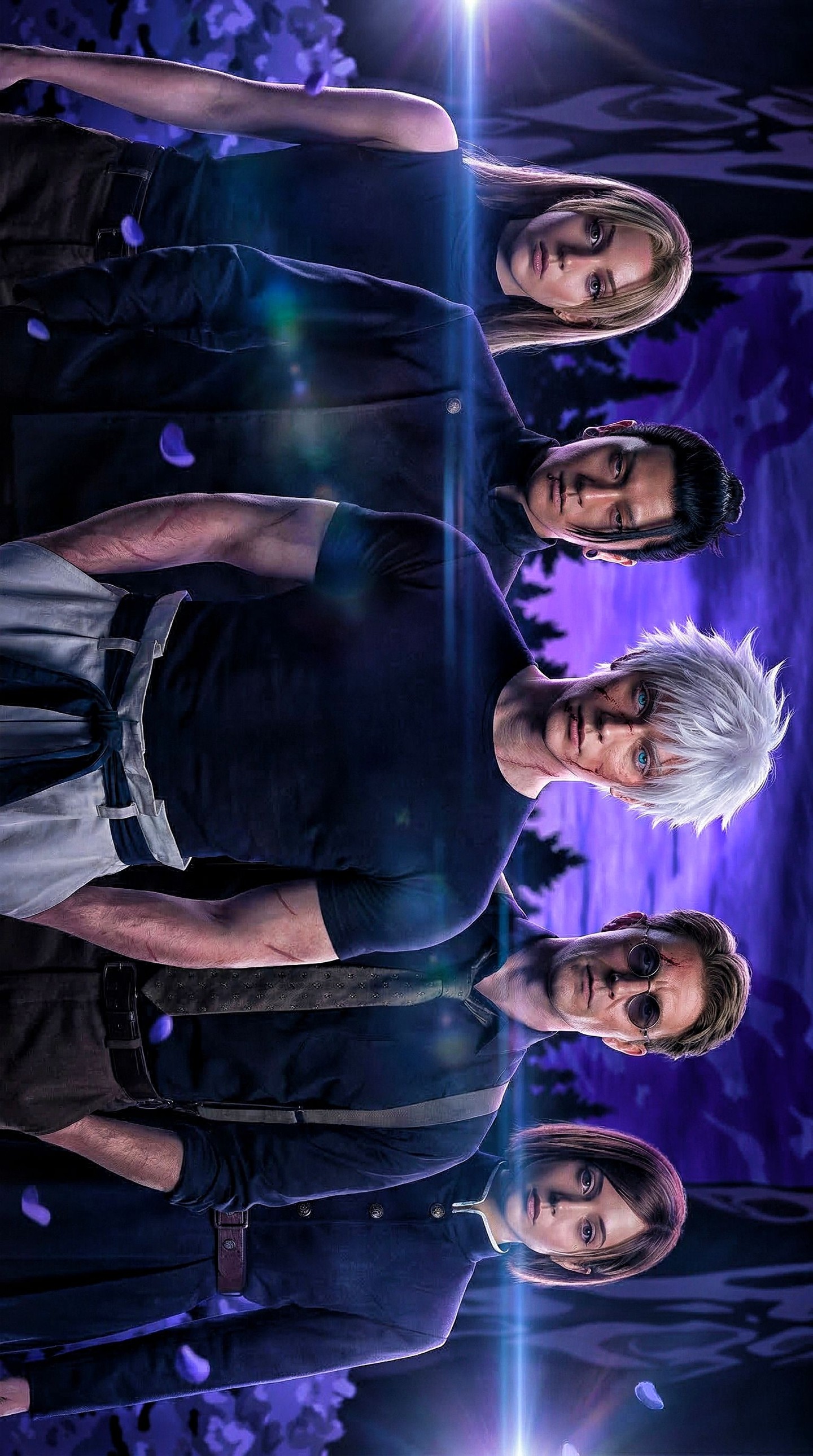
[Subject] Stylized anime-inspired ensemble poster featuring five human characters standing shoulder-to-shoulder in a heroic lineup. Center: one young adult male with very pale skin, sharp features, spiky silver-white hair, piercing icy blue eyes, athletic build, wearing a fitted black short-sleeve shirt and light gray belted pants, neutral intense expression. Left of center: one serious dark-haired adult male with medium skin tone, slicked-back black hair, fitted black shirt, muscular arms visible, stern expression. Far left: one young adult woman with fair skin and long straight light-brown hair, black fitted outfit, calm focused expression. Right of center: one rugged middle-aged man with light skin, short brown hair, stubble or beard shadow, dark sunglasses, dark shirt with suspenders, weathered expression. Far right: one young adult woman with fair skin and dark hair pulled back, dark high-collar outfit with red-brown strap detail, composed expression. [Environment] Fictional or cinematic twilight setting with deep violet-purple sky, dark silhouetted trees or forest line in the background, scattered glowing or drifting petal-like particles across the foreground and edges, moody decorative dark forms framing the scene on both sides, no urban objects, no modern room interior. [Composition/Camera] Vertical character-poster composition, medium shot framing from upper thighs or waist upward, all five characters arranged in a tight horizontal line with the white-haired male centered and slightly dominant, slight low-angle heroic perspective, bright horizontal lens flare streak cutting across the chest level, top light source creating a vertical starburst over the group, symmetrical blockbuster ensemble layout. [Lighting] Strong cool-violet cinematic lighting with bright top spotlight and horizontal blue lens flare, soft rim light on hair and shoulders, cool ambient fill, subtle specular highlights on faces and clothing, high contrast with glowing atmospheric accents, no flat daylight. [Style/Rendering] Polished anime / animated-series poster art, semi-realistic character rendering, cinematic game-promo finish, glossy dramatic color grading, clean linework blended with painterly shading, fandom-style crossover or adaptation poster energy, high-detail fantasy-action ensemble aesthetic. [Detail constraints] Keep exactly five characters in a centered lineup with the white-haired blue-eyed male in the middle, preserve the purple twilight backdrop, horizontal lens flare, drifting petals, dark fitted clothing palette, and ensemble-poster mood; do not add weapons, extra characters, bright city lights, or comedic styling; maintain the serious supernatural-action tone and the balanced group hierarchy.

Negative prompt: photoreal live-action cast photo, daytime sky, bright warm sunlight, extra characters, missing lens flare, cheerful smiles, school uniforms, futuristic armor, weapons in hand, empty background, cartoon chibi style, low-detail anime screencap, urban street, colorful rainbow palette, messy composition, beach scene, casual selfie framing.

Suggested parameters: aspect ratio 9:16 vertical poster or 4:5 tall character lineup, focal length equivalent 50mm to 70mm heroic portrait feel, moderate depth of field with all characters readable, 28-38 steps, CFG/style strength 6-7, sampler DPM++ 2M Karras or equivalent illustrated-detail sampler, seed suggestion 731552.

Delta prompt strategy:
1. Center character loses prominence: “restore the silver-white-haired blue-eyed male as the exact center focal point”
2. Group count changes: “keep exactly five characters standing shoulder-to-shoulder in one heroic row”
3. Lighting becomes flat: “add a bright top spotlight and a horizontal blue lens flare across the group”
4. Background turns generic: “maintain a deep violet twilight sky with dark tree silhouettes and atmospheric petals”
5. Style drifts to live action: “preserve polished anime poster rendering with semi-realistic shading”
6. Clothing becomes colorful: “keep the wardrobe dark, fitted, and understated to support the ensemble tone”
7. Right-side older man changes look: “keep one rugged adult male with sunglasses and suspenders on the right side”
8. Female characters lose presence: “preserve one woman on each outer side anchoring the lineup”
9. Mood becomes cheerful: “maintain a serious supernatural-action ensemble expression across all characters”
10. Petals vanish: “scatter a few soft glowing petal-like particles in the foreground and side edges”
Create a stylized 2D animated synth-pop music-video sequence in an 80s anime and risograph-inspired visual language, but with a cooler, more graphic New Wave mood than a soft fantasy dream. Center the video on a blond, androgynous figure moving through neon city streets, staring ahead in close-up, then transitioning into symbolic spaces like a futuristic stage, a desert highway at dusk, and bold title-card environments built around the phrase “Sweet Dreams.”

Use sharp composition, limited but electric color palettes, and repeated iconography rather than naturalistic storytelling. Include a glowing eye close-up, circular neon tunnels, a stark road stretching into the horizon, and a surreal cow or bull close-up that feels like a symbolic interruption rather than a literal plot point. Let the typography become part of the scenery, with “Sweet Dreams” appearing again and again in different graphic treatments. The whole piece should feel like a retro MTV opening sequence mixed with art-school poster design: hypnotic, cool, enigmatic, and rhythm-driven.
GLOBAL LOCK: one Rod Serling-inspired anthology host, middle-aged white man, slick dark hair combed back, clean-shaven, sharp cheekbones, black suit, white dress shirt, slim black tie, holding a lit cigarette with calm vintage-TV poise; black seamless studio background with a faint charcoal gradient; a polished gold nameplate or plinth edge visible near the bottom foreground; monochrome-to-muted neutral palette, premium studio portrait finish, subtle film grain, no extra people, no set changes, no props besides the cigarette and the gold base, no text overlays, no title cards, no environment cutaways.

00:00:00-00:00:02 — Start on a front three-quarter waist-up portrait. The host faces slightly camera-left with the cigarette raised near his chest. He breathes lightly, keeps a composed expression, and holds the stillness of a classic television narrator introducing an episode. Camera is locked-off, medium portrait framing, soft top-front key with gentle rim light separating him from the black background.

00:00:02-00:00:04 — Continue the same uninterrupted setup as the body begins a slow, elegant rotation toward profile. The cigarette hand drifts a few centimeters upward, the shoulders angle more clearly, and the face tracks through a controlled studio turn rather than a performance gesture. Keep the gold base visible at the bottom edge.

00:00:04-00:00:06 — Reach the cleanest side angle and slightly back-shoulder view. The suit silhouette, tie line, and cigarette shape stay crisp against the dark void. Motion remains minimal and deliberate, like a museum-grade portrait display or luxury character turntable rather than a dramatic acting beat.

00:00:06-00:00:08 — Ease past the side angle into a restrained back-three-quarter rotation. The head inclines subtly, preserving the cool, omniscient host energy. Lighting stays soft and sculptural, with controlled highlights on the cheek, lapel, cigarette, and hair.

00:00:08-00:00:09.8 — Finish the arc with the host nearly turned away, still calm and immaculate, then settle into a final still pose. Preserve the black studio, the gold plate edge, and the premium portrait mood without introducing any new action or cuts.

CAMERA: locked studio camera, medium waist-up framing, portrait-lens compression, no zooms, no handheld shake, no whip pans, no reframing.

LIGHTING: classic studio portrait key, faint rim light, controlled highlights on face and suit, low-key black background, subtle cigarette ember glow if visible.

GRADE: polished vintage anthology-host portrait, deep blacks, gentle silver-gray rolloff, elegant contrast, restrained filmic texture.

MOTION: ultra-slow body rotation, tiny breathing motion, micro hand adjustment on the cigarette, otherwise statuesque.

SPEECH: no spoken dialogue required; if any mouth movement appears, keep it minimal and silent, like a host pausing before narration.

NEGATIVE PROMPT: no comedy gestures, no smiling widely, no frantic acting, no crowd, no city, no Twilight Zone environment scene, no episode montage, no floating text, no camera flash, no extra smoke clouds, no color-neon nightclub look, no weapon, no hat, no beard, no turntable pedestal spin blur, no CGI background swap.

SPEECH PACK: silent studio portrait, no subtitles, no captions, no narration audio cues, no visible dialogue sync requirement.
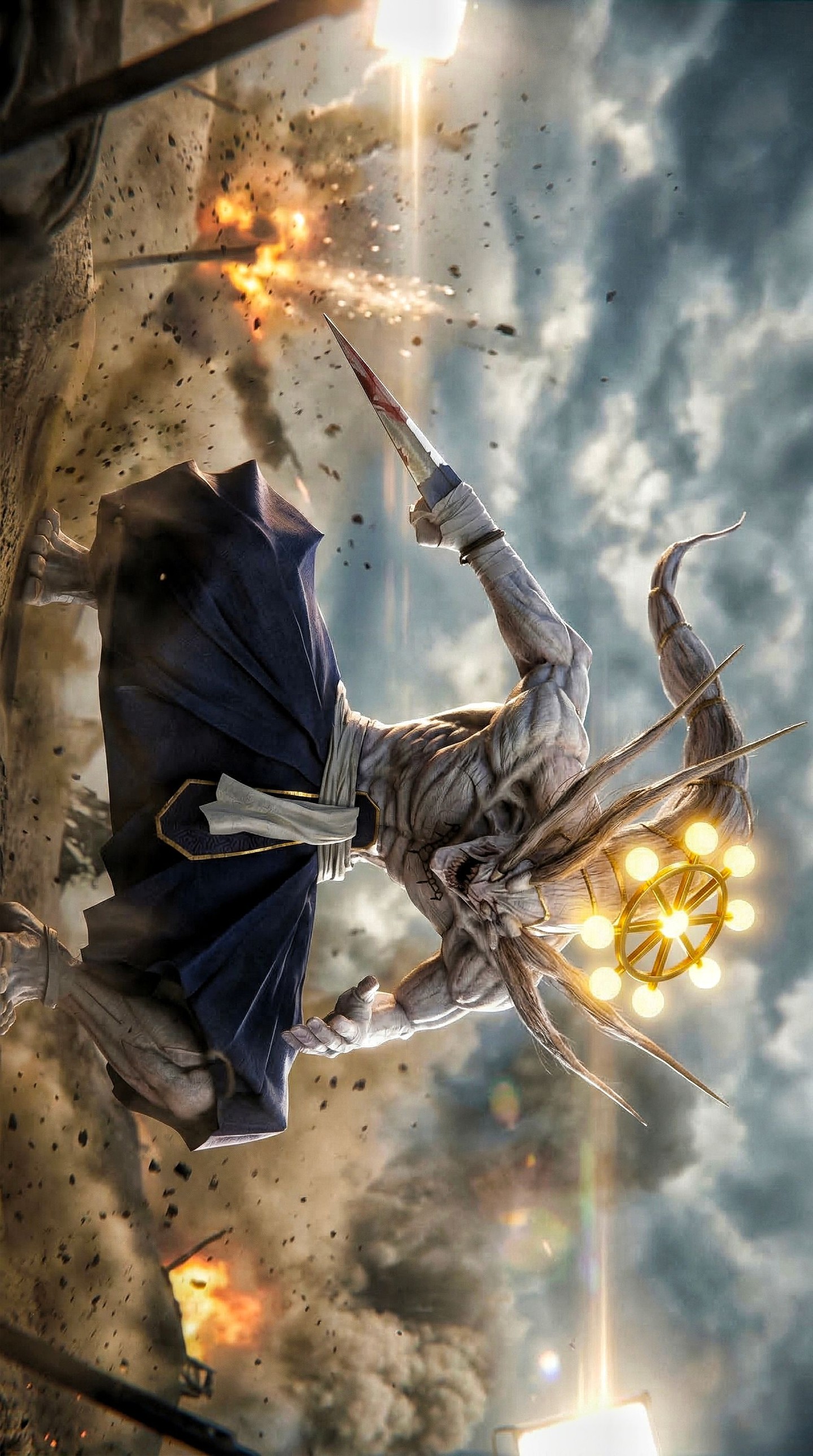
[Subject]
A monstrous anime-fantasy battle character mid-attack, suspended in a dynamic airborne pose against a chaotic sky filled with explosions and debris. The creature has a pale muscular body, multiple horn-like appendages, a glowing circular halo structure near the head, and carries a blood-tipped blade while wearing dark flowing lower garments.

[Clothing & materials]
Minimal costume with dark navy or black draped hakama-like fabric tied at the waist, exposed sinewy pale anatomy, sharp horn structures, glowing golden ring ornament, and a polished blade. The design blends demonic body horror with ceremonial fantasy styling.

[Environment]
Catastrophic battlefield atmosphere with broken debris, smoke plumes, fire bursts, fractured earth, and dramatic cloud-filled sky. The scene is full of destruction but still organized around the character as the central visual force.

[Composition/Camera]
Vertical action-poster composition, dramatic foreshortening, subject rotating diagonally across the frame, low-angle heroic-villain perspective, intense motion implied through debris streaks and tilted horizon energy.

[Lighting]
Explosive backlight from the sky, bright atmospheric flares, warm fire accents, rim light along the creature's limbs and horns, and high-contrast cinematic grading that separates the figure from the smoky background.

[Color palette]
Storm grey, ash brown, pale flesh white, black-blue fabric, fiery orange explosions, and glowing gold halo lights. The palette is apocalyptic and high-impact.

[Style/Rendering]
Epic anime battle poster, dark fantasy creature design, hyper-detailed action illustration, cinematic destruction scene, dramatic VFX lighting, high-energy shonen antagonist or cursed-spirit aesthetic.

[Detail constraints]
Preserve the twisted airborne pose, the horned silhouette, the glowing circular halo detail, and the battle-sky destruction around the character. Avoid extra limbs, muddy anatomy, weak motion, text, watermark, or flat backgrounds that reduce the intensity.

Negative prompt: low detail, blurry motion, extra arms, extra horns, distorted face, broken blade, text, watermark, flat lighting, static pose, weak explosions, cartoon simplicity, muddy smoke, bad anatomy.

Suggested parameters: vertical action poster, cinematic battle scene, creature-focused composition, high detail, explosive atmosphere, dramatic foreshortening, anime dark fantasy tone.

Delta prompt strategy: start from a standard monster action pose and amplify it into a poster-grade battlefield image. Tilt the composition, add debris and explosion depth, give the creature one iconic glowing ornament near the head, and keep the anatomy sharp so the result feels like a climactic anime key visual.
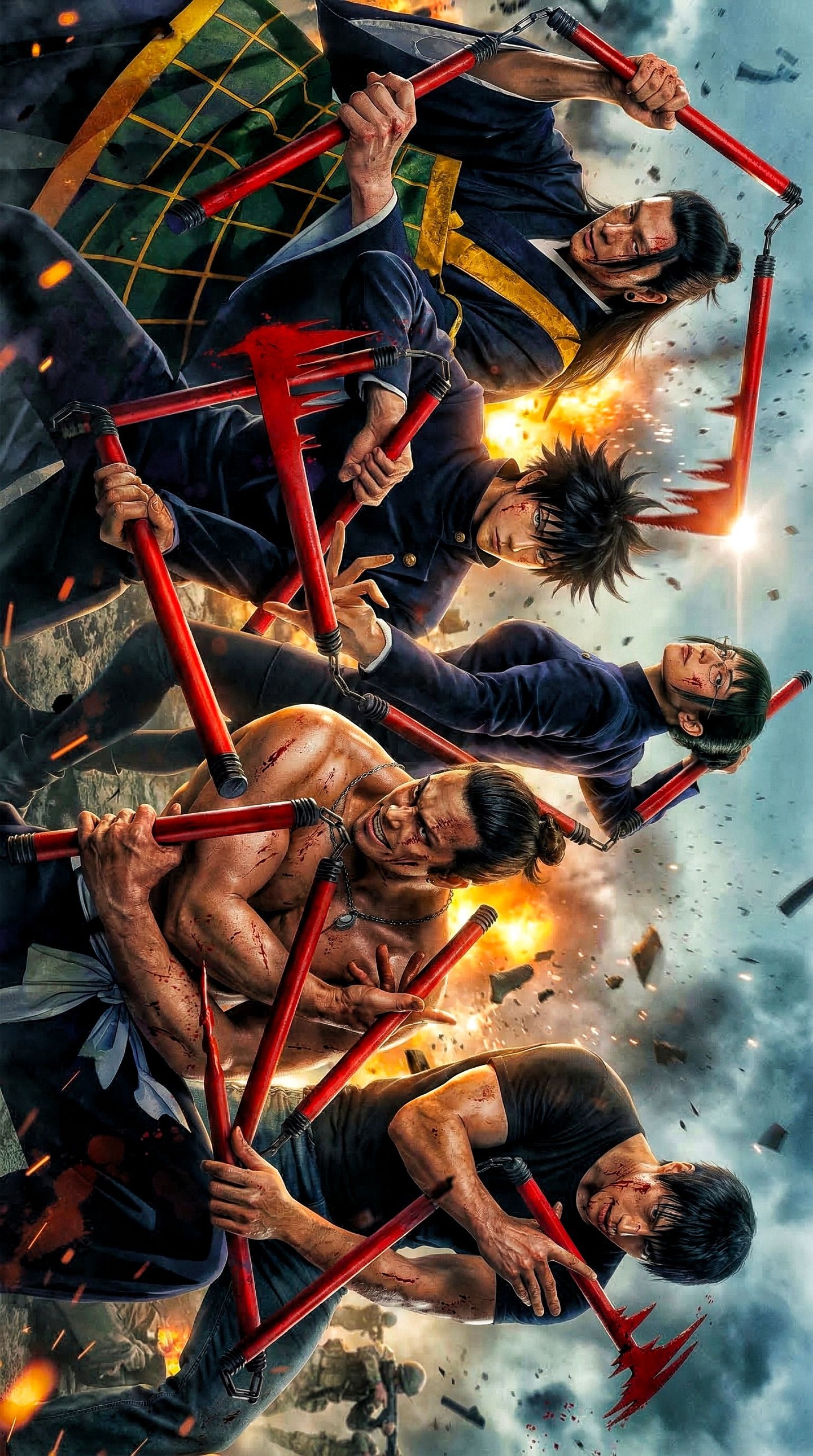
[Subject] A vertical anime battle poster featuring five fierce fighters locked in a tightly packed ensemble composition, each wielding vivid red polearms or hooked staff weapons, with intense expressions, battle-worn clothing, and a high-stakes team-combat energy.

[Environment] A war-torn battlefield atmosphere with firebursts, airborne debris, smoke plumes, and a stormy blue-gray sky, serving as a chaotic backdrop behind the clustered fighters.

[Composition/Camera] Dynamic tilted poster composition, stacked ensemble arrangement from top to bottom, overlapping bodies and weapons forming strong diagonals, close-cropped framing, and explosive visual density designed like a season-finale key art image.

[Lighting] High-contrast cinematic action lighting with warm firelight from behind and between the characters, cool daylight in the clouds, sharp specular highlights on weapons and skin, and glowing sparks scattered across the frame.

[Style/Rendering] Premium anime battle key visual with semi-realistic musculature, painterly effects, intense line-driven action styling, and blockbuster ensemble-poster polish.

[Detail constraints] Keep the red weapons crisp and readable, preserve distinct poses and silhouettes for all five fighters, maintain the diagonal composition and layered depth, render smoke and fire as supporting atmosphere rather than visual clutter, and avoid generic crowding or muddy action blur.

Negative prompt: extra limbs, unreadable weapons, muddy fire effects, low-detail faces, blurred anatomy, duplicated characters, flat lighting, random clutter, weak silhouettes, pastel palette, text overlay, watermark.

Suggested parameters: vertical anime action poster, ensemble battle composition, cinematic explosion lighting, high detail, dramatic diagonal framing, premium key-visual finish.

Delta prompt strategy:
1. If the composition feels messy, add “clear layered ensemble poster hierarchy with separated silhouettes despite overlap.”
2. If the red weapons lose impact, add “bold lacquered crimson polearms with sharp graphic contrast against the smoky sky.”
3. If the action feels flat, add “bodies twisted in mid-combat tension with diagonal force lines across the frame.”
4. If the explosions overpower the scene, change to “controlled firebursts used as rim-light sources rather than dominant effects.”
5. If the faces lack intensity, add “battle-focused expressions with clenched jaws, strain, and concentrated eye lines.”
6. If the poster lacks depth, add “foreground weapon overlap, midground bodies, and background debris with atmospheric separation.”
7. If the style becomes too realistic, add “anime key-art exaggeration with polished painterly action rendering.”
8. If the sky feels generic, add “storm-heavy battlefield clouds with cool light cutting through smoke.”
9. If the team chemistry is weak, add “cohesive ensemble confrontation energy with each fighter contributing to one unified combat tableau.”
10. If the image feels generic, add “season-finale anime battle poster where weapon rhythm and diagonal staging drive the entire composition.”
Nanami Kento AI Generator
Nanami works because his design already carries a complete mood. He does not need oversized power effects to stay recognizable. The suit, tie, composed face, and restrained posture do most of the work, which makes him unusually strong for creators who want JJK visuals that feel cleaner and more mature. That businesslike structure is also what separates him from generic anime men. If the image loses the suit discipline and calm expression, it usually stops feeling like Nanami very quickly.
> The easiest way to improve Nanami prompts is to protect the balance between professionalism and threat. If the image only keeps one side, it usually feels incomplete.
Creators usually get stronger Nanami results when they focus on the visual contrast that makes him interesting: formal clothing and controlled expression paired with the possibility of violence. For portraits, let the suit, blond hair, tie, and glasses-free stare carry the image. For battle art, keep the same restraint and add only enough motion or weapon detail to signal danger. Nanami is not strongest when treated like a flashy fantasy character. He is strongest when he feels composed, overqualified, and slightly exhausted in a way that still reads powerful. That makes him especially useful for wallpapers, cleaner edits, and more mature anime fan-art directions.
This page is the better route when you want JJK visuals with polish, order, and a colder kind of presence. If you want louder color and explosive power cues, other character pages move faster. If you want composed pressure and sharper styling, Nanami is the better fit.
## FAQ
### What makes Nanami AI art recognizable? The strongest signals are the suit, tie, blond hair, calm serious expression, and an overall formal but dangerous presence. Those details matter more than oversized effects.
### Should Nanami prompts include the weapon? Include it when you want a combat image or a more complete character scene. For portraits, the suit and expression are often enough to make the result read correctly.
### Is Nanami better for portraits than action art? Portraits usually work especially well because his design is so clean and readable, but restrained action art can be strong too when the image keeps his calm authority intact.
### Can I use Nanami visuals for edits and wallpapers? Yes. Nanami translates well into polished edits, wallpapers, and more mature anime fan art because his styling already feels complete without needing a crowded scene.