What's the Best Thumbnail Workflow? A System Tested on 3 Big Creators (2026)
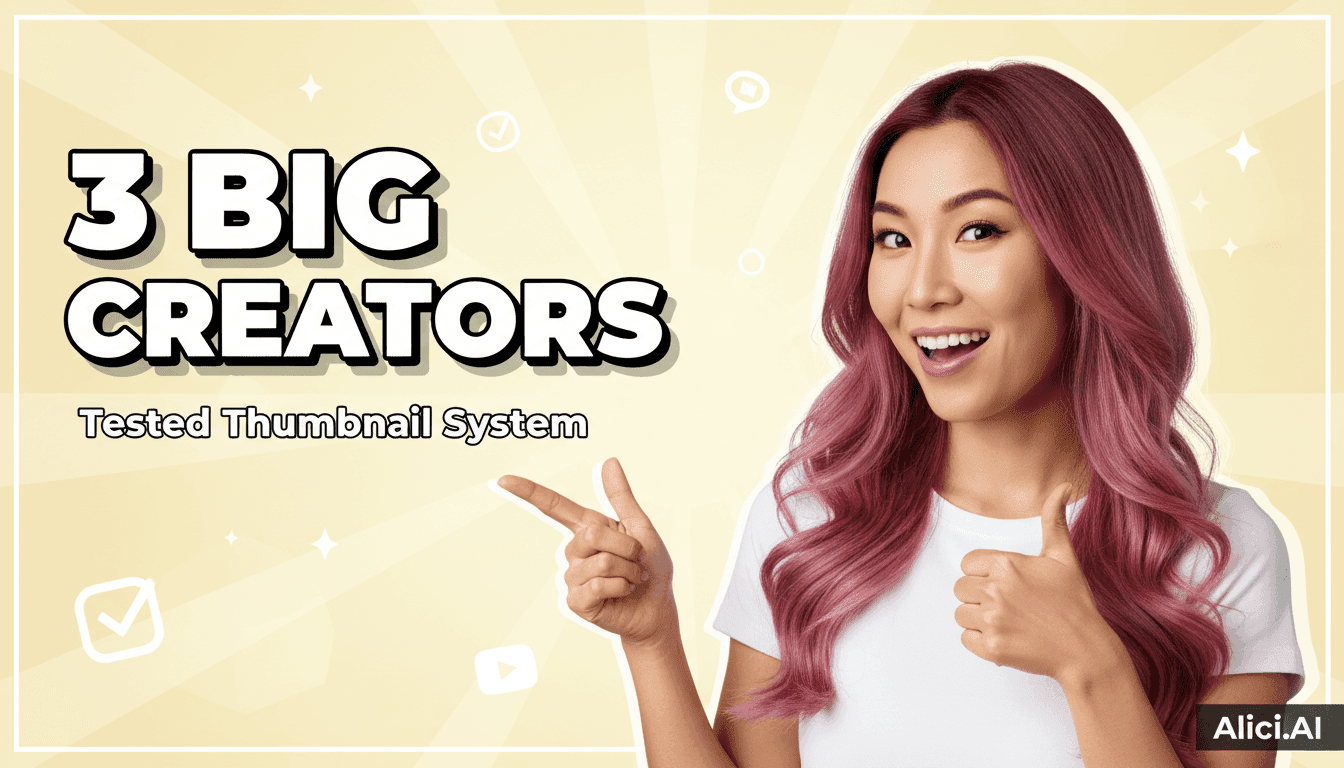
A repeatable thumbnail system based on MrBeast, Ali Abdaal, and Veritasium patterns
|
14 min
TL;DR
The best thumbnail workflow follows 6 steps: define the promise, choose one dominant visual (face/object/result), add 2-4 words of text only if it increases clarity, push contrast + emotion, lock a template, then run a 7-day single-variable testing sprint.
Key Takeaways
YouTube's help documentation notes that 90% of top videos have custom thumbnails - thumbnails are not "decoration," they're the click gate. (YouTube Help)
Big creators don't rely on taste alone. They run a repeatable system: promise - visual - text (optional) - contrast - template - test.
The fastest wins usually come from clarity (one focal point + readable at phone size), not from adding more design elements.
Copy big-creator patterns as hypotheses, not guarantees. Validate what works for your niche and traffic sources.
If your thumbnail promise doesn't match the first 30 seconds, viewers feel baited - short-term clicks won't compound.
Quick Answer
To create YouTube thumbnails like big creators, build a workflow you can repeat every week:
define the video's promise,
choose one dominant visual (face/object/result),
use 2-4 words of thumbnail text only if it increases clarity,
push contrast + emotion for fast readability,
lock a template (fonts/colors/layout), then
run a single-variable testing loop (3-5 variants, 7 days).
Reader fit: this guide is written for small YouTubers who want "big-creator-like" thumbnails without a big team. You can do every step in any design tool - A/B tools just speed up learning.
Why this works (Problem - Solution framing)
Most creators either (a) over-design thumbnails, or (b) copy big creators blindly. Both fail for the same reason: no repeatable decision system.
The solution is not "better taste." It's a consistent pipeline that turns each video into a clear promise, then tests a small number of variations to find what your audience actually clicks - without clickbaiting them.
Quick Start: Generate multiple thumbnail variations fast with Thumbnail Expert Pro. Create Click-Worthy Thumbnails
What This Guide Is (and Isn't)
Is: a practical "how-to" system built from public best practices (vidIQ, TubeBuddy) + observable creator patterns (MrBeast, Ali Abdaal, Veritasium).
Isn't: a promise that your CTR will jump by X%. Thumbnails depend on niche, audience, traffic source, and how well your video delivers the promise.
The Big-Creator Checklist (do this before you design)
Use this 60-second checklist every time:
What is the promise? (result / change / secret / how-to / emotion)
What is the one dominant visual? (face / object / result)
Can a viewer understand it in 1 second at phone size?
Does the thumbnail match the first 30 seconds?
Is the design consistent with your channel templates?
Step 1: Start With the "Promise" (not the design)
Before you touch any design tool, write one sentence:
This video helps the viewer get ____ by doing ____ (or seeing ____).
This "promise-first" approach mirrors public best-practice guidance from vidIQ: match your thumbnail approach to your content goal, then test and refine.
5 promise types you can reuse (AEO-friendly)
Promise type | What the viewer expects | Best thumbnail angle |
|---|---|---|
Result | a clear outcome | show the outcome big and obvious |
Change | a transformation | before/after split |
Secret | a surprising explanation | "curiosity gap" visual |
How-to | steps and clarity | clean object + method label (2-4 words) |
Emotion | a vibe / story / reaction | face-first emotion or strong visual mood |
Where the "big creator" names fit (observational, not performance claims):
MrBeast often leans into Result and Change promises.
Ali Abdaal often leans into How-to and Clarity promises.
Veritasium often leans into Secret / Curiosity promises.
Step 2: Choose one dominant visual (face, object, or result)
Big thumbnails look simple because they're single-focus.
Pick your focal point:
Face: when emotion is the promise (reaction, shock, relief, excitement).
Object: when the "thing" is the promise (product, tool, demo).
Result: when the outcome is the promise (reveal, comparison, transformation).
Rule of thumb: your dominant visual should take ~1/3 of the frame or more.
Step 3: Add thumbnail text only if it increases clarity
When text exists, it does one job:
Label the method: "3 STEPS", "NO EDITS", "BEGINNER"
Name the stake: "$10 vs $10,000", "1 WEEK"
Create contrast: "BEFORE" / "AFTER", "GOOD" / "BAD"
Text rules that survive mobile + TV
Use 2-4 words, max.
Don't copy the title - make it complementary.
One font. Heavy weight. High contrast.
If text doesn't add clarity, go textless. Minimal thumbnails can win in niches where the object/result is instantly understandable.
Step 4: Use contrast + emotion as your "attention engine"
TubeBuddy's "big creator" tips can be summarized as four repeatable levers:
Lever | What it means | Fast way to apply it |
|---|---|---|
Contrast | separate subject from background | outline/stroke + simple background |
Clarity | no low-res muddy frames | use a crisp photo or clean cutout |
Emotion | the viewer feels something instantly | face close-up with readable expression |
Story | the thumbnail implies a question | before/after or "what happens next?" |
Important: "emotion" must match your content. Don't force exaggeration if your niche is calm/educational.
Step 5: Build a template system (the real "big creator" advantage)
Small creators try to design better. Big creators try to produce consistently.
Create a one-page template spec:
Token | Decide once | Example |
|---|---|---|
Font | 1 primary font | bold sans-serif |
Text zones | 1-2 safe zones | left third / bottom band |
Palette | 2-3 colors | background + accent |
Outline | on/off + thickness | text stroke + subject stroke |
Face cutout | yes/no | consistent masking style |
Step 6: Pass the mobile + TV checklist (before you publish)
60-second pre-publish checklist
Can I understand the promise in 1 second?
Is there only one focal point?
Is text readable at phone size (or removed)?
Is subject separation obvious (contrast/outline)?
Does it match the first 30 seconds (anti-clickbait)?
Export basics (avoid unforced errors)
Canvas: 1280x720 (16:9) (YouTube Help)
Format: JPG or PNG
File size: keep under 2MB
Step 7: Run a 7-day single-variable testing sprint
If you want big-creator outcomes, copy the big-creator process: iterate.
Sprint rules (simple and reliable)
Pick one video with strong impressions but weak clicks (or your newest upload).
Create 3-5 thumbnail variants.
Change one variable at a time (only one): Text (phrase) only, Face (expression) only, Background color only, Object size only
Run long enough to get signal (don't switch every hour).
Keep the winner, then update your template spec.
What to watch (signals, not guarantees):
CTR trend (within the same traffic source where possible)
First 30 seconds retention (promise-delivery alignment)
Average view duration (avoid "high click, low stay")
BONUS: Create 3 strong variants in minutes (without a full photoshoot)
After you learn the manual system, here's a faster workflow you can use when you're time-constrained:
Paste your video title + 1-sentence promise into Thumbnail Expert Pro.
Ask for 3 variants that change only one variable: Variant A: different promise text (2-4 words), Variant B: different background contrast, Variant C: different focal crop/scale
Pick the clearest one at mobile size, then publish and measure for 48-72 hours.
Creator Mini-Playbooks (MrBeast, Ali Abdaal, Veritasium)
You asked for the "big creator" part to be concrete. Below are mini playbooks you can copy without copying budgets.
These are observable patterns, not performance guarantees. Use them as hypotheses and validate with your own channel data.
MrBeast: "Stakes + Clarity + Scale"
What to notice (pattern-level):
One dominant subject (often a face or outcome)
Clear stakes (often expressed with a specific number or obvious "result" visual)
High contrast + zoomed-in crop for mobile readability
Copy-this recipe (small creator friendly):
Element | Do this | Avoid this |
|---|---|---|
Promise | Make the outcome obvious ("result" promise) | abstract topic thumbnails |
Focal point | Face/result fills ~40-60% of frame | multiple competing subjects |
Stakes | use one clear stake cue (number/visual) | stacking 3-5 cues at once |
Background | simple or lightly blurred | busy scenes that kill clarity |
What to test next week (single-variable):
Variant A/B: tight crop vs slightly wider crop
Variant A/B: stake cue (number vs no number)
Variant A/B: background blur vs flat background
Deep dive: Mr.Beast Playbook
Ali Abdaal: "One Subject + Transformation + Consistency"
Ali-style thumbnails are often "stop-the-scroll" because they're calm but extremely readable. A simple way to copy the logic is the 4-element model:
Expressive face (one emotion that matches the promise)
High-res subject (sharp = trustworthy)
High contrast (reads on mobile)
Story cue (one visual hint of the narrative)
Two patterns you can apply immediately:
Pattern | Best for | How to copy |
|---|---|---|
Transformation split | before/after, then/now | same subject on both sides; one change only |
Face anchor | most creator niches | face = biggest element; eyes point to the object/text |
What to test next week (single-variable):
Variant A/B: emotion (surprise vs calm confidence)
Variant A/B: split (with/without before-after)
Variant A/B: color pop (one accent background color vs neutral)
Deep dive: Ali Abdaal Playbook
Veritasium: "Curiosity Without Misleading"
Veritasium-style thumbnails are great for education because they create a specific question ("why / how / what's going on?") without breaking trust.
Use this boundary check:
If your thumbnail... | You're doing... | Fix |
|---|---|---|
creates curiosity but can be explained quickly | healthy curiosity gap | keep, then deliver early |
implies something your video doesn't deliver | misleading clickbait | tighten the promise or change the visual |
Practical workflow (copy this):
Write one "curiosity sentence": People think A, but actually B; the video proves/explains it.
Create 2-3 versions where each one changes only one variable (emotion / subject / text).
Publish, then iterate on a fixed cadence instead of panic-editing hourly.
Deep dive: Veritasium Playbook
One-table summary (fast scan)
Creator | Best used for | "Steal this" shortcut |
|---|---|---|
MrBeast | challenges, experiments, high-stakes results | zoom + contrast + one stake cue |
Ali Abdaal | tutorials, productivity, calm authority | one face + readable layout + transformation |
Veritasium | education, science, "why/how" stories | curiosity sentence + early payoff |
Common mistakes (why thumbnails don't get clicks)
Too much text (mobile can't read it).
Low-resolution / muddy frames (looks untrustworthy).
No promise (viewer can't predict what they get).
Mismatch with the video (clickbait feeling, weak retention).
No template (every upload looks like a new channel).
Copy-paste thumbnail templates (3 you can use today)
Template 1: Result Reveal (challenges, experiments)
Visual: outcome as the focal point
Text: optional label ("THE RESULT", "1 WEEK")
Contrast: bright subject, simple background
Template 2: Before/After (transformations)
Visual: split-frame (left before, right after)
Text: minimal ("BEFORE" / "AFTER")
Template 3: Curiosity Question (educational videos)
Visual: object + one "weird" detail
Text: question fragment ("WHY?", "HOW?")
Video alignment: answer within the first 30 seconds
Disclosure and Limitations
alici.ai is our product. This article describes publicly observable thumbnail patterns and general best practices. We do not have access to creators' internal A/B data, and we do not claim guaranteed CTR improvements.
FAQ
Q: What size should a YouTube thumbnail be?
YouTube recommends 1280x720 (16:9) and a file size under 2MB. (YouTube Help)
Q: Should I always put my face in the thumbnail?
No. Faces can help in many niches, but some formats (ASMR/food/object demos) can win with a clean object/result shot. Choose the focal point that best communicates your promise.
Q: How many words should I put on a thumbnail?
Aim for 2-4 words. If you need more to explain the promise, your concept is probably unclear.
Q: How do I avoid clickbait while staying clickable?
Make the thumbnail a restatement of the title's promise, then deliver the promise in the first 30 seconds. If viewers feel misled, you may see weak retention even if clicks spike briefly.
Q: Do I need A/B testing tools to improve?
No. You can still improve by changing one variable per week, tracking results, and rolling back if it gets worse. A/B testing just speeds up learning.
🎁
Limited-Time Creator Gift
Start Creating Your First Viral Video
Join 10,000+ creators who've discovered the secret to viral videos