/
/
Kling 3.0 vs Seedance 2.0: I Tested Both With the Same Prompts — Here's What Actually Happened (2026)
Kling 3.0 vs Seedance 2.0: I Tested Both With the Same Prompts — Here's What Actually Happened (2026)
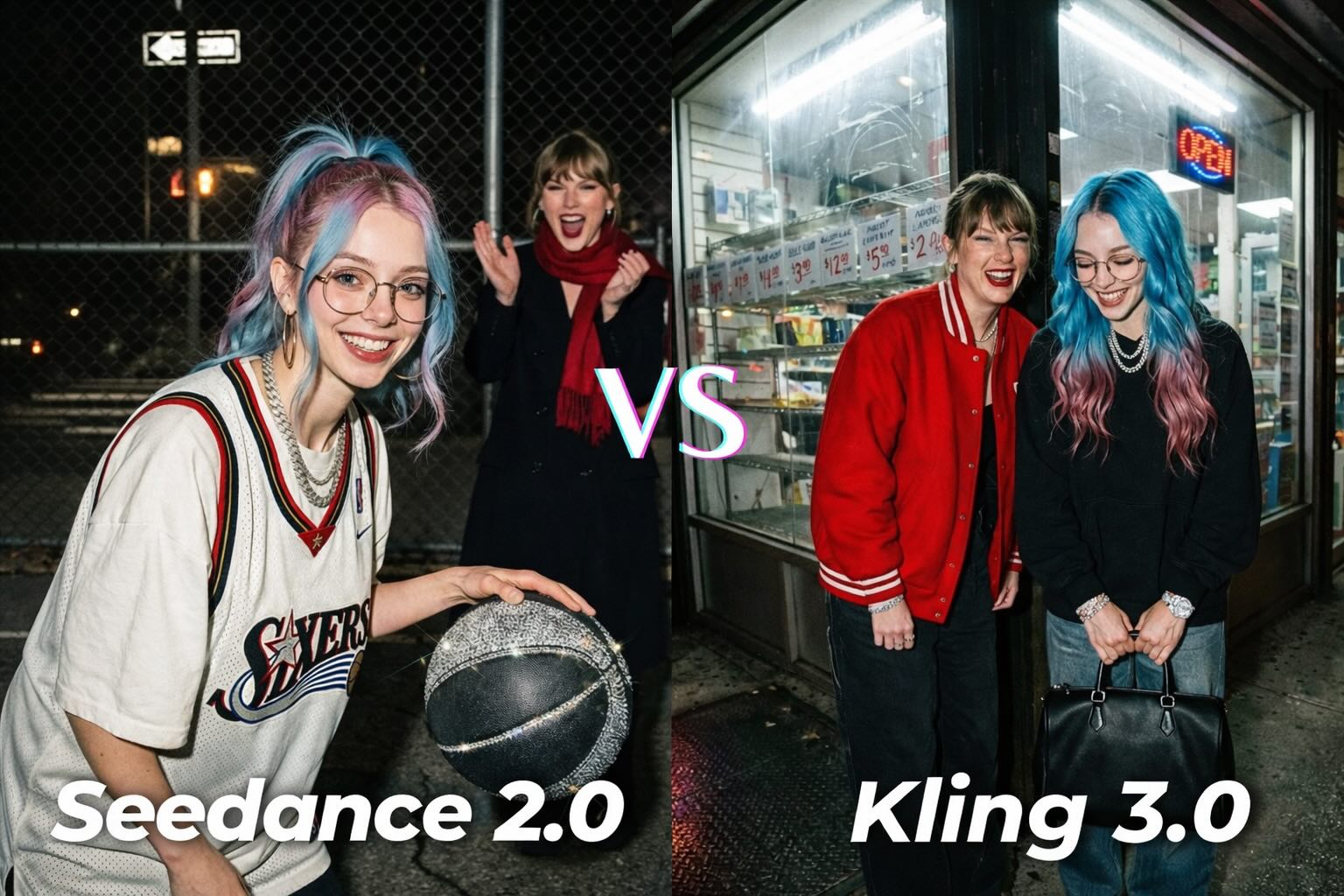
Same-prompt testing reveals clear winners for each content type - Kling wins on execution, Seedance wins on feel.
|
14 min
TL;DR
Neither Kling 3.0 nor Seedance 2.0 is simply "better" - they're better at different things. Your content type determines the winner, not model quality or complexity.
Kling 3.0 and Seedance 2.0 are the two strongest Chinese-developed AI video generators available in 2026 - and after testing both with identical prompts, I can tell you: neither is "better." They're better at different things. Kling follows your instructions more faithfully and handles continuous-shot narratives with real discipline. Seedance produces visuals with a kind of organic rhythm that's hard to articulate until you see it - particularly with creature and fantasy content. The real skill is knowing which tool to reach for depending on what you're making.
Key Takeaways:
Kling 3.0 is the director's tool. Higher prompt adherence, genuine continuous takes, cleaner human faces. When you write a specific shot sequence, Kling actually tries to execute it.
Seedance 2.0 is the cinematographer's tool. Superior visual texture, natural motion rhythm, and creature rendering that feels alive. When it works, the output has a breathing quality that Kling's clips lack.
Your prompt type determines the winner - not complexity, not price. Human action narratives favor Kling. CG creatures and viral meme content favor Seedance. I'll show you exactly why.
Access still matters: Kling is globally available. Seedance 2.0 requires Chinese platform access via Jimeng.
Every AI video demo reel looks incredible. That's the point - those clips are cherry-picked from dozens of generations using prompts fine-tuned by people who know exactly what the model handles well.
I wanted to know what happens when you give both models the same prompt and just... see what comes back.
So I ran three identical prompts through Kling 3.0 and Seedance 2.0: a high-action street chase, a spy thriller continuous take, and a giant-cat meme video. Then I analyzed every second of every output using Gemini multimodal AI for frame-by-frame evaluation - roughly 36,000 words of analysis across six videos.
What I found changed how I think about choosing between these tools.
Quick Answer
If you need the video to match your prompt: Kling 3.0. It's more disciplined about executing what you actually wrote - especially continuous takes and human-centric narratives.
If you need the video to feel right: Seedance 2.0. There's a quality to its best outputs - a rhythm between motion, sound, and timing - that's genuinely hard to get from any other model right now.
If you're outside China: Kling 3.0. Seedance 2.0 is locked to Jimeng (即梦), ByteDance's Chinese-market creative platform.
If you want to skip the choice entirely: alici.ai lets you generate across multiple models from one interface - compare outputs side by side without juggling accounts.
💡 Not sure which fits your workflow? Try Kling and other models on alici.ai - one platform, no juggling.
At a Glance
Kling 3.0 | Seedance 2.0 | |
|---|---|---|
Developer | Kuaishou | ByteDance |
Sweet spot | Structured narratives, reliable faces, continuous takes | Visual polish, creature content, viral meme formats |
Max resolution | 1080p | Up to 2K |
Max duration | 15s/scene x 6 scenes (~90s) | 15s single generation |
Native audio | Yes (synchronized) | Yes (dual-branch, generated with video) |
Input modes | Text, image, audio | Text, image, video, audio (quad-modal) |
Multi-shot | 2-6 explicit scenes, user-defined | Auto narrative planner from single prompt |
Global access | ✅ klingai.com + Alici AI | ⚠️ coming soon on Alici AI |
Unique edge | Element binding across scenes (Omni mode) | 12-file reference system with @role tags |
Verified March 2026. Sources: DataCamp.
How I Tested
I'm Lucy Alice, Co-Founder of Alici.ai. I test AI video models the same way I test any production tool: by throwing real creative briefs at them and seeing what survives.
For this comparison, I designed three prompts that stress-test different capabilities:
Prompt 1 - High-Action Chase:
Camera follows a man in black sprinting through a crowded street, a group chasing close behind. The shot cuts to a side tracking angle as he panics and crashes into a roadside fruit stall, scrambles to his feet, and keeps running. Sounds of a frantic crowd.
Tests: human motion, crowd rendering, physics, camera tracking.
Prompt 2 - Spy Thriller Continuous Take:
Spy thriller style. Front-tracking shot of a female agent in a red trench coat walking forward through a busy street, pedestrians constantly crossing in front of her. She rounds a corner and disappears. A masked girl lurks at the corner, glaring after her. Camera pans forward as the agent walks into a mansion and vanishes. Single continuous take, no cuts.
Tests: long-take discipline, multiple characters, narrative transitions, camera continuity.
Prompt 3 - Giant Cat Meme (Mockumentary):
Mockumentary, mobile Vlog perspective, hyperrealistic CG combined with real scenes. A Godzilla-sized orange tabby cat stuck between two buildings. A bus driver reaches up to pet its nose. The cat sneezes, blowing away pedestrians and hats. Memetic ending.
Tests: CG creature rendering, human-animal interaction, comedic timing, style adherence.
Each prompt was fed identically to both models. Each output video was then analyzed by Gemini 2.5 Flash with frame-by-frame evaluation across seven dimensions. Total analysis output: approximately 36,000 words across six videos.
Disclosure: Alici.ai is a multi-model video generation platform that includes Kling access. Seedance 2.0 is not currently on our platform. The scores below reflect honest test results - I have no reason to favor either model.
The Test Results: What I Actually Saw
Scene 1: The Chase - Kling Wins on Execution
Both models delivered solid chase sequences. But the difference showed up in the details.
Kling 3.0 nailed nearly every element from the prompt. The man in black sprinting, the pursuing group, the camera cut to a side tracking angle, the fruit stall crash - it was all there, in the right order. The protagonist's face stayed consistent throughout, expressions natural and readable. Prompt adherence: 9.5/10.
The weakness? Background characters. The pursuers had blurry faces and slightly robotic motion - you can see it clearly around 0:02-0:03. And the fruit stall collision, while present, felt "pre-animated" - objects scattered too uniformly, like a physics simulation running on default settings rather than real chaos.
Seedance 2.0 hit most of the same beats (prompt adherence: 8/10), and honestly, its camera tracking felt just as professional. But there's a problem I can't overlook: at 0:05-0:07, the protagonist's face warped significantly - mouth and jawline distortion during the closest frames. For any content that puts human faces front and center, that's a dealbreaker.
Where Seedance surprised me was motion naturalism. The running felt slightly more fluid, the weight distribution more convincing. If you could fix the face, the Seedance clip would be the better raw footage.
Bottom line: Kling is the safer choice for human action scenes. Seedance has a higher motion ceiling but a lower floor on facial consistency.
Scene 2: The Spy Thriller - The Most Revealing Test
This is where the comparison got genuinely interesting.
The prompt asks for something technically demanding: a single continuous take following a woman in a red trench coat through a busy street, around a corner, past a masked girl, and into a mansion. No cuts.
Kling 3.0 delivered a real continuous take. One unbroken shot, no visible cuts, smooth tracking from the busy street through the corner turn to the mansion entrance. Camera work scored 9/10 - it even managed a natural transition from front-tracking to side-tracking as the agent rounded the corner. Prompt adherence: 7/10 overall (the agent doesn't quite "disappear" as requested, and the camera tracks rather than pans at the end, but the core elements are there).
The visual trade-off? Background pedestrians looked rough. Blurry faces, stiff "sliding" movements, occasionally ghostly presence. The main agent and the masked girl were well-rendered, but the busy street felt more like a stage set than a living city.
Seedance 2.0 chose visual quality over prompt discipline. The individual frames are beautiful - higher resolution, better skin texture, more natural lighting. Visual quality scored 7/10 vs Kling's 6/10. Motion was also more natural within each segment (6/10 vs 5/10).
But here's the thing: Seedance broke the continuous take into three separate shots with two visible cuts. At 0:06.5, a hard cut from the agent to the masked girl. At 0:09.5, another cut to the mansion entrance. The prompt's core requirement - "single continuous take, no cuts" - was simply ignored. Prompt adherence: 3/10.
It's a fascinating trade-off. Kling gave me what I asked for, even though the pixels were rougher. Seedance gave me prettier pixels but rewrote my brief. As a creator, I'd rather have the tool that follows my direction - I can fix visual quality in post, but I can't fix a broken shot structure.
Bottom line: If your creative vision depends on specific camera work and shot structure, Kling is the model that actually listens. If you're flexible about structure and just want the best-looking frames, Seedance delivers more polished individual shots.
Scene 3: The Giant Cat - Where Seedance Comes Alive
This is the test where I stopped thinking about scores and just watched.
Seedance 2.0 produced something that genuinely made me laugh. The giant orange cat stuck between buildings, the bus driver reaching up, the sneeze - there's a rhythm to the whole sequence that feels almost... directed. The timing between the pet, the cat's reaction, and the sneeze effect had an organic comedy beat that I didn't expect from a generative model. Hans (my co-founder, who's been making videos for two decades) watched this clip and used the word "breathing" - as in, the whole scene had a mature, natural rhythm to it, like it was paced by someone who understands comedic timing.
The cat rendering was exceptional: fur physics that react to wind and motion, facial expressions that shift from confused to annoyed, scale relationships between the cat and buildings that feel natural rather than composited. Commercial viability: 9/10. This clip is genuinely TikTok-ready.
Why does Seedance do this so well? I have a theory. ByteDance owns TikTok and Douyin - and "giant animal destroys city" is one of Douyin's most reliable viral meme templates. Seedance was likely trained on an enormous dataset of exactly this kind of content. It doesn't just interpret the prompt; it recognizes the genre and fills in the comedic grammar automatically.
There's also a technical factor: Seedance 2.0 uses dual-branch diffusion, generating video and audio simultaneously. The sneeze sound and the visual effect aren't "synced" - they're born together. That's where the breathing quality comes from.
Kling 3.0 produced a competent but lifeless version. The cat was there, the buildings were there, the bus driver reached up. But the interaction felt stiff - the driver's arm moved like a mechanical extension rather than a human gesture. The cat's expression stayed neutral where Seedance's cat showed real personality. And Kling added an unrequested ending shot of the cat sitting on a bridge watching traffic - technically fine, but it killed the punchline.
Hans's verdict on the Kling version: "barely passing." I'd give it roughly 4-5/10 overall where Seedance scored 9/10.
Bottom line: For creature content, fantasy CG, and viral meme formats, Seedance isn't just better - it's playing a different game. If this is your content niche, Seedance is worth the Jimeng access hassle.
The Pattern: Prompt Type Matching
After analyzing all six videos, a clear pattern emerged - and it's not what I expected going in.
I initially hypothesized a "Prompt Complexity Cliff" - that as prompts got more complex, both models would degrade. The data told a different story. It's not complexity that determines which model wins. It's prompt type.
Content Type | Better Model | Why |
|---|---|---|
Human action / chase | Kling 3.0 | Consistent facial rendering, reliable prompt execution |
Continuous long takes | Kling 3.0 | Actually delivers no-cut sequences (9/10 camera in spy thriller) |
CG creatures / fantasy | Seedance 2.0 | Superior creature physics, organic timing, genre recognition |
Viral meme formats | Seedance 2.0 | Trained on Douyin viral templates, automatic comedic grammar |
Visual-first / mood pieces | Seedance 2.0 | Higher per-frame quality, better lighting and texture |
Face-critical content | Kling 3.0 | No facial distortion during dynamic motion |
This isn't about one model being "better" - it's about matching your prompt type to the model's training sweet spot.
Think of it this way: Kling is like a disciplined director who executes your shot list faithfully. Seedance is like a creative DP who might improvise on your brief, but when the improvisation works, the result has a quality you couldn't have scripted.
The key insight from our same-prompt testing: the winner between Kling 3.0 and Seedance 2.0 isn't determined by prompt complexity or model version - it's determined by prompt type. Human-centric action and continuous takes favor Kling's execution discipline. Creature content and viral formats favor Seedance's organic timing and visual richness. Choosing the right model for your content type matters more than choosing the "best" model overall.
Scorecard
Dimension | Kling 3.0 | Seedance 2.0 | What I Noticed |
|---|---|---|---|
Prompt Adherence | ★★★★☆ | ★★★☆☆ | Kling follows the brief; Seedance reinterprets it |
Visual Quality | ★★★½☆ | ★★★★½ | Seedance's raw image quality is a step above |
Motion Realism | ★★★★☆ | ★★★★★ | Seedance's motion has that "breathing" quality |
Camera Intelligence | ★★★★★ | ★★★☆☆ | Kling delivered a real continuous take; Seedance faked it |
Creature Rendering | ★★★☆☆ | ★★★★★ | Seedance's cat was genuinely alive; Kling's was a prop |
Human Faces | ★★★★☆ | ★★★☆☆ | Seedance warped faces during action; Kling stayed clean |
Audio Sync | ★★★★☆ | ★★★★☆ | Both adequate; Seedance's dual-branch feels slightly more natural |
Commercial Readiness | ★★★★☆ | ★★★★☆ | Kling is more consistent; Seedance's ceiling is higher |
Overall: It's not a score comparison - it's a matchup chart. The right answer depends on what you're making.
See the difference for yourself - run the same prompt across Kling and other models on alici.ai. One prompt, multiple outputs, side-by-side.
Kling 3.0: What It Does Best
Version tested: 3.0 (March 2026)
Kling 3.0's defining quality is reliability. In my testing, when I asked for something specific - a continuous take, a particular camera transition, a character in a defined costume - Kling was more likely to deliver exactly that. It's the model I reach for when the brief is specific and the output needs to match.
Where it shines:
Multi-shot scene structure: Define 2-6 scenes with per-scene duration targets (5s/10s/15s). This is genuinely useful for ads and structured content - you're directing, not just prompting
Continuous take execution: The spy thriller test proved this isn't just marketing - Kling can sustain a single unbroken shot across scene transitions.
Consistent human faces: No facial warping during dynamic motion. For talking heads, ads with actors, or any face-critical content, this matters more than raw visual quality.
Global availability + API: Available worldwide via web and fal.ai, with comprehensive documentation.
Where it falls short:
Background characters: Blurry faces, robotic motion, occasionally "ghostly." Fine for short social clips, distracting for anything longer.
Physics feel pre-rendered: Collisions and object interactions lack randomness - things scatter too neatly.
Creature content feels stiff: The giant cat test showed Kling can render a creature competently, but it can't give it personality.
Seedance 2.0: What It Does Best
Version tested: 2.0 (March 2026) | Access: Jimeng (China; ≥69 RMB/month) | Developer: ByteDance
Seedance 2.0 is the model I reach for when I want to be surprised. Its best outputs have a quality that's hard to quantify - a sense of timing, weight, and presence that goes beyond what the prompt literally describes. When I gave it the giant cat prompt, it didn't just render a big cat; it gave that cat a personality.
Where it shines:
Dual-branch generation: Video and audio are generated simultaneously, not layered. This creates tighter sync and that "breathing" quality - especially in scenes with physical interactions like the cat's sneeze.
Creature and fantasy rendering: Fur physics, facial expressions, scale relationships. Seedance treats creatures as characters, not objects.
Raw visual quality: Consistently higher-fidelity pixels across all tests. Better lighting, better textures, better skin rendering.
Quad-modal input system: Text, image, video, and audio references with up to 12 files and @role assignment. This system "improves temporal consistency, subject stability, and overall scene coherence significantly."
Auto narrative planner: Feed it a structured prompt with timing cues and it divides the concept into connected shots automatically.
Where it falls short:
Ignores shot structure requirements: "Single continuous take, no cuts" was completely disregarded. If your brief specifies camera continuity, Seedance may simply rewrite it.
Facial distortion during action: The chase scene showed visible face warping at 0:05-0:07. This is a known issue with fast-paced human close-ups.
China-only access: Seedance 2.0 requires Jimeng with Chinese phone verification. International users are limited to older versions (1.5 Pro) via third-party APIs.
Which Tool for Your Project?
I'll keep this practical.
Making TikTok or Instagram Reels? Start with Kling 3.0. Its prompt reliability means less regeneration time, and the global API access enables workflow automation. For creature or meme content specifically, Seedance is worth the extra effort if you have Jimeng access.
Producing ads or client work? Kling 3.0. Consistent facial rendering and structured multi-shot generation (up to 6 scenes) are built for approval cycles and repeatable output. You can show a client a shot list and deliver something close to it.
Creating creature or animal content? Seedance 2.0, no contest. The difference in rendering quality and character expressiveness is not marginal - it's a generation gap.
Mood pieces, fashion, or visual-first content? Seedance 2.0. When per-frame quality matters more than prompt precision, Seedance's visual ceiling is genuinely higher.
Working internationally without Chinese platform access? Kling 3.0 is your only real option for the current generation. Keep an eye on alici.ai. for Seedance 2.0 availability.
Quick Decision Guide
Your situation | Recommended |
|---|---|
Need the output to match your brief | Kling 3.0 |
Need the best visual quality per frame | Seedance 2.0 |
Outside China | Kling 3.0 |
Content features animals or creatures | Seedance 2.0 |
Human faces are prominent | Kling 3.0 |
Need multi-shot structured video | Kling 3.0 |
Creating viral/meme content | Seedance 2.0 |
Want to compare multiple models |
What I Couldn't Test
Chinese-language prompts. Community reports suggest Seedance performs better with Chinese prompts - I tested in English only and can't verify this. Given ByteDance's training data likely skews toward Chinese-language content, this seems plausible.
Seedance's full reference system. The @tag multi-reference workflow (up to 12 files) is one of Seedance 2.0's most powerful features on paper. I tested text-only prompts for fair comparison, but the reference system may significantly change the quality equation.
Kling's extended multi-scene. I tested individual scenes, not Kling's full 6-scene, ~90-second capability. My Kling 3.0 complete guide covers the multi-shot workflow in depth.
Version stability. Both models update frequently. These results reflect March 2026 versions - capabilities may shift without announcement. Seedance 2.0 in particular is still in its early access phase.
Frequently Asked Questions
Is Kling 3.0 or Seedance 2.0 better for beginners?
Kling 3.0. It's globally accessible, has English documentation, and its higher prompt adherence means your output will more closely match what you described. Seedance 2.0 requires navigating a Chinese-language platform and tends to "reinterpret" prompts, which is harder to troubleshoot when you're still learning prompt craft.
Can I use Seedance 2.0 outside China?
Not the 2.0 version directly. It's exclusive to ByteDance's Jimeng (即梦) platform, requiring Chinese phone verification. DataCamp's guide tracks current access options.
Which generates better-looking videos?
Frame for frame, Seedance 2.0. Better resolution, textures, and lighting across all three of my tests. But "better-looking" and "more useful" aren't the same thing - a gorgeous clip that ignores your prompt costs you regeneration time.
Do these models work well together?
Yes - and that's actually my recommended approach for production work. Use Kling for scenes requiring structured shots and reliable faces. Use Seedance for hero visual moments and creature content. Edit together in post. This is how professional workflows already combine multiple generation tools.
What about Sora 2, Veo 3.1, or other competitors?
This comparison focuses on Kling 3.0 vs Seedance 2.0 because they represent the most direct head-to-head in the Chinese AI video space as of March 2026. For broader comparisons, Freepik published a useful multi-model overview covering Sora 2, Veo 3.1, PixVerse, and others.
Final Verdict
Here's what I actually believe after spending a week with both models:
Kling 3.0 is the workhorse. When I need consistent output that matches my brief for a content calendar or client deliverable, Kling is where I start. It respects my shot structure, keeps faces intact, and is available everywhere. It's not going to surprise me, but it's not going to waste my time either.
Seedance 2.0 is the wild card. When I want something with feeling - a creature that seems alive, a scene with comedic timing, a clip with that hard-to-define cinematic rhythm - Seedance delivers moments that Kling simply can't. But I have to be prepared for it to ignore my camera directions and occasionally warp a face.
The honest answer is that I use both. Different tools for different shots. That's not a cop-out - it's how professional video production has always worked. You don't shoot every scene with the same lens.
And if managing multiple platforms sounds like overhead you don't need: that's exactly the problem alici.ai is designed to solve. One interface, multiple models, side-by-side comparison. Because the right answer to "which AI video generator is best?" is almost always "it depends on the shot."
🚀 Try both approaches in one place: Generate with Kling, compare across models, find what works for each shot - no platform juggling. Start Creating on alici.ai →
Written by Lucy Alice. Last updated: March 8, 2026.
Lucy Alice is Co-Founder of Alici.ai, where she builds AI video workflows for creators and performance marketing teams. She tests new generative video models as production tools - not demos - and turns what works into repeatable frameworks.
Follow her on @TikTok @x @Instagram
🎁
Limited-Time Creator Gift
Start Creating Your First Viral Video
Join 10,000+ creators who've discovered the secret to viral videos