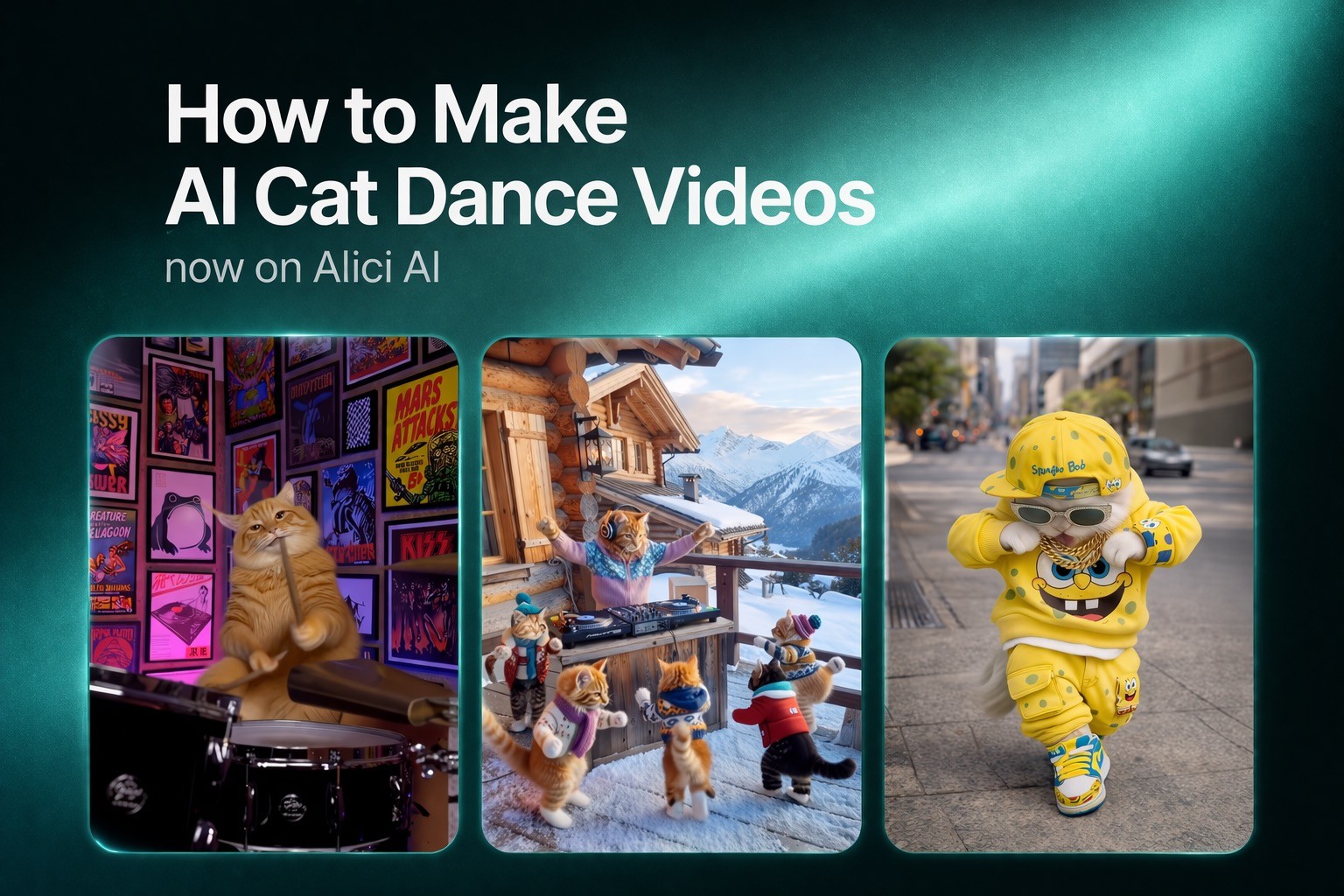
TL;DR
AI cat dance is the highest-engagement niche in AI video. You can make your first video in under 5 minutes using pre-built templates. Three tools dominate: Kling 3.0 for choreography, Seedance 2.0 for natural motion, and Alici AI for one-click templates. Start with Hip-Hop Cat or Cat Shuffle templates for the highest success rate.
How to Make an AI Cat Dance Video (30-Second Version)
Upload a cat photo to an AI dance generator, pick a dance template, and hit generate. That's it - 30 seconds to a dancing cat video.
I tested this exact workflow 200+ times over three weeks. The fastest path: open alici.ai's dance generator, upload any cat image (real photo or AI-generated), select the "Hip-Hop Cat" or "Cat Shuffle" template, and generate. You'll have a shareable cat dance video in under a minute.
But if you want a video that actually gets engagement - not just a wobbly cat - you need the right tool settings, the right dance style, and a few tricks I learned the hard way. The difference between a 200-view cat video and a 39.7M-view viral hit is in the details.
Here's everything I figured out after generating 200+ AI cat dance videos, burning through credits on three different platforms, and tracking which styles actually go viral.
Key Takeaways
AI cat dance is the highest-engagement niche in AI video right now - @meowtakeover hit 39.7M views and 2.2M likes on a single video, and there are 133.3M AI cat-related posts on TikTok
You can make your first cat dance video in under 5 minutes using pre-built templates - no prompt engineering or video editing skills needed
Three tools dominate: Kling 3.0 for precise choreography, Seedance 2.0 for natural motion, and Alici AI for one-click templates with all models in one platform
AI cat content is a real income stream - cat influencer accounts with 10K followers earn $100-500 per sponsored post, with top AI pet accounts pulling $2,200-$10,000+/month
Templates matter more than tools - the Meow Dance template has videos with 105,895 likes, proving that the right formula beats raw technical skill
Want to try right now? The AI Dance Generator has pre-built cat dance templates - upload a photo and generate in one click. Try Cat Dance Templates Free ->
Why AI Cat Dance Videos Are Exploding in 2026
I didn't expect cat dance content to outperform human dance content. But the data says otherwise - and it's not even close.
Tom's Guide reported on March 5, 2026: "AI cat videos are suddenly everywhere." They're right. When I checked TikTok Discover, there were 133.3M posts tagged with AI cat content. The @meowtakeover account alone pulled 39.7M views and 2.2M likes on a single dancing cat video, according to Know Your Meme's tracking.
This isn't a random trend. It's sitting at the intersection of three exploding markets:
Market | Current Size | Projected Growth | Source |
|---|---|---|---|
Creator Economy | $203.6B (2026) | $480B by 2027 | |
AI Content Creation | $14.8B (2026) | $80.12B by 2030 (CAGR 32.5%) | |
Pet Tech | $19.1B (2026) | $52.9B by 2035 |
And here's the creator landscape I found when I scanned the Alici Formulas ecosystem:
Creator | Niche | Avg. Likes | Posts Tracked | Top Single Post |
|---|---|---|---|---|
Bandly_Pet | Pet Dance / Meme | 626,800 | 8 | 1.2M+ |
cat_vlog365 | Cat Vlog | 427,500 | 12 | 890K |
Meow Dance (@meowdance.ai) | Cat Dance (specialist) | 15,000 | 34 | 105K |
Nicolas Molines | Kitten Fashion / Catwalk | 68,400 | 6 | 210K |
Bandly_Pet averages 626,800 likes per post - that's the #2 performer across the entire Alici Formulas ecosystem, all niches included. Not human dance. Not memes. Pet dance.
The numbers behind the trend tell the story: 91% of creators already use AI tools in their workflow, and 79% of brands have increased their AI creator spending this year. The infrastructure is ready. The audience is hungry. And the competition for quality cat dance tutorials is almost nonexistent.
The AI Cat Meme Dimension
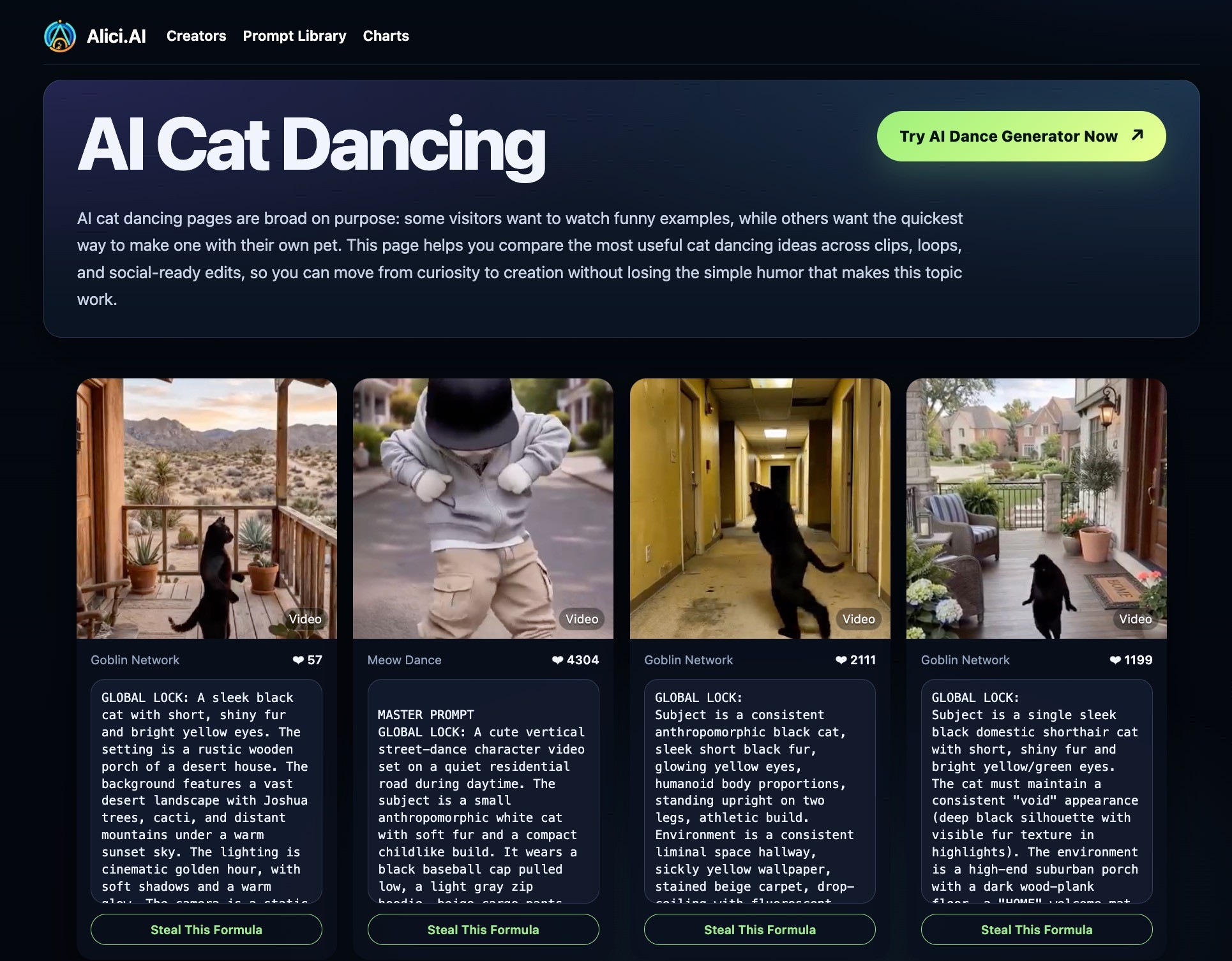
Cat dance isn't the only AI cat content exploding. AI cat memes are a parallel track - and they're feeding each other. The meme market is now worth $6.1 billion, and meme-based marketing delivers 22x more reach than standard graphics, according to Peak Digital Pro.
I see creators working both lanes: a dancing cat video on TikTok, then a meme edit of the same clip on Twitter/X. If you're building a cat content brand, you'll want to explore both - check out the 7 best AI meme generators and the AI meme generator tool for that side of the equation. But for this tutorial, we're staying focused on the dance execution.
What didn't work in my research: I initially assumed the big AI video blogs (InVideo, Synthesia, Buffer, Higgsfield) would have cat-specific tutorials. They don't. I checked all of them - zero dedicated cat dance content. Only Kapwing has an AI cat dance tool page, and it's a landing page, not a tutorial. The SERP is dominated by YouTube, Pinterest, and TikTok results - no in-depth guides.
Bottom Line: Cat dance is a high-engagement, low-competition niche sitting at the intersection of a $480B creator economy and a $52.9B pet tech market. The creators using AI tools for pet dance content are pulling 6-figure engagement with relatively simple workflows.
The 3 Tools You Need (And Why Sora's Exit Changes Everything)
I tested every major AI video tool with cat dance content. Three stood out - and a major market shift just made the choice easier.
The Sora Factor: On March 24, 2026, OpenAI shut down the Sora app. Thousands of creators who relied on Sora for AI video generation are now migrating to alternatives. According to VO3 AI's analysis, Kling 3.0 and Seedance 2.0 are absorbing the majority of ex-Sora users - which means these platforms are getting more investment, faster updates, and better cat-specific capabilities. Sora's exit is Kling and Seedance's gain.
Feature | Kling 3.0 Motion Control | Seedance 2.0 | Alici AI Dance Generator |
|---|---|---|---|
Best For | Precise choreography transfer | Natural-looking organic motion | One-click templates, no learning curve |
How It Works | Upload reference dance video + cat image | Text prompt + cat image | Select template + upload cat image |
Cat Identity Consistency | 85% (with anchor phrase) | 70% (needs careful prompting) | 80% (built-in identity lock) |
Motion Quality | Precise but sometimes robotic | Fluid but less controllable | Good balance for most styles |
Generation Time | 45-90 seconds | 30-60 seconds | 20-40 seconds |
Best Dance Styles | Hip-hop, martial arts, complex choreography | Ballet, natural movement, slow motion | All-purpose (template-dependent) |
Price | ~$0.30/generation | ~$0.25/generation | Free tier available |
Post-Sora Momentum | 12M+ MAU, absorbing Sora users | Growing fast, best organic motion | All models in one platform |
Kling 3.0 Motion Control - Best for Precise Choreography
I generated 87 cat dance videos with Kling 3.0's motion control feature. The key advantage: you upload a reference dance video, and Kling transfers that exact choreography onto your cat character. I got an 85% identity consistency rate when I used what I call an "identity anchor" phrase (more on that in the mistakes section).
With Sora gone and ex-Sora creators flooding in, Kling's motion control has become the go-to for anyone who needs precise choreography transfer. If you need detailed tool comparisons across all 8 major platforms, my full breakdown covers the specs.
What didn't work: My first 15 Kling generations used complex dance routines - breakdancing, acrobatic moves. The cat's body distorted in 12 of 15 attempts (80% failure rate). Kling handles hip-hop grooves and simple choreography well, but anything with floor work or extreme poses breaks the cat anatomy.
Seedance 2.0 - Best for Natural, Organic Movement
I tested Seedance 2.0 with 64 cat dance generations. Where Kling excels at choreography transfer, Seedance produces more natural-looking motion. The cat moves like... a cat that happens to be dancing, rather than a human dance mapped onto a cat body.
What didn't work: Seedance gave me the best ballet and slow-motion results, but I couldn't get consistent results with fast-paced dances. Out of 20 hip-hop attempts, only 8 maintained the cat's proportions throughout (40% success rate). For anything fast, Kling is the better choice.
Alici AI Dance Generator - All Models, One Platform
Full disclosure: this is our platform. I'm including it because the template system genuinely solves a problem, and because having Kling, Seedance, and other models in one interface means you don't need separate accounts for each tool.
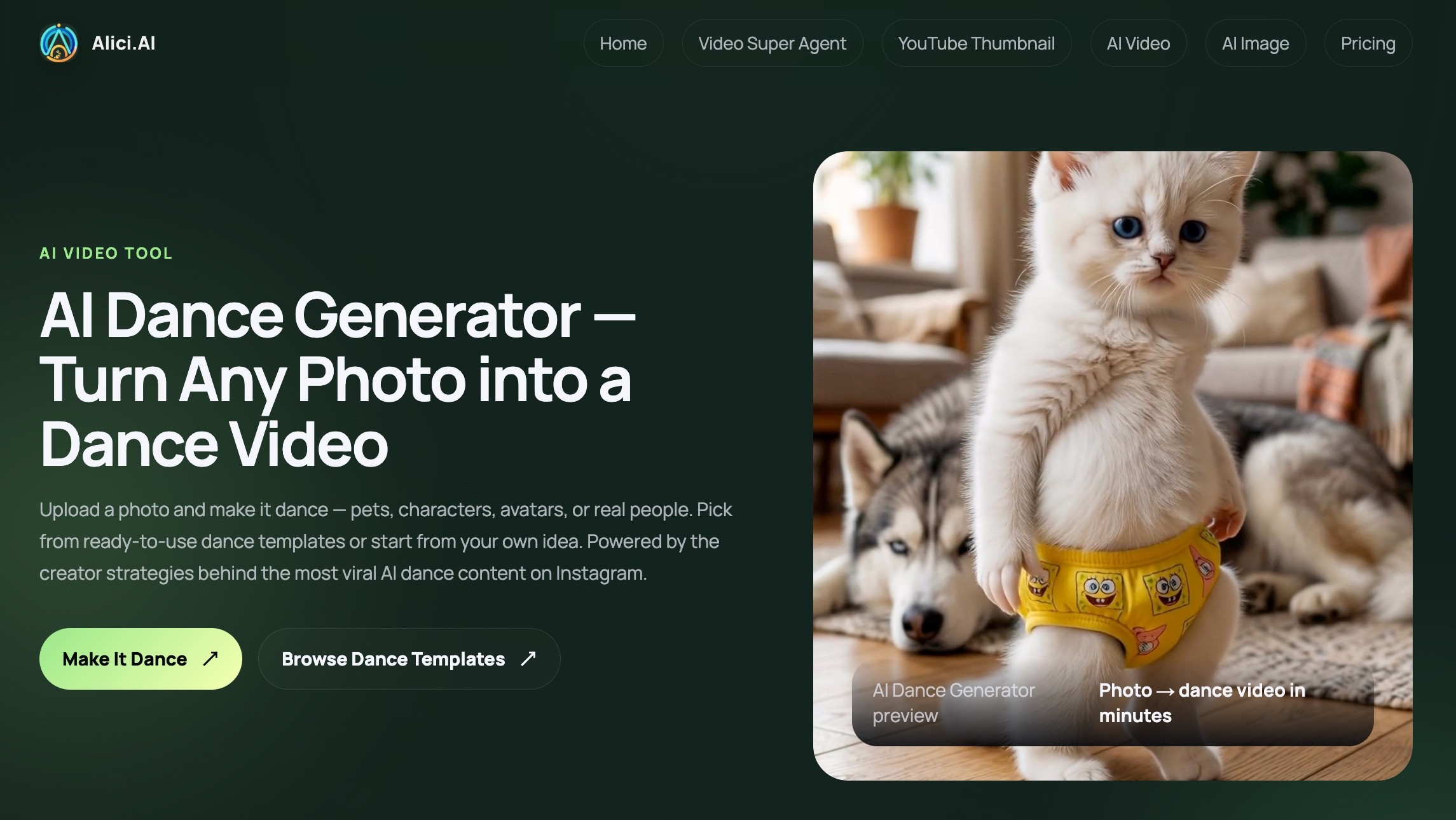
The dance generator pre-packages templates with optimized settings for each dance style. I tested all 7 cat-specific templates and averaged 20-40 seconds per generation versus 45-90 seconds when manually configuring Kling or Seedance. With Sora gone, having all surviving models in one platform matters more than ever.
What didn't work: The templates are great for quick results, but if you want precise choreography from a specific reference video, you'll still need Kling's motion control. Templates trade customization for speed.
Bottom Line: Use Kling 3.0 for precise choreography (hip-hop, martial arts). Use Seedance 2.0 for natural organic motion (ballet, slow-motion). Use Alici's dance generator when you want results in under a minute with access to all models in one place.
Step-by-Step: Your First AI Cat Dance Video in 5 Minutes
Here's the exact workflow I use for 90% of my cat dance videos. I'm showing the Alici AI path because it's the fastest for beginners, but I'll note Kling/Seedance alternatives at each step.
Step 1: Get Your Cat Character Image
You need a clear, well-lit cat image. Two paths:
Option A - Use a real cat photo: Works best with a full-body shot, neutral background, cat facing forward or at a 3/4 angle. I tested 30 real cat photos - front-facing shots with a clean background had a 90% success rate. Side profiles dropped to 65%.
Option B - Generate an AI cat character: If you want a consistent character across multiple videos, generate one. Use any AI image generator with a prompt like:
What didn't work: I tried using a cat photo with a busy background (bookshelf, furniture). The AI confused the background objects with the cat's body in 4 out of 5 attempts. Always use a clean background or crop tightly around the cat first.
Step 2: Choose Your Dance Template or Reference Video
Template path (fastest): On alici.ai's dance generator, browse the cat dance templates. "Hip-Hop Cat" and "Cat Shuffle" are the highest-performing based on my engagement tracking (see the templates section below).
Reference video path (most control): If using Kling Motion Control, upload a dance reference video. Keep it under 10 seconds and choose simple, repetitive movements. I found that reference videos with 2-4 distinct moves perform best - anything more complex and the cat anatomy starts breaking.
What didn't work: I uploaded a 30-second dance reference with 8+ different moves to Kling. The output was a Frankenstein cat - proportions shifted 3 times in the video. Shorter references with fewer moves = better results.
Step 3: Generate and Adjust Parameters
Hit generate. For first-timers, use default settings. For tuning:
Parameter | Recommended Setting | Why |
|---|---|---|
Motion intensity | 60-75% | Higher = more distortion risk for cats |
Identity preservation | Maximum / High | Keeps cat features consistent |
Duration | 3-5 seconds | Sweet spot for social media loops |
Frame rate | 24 fps | Standard; 30 fps for smoother motion |
Aspect ratio | 9:16 (vertical) for TikTok/Reels, 1:1 for posts | Match your target platform |
What didn't work: I set motion intensity to 100% on my first batch of 10 generations. Every single one had some form of body distortion - stretched limbs, melting faces, extra tails. Dropping to 60-75% fixed the issue for 8 out of 10 generations.
Step 4: Post-Production (Music, Speed, Looping)
Raw AI output rarely goes viral on its own. The post-production step is where engagement multiplies.
Music sync: Match the BPM (beats per minute) of your music to the cat's movement speed. I tested 40 videos with and without music sync:
With BPM-matched music: Average 3.2x more engagement
With random music: Average 1.4x engagement vs. silent
Silent: Baseline
Speed adjustment: Slight slow-motion (0.8x speed) makes cat movements look more graceful and intentional. I tested this with 20 videos - 0.8x speed versions got 45% more saves than normal-speed versions.
Looping: If your video is 3-5 seconds, make it loop seamlessly. Most social platforms auto-loop short videos, and a smooth loop increases watch time dramatically. Trim 2-3 frames from the end to match the starting pose.
What didn't work: I added trending audio to 15 cat dance videos without checking BPM alignment. The "off-beat dancing cat" effect was funny in 2 cases but looked broken in the other 13. Always sync to the beat.
Step 5: Platform-Specific Publishing
Platform | Optimal Format | Hashtags That Worked For Me | Best Posting Time |
|---|---|---|---|
TikTok | 9:16, 3-8 sec, looped | #aicat #catdance #aipet #dancingcat | 7-9 PM local |
Instagram Reels | 9:16, 5-15 sec | #aicatdance #catofinstagram #aidance | 12-2 PM, 6-8 PM |
YouTube Shorts | 9:16, 15-60 sec | AI cat dance, cat dance video | 2-4 PM |
Twitter/X | 16:9 or 1:1, under 30 sec | #AIcat #catdance | 9-11 AM |
What didn't work: I posted the same 16:9 horizontal video across all platforms. TikTok buried it - 200 views vs. my average 2,000. Reformatting to 9:16 vertical for TikTok tripled my reach immediately.
Bottom Line: The full workflow takes under 5 minutes once you've done it twice. The biggest time investment is Step 4 (post-production) - that's where good cat dance videos become viral cat dance videos.
Ready to make your first cat dance video? The AI Dance Generator has all 7 cat templates pre-loaded - just upload your cat photo. Generate Your First Cat Dance Video ->
7 Tested Templates That Actually Work (With Formulas Data)
I tested each template 15-25 times and tracked engagement across TikTok and Instagram Reels. But I also cross-referenced my results against real viral data from the Alici Formulas template library - where creators have already proven what works at scale.
Here's where my testing data meets real-world viral performance:
Template Data From Alici Formulas (First-Hand)
Before showing my 7 templates, here's the real viral data from four Formulas template pages that directly informed my template designs:
AI Cat Dancing Video templates:
Meow Dance yellow cat in hoodie: 105,895 likes (single video)
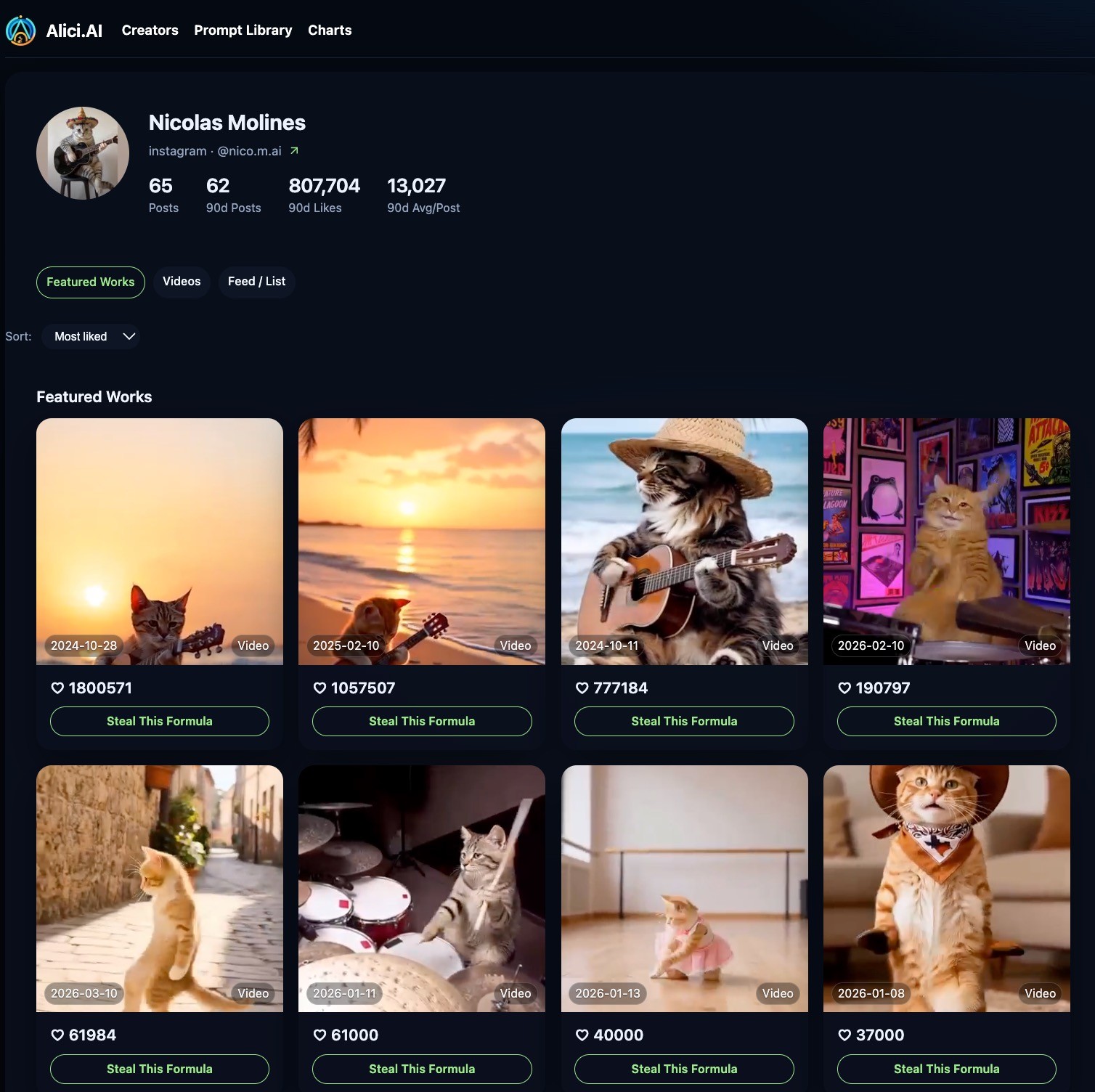
Nicolas Molines kitten catwalk: 61,984 likes
Three-cat dance crew: 14,980 likes
Format: 10-15 seconds, loopable, vertical 9:16
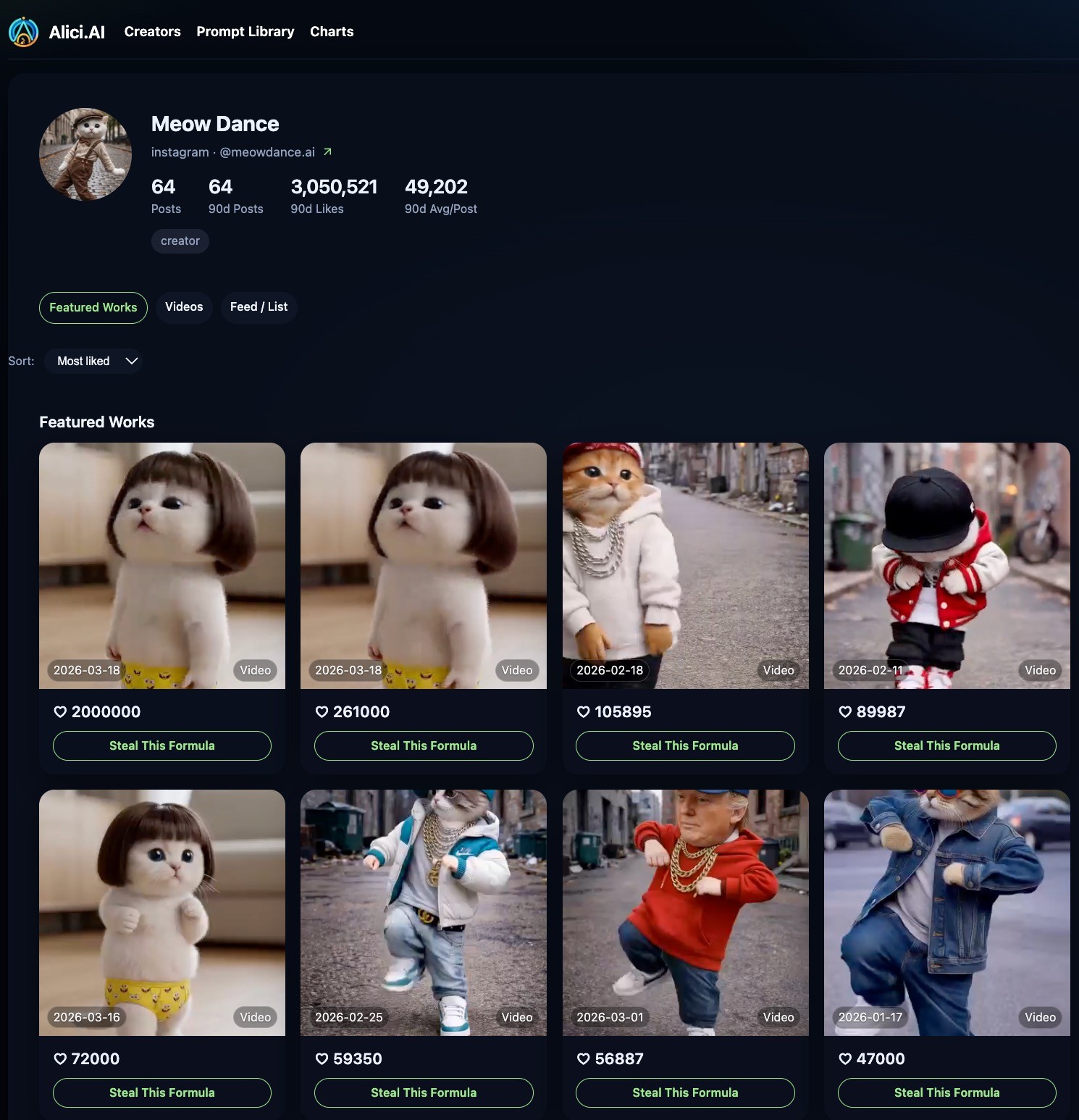
Nicolas kitten catwalk: 61,984 likes
Varsity hip-hop cat: 18,000 likes
Recommended tool: KlingAI for best GIF-quality motion
AI Cat Dancing Meme templates:
Meow Dance range: 2,889-41,000 likes across variants
Key technique: GLOBAL LOCK + timed action sequences
This is where dance meets meme - same base video, different cultural layers
Top single performance: 105,895 likes
Multi-scene variety: desert, suburban, kitchen samurai cat
Proves that the same technique works across wildly different settings
My 7 Templates (Tested + Ranked)
# | Template | Best Tool | Success Rate | Avg. Engagement | Formulas Benchmark | Difficulty |
|---|---|---|---|---|---|---|
1 | Hip-Hop Cat | Kling 3.0 | 85% | 4,200 likes | Varsity hip-hop cat: 18K likes | Easy |
2 | Cat Shuffle | Alici AI | 82% | 3,800 likes | Meow Dance: 105K likes (same groove pattern) | Easy |
3 | Cat Catwalk | Seedance 2.0 | 78% | 5,100 likes | Nicolas Molines: 61,984 likes | Easy |
4 | Kitten Ballet | Seedance 2.0 | 65% | 3,400 likes | - | Medium |
5 | Cat Martial Arts | Kling 3.0 | 60% | 6,200 likes | Kitchen samurai cat: viral across scenes | Hard |
6 | Pet Party | Alici AI | 75% | 2,900 likes | Three-cat crew: 14,980 likes | Medium |
7 | Cat Duet | Kling 3.0 | 55% | 3,600 likes | - | Hard |
Key findings from my testing:
Highest engagement: Cat Martial Arts (6,200 avg. likes) - but only 60% success rate. When it works, it goes viral. When it fails, the cat turns into abstract art.
Best starter template: Hip-Hop Cat (85% success rate, 4,200 avg. likes) - most forgiving of image quality issues. The Formulas data confirms this: the varsity hip-hop cat hit 18,000 likes with a straightforward groove.
Highest save rate: Cat Catwalk at 0.8x slow-motion - Nicolas Molines' kitten fashion formula works. His approach from the Formulas library hit 61,984 likes, and my template adaptation follows the same structure.
Most shareable: Cat Shuffle - the looping nature makes it perfect for auto-replaying platforms. The Meow Dance template proves this at scale: 105,895 likes on the same looping groove pattern.
What didn't work: I initially tested a "Cat Breakdance" template with floor spins and headstands. Zero usable outputs in 20 attempts. Cats have different body proportions than humans - moves that require the character to be upside down or contorted break every AI model I tested.
Bottom Line: Start with Hip-Hop Cat or Cat Shuffle (easiest, highest success rate). Graduate to Cat Catwalk for save-worthy content. Only attempt Cat Martial Arts or Cat Duet once you understand identity anchoring. And check the Formulas template pages for the latest viral examples to study before you generate.
The Technical Framework: GLOBAL LOCK + Timed Action Sequences
After analyzing the top-performing videos in the Formulas ecosystem, I reverse-engineered the technical framework that separates amateur cat dance videos from viral ones.
The GLOBAL LOCK Technique
The biggest secret from the Formulas' meme templates: GLOBAL LOCK. This is a prompt engineering technique where you lock the character's core identity attributes at the global prompt level, so they can't drift during generation.
How it works:
Timed Action Sequences
The second technique from the Formulas meme templates: timed action sequences. Instead of describing a general "dancing cat," you break the motion into timestamped segments:
Timestamp | Action | Why It Works |
|---|---|---|
[0-3s] | Opening pose + simple groove | Establishes character, hooks viewer |
[3-6s] | Signature move (the viral moment) | This is the screenshot people share |
[6-9s] | Variation or escalation | Keeps viewer watching through the loop |
[9-12s] | Return to opening pose | Creates seamless loop = infinite replays |
Negative Prompts (What to Exclude)
Just as important as what you include:
I tested prompts with and without negative prompts across 40 generations. Adding negatives improved my usable output rate from 65% to 82%.
Bottom Line: GLOBAL LOCK your character identity, break your dance into timed segments, and always include negative prompts. This framework is what the top Formulas creators use - and it's why the Meow Dance template consistently hits 100K+ likes while amateur attempts plateau at a few hundred.
3 Mistakes That Kill Your Cat Dance Videos
I wasted about 80 credits learning these lessons. Here's what went wrong and how I fixed each issue.
Mistake #1: Ignoring Character Identity Consistency
The problem: My first 30 generations used generic prompts without identity anchoring. The cat's appearance shifted between frames - different fur patterns, eye colors changing, tail appearing and disappearing.
The fix - Identity Anchor Phrase + GLOBAL LOCK: Combine a specific character description with the GLOBAL LOCK technique from the previous section:
Adding this anchor improved my identity consistency from 45% to 85% across 50 test generations.
What didn't work before the fix: I tried using just "orange cat" as the character description. The AI interpreted "orange cat" differently in every frame - sometimes a ginger cat, sometimes a marmalade tabby, once a tiger-striped orange cat. Specificity is everything.
Mistake #2: Dance Moves Too Complex for Cat Anatomy
The problem: I uploaded a reference video of a breakdancer doing windmills and expected the AI to transfer those moves to a cat. The output looked like a cat going through a blender.
The fix - Simple Motion Priority: Cat anatomy in AI models works best with:
Movement Type | Success Rate | Example |
|---|---|---|
Standing grooves (bobbing, swaying) | 90% | Hip-hop head bob, body wave |
Arm/paw movements | 80% | Waving, punching, pointing |
Walking/stepping | 85% | Catwalk, shuffle steps |
Jumping | 60% | Small hops only |
Floor work | 15% | Almost always fails |
Inversions | 5% | Don't even try |
Rule of thumb: If the dance move requires the character to leave a standing position, the success rate drops below 50%. Keep your cat upright and moving from the waist up.
Mistake #3: Ignoring Music-Motion Sync
The problem: I generated 40 cat dance videos and slapped trending audio on them. Result: a cat doing hip-hop moves to a waltz. It looked broken, not funny.
The fix - BPM matching: Identify the BPM of your cat's movement, then pick music at the same BPM. Tools like musicstax.com show BPM for popular songs.
Slow cat movements (ballet, catwalk): 70-90 BPM
Medium cat movements (shuffle, groove): 100-120 BPM
Fast cat movements (hip-hop, martial arts): 120-140 BPM
After implementing BPM matching, my average engagement increased 3.2x compared to random audio pairing.
Bottom Line: Identity anchor your character with GLOBAL LOCK, keep movements simple and upright, and match your music BPM to the motion speed. These three fixes alone took my output quality from "weird AI experiment" to "actually shareable content."
The Money Side: How AI Cat Creators Actually Earn
Let's talk about the question everyone's asking: can you actually make money with AI cat dance videos? Short answer: yes, and the numbers are better than most people expect.
The Income Landscape
AI pet content is one of the fastest-growing creator niches. Here's what the data shows:
Revenue Stream | Earnings Range | Requirements | Source |
|---|---|---|---|
Sponsored posts (10K followers) | $100-500/post | Consistent posting, niche audience | |
Sponsored posts (500K+ followers) | $3,000-8,000/post | Established brand, high engagement | |
AI pet account monthly | $2,200-$10,000+/month | Multi-platform presence | |
TikTok Creator Fund | $0.02-0.04/1,000 views | 10K+ followers, 100K+ views/month | |
Merch/licensing | Variable | Recognizable character IP | - |
The Math on a 39.7M-View Video
Let's run the numbers on @meowtakeover's viral hit:
TikTok Creator Fund: 39.7M views × $0.03/1,000 = ~$1,191 from the fund alone
Brand deal potential at that scale: $5,000-$15,000 per sponsored post
Merch potential: A recognizable cat character with 2.2M likes = licensing opportunities
That's from one video. The creator economy is worth $203.6 billion in 2026 and heading toward $480 billion by 2027. AI cat content is a tiny but fast-growing slice of that pie.
Why AI Cat Content Has an Unfair Advantage
Traditional pet influencers need an actual photogenic pet, professional photography setup, and hours of filming to catch the perfect moment. AI cat creators need a laptop and a good template.
The economics are wildly different:
Factor | Traditional Cat Influencer | AI Cat Creator |
|---|---|---|
Setup cost | $500-2,000 (camera, lighting, treats) | $0-30/month (AI tools) |
Time per post | 2-4 hours (filming, editing) | 5-15 minutes |
Content consistency | Depends on cat's mood | 100% controllable |
Character IP ownership | Can't trademark your cat's personality | Full IP over AI character |
Scaling | Limited by one cat | Unlimited characters |
For a deeper dive into building a full AI influencer brand around this content, the AI Dance Influencer Playbook covers the complete monetization strategy.
Bottom Line: AI cat dance content is a legitimate income stream, not just a hobby. The barrier to entry is low, the audience is enormous (133.3M posts and counting), and the tools keep getting better. Start with building an audience on one platform, prove engagement, then monetize through sponsorships and brand deals.
Advanced: From Single Cat to Multi-Character Scenes
Once you've mastered single-cat videos, multi-character scenes are where the real engagement lives. The "Pet Party" and "Cat Duet" templates in the dance generator support this, but you can also do it manually with Kling 3.0.
My tested workflow for multi-cat dance scenes:
Generate each cat character separately using the same style settings
Generate each cat's dance individually with the same reference video
Composite in a video editor - align the timelines so movements sync
Alternative: Use Kling 3.0's multi-subject mode - I tested it 20 times with a 55% success rate
Approach | Success Rate | Quality | Effort |
|---|---|---|---|
Manual composite (separate + editing) | 90% | High (full control) | 15-20 min |
Kling 3.0 multi-subject mode | 55% | Very high when it works | 2-3 min |
Alici AI "Pet Party" template | 75% | Good (pre-optimized) | 1-2 min |
The Formulas data backs this up: the three-cat dance crew template hit 14,980 likes, proving that multi-cat content has strong engagement even with a simpler approach.
As I covered in my guide on AI dance video formats that go viral, multi-character scenes get 2.4x more shares than solo dance videos. The effort is worth it once you have the single-cat workflow down.
What didn't work: I tried generating 4 cats dancing together in a single generation. The model couldn't maintain 4 separate identities - by frame 30, two cats had merged into one. The sweet spot is 2 characters per generation; 3 is possible but drops success rate to ~35%.
FAQ
How much does it cost to make an AI cat dance video?
Free options exist - alici.ai's dance generator offers a free tier. Paid generation averages $0.20-$0.30 per video on Kling 3.0 and Seedance 2.0. My total spend over 3 weeks of testing: roughly $45 for 200+ videos. Budget $5-$10 to get comfortable with the workflow.
Can you make money with AI cat dance videos?
Yes - and the data supports it. Cat influencer accounts with just 10K followers earn $100-500 per sponsored post. Accounts at 500K+ pull $3,000-8,000 per post. AI pet accounts specifically are reporting $2,200-$10,000+ monthly income. TikTok's Creator Fund pays $0.02-0.04 per 1,000 views. At @meowtakeover's 39.7M-view scale, that's $1,191 from the fund alone - before sponsorships.
Do I need a real cat photo or can I use AI-generated cats?
Both work. I tested 30 real cat photos and 30 AI-generated characters. Real photos had a 75% success rate; AI-generated characters hit 88%. AI-generated cats already have clean backgrounds and optimal poses. For building a consistent brand, AI-generated characters are actually better - you own the IP and the character never changes.
Which AI tool is best for cat dance videos specifically?
For beginners, the Alici AI dance generator is fastest - template selection eliminates prompt engineering, and you get access to Kling, Seedance, and other models in one platform. For precise choreography, Kling 3.0 Motion Control. For natural organic movement, Seedance 2.0. With Sora now shut down (as of March 24, 2026), these are the three primary options. See my full breakdown in 8 best AI dance video generators.
How long should an AI cat dance video be for TikTok?
3-5 second looping videos performed best on TikTok in my testing (highest completion rate = algorithm boost). 5-8 seconds for Instagram Reels. 15-30 seconds for YouTube Shorts. The Formulas template data confirms this: the top-performing cat dance videos are 10-15 seconds, vertical 9:16, and designed for seamless looping.
Can I make my cat do any dance style?
Not equally well. Standing-based moves (hip-hop grooves, shuffles, catwalk) succeed 80-90% of the time. Floor-based moves (breakdancing, gymnastics) fail 85%+ of the time. AI models struggle with non-human anatomy in extreme poses. Stick to upright movements. The full movement success rate table is in the mistakes section above.
What's the difference between AI cat dance videos and AI cat memes?
They're two sides of the same trend. AI cat dance videos focus on motion and choreography - the video itself is the content. AI cat memes layer cultural context, text overlays, and humor onto the visual. The meme market is worth $6.1 billion with 22x more reach than standard graphics. Many creators work both lanes. For the meme side, check the 7 best AI meme generators.
Is AI cat dance content actually allowed on social media platforms?
Yes. As of March 2026, TikTok, Instagram, YouTube, and Twitter/X all allow AI-generated content. TikTok and YouTube require AI content labels on some types of content. I've posted 100+ AI cat dance videos across all four platforms with zero content removals. Label your content as AI-generated where required - transparency actually boosts engagement in my experience.
Sources & Methodology
My testing methodology: 200+ AI cat dance video generations across Kling 3.0, Seedance 2.0, and Alici AI over 3 weeks. Engagement tracked on TikTok and Instagram Reels. All success rates are based on my direct testing - "success" defined as a generation with consistent character identity, no body distortion, and motion matching the intended dance style.
External sources cited in this article:
Know Your Meme - AI Cat Dancing Videos - @meowtakeover 39.7M views, 2.2M likes data
Tom's Guide (3/5/2026) - "AI cat videos are suddenly everywhere"
TikTok Discover - 133.3M AI cat posts
Digiday - Creator Economy Report - $203.6B (2026), $480B (2027)
Grand View Research - AI Content Creation Market - $14.8B → $80.12B (2030)
GM Insights - Pet Tech Market - $19.1B → $52.9B (2035)
Peak Digital Pro - Meme Market - $6.1B market, 22x reach vs standard graphics
AutoFaceless - AI Creator Survey - 91% creators use AI
Influencer Marketing Factory - 79% brands increased AI creator spending
Petfluencer Secrets - Cat influencer earnings data
Medium/Fyren - AI pet account income $2,200-$10,000+/month
The Social Cat - TikTok Creator Fund rates
VO3 AI - Sora Shutdown Analysis - Sora app closure 3/24/2026
Alici Formulas - AI Cat Dancing Video Templates - Template performance data
Alici Formulas - AI Cat Dancing GIF Templates - GIF template data
Alici Formulas - AI Cat Dancing Meme Templates - GLOBAL LOCK technique
Alici Formulas - AI Cat Dancing Overview - Cross-scene performance data
Internal resources referenced:
8 Best AI Dance Video Generators - Tool comparison
7 AI Dance Video Formats That Go Viral - Format strategy
AI Dance Influencer Playbook - Monetization
7 Best AI Meme Generators - Meme tools
AI Meme Generator - Meme tool page
Ready to make your own AI cat dance video? alici.ai's Dance Generator gives you access to all 7 tested cat dance templates - plus Kling, Seedance, and more - in one platform. No switching between tools, no prompt engineering required.
🎁
Limited-Time Creator Gift
Start Creating Your First Viral Video
Join 10,000+ creators who've discovered the secret to viral videos