How to Create an AI Dance Influencer in 2026 (The Complete Playbook)
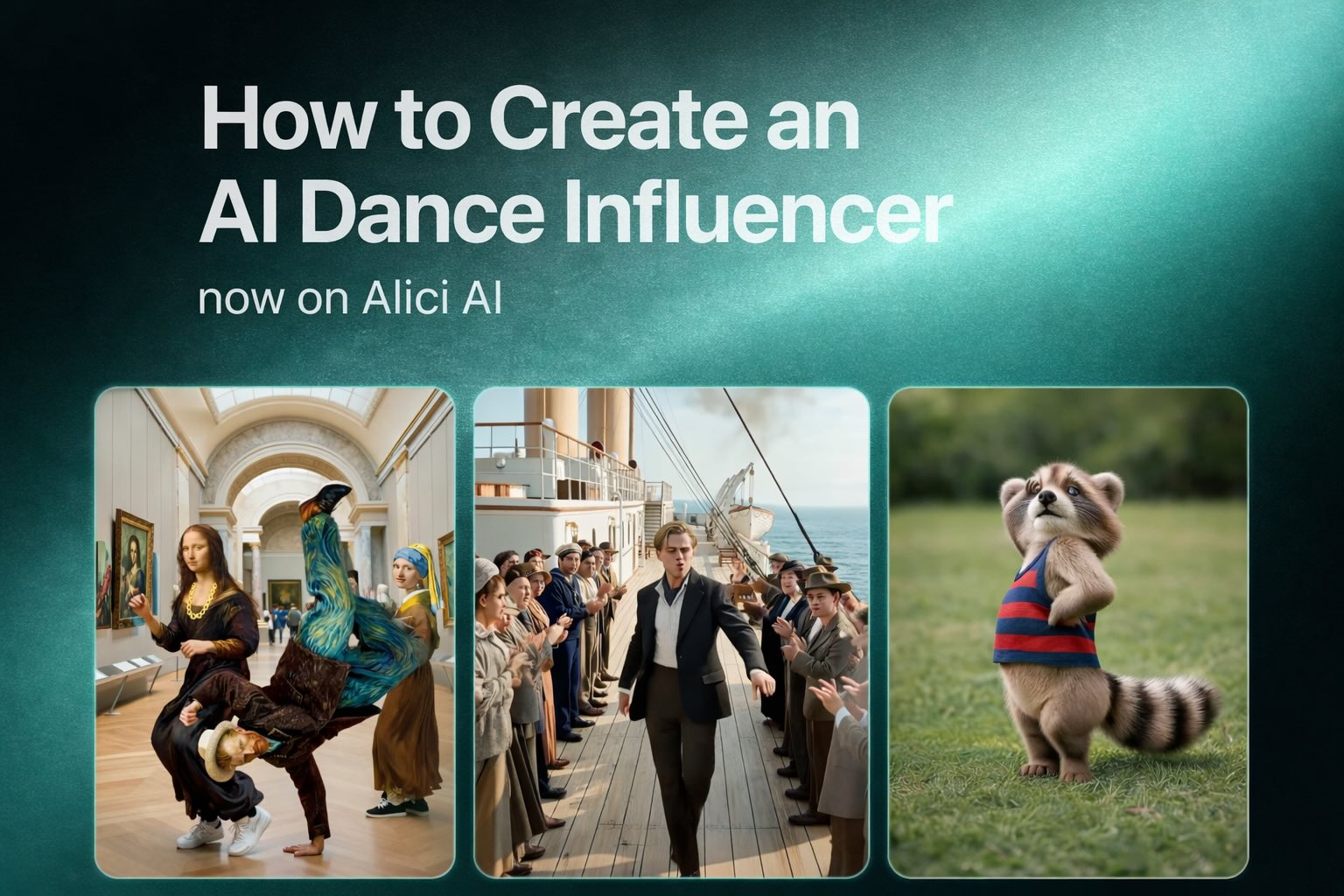
From character creation to 138K likes — the step-by-step playbook for building an AI dance influencer, with real creator formulas and production workflows.
|
18 min
TL;DR
To create an AI dance influencer: generate a consistent character, pick from 60+ dance templates on Alici AI's Dance Generator, upload your photo, and the platform handles model selection and generation. No prompts needed. Each video takes under 5 minutes. Dance is the killer content format for AI influencers because it solves uncanny valley, eliminates lip-sync risk, and achieves 3x engagement of human creators.
I'll let you in on something: creating an AI dance influencer is absurdly easy to start and dangerously addictive once you do. You don't write prompts. You don't choreograph anything. You find a viral dance on Alici AI's Dance Generator, pick a template from 60+ options, upload your character's photo, and the platform handles the rest - model selection, clip trimming, even publishing. Your character is now dancing - identity preserved, physics realistic, ready to post. I made my first one in under 5 minutes. By the third day, I had a week's worth of content.
That's the insight nobody tells you: the barrier isn't skill - it's deciding to start. The AI Influencer dance space hit $6.1 billion in 2026 (according to InVideo's market analysis), and AI influencers achieve 3x the engagement rate of human creators (5.9% vs 1.9%). Yet most guides treat "AI influencer" and "AI dance" as separate topics. They're not. Dance is the killer content format for AI influencers - and this guide shows you exactly how to combine them.
Quick Answer: To create an AI dance influencer: (1) Generate a consistent character using Alici AI's Image Studio, (2) browse Alici AI's Dance Generator to pick from 60+ viral dance templates with ready-to-use reference clips, (3) upload your character photo and let the platform handle model selection, clip trimming, and generation, (4) post consistently with a locked visual identity. The entire process takes under 5 minutes per video. For advanced users, Kling 3 Motion Control gives frame-level control. For everyone else, the AI Dance Generator one-click workflow is the fastest path from zero to published. Study what top creators do on Alici Formulas.
Key Takeaways:
Dance solves the three problems of AI influencer content. Static AI images feel uncanny. AI dialogue sounds robotic. But AI dance? It's stylized motion set to music - there's no uncanny valley because viewers expect non-realistic movement. No dialogue means no lip-sync failures. And music-driven short clips are the highest-engagement format on every platform.
You don't need to write dance prompts. The biggest misconception about AI dance: that you need to describe choreography in text. You don't. Find a 10-second reference video (any TikTok, any MV, any dance clip), upload it with your character photo, and Kling 3 Motion Control handles the rest. The reference video IS your prompt.
The top AI dance influencer gets 427K average likes per post. From Alici Formulas charts: cat_vlog365 averages 427,500 likes - the highest in the entire ecosystem of 112 tracked creators. Dreamweaver's Dirty Dancing series hit 9.6 million views on a single video. These aren't outliers - they're the result of repeatable formulas.
Dirty Dancing AI is the hottest trend in this space. The "Nobody puts [X] in a corner" format is everywhere - from cats to historical figures to anime characters. Dreamweaver (880K Instagram, 889K TikTok) built his following almost entirely on this format.
One reference dance → unlimited character variations. This is the production multiplier that makes AI dance influencers viable: one 10-second dance clip can power dozens of outputs. Same choreography, different characters, different settings, different outfits. I proved this in my Kling MC guide with four streetstyle variations from one reference dance.
Why Dance Is the Killer Content Format for AI Influencers
Before we build anything, let's understand why dance specifically - not static images, not talking head videos, not AI art - is the format that works best for virtual influencers.
The Three Problems Dance Solves
Problem with AI Influencer Content | Why Dance Solves It |
|---|---|
Uncanny valley - realistic AI faces look "off" in static images | Dance is stylized motion. Viewers expect non-realistic movement in dance videos. The character feels alive without triggering uncanny valley |
Lip-sync failure - AI dialogue sounds robotic, timing feels wrong | Dance has no dialogue. Music replaces speech. Zero lip-sync risk |
Low engagement - static AI images get likes but not shares | Music-driven short clips are the highest-engagement format on TikTok (3M+ median views for dance content, 25% above other categories) |
The Production Economics
Traditional AI influencer content (dialogue, storytelling, product reviews) requires: script writing, voice generation, lip-sync, editing. Each video takes 30-60 minutes.
AI dance influencer content requires: find a reference video, upload character photo, click generate. Each video takes under 5 minutes.
That's a 10x production speed advantage. Which means you can test more concepts, post more frequently, and find your viral formula faster.
Step 1: Create Your Character (And Lock the Identity)
Your character is the foundation of everything. Get this right and every video after it becomes easier. Get it wrong and you'll spend weeks redoing assets.
What Makes a Good AI Dance Character?
From studying the top creators on Alici Formulas, I found a clear hierarchy of what works:
Character Type | Avg. Engagement | Why It Works for Dance | Example |
|---|---|---|---|
Costumed animals | Highest (427K avg - cat_vlog365) | Impossibility = shareability. No casting director can book a dancing raccoon | Meow Dance cats, Hugh's raccoon |
Celebrity-coded characters | Very high (44.5K avg, 7x vs non-celebrity) | Recognition → "Who is that?" comments → algorithm boost | Dreamweaver's Dirty Dancing series |
Stylized human characters | High (42K avg - Eva Delonne) | Unique aesthetic = brand identity | Fashion-forward AI influencers |
Cultural icons/paintings | High (38K - Mona Lisa & Friends) | Pre-loaded cultural recognition + incongruity | Renaissance paintings dancing hip-hop |
Realistic human characters | Lower (<10K avg) | Uncanny valley risk. Competes with real humans | Generic AI influencer attempts |
My recommendation: Start with a non-human character (animal or stylized) for maximum engagement, OR a celebrity-coded character for maximum growth speed. Avoid hyper-realistic human characters unless you have a specific brand reason.
How to Generate Your Character
Use Alici AI's Image Studio or Nano Banana Pro to generate your character - for a deep dive into character creation with 10 photography prompt styles, see our AI Influencer creation guide
Create 5-7 reference images of the same character in different poses and angles
Lock the visual identity: same outfit palette, same hair/fur, same proportions
Ensure at least one image is full-body with clear face - this becomes your primary Motion Control input
The "Global Lock" technique (from Dreamweaver's formula): Before your first video, lock these elements across ALL future content:
Color palette (Dreamweaver: consistent warm cinematic tones)
Character proportions (same body type, same face structure)
Environment mood (same lighting style, same backdrop feel)
Wardrobe system (2-3 signature outfits that repeat)
6 out of 8 Dreamweaver videos display this visual consistency - it's not accidental, it's a system.
My own identity lock - Lucy's system: I learned this the hard way. Lucy's identity anchor is her blue-pink gradient hair. Across 5 dance videos - from a rainbow feather carnival costume to a Mai Shiranui cosplay to yellow punk streetwear - that hair color is always the same. Everything else changes (outfit, setting, dance style), but the hair says "this is Lucy." When I look at my 5 videos side by side, the identity is instantly recognizable despite radical costume changes. That's the power of having ONE unmistakable visual element locked before you start.
Step 2: Find Your Dance Reference (This Is Your Real Prompt)
Here's where the magic happens, and it's stupidly simple: you don't write a dance prompt. You find a video.
Where to Find Reference Dances
Source | Best For | Example |
|---|---|---|
TikTok trending dances | Viral trend participation | Search "trending dance" on TikTok Discover |
Music video choreography | Cinematic quality | Any K-pop MV, any music video with clear choreography |
Dirty Dancing clips | The hottest AI dance trend right now | The lift scene, the lake scene, the finale |
Your own dance | Maximum authenticity | Film yourself doing simple moves - nobody needs to see this reference |
Dance template libraries | Quick starts | Alici AI Dance Generator has 60+ templates with pre-selected reference clips |
Reference Video Requirements
What Works | What Fails |
|---|---|
3-10 seconds long | Multiple people (AI can't decide who to track) |
Single person, clearly visible | Heavy occlusion (hands covering face) |
Stable camera (tripod or locked shot) | Shaky handheld footage |
Good lighting, clean background | Extremely fast movements (especially fingers) |
Simple choreography (arm pops, swaying, steps) | Complex acrobatic footwork |
The choreography risk ladder (from Alici Formulas research):
Risk | Movements | Success Rate |
|---|---|---|
Low (start here) | Arm pops, shoulder bounces, step-touches, swaying | 90%+ |
Medium | Walking, running, social dances, simple hip-hop | 70-80% |
High (advanced) | Rapid footwork, acrobatics, multi-person contact | 40-60% |
My experience: The simplest dances go the most viral. Hugh's raccoon doesn't do backflips - it does goofy arm-flailing. Meow Dance's 105,895-like cat does basic hip-hop steps. The Dirty Dancing trend uses slow, theatrical movements. Complexity is your enemy.
Step 3: Generate the Dance Video (Under 5 Minutes)
The Easy Path: Alici AI Dance Generator (Recommended for Most Users)
The AI Dance Generator handles the technical complexity for you:
Browse 60+ dance templates - each based on a real viral video with proven engagement data from Alici Formulas
Pick a template (cat dance, K-pop, Dirty Dancing, hip-hop - whatever fits your character)
Upload your character photo (the one you locked in Step 1)
The platform automatically selects the best model, trims the reference clip, and checks your photo for common issues (limb cropping, face clarity)
Generate - typically 2-5 minutes
Compare takes, add music if needed, publish directly to TikTok/Instagram/Shorts
What the platform handles that you don't have to think about:
Model selection - automatically picks Kling 3 for motion control, Seedance 2 for beat-sync, or Hailuo for style presets based on the reference video
Clip trimming - AI detects the best 5-10 second window from your reference
Breathing Room precheck - warns if your character photo has cropped limbs (the #1 cause of artifacts)
Choreography risk - flags if the reference dance has complex footwork that might cause issues
This is the workflow I recommend for 90% of users. You don't need to understand Element Binding or Scene Source settings - the platform abstracts that away.
The Advanced Path: Kling 3 Motion Control (For Power Users)
If you want frame-level control over every aspect - Element Binding for multi-angle face locking, Scene Source switching, custom prompts for environment - use Kling 3 Motion Control directly. I documented the full 10-step workflow in my Kling MC guide.
When to go advanced: When you've made 20+ dance videos with the easy path and want more precision. When you're doing cosplay crossovers (like my Lucy x Mai Shiranui) where character details matter. When you need 30-second clips instead of the standard 5-10 seconds.
My Kling 2.6 vs 3 experience: I tested both with Lucy. The Kling 2.6 Sport Casual video has severe motion blur during fast moves - face and arms become unrecognizable. The same complexity in Kling 3 (Yellow Punk, K-pop Pink) comes out dramatically cleaner. If using the advanced path, Kling 3 is non-negotiable.
Why this is addictive: Whether you use the easy or advanced path, each video takes about 5 minutes from idea to output. Queue 3-4 variations in a 15-minute session. Same dance, different outfits. Same character, different dances. The combinatorial explosion is what makes AI influencer content scalable.
The Production Multiplier
One reference dance → multiple outputs:
This is exactly what I did in my Kling MC guide: one dance reference, four streetstyle outfits, one afternoon, one week of content.
For tool alternatives and detailed comparisons, see our Best AI Dance Video Generators. For the full step-by-step tutorial on each method, see How to Make AI Dance Videos.
My Experience: How I Got Addicted in 72 Hours
I want to share something personal here, because it's the best proof of concept I have.
I started testing Kling 3 Motion Control for my Motion Control guide - purely as research. By the end of day one, I had Lucy (my AI persona) dancing in a yellow punk outfit in a garage setting. By day two, I had her in four different looks: K-pop pink, red satin, checker racing, and a plaid prayer pink look - all from the same reference dance. By day three, I was cosplaying Mai Shiranui (the fighter game character), doing traditional Chinese finger dances, and testing a sporty casual look.
In one week, I had 11 distinct dance styles:
Style | Reference Source | What I Learned |
|---|---|---|
Yellow Punk | Street dance TikTok | My best video - Lucy in yellow off-shoulder top, chain belt, combat boots, underground parking lot. Her expression is confident, almost smiling. This one looks publishable as-is. |
K-pop Pink | K-pop MV clip | Same parking lot, different outfit - pink cropped cardigan + white tutu skirt + pink platforms. Lucy leans against the P-Level 4 pillar. The industrial x sweet contrast proves the Contradiction Rule works at the outfit level |
Mai Shiranui | Fighting game cosplay | Game character x dance crossover: Lucy in a red kimono combat outfit with cherry blossom patterns and rope belt. Face detail is stunning - eyes half-closed, confident expression. This opened a whole new sub-niche for me: cosplay dance |
Carnival Full Body | Theatrical dance | The most ambitious one: rainbow feather wings + blue-gold sequin bodysuit. Kling 3's physics engine handles the feathers beautifully - they flutter with every arm movement. This pushed my understanding of what Motion Control can handle |
Sport Casual (Kling 2.6) | Athletic K-pop dance | This was my Kling 2.6 test - and the difference is brutal. Fast dance moves = motion blur on face and arms. Same Lucy, same reference quality, but the Kling 2.6 engine can't keep up. Upgraded to Kling 3 the same day |
The key insight: I didn't plan 5 styles in advance. I just kept finding new reference videos and thinking "I wonder what Lucy would look like doing THAT." A K-pop MV → Lucy dances K-pop. A fighting game → Lucy becomes Mai Shiranui. A carnival video → Lucy sprouts rainbow feather wings. That curiosity loop is the engine of AI dance influencer content.
What I learned from 5 videos that you can't learn from reading:
Same location, different outfit = instant content variation - Videos 3 and 5 use the same parking lot. Nobody notices. The outfit change makes them feel completely different.
Kling 2.6 vs Kling 3 is night and day - Video 2 (Kling 2.6) has severe motion blur during fast moves. Videos 1,3,4,5 (Kling 3) are dramatically cleaner. Upgrade is non-negotiable.
Mid-tempo choreography > fast choreography - Mai Shiranui's graceful arm extensions look perfect. Sport Casual's rapid K-pop moves caused artifacts. Start slow, push speed limits gradually.
Your character's signature feature IS the identity anchor - Lucy's blue-pink gradient hair is recognizable in every video regardless of outfit. Pick one unmistakable visual element and never change it.
Cosplay x Dance is an untapped sub-niche - Mai Shiranui was an experiment. The result was good enough to imagine an entire "Lucy Cosplay Dance" series. Fighting games, anime, movies - every IP is a potential crossover
Step 4: The Dirty Dancing Formula (Case Study)
The Dirty Dancing AI trend is the biggest proof point that AI dance influencer content works at scale. Let me break down why it works and how to apply it.
Why "Dirty Dancing AI" Is Everywhere
The format is simple: take the iconic Dirty Dancing choreography (the lift, the lake scene, the finale walk) and apply it to ANY character - cats, paintings, anime figures, celebrity-coded characters, even fast food mascots.
Case study - Dreamweaver (@dreamweaver_ai_pl):
880K Instagram followers, 889K TikTok followers
Single video: 9.6 million views
Runway Dance video: 138,600 likes in under 2 weeks
Celebrity-coded dance videos average 44,500 likes vs 6,100 for non-celebrity = 7x engagement gap
Production pipeline: Nano Banana Pro (character) → Kling 3.0 Motion Control (dance) → CapCut (editing + color grading)
The "Contradiction Rule"
From Dreamweaver's Formula analysis:
"The environment signals high stakes while the dance signals carefree fun. The contradiction is visible in one frame."
Examples:
Dirty Dancing x Squid Game (8,787 likes + 409 comments) - survival setting + joyful dance
Queen Elizabeth x Lucifer ballroom (19,700 likes + 735 comments) - regal figure + devilish setting
Mona Lisa in a museum dancing hip-hop (123,138 likes) - classical art + modern dance
How to apply it: Pick a character or setting that has strong pre-existing associations. Pair it with a tonally opposite dance. The clash creates the share impulse - viewers can't resist commenting on the juxtaposition.
Dirty Dancing Templates on Alici AI
You don't need to figure this out from scratch. Alici AI has 7 Dirty Dancing templates with ready-to-use prompts and reference clips:
Dirty Dancing AI - general template
Dirty Dancing Couple - couple choreography
Dirty Dancing Lift Scene - the iconic lift
Dirty Dancing Lake Scene - the lake scene
Dirty Dancing x Kling MC - optimized for Motion Control
Dreamweaver's Formula - reverse-engineered from his viral videos
Step 5: Scale Your Content Production
An AI dance influencer isn't one viral video - it's a production system. Here's what the data from Alici Formulas shows about how top creators scale:
The Numbers That Matter
Metric | Evidence | What It Means |
|---|---|---|
100+ videos before peak viral | Hugh's raccoon: 100+ videos → 140,700 likes | Going viral is a compound game, not a lottery |
7x engagement from celebrity coding | Dreamweaver: 44.5K avg vs 6.1K non-celebrity | Character strategy matters more than posting frequency |
5.9% vs 1.9% engagement rate | AI influencers vs human creators | The format itself has a structural advantage |
The Production Multiplier
With the AI Dance Generator, one session produces multiple pieces of content:
I proved this with Lucy: the same parking lot location with Yellow Punk and K-pop Pink outfits = two completely different pieces of content. Nobody notices the same background when the outfit energy changes.
The key isn't a content calendar - it's combinatorial math. One reference x multiple characters x multiple outfits x multiple platforms = exponential output from linear effort. The AI Dance Generator handles model selection, clip trimming, and quality checks, so you focus on the creative decisions.
For the complete viral strategy (platform algorithms, posting times, hook optimization), see our How to Go Viral with AI Dance Videos guide.
What Top AI Dance Influencers Actually Do (Formulas Reverse-Engineered)
These aren't theories - they're reverse-engineered from the top performers on Alici Formulas:
Creator | Strategy | Top Result | What to Learn |
|---|---|---|---|
Costumed cat + daily dance content | 427K avg likes (Formula #1 creator) | Consistency + character lock = compound growth | |
Celebrity-coded Dirty Dancing | 138K likes, 9.6M views | Contradiction Rule + visual identity system | |
Recurring raccoon (100+ videos) | 140K likes (Taylor Swift raccoon) | Accumulated Character IP | |
Cat army in streetwear | 105K likes (orange cat hip-hop) | Fashion-forward animal characters | |
"Just vibing" bedroom dance aesthetic | 124K likes | Authenticity beats production value | |
Classical art x modern dance | 123K likes (museum paintings) | Cultural IP Collision |
Study their full formulas, prompts, and production pipelines on Alici Formulas. Each creator page includes engagement data, prompt breakdowns, and the exact tools they use.
The Sub-Niches: AI Dance Influencer Isn't One Category - It's Dozens
One of the most exciting things about AI dance influencers is the sub-niche explosion. You're not competing in one crowded lane - you can carve out a specific identity that nobody else owns. Here are the sub-niches I've identified from studying Alici Formulas creators and trends:
Character-Based Sub-Niches
Sub-Niche | Example | Why It Works | Alici Template? |
|---|---|---|---|
AI Pet Dance (cat/dog/raccoon) | cat_vlog365 (427K avg), Meow Dance, Hugh's raccoon | Cuteness + impossibility = shares | |
AI Historical/Time Travel | Mona Lisa dancing, Claude-era figures | Cultural recognition + incongruity | Templates available |
AI Anime/Game Cosplay | Lucy as Mai Shiranui | Fandom crossover audience | Partial |
AI Celebrity Reimagination | Dreamweaver's entire catalog | 7x engagement multiplier | |
AI Fashion/Runway | Eva Delonne (42K avg) | Style appeal + aspirational | Templates growing |
Content-Format Sub-Niches
Sub-Niche | Format | Platform Fit | Example |
|---|---|---|---|
Dance Memes | Short loops, humor | TikTok | Coffin dance, Toothless dance, Spongebob |
Dance Challenges | Trend participation | TikTok + IG | AI sway dance, baby dance, Tyla dance |
Cinematic Dance | High-quality, narrative | Instagram + YouTube | Dirty Dancing series, runway walks |
Dance Tutorials | How-to, educational | YouTube | "How I made this AI dance" breakdowns |
Dance Music Videos | Full-length, beat-synced | YouTube | Using Seedance 2 for audio-driven generation |
Emerging Sub-Niches (Verified with Data)
Sub-Niche | Evidence | Potential |
|---|---|---|
AI Cosplay Dance | I tested Lucy as Mai Shiranui - face detail preserved, costume accurate. GenZ.ai reports anime cosplay dance challenges are "exploding on TikTok in 2026" with 60M+ views across 500+ videos | High - every game/anime character = a crossover |
AI Elderly/Grandparent Dance | TIME Magazine covered "Granny Spills" - an AI grandma who hit 400K TikTok + 1M Instagram followers in weeks, with videos approaching 1M likes. "Teddy and Grandma" on Formulas: 53.6K avg | Very high - mainstream media validated |
AI Chibi/Miniature Dance | Dedicated Kling MC chibi dance tutorials exist with 2M+ TikTok views. Upload a chibi character + motion reference → toy-proportioned dance | Medium-high - cute factor + proven workflow |
Historical figure dance (Einstein, Lincoln) exists as scattered one-offs on TikTok but hasn't coalesced into a defined niche yet - worth experimenting with but don't build your strategy around it.
The strategic insight: Pick ONE sub-niche and dominate it before expanding. Hugh didn't start with "general AI dance" - he started with one raccoon. Dreamweaver didn't start with "all dance" - he started with Dirty Dancing celebrity mashups. Depth beats breadth in the AI influencer game.
Browse all available sub-niche templates on the AI Dance Generator page - 60+ templates spanning every category above.
Common Mistakes (And How I Avoid Them)
Mistake | Why It Kills Your AI Influencer | Fix |
|---|---|---|
Changing character appearance between videos | Destroys recognition → algorithm can't categorize → followers don't recognize you | Lock visual identity BEFORE first post (Step 1) |
Complex choreography | More artifacts, lower completion rate, less rewatchable | Start with low-risk moves: arm pops, swaying, shoulder bounces |
Writing dance prompts instead of using reference video | Kapwing tested 8 models: text prompts fail to reproduce specific choreography | Always use reference video for dance. Text prompt = scene only |
Posting real human photos as AI characters | Uncanny valley + privacy concerns + low shareability | Use AI-generated or non-human characters |
Posting once and waiting for virality | Growth is a 100-video compound game, not a 1-video lottery | Commit to 3-5 posts/week for minimum 3 months |
Ignoring platform differences | TikTok, IG, Shorts have completely different algorithm signals | See our viral strategy guide for platform playbooks |
FAQ
How long does it take to create an AI dance influencer?
The character creation takes 15-30 minutes (one time). Each dance video takes under 5 minutes with Kling 3 Motion Control via Alici AI. A week's worth of content (3-4 videos) takes about 95 minutes total. The initial setup is the investment; the ongoing production is nearly effortless.
Do I need to know how to dance?
No. The reference video handles all choreography. You can use any existing dance clip - a TikTok trend, a music video, or even one of the 60+ dance templates on Alici AI. Your character performs the dance, not you.
Can I make money with an AI dance influencer?
Yes. The virtual influencer market is $6.1 billion in 2026. Revenue paths: brand sponsorships (10K+ followers), selling dance templates/prompts, affiliate revenue from tools like Alici AI, building a merchandise brand around your character. The top Formula creators are earning from multiple streams.
What's the best character type for an AI dance influencer?
Animals in human clothing (highest engagement - cat_vlog365 averages 427K likes), celebrity-coded characters (7x multiplier vs non-celebrity), or unique stylized characters with strong visual identity. Avoid hyper-realistic humans - the uncanny valley hurts more than it helps. See the character hierarchy data in Step 1.
What's the difference between this and just making AI dance videos?
Making an AI dance video is a one-off project. Building an AI dance influencer is a system: locked character identity, consistent visual style, planned content calendar, platform optimization, growth strategy. The tools are the same (Alici AI), but the mindset is different. For the one-off tutorial, see How to Make AI Dance Videos. For the viral strategy, see How to Go Viral. This guide connects both into a sustainable creator system.
Does Alici AI have a one-click dance video solution?
Yes. The AI Dance Generator is a one-click workflow: browse 60+ dance templates (each sourced from real viral videos), upload your character photo, and the platform handles model selection (Kling 3, Seedance 2, or Hailuo), clip trimming, quality checks, and even auto-publishing to TikTok/Instagram/Shorts. It also pre-checks your photo for common issues like cropped limbs (the #1 cause of artifacts) and recommends the best reference clip segments. For advanced users who want frame-level control, Kling 3 Motion Control is available through Video Studio. But for most creators, the Dance Generator's automated workflow is the fastest path from zero to published content.
Is Dirty Dancing the only AI dance trend?
No, but it's the biggest right now. Other working formats: K-pop dance covers, baby dance (peaked but still viable), pet dance (1,600-1,900 monthly searches for cat/dog), meme dances (coffin dance, Toothless dance), and Cultural IP Collision (paintings dancing). Browse Alici AI's 60+ dance templates for all available formats, or study creator formulas to discover which trends are working right now.
Your Next Steps
Create your character - use Alici AI's Image Studio and lock the identity with 5-7 reference images
Find your first dance - browse the AI Dance Generator templates or pick any trending TikTok dance
Generate your first video - Kling 3 Motion Control via Alici AI, under 5 minutes
Study the pros - browse Alici Formulas to reverse-engineer what top creators do
Post and iterate - 3-5 times per week, study analytics, double down on what works
Scale with the system - one reference dance → multiple character variations → multiple platforms
The gap between "making AI dance videos" and "building an AI dance influencer" is not talent or tools - it's system thinking. The creators who win treat content like a production pipeline, not a creative project. Now you have their playbook.
Ready to build your AI dance influencer? Start with Alici AI - create your character, choose from 60+ dance templates, study top creator formulas, and generate your first dance video in under 5 minutes. Start for free.
🎁
Limited-Time Creator Gift
Start Creating Your First Viral Video
Join 10,000+ creators who've discovered the secret to viral videos