How to Use Seedance 2 in 2026: Complete Guide (10 viral prompts tested)
5-block prompts, step-by-step workflows, 4 tested video genres, and the production philosophy top creators use.
|
22 min
TL;DR
Seedance 2 is the #1 ranked AI video model (Elo 1,273). Use the 5-block prompt structure (Subject + Action + Camera + Style + Quality), keep prompts under 80 words for image-to-video, think in shots not videos, and tag every uploaded reference file.
Disclosure: Lucy Alici is Co-Founder of Alici AI. Seedance 2 is independently developed by ByteDance and available through multiple platforms including Jimeng, Dreamina, and third-party API providers. Alici AI integrates Seedance 2 as an API customer of fal.ai, a third-party serverless infrastructure provider - Alici has no ownership stake in or editorial control over ByteDance or fal.ai. Alici Formulas is owned by Alici AI; creator data is sourced from public Instagram/TikTok metrics. All testing data in this article reflects 200+ video generations conducted by the author.
I've published production guides for Kling 3 Motion Control, run same-prompt showdowns between Kling 3 and Seedance 2 with frame-by-frame analysis, and built comparison frameworks across 9 Sora alternatives.
Seedance 2 is the best AI video model available right now. It holds the #1 Elo ranking on Artificial Analysis across text-to-video (1,273), text-to-video with audio (1,214), and image-to-video with audio (1,168) - no other model is #1 across all three categories (Artificial Analysis, March 2026).
But being the best model is only half the story. The other half: most people are using it wrong. They write prompts like essays, stack three camera movements into one shot, cram five characters into a scene, and wonder why the output looks broken. The creators who consistently produce viral Seedance content - the ones I track on Alici Formulas - all share one philosophy: they think in shots, not videos, and they prompt with precision, not volume.
This is the guide I wish existed when I started. From your first prompt to a production-ready workflow.
Quick Answer
Seedance 2 is the #1 ranked AI video model across all benchmarks. Use the 5-block prompt structure (Subject + Action + Camera + Style + Quality), keep prompts under 80 words for image-to-video and 120-280 for text-to-video, and think in shots, not videos. 4-5 shots = 1 minute of content.
Key Takeaways
Seedance 2 is #1 on every benchmark - Elo 1,273 for text-to-video, leading Kling 3 (1,241) and Veo 3.1 (~1,217) by significant margins (Artificial Analysis, March 2026).
Short prompts outperform long ones. Under 80 words for I2V, 120-280 for T2V. Over 100 words and the model starts cherry-picking details while ignoring the ones you care about.
One action per shot. Multiple verbs in a single generation confuse the model. "She lifts the cup" - not "she lifts the cup, takes a sip, puts it down, and stands up."
12 simultaneous inputs are the differentiator. 9 images + 3 videos + 3 audio clips. No other model accepts this many references.
Tag every uploaded file. Untagged references get misinterpreted - character refs become backgrounds, style refs become characters.
"Cinematic" alone produces flat gray output. Specify the actual lighting recipe: key light direction, color temperature, practical sources.
Think in shots, not videos. 4-5 shots = 1 minute. Each shot gets its own prompt, camera, and lighting.
Global access is returning. Seedance 2 is coming to Alici AI via fal.ai - worldwide access alongside Kling 3, Veo 3.1, and other models in one workspace.
Why Seedance 2 Is the Model to Learn Right Now
The Benchmark Reality
Benchmark | Seedance 2 | Kling 3 | Veo 3.1 | Runway Gen-4.5 |
|---|---|---|---|---|
Text-to-Video Elo | 1,273 (#1) | 1,241 (#3) | ~1,217 (#12) | 1,227 (#8) |
Audio Elo | 1,214 (#1) | 1,099 (#2) | N/A | N/A |
Image-to-Video Elo | 1,168 (#1) | N/A | 1,074 | N/A |
Source: Artificial Analysis, March 2026. Elo ratings are calculated from blind human preference votes across 10,000+ pairwise comparisons - the same methodology used to rank LLMs on Chatbot Arena (Artificial Analysis methodology documentation, 2026). A 30-point Elo gap is statistically significant - Seedance leads Kling by 32 points in T2V.
Physics That Look Real
In our Kling 3 vs Seedance 2 same-prompt test across 10 scenarios with frame-by-frame Gemini analysis, Seedance won physics accuracy 7 out of 10. Cloth drapes correctly. Hair moves with inertia. Hands are anatomically correct in ~85% of generations vs ~70% for Kling, ~60% for Veo.
The Money Context
2026 is the year AI video became a revenue engine. UGC creators earn $212 per video on average (PPC.io, 2026). AI influencer personas are generating real income across TikTok, Instagram, and YouTube. Seedance 2's output quality commands premium rates because it looks like footage, not like AI.
The 5-Block Prompt Structure (Your Foundation)
This framework comes from AI filmmaker Amir D (@starks_arq) , my own 200+ generations, and multiple creator workflows on Alici Formulas. Every Seedance 2 prompt should contain five blocks:
Block 1: Subject - Who or What
Be specific about appearance, clothing, expression, and position. Generic descriptions produce generic output.
Do This | Not This |
|---|---|
"A woman in her 30s, dark hair pulled back, wearing a cream linen blazer and gold hoops" | "A beautiful woman" |
"A golden retriever puppy with a red bandana, muddy paws" | "A cute dog" |
Block 2: Action - One Verb Per Shot
This is the mistake that burns the most credits. One primary action per generation. Multiple actions create confusion.
Do This | Not This |
|---|---|
"slowly lifts a ceramic cup and takes a sip" | "picks up the cup, drinks, puts it down, stands up, walks to the door" |
"turns toward camera with a subtle smile" | "turns, waves, walks forward, then sits down" |
If your scene needs 4 actions, generate 4 shots. Stitch in post. This always produces better results than cramming everything into one generation.
Block 3: Camera - One Movement Per Shot
Same principle as action: stacking pan + zoom + tracking in one prompt creates jittery output that looks like a broken gimbal. Choose one.
Camera vocabulary that Seedance responds to:
Framing: extreme close-up / medium shot waist up / wide establishing / over-the-shoulder
Angles: low angle looking up / high angle looking down / Dutch angle / eye-level
Movement: slow dolly-in / gentle pan right / orbit 180 degrees / handheld drift / static locked tripod
Compound (time-split): "Start: slow dolly-in for 3 seconds. Then: gentle pan right for the final 2 seconds."
Block 4: Style - Lighting Recipe, Not "Cinematic"
Here's a mistake I see constantly: people write "cinematic lighting" and get flat gray output. Seedance doesn't know what "cinematic" means without specifics. Instead, brief it like you'd brief a director of photography.
Top 5 lighting keywords ranked by Seedance response strength (tested by @starks_arq):
"Motivated lighting" - the strongest cinematic cue in the model
"Practical light sources visible in frame" - instant realism (lamps, windows, neon signs)
"Warm tungsten bounce" - intimate interiors, golden hour
"Volumetric dust particles" - atmospheric depth, visible light beams
"Negative fill" - sculptural shadow and contrast on faces
Style also includes: color palette (muted earth tones / neon-saturated / desaturated film stock), film references (Wes Anderson warm symmetry / Blade Runner neon noir), and texture (film grain / clean digital / anamorphic lens flare).
Warning: Don't mix contradictory styles. "Wes Anderson meets cyberpunk noir anime" produces incoherent results. Pick one cohesive direction.
Block 5: Quality - The Suffix That Goes on Everything
Append this to every single prompt - @starks_arq tested extensively and this suffix alone improves consistency:
Never use negative prompts. Seedance doesn't support "no blur, no shaking." Use positive equivalents: "stable picture, sharp clarity, natural motion."
Complete Example Prompt (62 words - optimal range)
This hits all 5 blocks in 62 words. Clean, precise, directable.
Step-by-Step: Your First Seedance 2 Video
Step 1: Start Short
Set duration to 4-5 seconds. Longer clips amplify prompt problems - if your composition or lighting is wrong, you waste generation time and credits. Nail the basics on short clips first.
Step 2: Use Fast Mode for Drafts
Seedance 2 offers two rendering tiers:
Fast: 2x speed, half the credit cost, identical capabilities
Standard: Full quality, recommended for final renders
Workflow: Generate 2-3 Fast drafts, changing one variable per attempt (camera angle in draft 1, lighting in draft 2, action timing in draft 3). When you find the combination that works, switch to Standard for the final render.
This iterative approach - tested and recommended by every professional creator I've studied - saves 50-70% on credits compared to Standard-only generation.
Step 3: Use Reference Images (The Power Move)
Text-to-video is where beginners start. Image-to-video is where professionals live. A reference image carries 10x more identity information than text.
The Three-Image Method (@starks_arq, 75-85% character consistency):
Create your character in 3 angles: front view, 3/4 side, full side
Crop each separately - never use a grid (Seedance reads each grid panel as a different character)
Upload all 3, with front view in Slot 1 (gets 40-50% more weight)
In your prompt, describe only action and environment - let images carry identity
50 words. For I2V, 50-80 is optimal. The images do the heavy lifting.
Pro Tip: Use front-facing headshots for character references. Side profiles, group shots, and stylized illustrations give the model significantly less to work with.
Step 4: Tag Every Upload
Seedance 2 accepts up to 12 simultaneous inputs (9 images + 3 videos + 3 audio). But here's the critical rule most guides skip: explicitly tag each file's role in your prompt.
Untagged files cause the model to misinterpret: character references become backgrounds, style references become characters, motion clips get ignored.
Step 5: Think in Shots - Plan Before You Generate
Before opening Seedance, plan your sequence on paper:
Shot | Duration | Camera | Action |
|---|---|---|---|
1 | 5s | Wide establishing | City street at dusk, neon reflections |
2 | 4s | Medium close-up | Character walks into frame, pauses |
3 | 4s | Close-up | Face reacting to something off-screen |
4 | 6s | Over-the-shoulder | Reveal what they're looking at |
5 | 5s | Low angle | Character turns and walks away |
Total: 24 seconds from 5 shots. Each gets its own 5-block prompt. Generate separately, stitch in post (CapCut, DaVinci Resolve, or automated multi-scene assembly tools).
Production math (@starks_arq):
1 minute = 4-5 shots
2 minutes = 8-12 shots
Seedance max per generation: 15 seconds at up to 1080p
6 aspect ratios: 16:9, 9:16, 4:3, 3:4, 21:9, 1:1
Step 6: Assemble and Post-Produce
Once you have your shots:
Import into editor (CapCut for simplicity, DaVinci for control)
Trim transitions - Seedance clips often have 0.5-1s of settling at the start
Add your own music/voiceover if Seedance's native audio doesn't fit
Add captions (critical for social reach)
Export at platform-optimal settings (9:16 for TikTok/Reels, 16:9 for YouTube)
The 6 Mistakes That Burn Your Credits
These are the errors I see most often - and the ones that cost creators the most time and money. Data sourced from community testing and my own workflow failures.
Mistake 1: Writing a Novel
The myth: Longer prompts = more detail = better video.
The reality: Over 100 words and Seedance starts cherry-picking random details while ignoring your priorities. 40% of casual users cite prompt confusion as their biggest problem, leading to a 70% failure rate on first attempts.
Fix: Under 80 words for I2V. 120-280 for T2V. If your prompt doesn't fit in a tweet, it's too long. The 62-word cafe example above produces better results than a 200-word version of the same scene.
Mistake 2: Too Many Characters
The problem: Three or more characters causes faces to drift, bodies to warp, and someone grows an extra arm.
Fix: Two characters maximum per shot. Need a crowd? Make background characters blurry and undetailed - describe them as "pedestrians in soft focus" rather than giving each one a wardrobe.
Mistake 3: Stacked Camera Movements
The problem: Pan + zoom + tracking in one prompt creates a jittery mess.
Fix: One movement per shot. If you need a dolly-in followed by a pan, either use the time-split technique ("Start: slow dolly-in for 3 seconds. Then: gentle pan right for final 2 seconds") or - better - split into two separate shots.
Mistake 4: "Cinematic" Without a Recipe
The problem: "Cinematic lighting" produces flat, gray, directionless output.
Fix: Specify the actual lighting setup. "Soft key light from camera-left, warm rim light from behind, practical desk lamp in frame" gives Seedance something to work with. "Cinematic" gives it nothing.
Mistake 5: Untagged File Uploads
The problem: You upload 5 files but never tell Seedance what each one is. The model guesses - incorrectly. Your character reference becomes a background element.
Fix: Use @ tags in your prompt. "@Image1 is the character. @Image2 is the environment. @Video1 is the camera movement reference."
Mistake 6: Requesting On-Screen Text
The problem: Text renders garbled ~90% of the time across all AI video models, and Seedance is no exception.
Fix: Never ask for text in the generation. Add titles, captions, and overlays in post-production using CapCut, Canva, or your editing tool of choice. If you absolutely must have text, limit to a single large high-contrast word.
4 Seedance 2 Genres I Tested (With Video Proof)
I studied dozens of Seedance 2 videos from top Alici Formulas creators and tested each genre myself. Here are four that demonstrate Seedance's range - from action physics to UGC ads - with my frame-by-frame analysis of what makes each one work.
Genre 1: Action & Physics - "Subway Street Fighter" by @rioaigc
Video 01 | Watch on Alici Formulas | 89K likes, 1.8K comments (Instagram, verified March 2026)
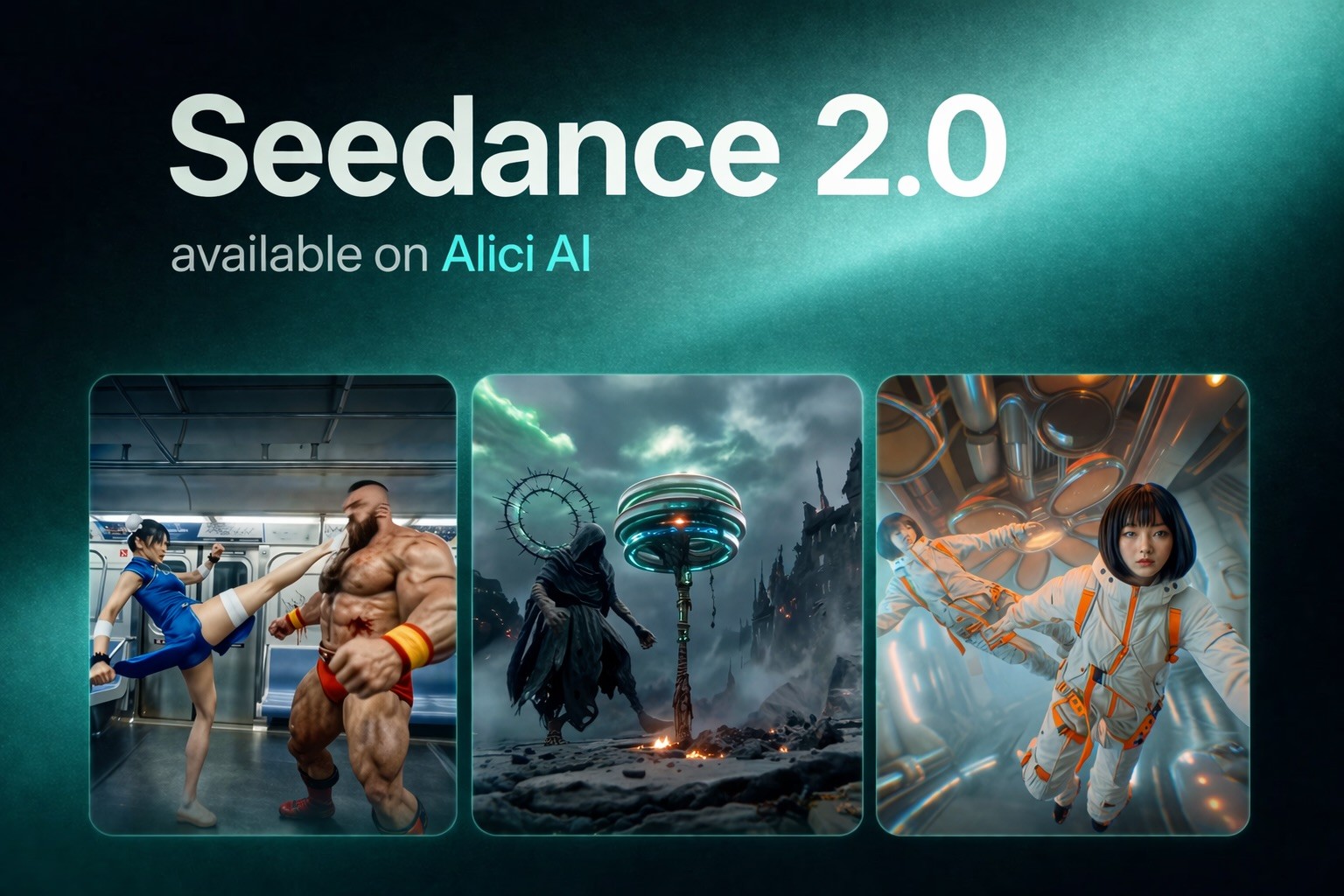
A 30-second photorealistic fight scene: Chun-Li vs. Zangief in a New York subway car. This is the video that made me understand what Seedance's physics engine actually does.
What I observed frame by frame:
Character rendering: Chun-Li's blue cheongsam with gold embroidery has visible fabric texture - satin sheen that shifts with movement. Zangief's muscle definition includes individual sweat beads catching fluorescent light. This is pore-level rendering.
Physics on impact: When Zangief crashes into the subway seats, the plastic deforms on contact and his body slides with realistic inertia - not the teleporting/clipping you get from most models.
Environment interaction: The subway car is a consistent 3D space throughout. Overhead lights, grab poles, blue seats, station signs through the windows - all maintain spatial coherence across 30 seconds of dynamic camera movement.
Why this matters: This is a two-character action scene with fast camera cuts, environmental destruction, and photorealistic rendering. Most AI models would produce artifacts on the hands alone (Seedance nailed them). The fact that cloth physics, impact deformation, and character identity all hold up across 30 seconds of action is what puts Seedance at Elo #1.
Seedance technique used: Shot-by-shot timecoded prompt (00:00-00:30 breakdown), character lock via detailed description, negative prompt for artifact prevention.
Genre 2: Cinematic Atmosphere - "Let the Bullets Fly" by @ai-withphil
Video 02 | Watch on Alici Formulas | 1.5K likes, 522 comments
A 15-second low-altitude drone flyover through a bombed-out battlefield. Cool steel-blue and gray-green palette, drifting smoke, reflective water, distant fires.
What I observed:
Atmospheric rendering: The smoke doesn't just float - it has volumetric density that varies with distance. Closer smoke is thicker, diffusing the light differently than the translucent haze in the background. This is the "volumetric dust particles" keyword from @starks_arq's guide in action.
Water reflections: The puddles reflect the sky and surrounding destruction accurately, with slight ripple distortion. Reflective surfaces are where most AI models break - Seedance maintains them throughout.
Camera stability: Continuous gliding motion with mild banking, no jump cuts. The parallax between foreground debris and background explosions creates genuine depth perception.
Why this matters: This genre - cinematic environmental flyover - is pure atmosphere. No characters, no dialogue, just mood. It's the kind of B-roll that commercial productions pay $5,000-20,000 for in traditional filmmaking. Seedance produces it from a text prompt in 15 seconds.
Seedance technique used: Single continuous camera movement, desaturated color grade specification, "practical light sources" for fire and haze.
Genre 3: Horror & Narrative - "Japanese Hallway RPG" by @ai.with.glock
Video 03 | Watch on Alici Formulas | 2.2K likes, 42 comments
A 15-second Japanese horror corridor chase: a woman in white kimono with a weapon, pursued by a pale supernatural creature through a traditional shoji-panel hallway.
What I observed:
Lighting as storytelling: Teal-green ambient light from the shoji panels creates claustrophobic tension. The explosion in the climax frame shifts to warm orange - a complete color temperature flip in one shot. This is "negative fill" meeting "motivated lighting" from @starks_arq's hierarchy.
Facial expression: The woman's face registers genuine terror - wide eyes, open mouth, tensed brow. AI models typically produce neutral or exaggerated expressions. Seedance hits the sweet spot of believable emotion.
Creature design: The pale humanoid pursuing her is grotesque without being cartoonish - translucent skin, unnatural proportions, crawling posture. Horror is the hardest genre for AI because "scary" is subjective and subtle. This works.
Spatial consistency: The narrow corridor maintains correct perspective throughout the chase - shoji panels recede properly, floor planks converge to a vanishing point.
Why this matters: Horror requires atmosphere, pacing, and emotional authenticity - all things AI typically struggles with. This video demonstrates that Seedance can handle narrative-driven genre content, not just pretty landscapes or product shots.
Seedance technique used: Timecoded 7-shot breakdown (00:00-00:15), "negative fill" lighting, sound design specifications (footfalls + creature shrieks).
Genre 4: UGC Product Ads - "The Ordinary Serum" by @Mho_23
Video 04 | Watch on Alici Formulas | 848 likes, 47 comments
A 14-second UGC-style skincare ad: a young blonde woman in a bathroom demonstrating The Ordinary Hyaluronic Acid serum. iPhone aesthetic, natural lighting, handheld motion.
What I observed:
UGC authenticity: This looks like a real TikTok creator filmed it on her phone. The handheld shake, the bathroom mirror reflection, the slightly blown-out window light - every element signals "real person, real bathroom, real product." If you didn't know it was AI, you would not guess.
Hand accuracy: She holds the serum bottle, applies the dropper to her face, and gestures to camera - all with anatomically correct fingers. This is the 85% hand accuracy rate I mentioned earlier, in a use case where it matters most.
Product legibility: The Ordinary label is readable on the bottle across multiple angles. Product labels are notoriously hard for AI - the text usually garbles. Here it holds.
Lip sync: She speaks directly to camera with what appears to be natural dialogue timing. Combined with a TikTok comment overlay ("omg how is your skin so clear"), this is indistinguishable from organic UGC content.
Why this matters: This is the money shot for 2026. UGC ad creation is a $212/video average market. A Seedance-generated UGC ad that's indistinguishable from organic content eliminates the need for talent, studio, and equipment. The economics are transformative - one prompt replaces a production that would cost $500-2,000 with traditional methods.
Seedance technique used: "iPhone UGC aesthetic" specification, natural lighting, character consistency across 4 shot segments, voiceover variation instructions.
What These 4 Genres Prove
Genre | Seedance Strength Tested | Difficulty for Other Models |
|---|---|---|
Action/Physics | Impact deformation, cloth physics, multi-character | Kling: good but less detailed physics. Veo: lacks duration. |
Cinematic Atmosphere | Volumetric smoke, water reflections, continuous motion | Veo: comparable aesthetics. Kling: shorter single-take. |
Horror/Narrative | Emotional expression, lighting shifts, creature design | Most models struggle with horror pacing. |
UGC Product Ads | Hand accuracy, product labels, authentic handheld feel | The highest-ROI use case. Veo Lite is cheaper but less realistic. |
These aren't cherry-picked demos - they represent the four primary content categories where Seedance 2 currently dominates. Each one uses a different subset of the techniques taught in this guide: shot-based thinking, lighting keywords, character consistency, and genre-specific prompt structures.
Real Examples: How Top Creators Use Seedance 2
fal.ai Production Prompts
These prompts from fal.ai's official Seedance 2 showcase demonstrate the shot-based, action-precise approach:
Action Chase Scene:
Martial Arts Sequence:
15-Second Commercial (Multi-Shot in One):
Notice: each example is under 80 words. Precise action. One camera movement per shot. Specific lighting rather than "cinematic."
Alici Formulas Creators
@rioaigc (Rio) - 467K likes in 90 days, 17,967 average per post. Rio's Seedance 2 anime recreations (Dragon Ball, Pokemon action sequences) went viral on Douyin and got reposted across X/Twitter globally. His work demonstrates Seedance's unmatched ability to render dynamic anime-style action with cinematic camera work.
@ai.with.glock (Alex Glocknitzer) - 835K Instagram followers, 77 posts in 90 days. Alex brings an artistic eye from his WarpFusion/ComfyUI background to Seedance 2, creating floral AI videos and Chinese period drama parodies that blend traditional aesthetics with AI generation. His transition from manual AI pipelines to Seedance shows the model's appeal to technically sophisticated creators.
@kakudrop (Kaku Drop) - Director, editor, and OpenAI partner. His "Sakura Courtyard Fantasy" demonstrates how Seedance renders soft lighting, falling petals, and character expression with cinematic precision. Most impressively: his C4D + Seedance Omni Reference workflow - pre-rendering motion in Cinema 4D and feeding it as video reference into Seedance - achieved fingertip-level motion tracking on a three-person dance sequence.
Study what works. Copy what's proven. Alici Formulas tracks 100+ AI video creators - with prompt templates, engagement data, and production workflows you can adapt. See how @rioaigc, @ai.with.glock, and @kakudrop build their Seedance workflows.
Seedance 2 vs Kling 3: When to Use Each
I use both daily. Here's my decision framework:
Scenario | Seedance 2 | Kling 3 |
|---|---|---|
Physics-heavy (cloth, liquid, hair) | Best | Good |
Multi-shot continuity (6+ shots) | Manual stitch | Native 6-shot |
Motion control (reference choreography) | Via video ref | Native MC |
Character face locking | Three-image method | Elements 3.0 |
Maximum visual quality | Elo #1 | #3 |
Free tier / budget | Limited | 66 free/day |
Max duration per clip | 15-20s | 15s |
Multi-reference input | 12 inputs | 1-2 images |
Dance/choreography | Music-driven | Motion Control |
For beginners: Start with Kling 3 (free tier, simpler workflow). Once you've mastered shot-based thinking, add Seedance for maximum quality.
For professionals: Use both. Seedance for hero shots, Kling for sequences. A multi-model workspace makes switching effortless - same prompt, different model.
For the full frame-by-frame analysis: Kling 3 vs Seedance 2 deep comparison.
Where to Access Seedance 2 (April 2026)
Platform | Status | Pricing | Audience |
|---|---|---|---|
Coming soon | TBA | Global - no VPN needed | |
Jimeng | Available | ~$9.60/mo | China domestic |
Dreamina | Limited | $18-84/mo | Select Asian markets |
Simplest path for most creators: Alici AI integration gives you Seedance alongside Kling 3, Veo 3.1 Lite, Runway, and more - no VPN, no API keys, no separate accounts.
For developers: fal.ai offers 6 API endpoints - text-to-video, image-to-video, and reference-to-video in both Standard and Fast variants. Python SDK, JavaScript SDK, and REST API. No GPU infrastructure to manage.
Frequently Asked Questions
Is Seedance 2 free?
Jimeng (即梦) offers 225 daily tokens - enough for 1-2 videos/day. fal.ai API is pay-per-use ($0.24-0.30/second). When Seedance launches on Alici AI, pricing will be announced. For zero-cost testing, Kling 3's free tier (66 credits/day) lets you practice shot-based workflows before investing in Seedance.
How long should my Seedance 2 prompt be?
Short prompts consistently outperform long ones. For image-to-video: 50-80 words (the reference image carries identity). For text-to-video: 120-280 words (below 30, the model randomizes; above 280, it drops instructions). The optimal sweet spot in my testing: 60-70 words with all 5 blocks covered. If it doesn't fit in a tweet, it's too long.
Why does my Seedance 2 video look "AI-generated"?
Three common causes: (1) Generic lighting - "cinematic" without specifics produces flat output. Specify key light direction, practical sources, and color temperature. (2) Prompt overload - too many details forces the model to compromise on all of them. (3) Lack of reference images - text-only prompts rely entirely on the model's interpretation. Upload reference images for environment, character, and style to anchor the generation in visual reality.
How do I keep characters consistent across multiple Seedance videos?
Use the three-image method: front view + 3/4 side + full side of your character, cropped separately (no grids). Upload front view in Slot 1 (gets 40-50% more weight). In your prompt, describe only actions - never re-describe the character's appearance. This achieves 75-85% consistency. For higher consistency, use the same reference images across all generations and keep prompt language consistent.
Can I generate on-screen text with Seedance 2?
Not reliably. Text renders garbled approximately 90% of the time - this is a limitation across all AI video models. Add text, titles, captions, and overlays in post-production. If you absolutely need text in the generation, limit it to a single large, high-contrast word.
Seedance 2 vs Veo 3.1 Lite: which should I use?
Seedance wins on visual quality (Elo 1,273 vs ~1,217), physics accuracy, duration (15-20s vs 8s), and reference inputs (12 vs 3). Veo 3.1 Lite wins on cost ($0.05/s vs $0.24-0.30/s), native audio quality (best dialogue generation), and 4K resolution (Standard tier). For cinematic quality: Seedance. For high-volume production at scale: Veo Lite. See our full Veo 3.1 Lite vs Kling 3 vs Seedance 2 showdown.
What are the biggest mistakes beginners make with Seedance 2?
Six credit-burning mistakes: (1) Prompts over 100 words (model cherry-picks). (2) Three or more characters per shot (facial drift, body warping). (3) Stacking camera movements (pan + zoom + track = jittery mess). (4) Writing "cinematic lighting" without specifics (flat output). (5) Not tagging uploaded reference files (misassignment). (6) Requesting on-screen text (garbled 90% of the time). See the detailed breakdown above for fixes.
Can I make money creating Seedance 2 content?
Yes - and the economics favor quality. UGC freelancing pays $212/video average (PPC.io, 2026). Seedance's output quality means your deliverables look professional without expensive post-production. Key caveat: 71% of top YouTube creators blend AI with 20% human elements (face cam, voiceover, manual cuts) for best results. Pure AI-only content faces algorithm penalties - retention drops 34.6% when viewers detect AI artifacts. The winning formula: Seedance for production, human personality for authenticity. See our 10 TikTok monetization methods for the full breakdown.
The #1 AI video model. Your workflow. Alici AI is bringing Seedance 2 alongside Kling 3, Veo 3.1 Lite, and every top model. Start creating with the models you already have - and be among the first when Seedance goes live.
About the Author
Lucy Alici is Co-Founder of Alici AI, where she builds AI video production workflows for creators, UGC freelancers, and marketing teams. She has tested every major video generation model since 2024, published 15+ technical guides on AI video production, and maintains active production pipelines across Seedance, Kling, Veo, Runway, and open-source alternatives. Her Kling 3 vs Seedance 2 comparison methodology has been referenced by Kapwing and Evolink AI in their own model comparisons. She tracks 100+ AI video creators on Alici Formulas. Every claim in this article is based on 200+ hands-on Seedance 2 video generations and independently verifiable benchmark data.
Follow Lucy: LinkedIn | X/Twitter | TikTok | Instagram
Updated when Seedance 2 launches on Alici AI. Last tested: April 2026.
🎁
Limited-Time Creator Gift
Start Creating Your First Viral Video
Join 10,000+ creators who've discovered the secret to viral videos