

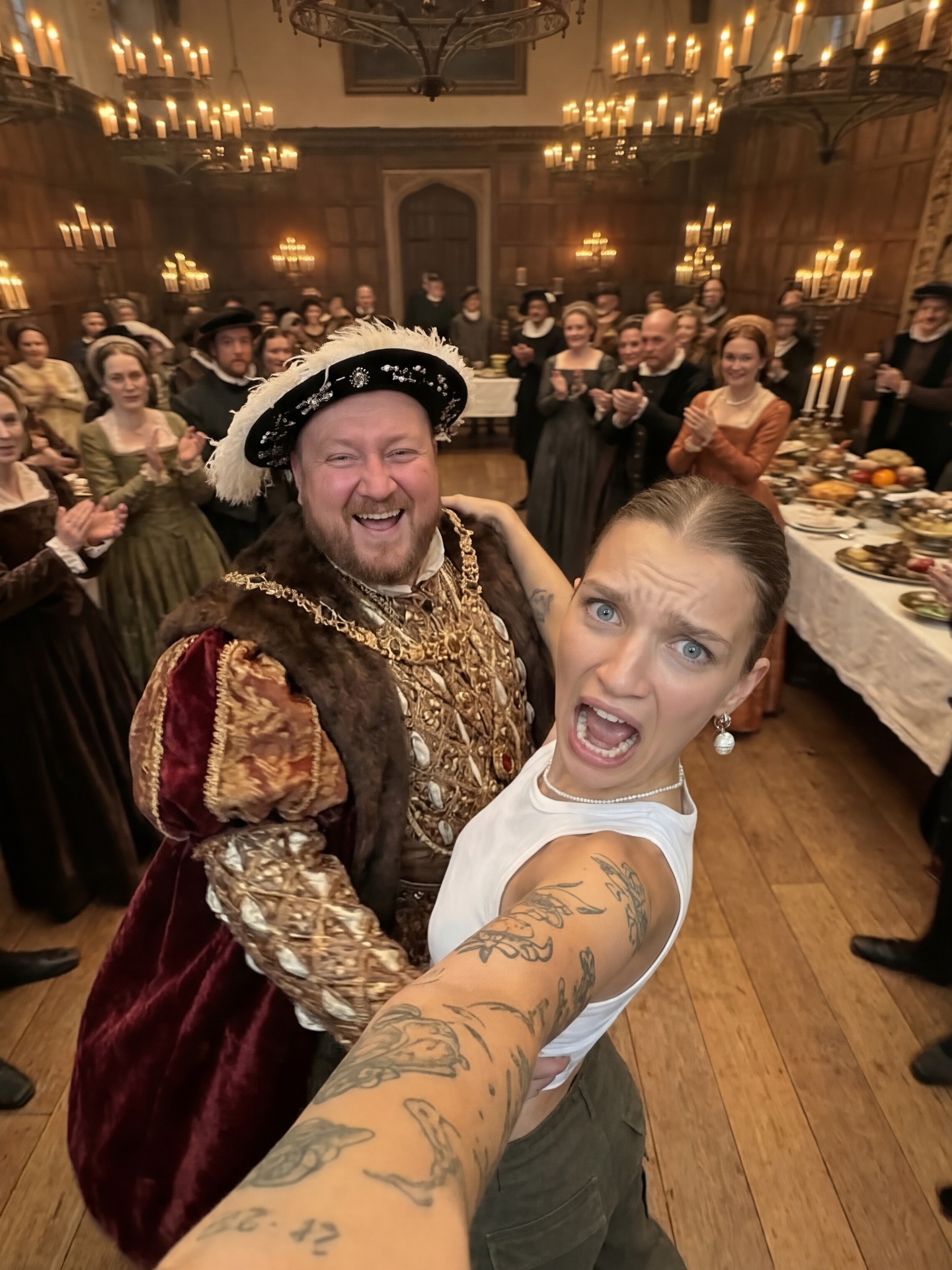
It’s been a crazy few days but I’m so blessed to have my Time Machine (it’s top secret) ⏳❤️ exciting things coming! #chloevshistory #history #timetraveller #travel
It’s been a crazy few days but I’m so blessed to have my Time Machine (it’s top secret) ⏳❤️ exciting things coming! #chloevshistory #history #timetraveller #travel
Image Breakdown
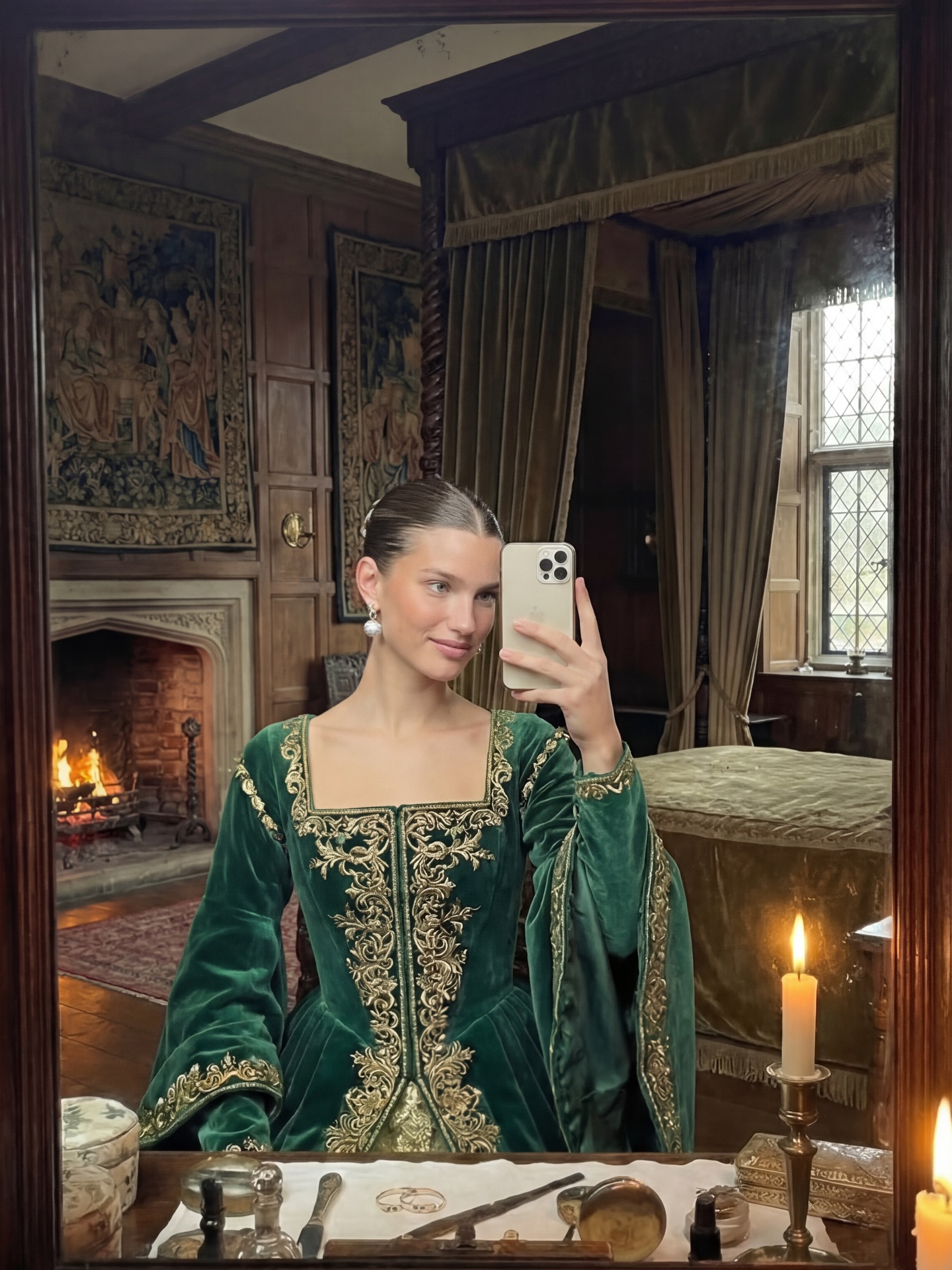
This image understands that historical fantasy becomes more interesting when it is not fully pure. The gown, room, fire, and candles build a believable period world, but the smartphone breaks the illusion just enough to make the frame contemporary and shareable.
The strongest viral mechanism is temporal contrast. Without the phone, this would be a beautiful heritage-core portrait. With the phone, it becomes a story about time travel, roleplay, or self-aware historical immersion. That tiny modern object changes the meaning of the whole frame. It gives the audience an easy entry point because they no longer have to decide whether the image is costume, editorial, or tourism. It is all three at once.
The second reason it works is density of believable detail. The fireplace, tapestries, canopy bed, candles, wood paneling, and vanity objects all support the same world. None of them feel random. When AI or staged imagery performs well, this is usually why: every object belongs to the same sentence. The scene feels complete before the subject even enters it.
The third reason is color authority. Emerald velvet against warm firelight is already a strong combination. Add gold embroidery and dark wood, and the image gets an instant sense of richness. Small creators can learn a lot from this. If the environment is dense, keep the palette disciplined so the frame does not collapse into visual noise.
| Signal | Evidence | Mechanism | Replication Action |
|---|---|---|---|
| Time-travel contrast | Modern phone held inside a fully historic interior | One modern object reframes the image as a contemporary story | Keep the world historically coherent, then add one intentional anachronism |
| Environment saturation | Fireplace, tapestry, bed canopy, candles, and vanity all reinforce the same era | World completeness makes the fantasy believable | Fill the room with 4-6 objects from one historical vocabulary, not mixed eras |
| Mirror intimacy | Selfie format makes the costume feel personal instead of museum-like | Mirror perspective invites the viewer into a private in-character moment | Use a mirror shot when you want a stylized world to feel lived in |
| Color richness | Emerald velvet, gold trim, amber flame, and dark wood all harmonize | A concentrated palette makes ornate scenes feel luxurious instead of cluttered | Choose one jewel tone and one warm accent family, then hold the rest neutral |
This format works especially well for history creators, heritage fashion accounts, travel storytellers, castle tourism, fantasy-adjacent editorial work, and AI creators building world-rich personas. It transfers easily to Regency interiors, Victorian trains, museum halls, desert ruins, or old libraries. The repeatable formula is a dense historical environment plus one modern self-aware element.
It is less effective for strict reenactment communities or brands that need historical purity, because the smartphone is intentionally breaking the period illusion. That break is the whole social-media trick.
Three transfer recipes are especially strong. Keep the mirror selfie and period gown; change the room to a Regency breakfast chamber for a “time traveler morning routine” concept. Keep the warm candle-and-fire palette; change the niche to Victorian gothic, old-money library, or museum-night storytelling. Keep the anachronistic phone reveal; change the historical layer to Roman, 1920s, or Belle Époque styling. A useful slot template is {historical room} + {era-accurate styling} + {mirror selfie} + {one modern object}.
The first aesthetic strength is layering. Mirror frame, candles, vanity, subject, bed, tapestries, fireplace, and window all sit at different visual depths. That gives the image the kind of density people associate with cinema. The second strength is fabric hierarchy. The velvet gown feels heavy and noble because the gold embroidery catches just enough light without ever glowing too brightly.
The third strength is controlled self-awareness. The subject is not acting out a dramatic historical scene. She is simply taking a picture. That calmness keeps the image elegant. If the pose were more theatrical, the phone gag would feel too obvious.
For recreation, the biggest risk is under-building the room. The gown alone is not enough. The environment is half the magic.
| Prompt chunk | What it controls | Swap ideas (EN, 2-3 options) |
|---|---|---|
| emerald medieval gown with gold embroidery | Era coding, luxury, and central color story | burgundy brocade gown, ivory regency dress, navy velvet bodice |
| mirror selfie with visible smartphone | Modern hook and personal intimacy | compact mirror photo, camcorder reflection, phone-in-window reflection |
| castle bedroom with fireplace and candles | World density and historical atmosphere | library hearth room, old manor salon, candlelit museum chamber |
| warm mixed practical light | Romance, intimacy, and texture richness | fire glow, candle ambience, soft window fill |
| sleek low bun and minimal jewelry | Polish and non-costumey elegance | braided updo, pearl drop earrings, simple jeweled pins |
Baseline lock first: keep the historical interior, keep the rich era wardrobe, and keep the visible modern phone. Those three ingredients define the whole concept. Once they are stable, everything else becomes flavor.
Use one-change iteration. If the image feels too pure-period, strengthen the phone visibility. If it feels too modern, deepen the room styling and fabric richness. The best version holds both timelines at once.