
It’s been a crazy few days but I’m so blessed to have my Time Machine (it’s top secret) ⏳❤️ exciting things coming! #chloevshistory #history #timetraveller #travel
It’s been a crazy few days but I’m so blessed to have my Time Machine (it’s top secret) ⏳❤️ exciting things coming! #chloevshistory #history #timetraveller #travel
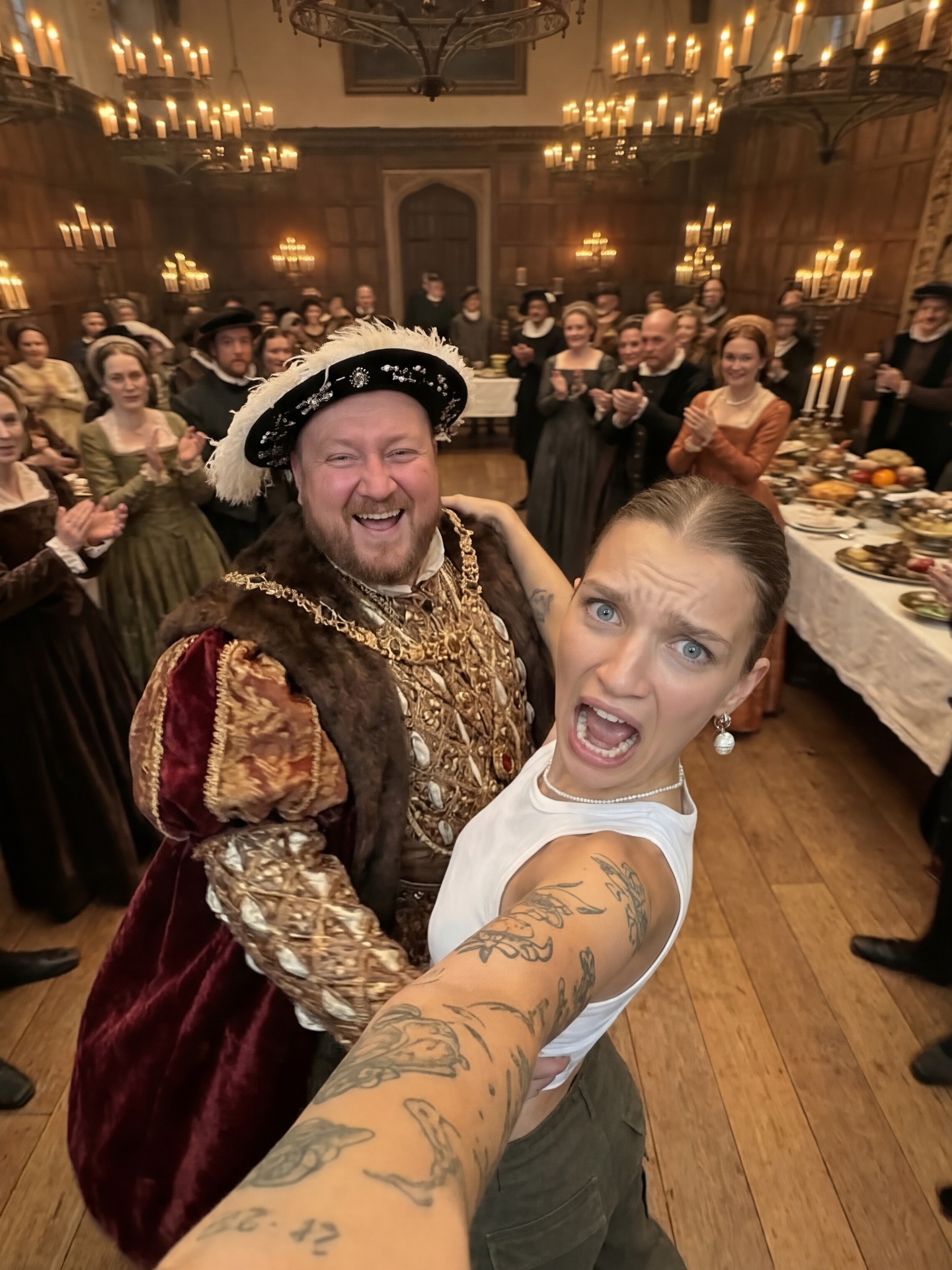
This image lands because it turns historical spectacle into social behavior the viewer already knows. The hall, costumes, chandeliers, and food tables create a big period world, but the emotional entry point is completely modern: a wide-angle selfie face, a tattooed arm, and a shocked-laughing expression that says, “I cannot believe this is happening.” That blend is what makes the scene easy to understand in under a second.
The time-travel framing is doing real work here. Without it, the image would still be funny, but with it, the contrast becomes intentional. The white sleeveless top and visible tattoos are not continuity errors inside the frame. They are the narrative engine. The image becomes a proof-of-experience photo, the kind of post people imagine taking if they were suddenly dropped into a royal banquet and reflexively pulled out their phone.
This formula works when you want your image to feel immersive, theatrical, and still instantly human. It is especially strong for creators whose content lives at the border of education and entertainment.
It is a poor fit for calm study content, minimalist home aesthetics, or highly polished luxury branding. The strength of this image is joyful excess, not refinement.
modern selfie with {historical icon} inside a grand {era} hall, cheering guests, warm practical light{present-day subject} pulled into a {historical celebration}, front-camera perspective, crowd reacting around themwide-angle selfie inside an ornate period hall, one modern outfit cue, one expressive face, one iconic costumed partnerThe room is visually rich, but it is not cluttered. Chandeliers, wood paneling, gowns, and banquet tables are enough to sell the Tudor world. That restraint matters because the modern foreground subject already introduces a lot of visual noise through tattoos, skin, and exaggerated perspective. The image works because the background is lush but organized.
The candlelight is doing more than mood. It softens the comedy. If this same scene were lit with hard flash, it would become parody. Warm ambient light makes the impossible crossover feel romantic, even a little sincere. That tonal softness keeps the image from slipping into costume-party kitsch.
The final useful choice is expression contrast. The historical figure is laughing broadly, while the selfie subject is shocked and delighted at the same time. That asymmetry creates movement. Two matching smiles would have made the frame flatter. The slight mismatch gives it rhythm and makes the scene feel like a real moment of collision rather than a rehearsed pose.
| Observed | Recreate move | Why it matters |
|---|---|---|
| Foreground tattooed arm creates strong lens distortion | Keep one near-camera limb to preserve selfie realism | The image needs obvious phone-camera grammar |
| Henry VIII-style costume dominates the left side with gold and burgundy texture | Use one opulent period outfit with instantly legible silhouette and trim | A single icon is stronger than many vague costumes |
| Candle chandeliers and wall sconces warm the entire room | Build lighting from visible practicals inside the scene | The historical world feels inhabited instead of staged |
| Crowd forms a loose semicircle around the pair | Stage the background as social witness, not flat backdrop | The group gives the moment legitimacy and scale |
| Banquet tables with food remain visible on the side | Add one or two feast details, then stop | Enough environmental proof keeps the room specific without overload |
This kind of image breaks when the prompt over-prioritizes the hall or the costume and forgets the camera behavior. The selfie distortion is not optional. It is the bridge between the viewer and the period world.
| Prompt chunk | What it controls | Swap ideas (EN, 2-3 options) |
|---|---|---|
| Selfie lens block | Arm extension, close face, and high-energy perspective | wide-angle front camera; arm-length selfie; immersive selfie distortion |
| Modern styling cue | Keeps the frame anchored in the present | white sleeveless top; visible tattoos; present-day streetwear contrast |
| Historical anchor figure | Provides period identity and charisma | Henry VIII-style king; Tudor nobleman; royal feast host |
| Hall atmosphere | Defines architectural scale and emotional warmth | candle chandeliers; dark wood paneling; banquet-hall glow |
| Crowd behavior | Creates social proof and movement | clapping guests; delighted court audience; feast-goers reacting |
| Table detail discipline | Adds specificity without cluttering the read | fruit platters; white-clothed banquet tables; serving dishes |
Lock the selfie lens, the icon figure, and the visible practical lighting before anything else. Once those are correct, the hall details become much easier to tune.
Baseline lock: the arm-extended selfie perspective, the Tudor king figure, and the candlelit banquet hall. Those are the load-bearing pieces.
Then use a strict one-change rule:
If the image starts reading like stage comedy, reduce costume exaggeration and strengthen candid cues like uneven smiles, slight blur, and off-balance movement. If it becomes too formal, add party energy, caught mid-laugh, and spontaneous selfie. The image works because it feels like a historical room behaving like a social feed moment.