It’s been a crazy few days but I’m so blessed to have my Time Machine (it’s top secret) ⏳❤️ exciting things coming! #chloevshistory #history #timetraveller #travel
It’s been a crazy few days but I’m so blessed to have my Time Machine (it’s top secret) ⏳❤️ exciting things coming! #chloevshistory #history #timetraveller #travel
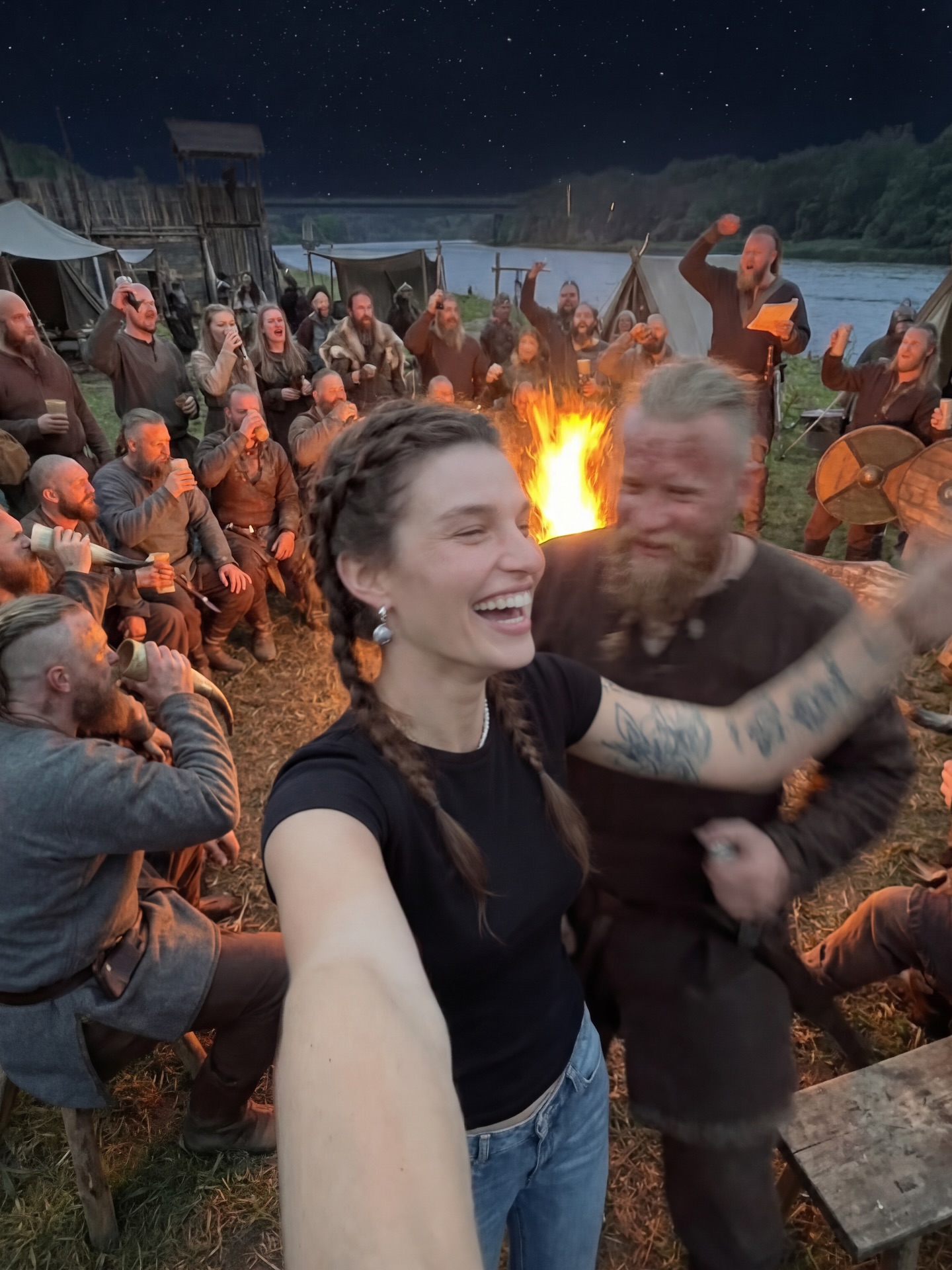
The image is powerful because it does not ask the viewer to admire a set. It asks the viewer to feel inserted into a moment. A modern selfie pose in front of a firelit historical crowd immediately collapses distance. The audience is not standing outside the camp looking in. They are pulled into the center of the noise, heat, and laughter through the extended arm and front-camera angle.
The “time machine” framing from the caption pushes the photo even further. Suddenly the black T-shirt and jeans are not mistakes in the frame, they are the point. The image becomes a playful proof of concept: what if someone from now really did walk into a Viking celebration and instinctively documented it the way we all would? That is why the post feels memorable. It merges immersion content with recognizable social behavior.
The first reason is contrast density. There is a modern creator in the foreground, a historical-costume crowd in the background, a bonfire in the center, and a starry riverside camp around all of it. Each layer adds a different time signal. Yet the composition stays readable because the selfie arm gives the whole frame a clear entry point. You know exactly where to look first, then the camp reveals itself.
The second reason is emotional contagion. Many people in the frame are cheering, drinking, singing, or lifting their arms. The energy is collective, not individual. That matters because crowd joy is easier to borrow than posed coolness. When a post lets the viewer imagine being absorbed into a group moment, it tends to earn stronger saves and shares than a static costume portrait.
| Signal | Evidence (from this image) | Mechanism | Replication Action |
|---|---|---|---|
| Time-collision hook | A modern selfie-taker in black tee and jeans stands inside a Viking-style camp gathering | The frame creates instant story tension without needing explanation | Keep one clearly modern element inside an otherwise consistent historical scene |
| Participation-first camera | The extended selfie arm makes the viewer feel physically inside the event | First-person energy increases immersion and lowers viewer distance | Use a front-camera composition instead of photographing the scene from the outside |
| Collective emotional charge | The background crowd is cheering, singing, and raising cups around the fire | Group joy spreads faster than isolated posing because it implies belonging | Populate the background with active reactions, not static extras |
| Fire as narrative center | The bonfire sits behind the subject and lights the camp | The flame acts as both light source and emotional anchor | Give the scene one shared focal object that explains why everyone is gathered |
This is ideal for creators building immersive historical, fantasy-adjacent, or “I stepped into another world” content. The frame can carry a lot because it is fundamentally about access and presence.
It is not a strong fit for quiet luxury, minimal interiors, calm study aesthetics, or formal costume catalog work. The image relies on chaos, warmth, and noise. If you sanitize it, you lose the point.
modern selfie inside a {historical gathering}, wide-angle front camera, central firelight, cheering crowd{subject} laughing in selfie view, one immersive crowd scene behind, warm practical light, no polished posingpresent-day traveler dropped into {era mood}, selfie arm visible, communal celebration, environment fully themedThe image succeeds because the fire is doing double duty. It is obviously the light source, but it also explains the composition. People gather toward it, faces turn toward it, and the whole frame radiates outward from it. Without the fire, the crowd would feel random. With it, the photo feels like a captured peak of shared attention.
The wide-angle distortion is also essential. A flatter lens would have made this a group portrait. The distorted arm and close face tell you instantly that the scene was entered, not merely witnessed. That is why the post feels current even though the environment reads historical. The camera grammar belongs to now; the world belongs to then.
Another smart choice is that the image does not over-style the historical camp. Tents, a shield, rough wood, river, and tree line are enough. The background sells the world without drowning the foreground in prop noise. This is useful for prompt writing, because too many “period details” often make generators lose the clean crowd read. Here, the environment supports the social energy instead of competing with it.
| Observed | Recreate move | Why it matters |
|---|---|---|
| Outstretched arm and close laughing face anchor the foreground | Protect the selfie distortion and keep the face large enough to read instantly | The image depends on participation, not observation |
| Bright bonfire glows in the center behind the subject | Use one obvious practical light source with visible flame bloom | The fire unifies the crowd and explains the warm highlights |
| Historical-costume crowd forms a dense ring around the flame | Fill the background with active bodies and clear reaction gestures | The crowd provides contagious emotional energy |
| River, tents, wooden fencing, and night sky frame the scene | Use a few decisive setting cues instead of a prop overload | The world feels immersive but still readable |
| Modern outfit remains untouched in the foreground | Leave one contemporary style cue fully visible | The entire narrative spark comes from the present-versus-past contrast |
This concept needs control blocks, because generators often choose one side of the image and forget the other. If you say “Viking camp selfie,” some models will delete the crowd. If you say “crowd around bonfire,” they will lose the first-person viewpoint. The prompt has to defend both.
| Prompt chunk | What it controls | Swap ideas (EN, 2-3 options) |
|---|---|---|
| Selfie camera grammar | Arm extension, wide-angle distortion, and front-camera immediacy | arm-length selfie; front-camera party shot; immersive wide-angle selfie |
| Modern focal styling | Keeps the foreground subject anchored in the present | black T-shirt and jeans; simple modern outfit; contemporary traveler look |
| Historical crowd block | Defines the era mood and the social density behind the subject | Viking camp revelers; medieval reenactment crowd; Norse-style feast circle |
| Central fire source | Provides believable light logic and a shared event center | bonfire glow; campfire core; flame-lit gathering center |
| Setting edges | Keeps the camp grounded in a real place instead of abstract darkness | riverside tents; wooden palisade; starry tree-lined camp |
| Motion language | Protects the candid party energy | slight motion blur; cheering crowd gestures; spontaneous low-light movement |
The practical rule is simple: lock camera grammar, light source, and crowd function before you fine-tune historical props. Those three variables carry most of the image’s impact.
Baseline lock: the selfie arm, the central bonfire, and the cheering historical crowd. If any one of those breaks, the image stops being special.
Then iterate in four clean passes:
If the image starts looking like a costume ad, add words like chaotic, spontaneous, and campfire singing. If it starts drifting into war imagery, explicitly say celebration, no battle, and joyful gathering. This image wins through social heat, not combat spectacle.