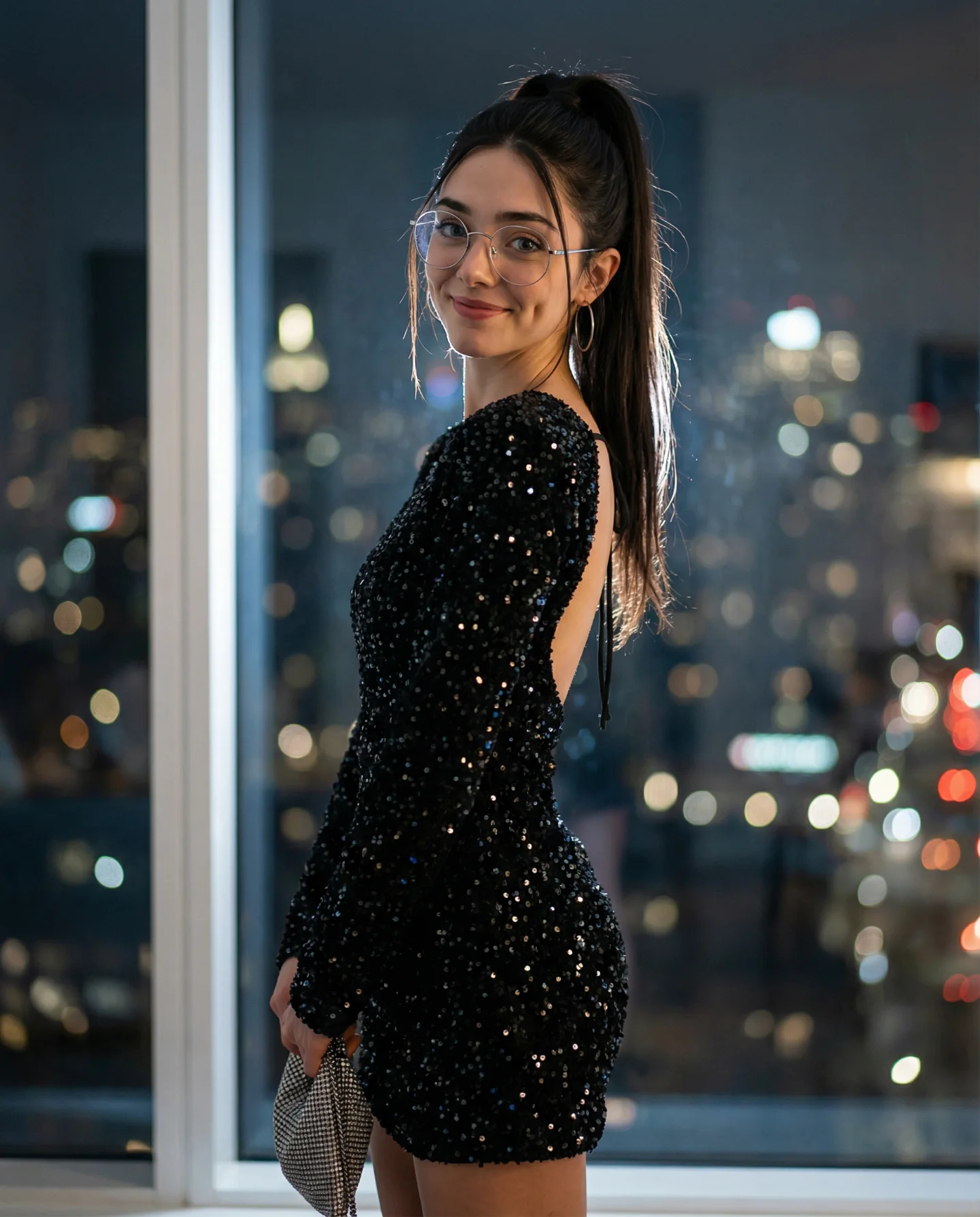
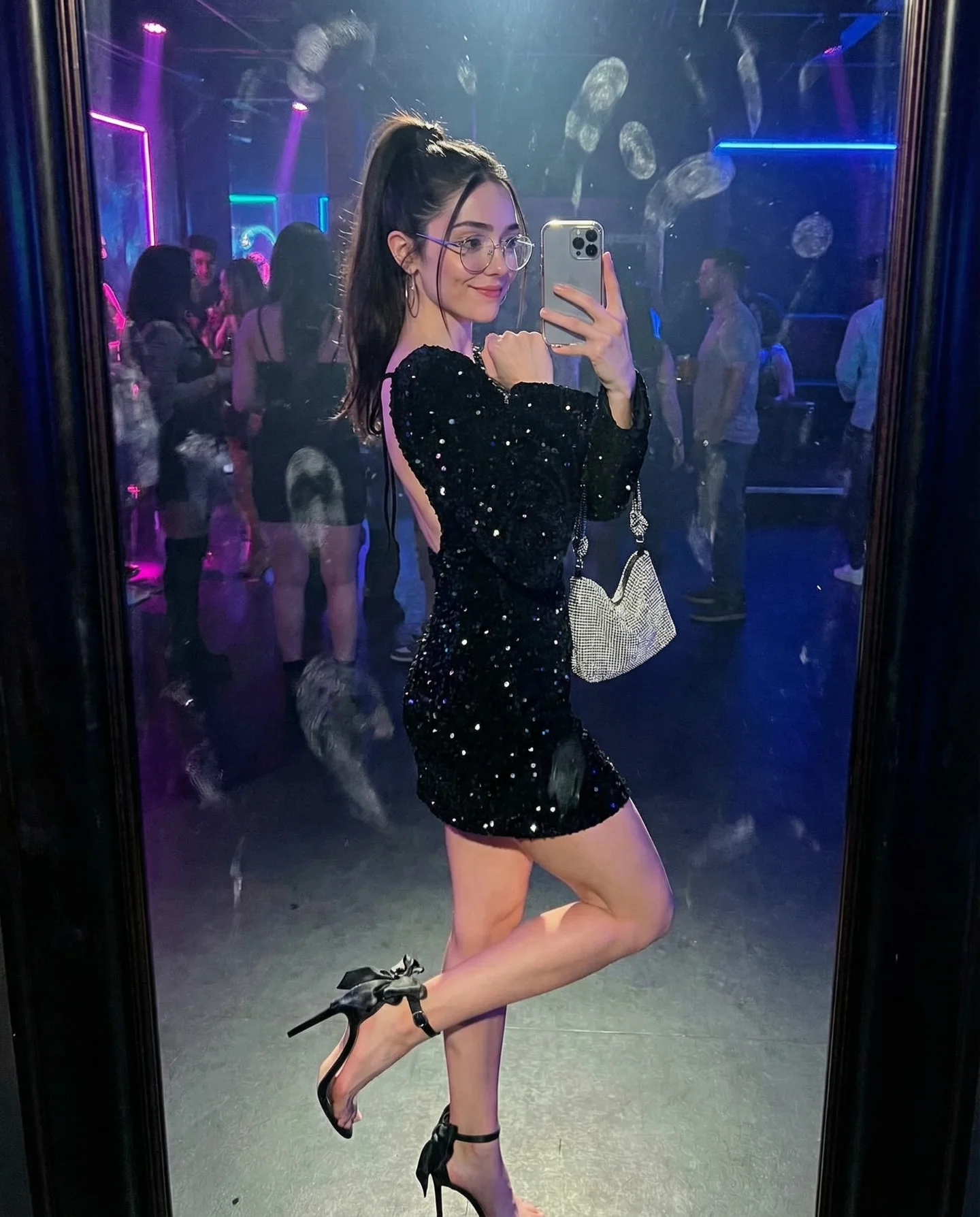
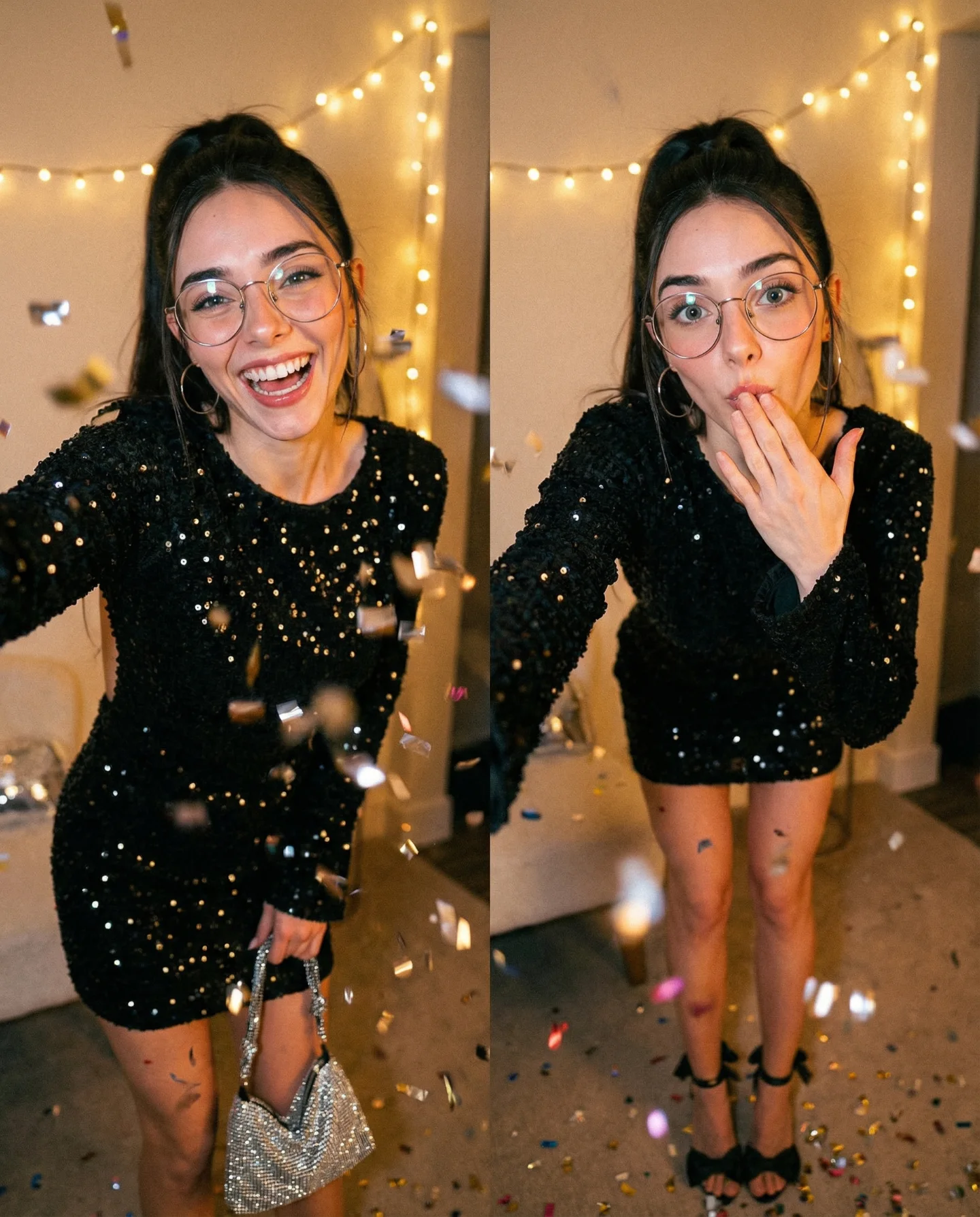
Soy_aria_cruz's Paparazzi Arrival Sequin Dress AI Image
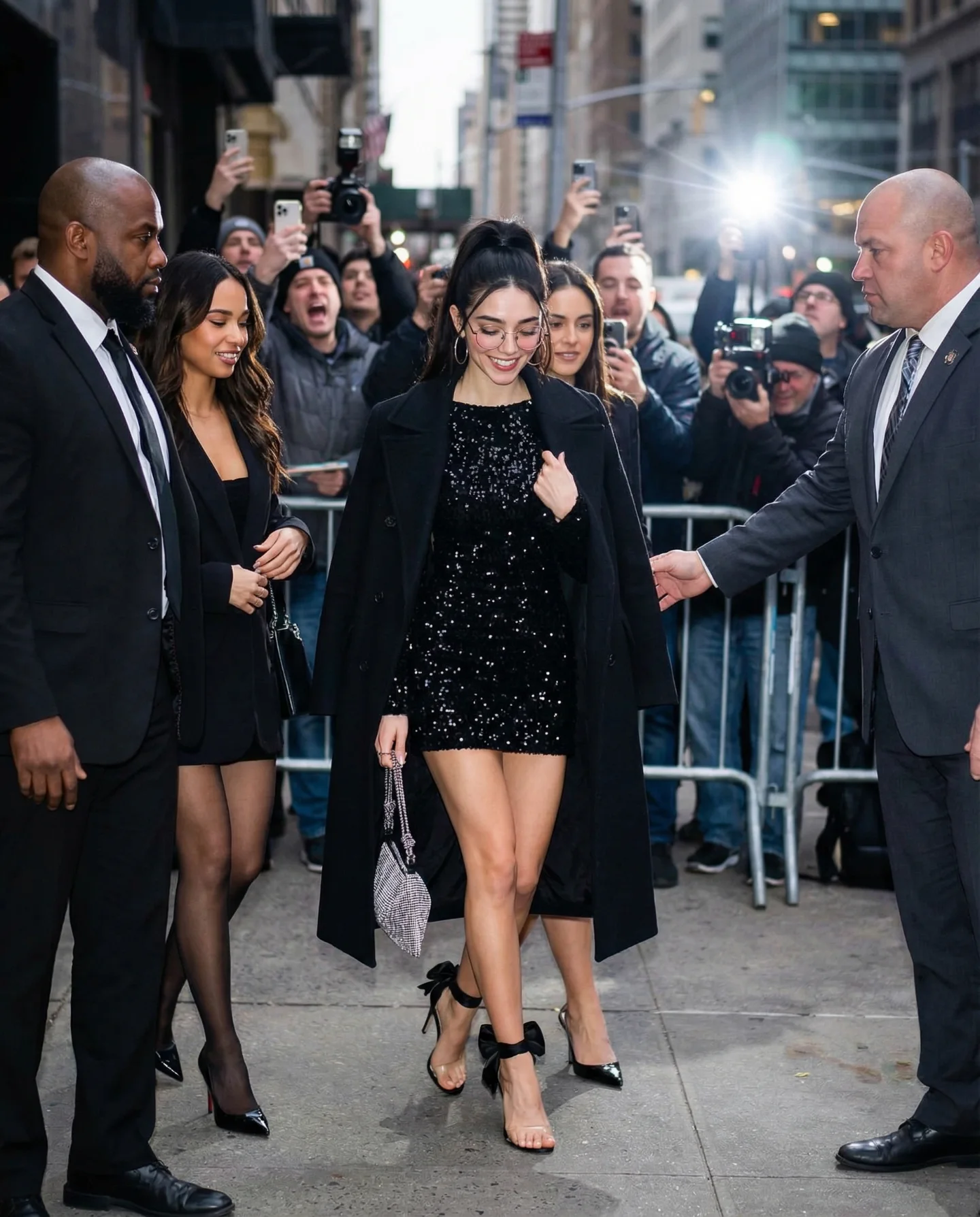
This image works because it compresses celebrity access, street fashion, and public spectacle into a frame that feels both candid and fully controlled. The star is not standing still for a portrait. She is moving through pressure. Security closes in at the edges, phones rise behind the barriers, and the flash burst in the background confirms that this is a moment other people are chasing in real time. That social proof matters. Viewers are not just looking at a dress. They are looking at attention itself.
The styling is also smart. Black sequins, a long dark coat, delicate glasses, and a sparkling bag create enough texture to feel expensive without becoming noisy. Because the palette is so restrained, the image can hold a busy background and still read instantly on a feed. It feels aspirational, but not distant. That balance is exactly why this kind of frame keeps getting reposted, remixed, and used as a reference.
Why It Pulls People In So Fast
A lot of viral fashion imagery fails because it only offers polish. This one offers hierarchy. There is a clear lead figure, clear supporting cast, and clear social environment. The bodyguards tell you the person matters. The barricades tell you access is restricted. The camera flashes tell you the moment is worth documenting. By the time a viewer notices the sequins and the heels, the narrative has already landed.
Another reason it performs is that it feels cinematic without looking overproduced. The scene is grounded in believable city texture: concrete, steel barricades, suited security, and real crowd behavior. But the styling gives it enough visual authority to feel like a poster frame. For creators, that is a useful lesson: the image becomes stronger when one wardrobe element sparkles and the rest of the scene stays disciplined.
| Signal | Evidence (from this image) | Mechanism | Replication Action |
|---|
| Status framing | Two bodyguards flank the frame while the crowd is held behind barriers | Protection implies importance, which immediately increases viewer curiosity | Frame the subject with security, assistants, or gatekeeping elements that show controlled access |
| Attention proof | Phones are raised and flash units are firing behind the subject | Visible audience interest acts as built-in validation for the viewer | Include watchers, cameras, or mirrored spectators to show that the subject is already being noticed |
| Texture contrast | Sequined dress and crystal bag stand out against matte black coats and suits | One sparkling texture creates a luxury anchor without overwhelming the image | Choose one reflective material to emphasize, then keep the rest of the wardrobe dark and simple |
| Moving candid energy | The lead subject is mid-step rather than posing directly for camera | Motion makes the image feel intercepted instead of staged, which raises replay value | Prompt a walking entrance and keep one leg stepping forward rather than using a static stance |
Where This Setup Works Best
- Celebrity-style fashion edits: best when you want a status-driven arrival moment and a clear sense of public attention.
- Nightlife or venue promotion: easy to adapt by swapping the sidewalk for club steps, a theater entrance, or a hotel drop-off.
- Luxury lifestyle campaigns: the image language communicates access, exclusivity, and social heat without needing obvious logos.
- Character intros for digital personas: useful when the goal is to make a fictional figure feel already famous.
This approach is less ideal for intimacy-heavy branding, family storytelling, wellness content, or understated product pages. The frame is built around spectacle and public gaze. If your message depends on softness or privacy, the paparazzi architecture will fight the tone.
Transfer recipe one: Keep the moving arrival, bodyguard framing, and crowd pressure. Change the wardrobe to white tailoring, the venue to a hotel, and the mood to awards-night elegance. Slot template: {venue entrance} {hero look} {security frame} {fame energy}.
Transfer recipe two: Keep the central walking composition and flash-heavy candid treatment. Change the subject to a musician, add instruments or merch cues, and shift the backdrop to a backstage alley. Slot template: {backstage setting} {performance wardrobe} {fan crowd} {press-storm mood}.
Transfer recipe three: Keep the black palette and status barrier system. Change the scene to a courthouse, tech launch, or private gallery, then tune the expression toward tension rather than glamour. Slot template: {public arrival scene} {dark tailored wardrobe} {attention audience} {controlled emotion}.
The Aesthetic Logic Behind the Image
The first thing this photo understands is edge control. The center subject is visually bright where it matters: sequins, skin, and the reflective bag. Everything around her becomes a frame rather than a competitor. Even the companion on the left is styled to support the hierarchy instead of stealing it. This is what makes the image feed-friendly. It is crowded, but never confusing.
The second strength is the mix of polish and friction. The coat, glasses, and heels feel composed. The crowd and flash burst feel uncontrolled. That tension gives the image its charge. There is also enough city depth in the background to imply a real location without making architecture the point. For creators, this is a strong model for making glamour feel social rather than sterile.
| Observed | Recreate |
|---|
| Centered lead figure walking through a corridor of people | Block the frame so side characters create passage and direct the eye toward the central subject |
| Mostly black wardrobe with one sparkling material | Use a narrow palette and let sequins, crystals, or gloss carry the luxury signal |
| Visible barriers and raised devices in background | Add crowd-control rails, phones, and cameras to make public attention explicit |
| One major flash source behind the crowd | Use a strong burst highlight that separates the foreground figures from the background chaos |
Prompt Technique Breakdown
| Prompt chunk | What it controls | Swap ideas (EN, 2–3 options) |
|---|
| celebrity arrival on a city sidewalk with paparazzi behind barriers | Story context and social stakes | hotel arrival; theater premiere entrance; gallery opening crowd |
| black sequined mini dress under a long black coat | Luxury texture and silhouette hierarchy | white satin mini dress; metallic blazer dress; sleek leather look |
| two bodyguards framing the left and right edges | Status signal and composition discipline | assistants and handlers; suited security pair; velvet-rope staff |
| bright paparazzi flash from background right | Candid realism and separation | multiple flash pops; softer camera strobes; sodium-vapor nightlife glow |
| walking mid-step with silver evening bag | Motion and prop detail | phone in hand; gloves and clutch; sunglasses and micro bag |
| crowd with raised phones and cameras | Social proof and feed energy | fans with posters; press microphones; autograph seekers |
How to Remix It Without Breaking the Formula
Lock three things first: the central walking composition, the access-control framing, and the single reflective luxury texture. Those are the pillars. If you lose them, the image stops feeling like a high-value arrival and starts looking like a normal street-fashion shot.
- Start with the exact arrival setup: central figure, crowd barriers, security on both sides, and one flash source.
- Change only the wardrobe family while preserving black-heavy tonal discipline and one sparkle material.
- Change only the venue type: sidewalk to hotel entrance, court steps, backstage alley, or private event gate.
- Change only the emotional read: smile, calm detachment, anxious urgency, or hard stare while keeping the same compositional skeleton.
The repeatable lesson here is simple: if you want a fame-coded image to travel, do not only dress the subject well. Build a world around the subject that proves other people are already paying attention.