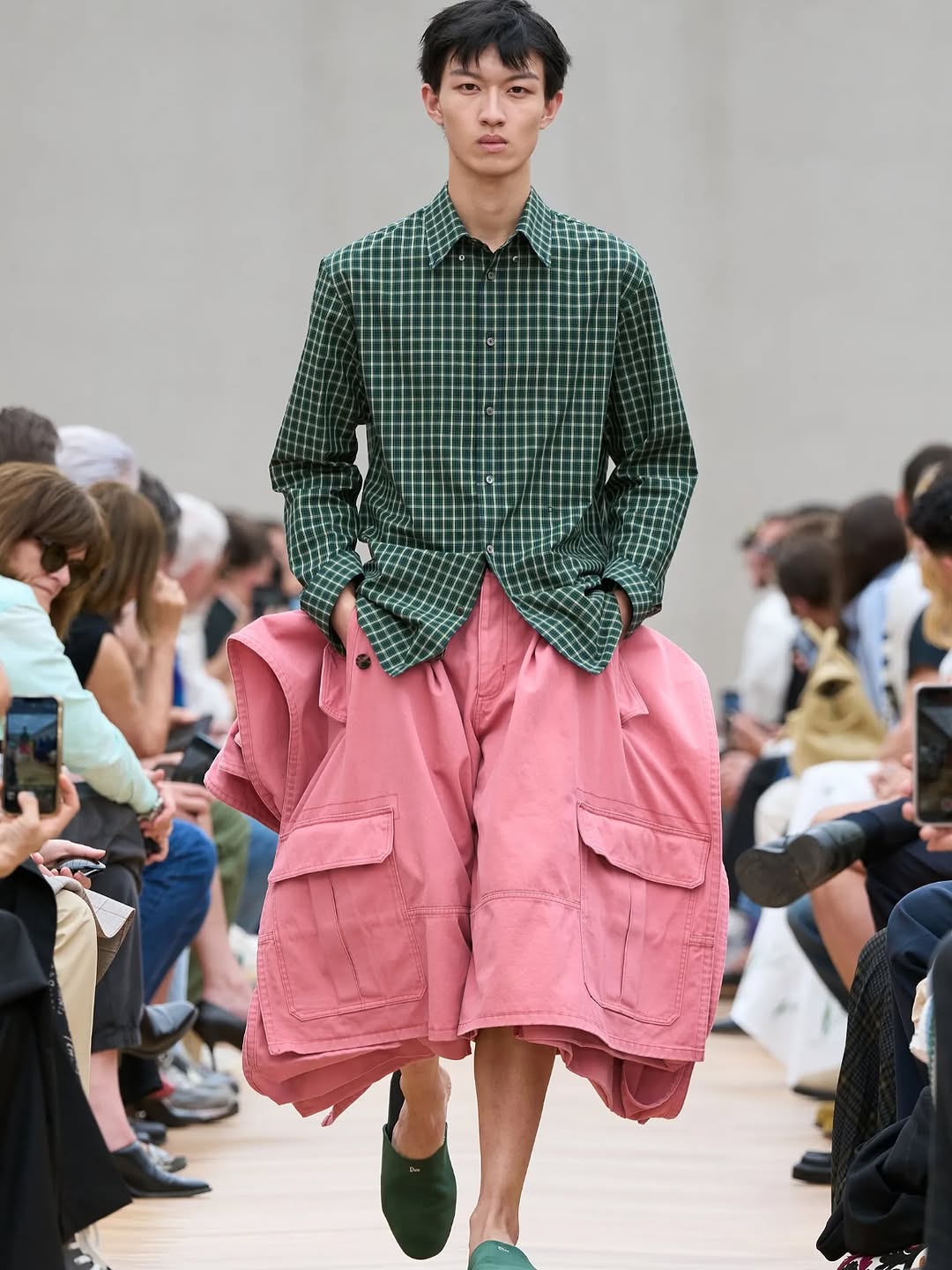
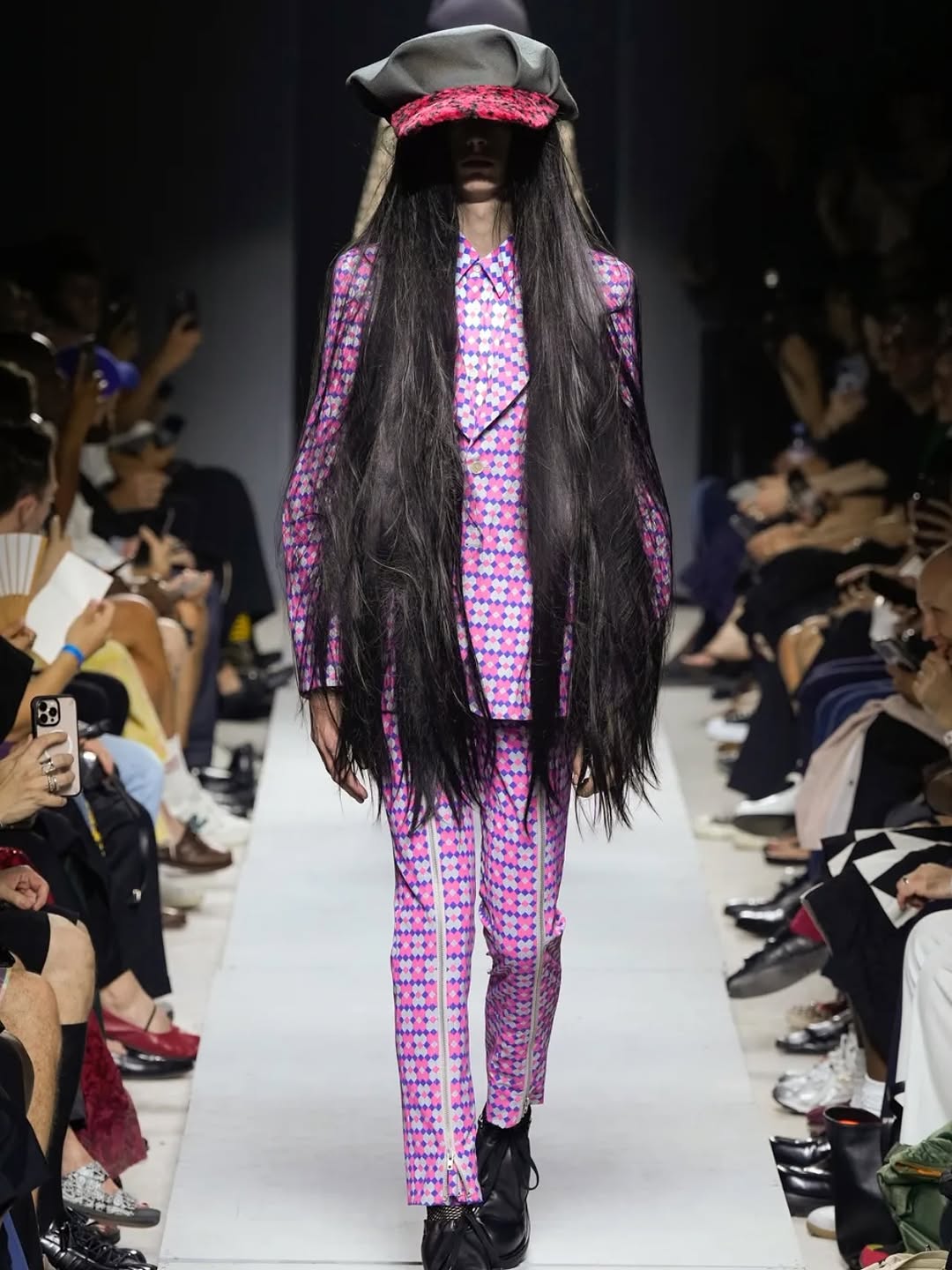
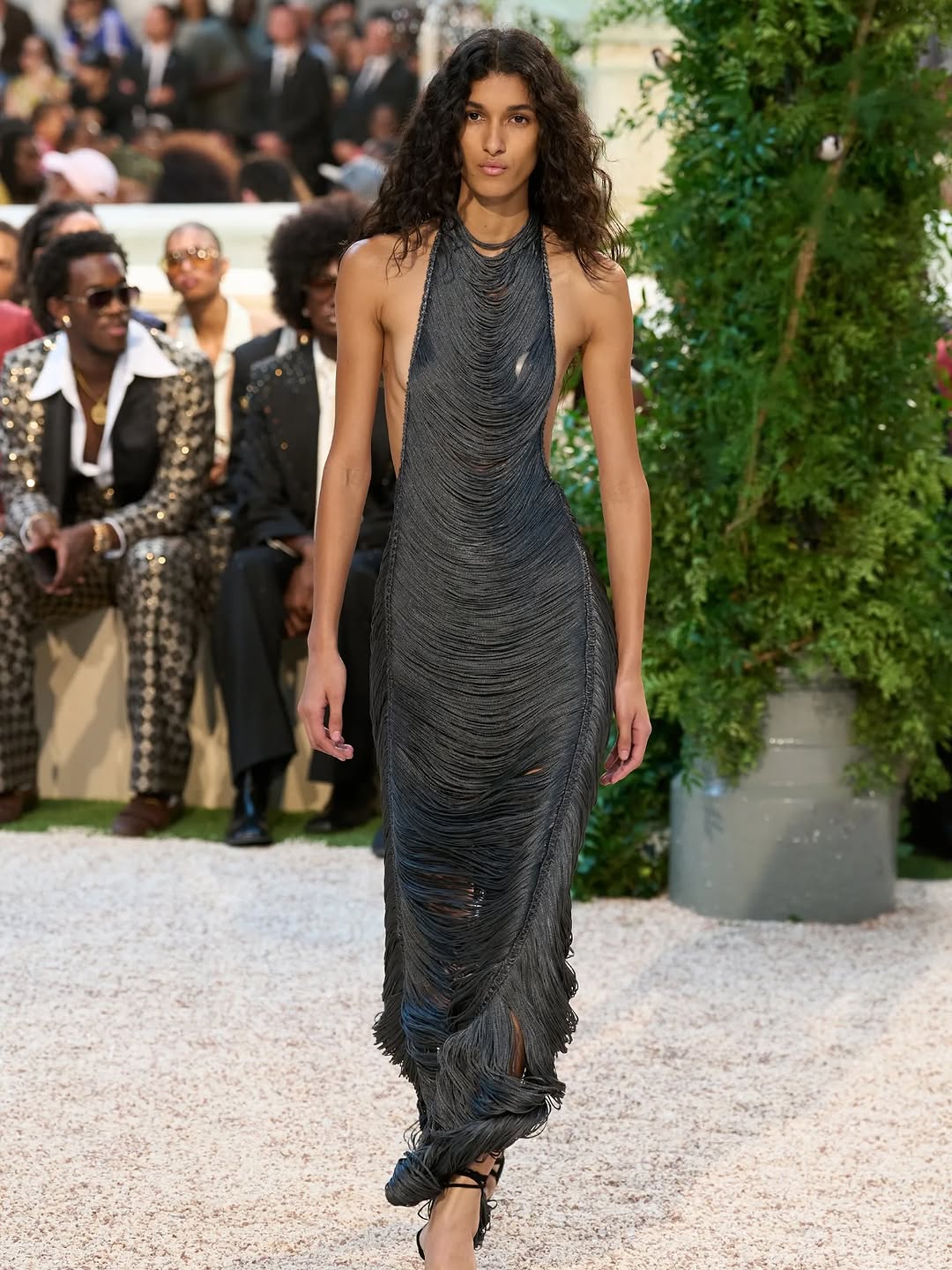
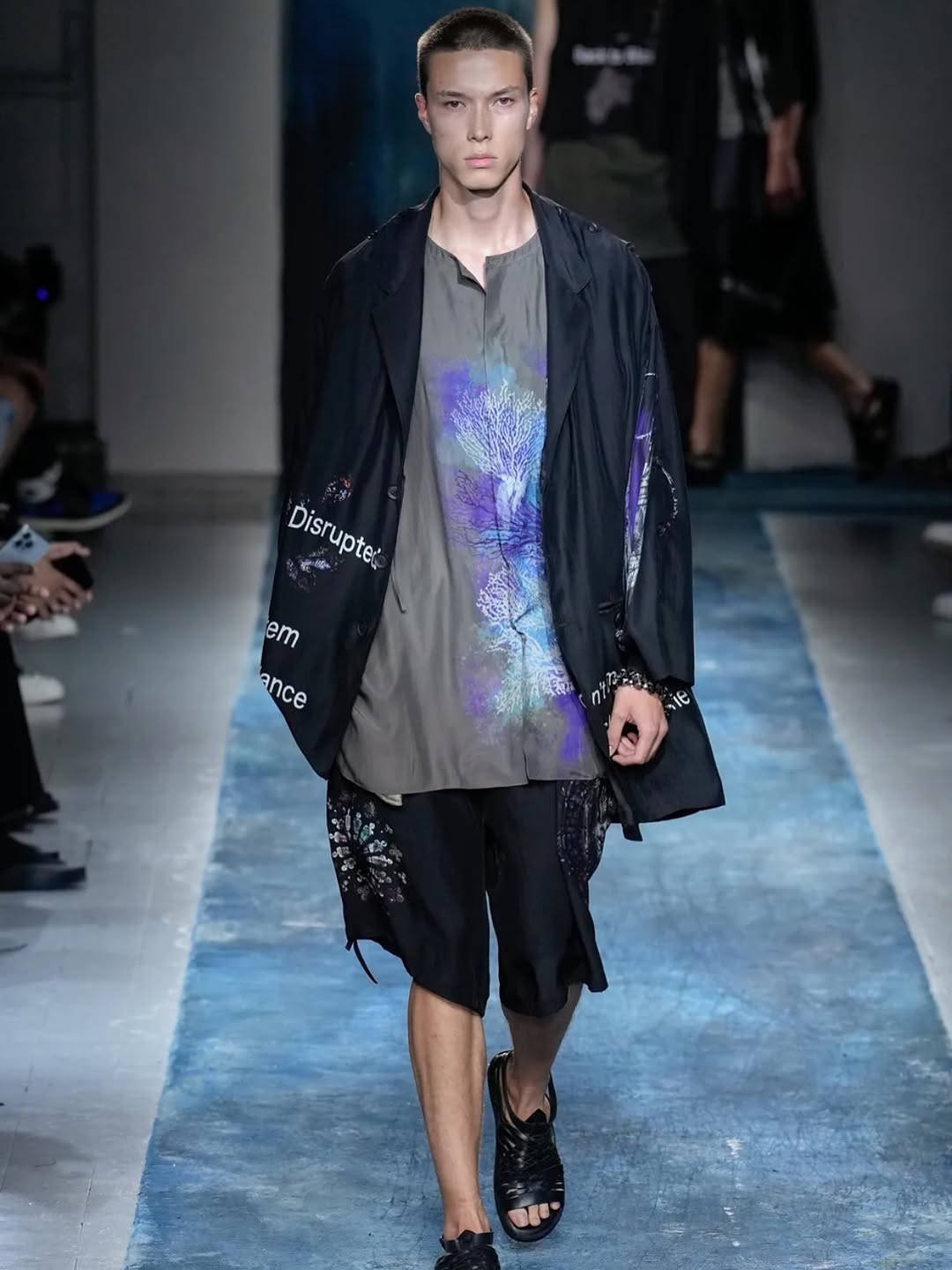
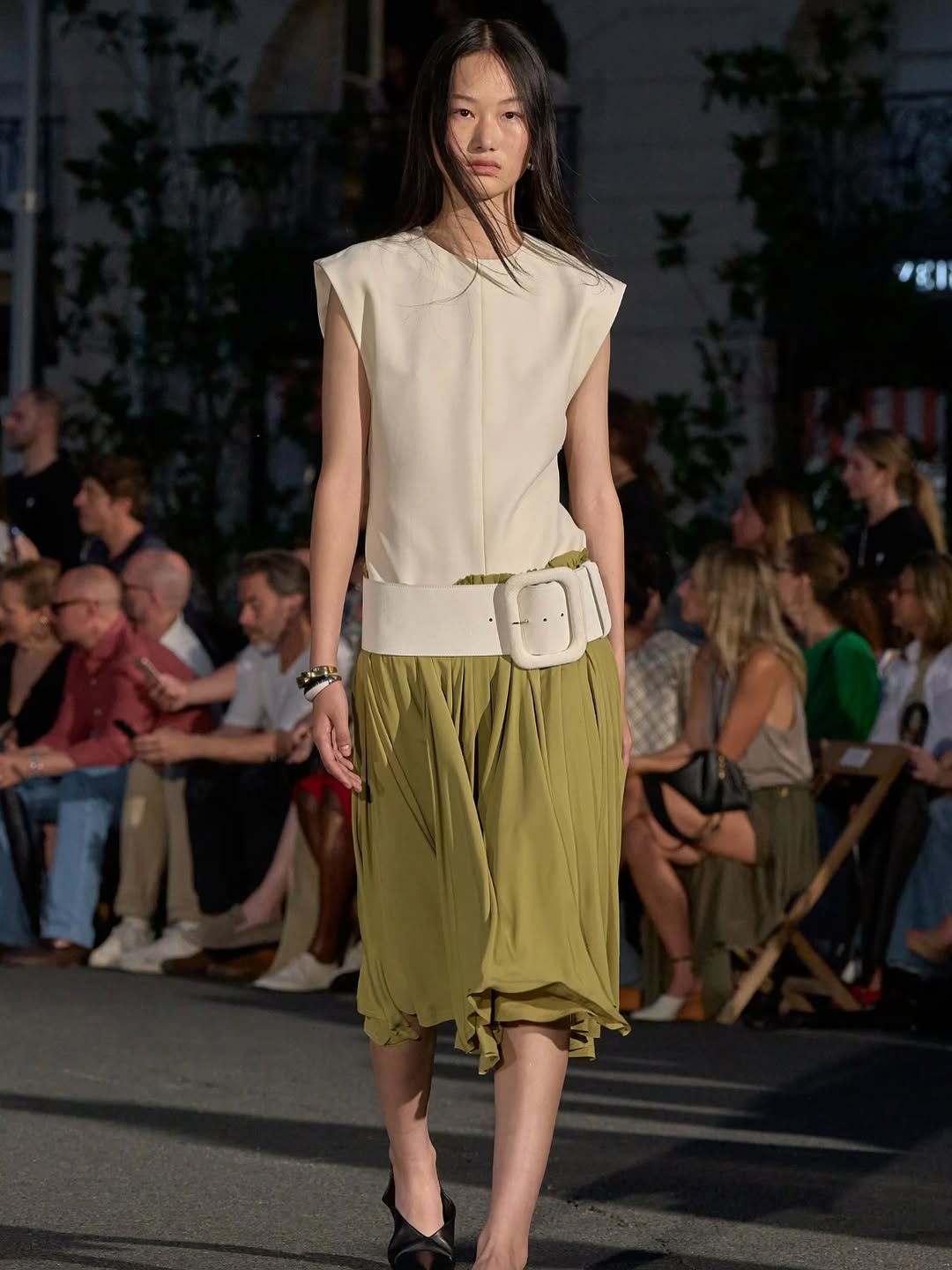
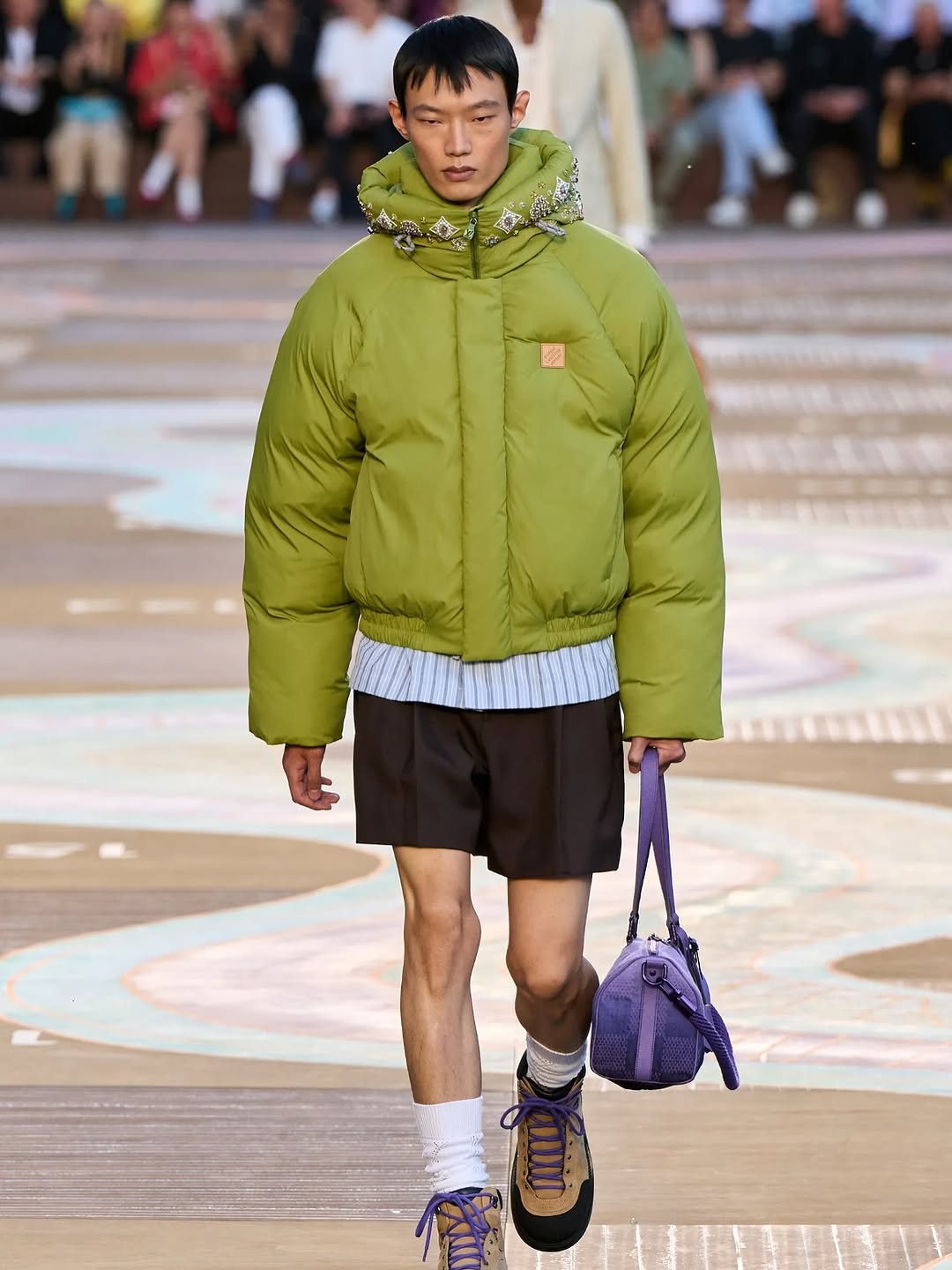
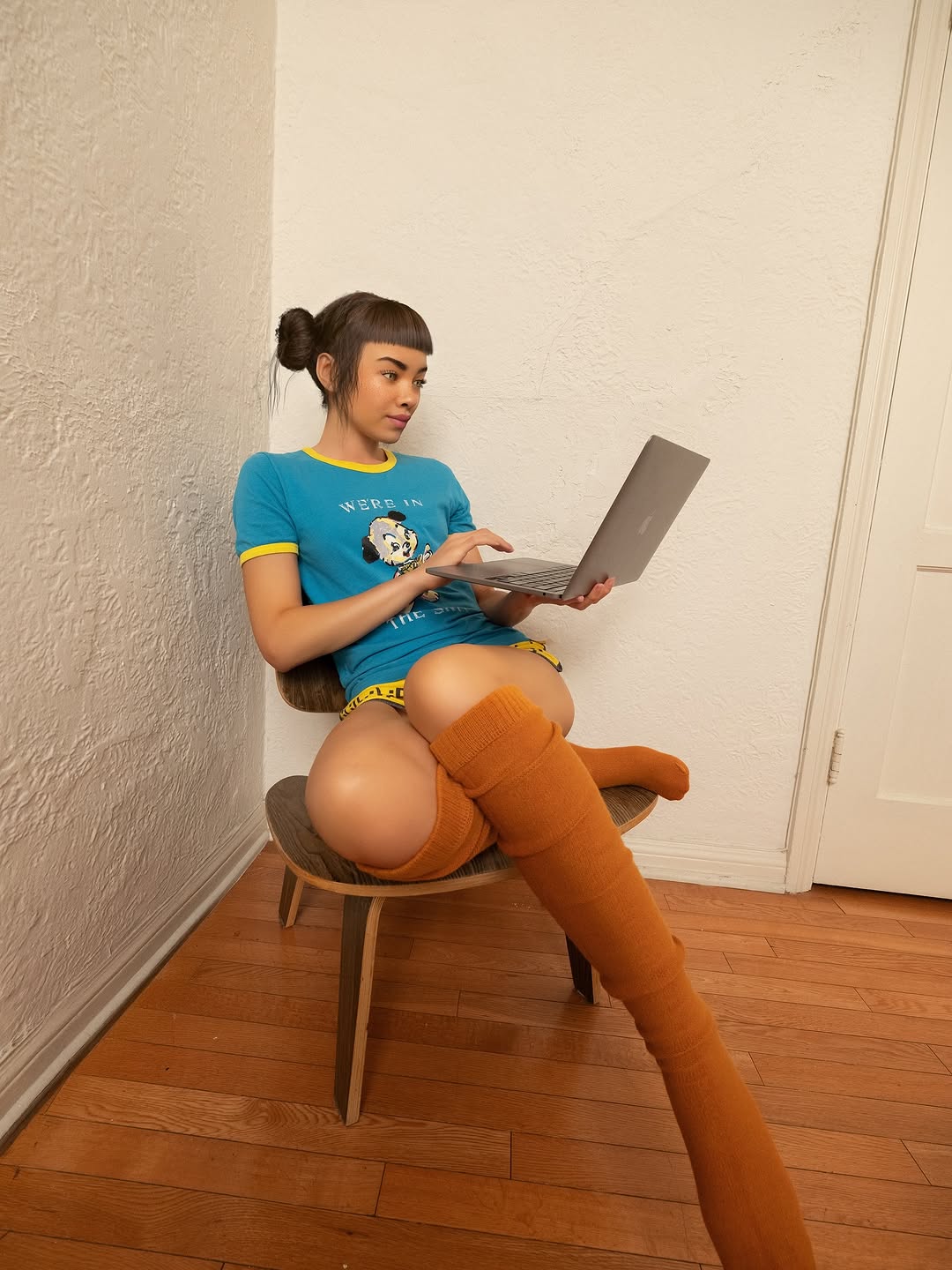
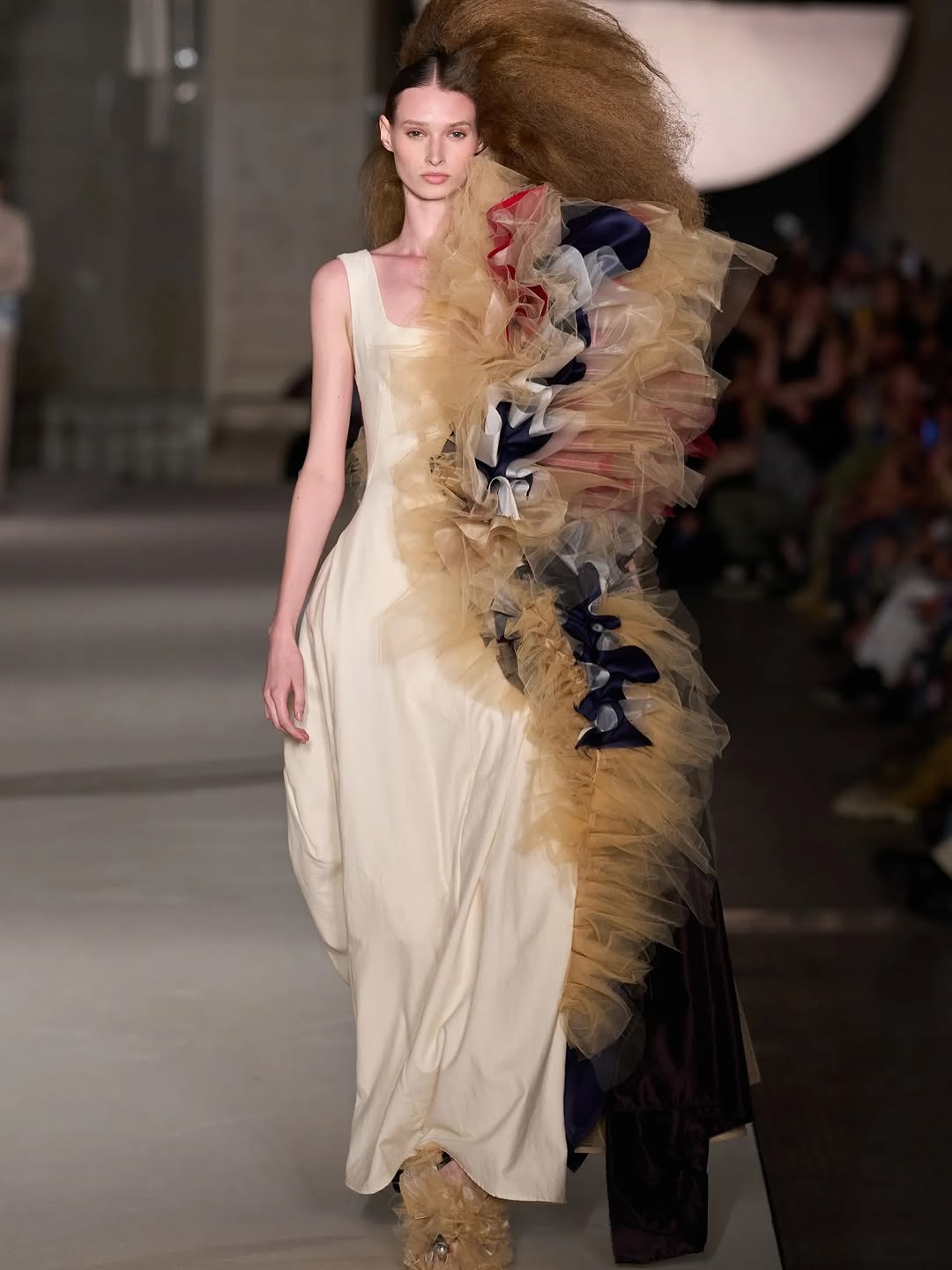
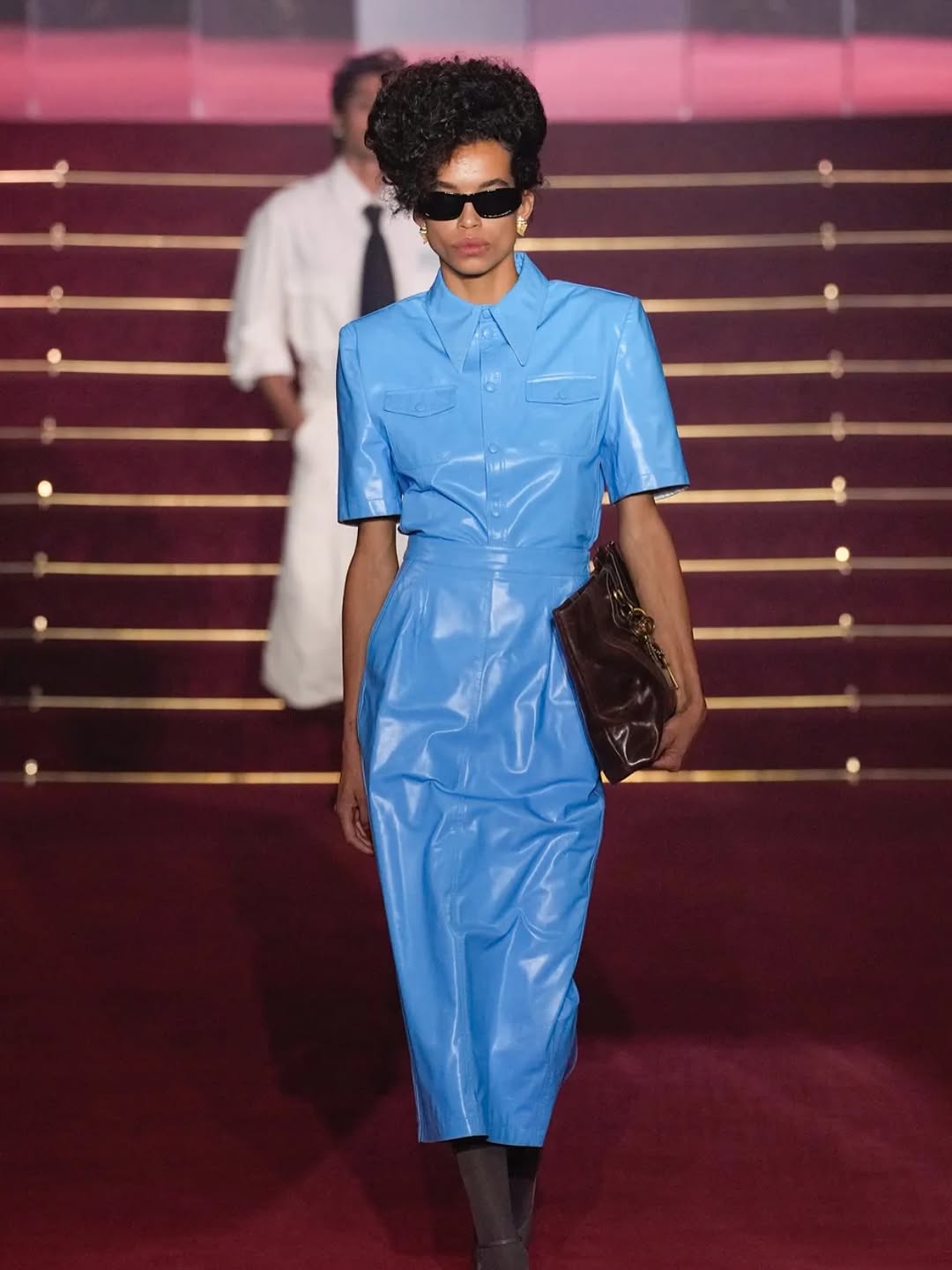
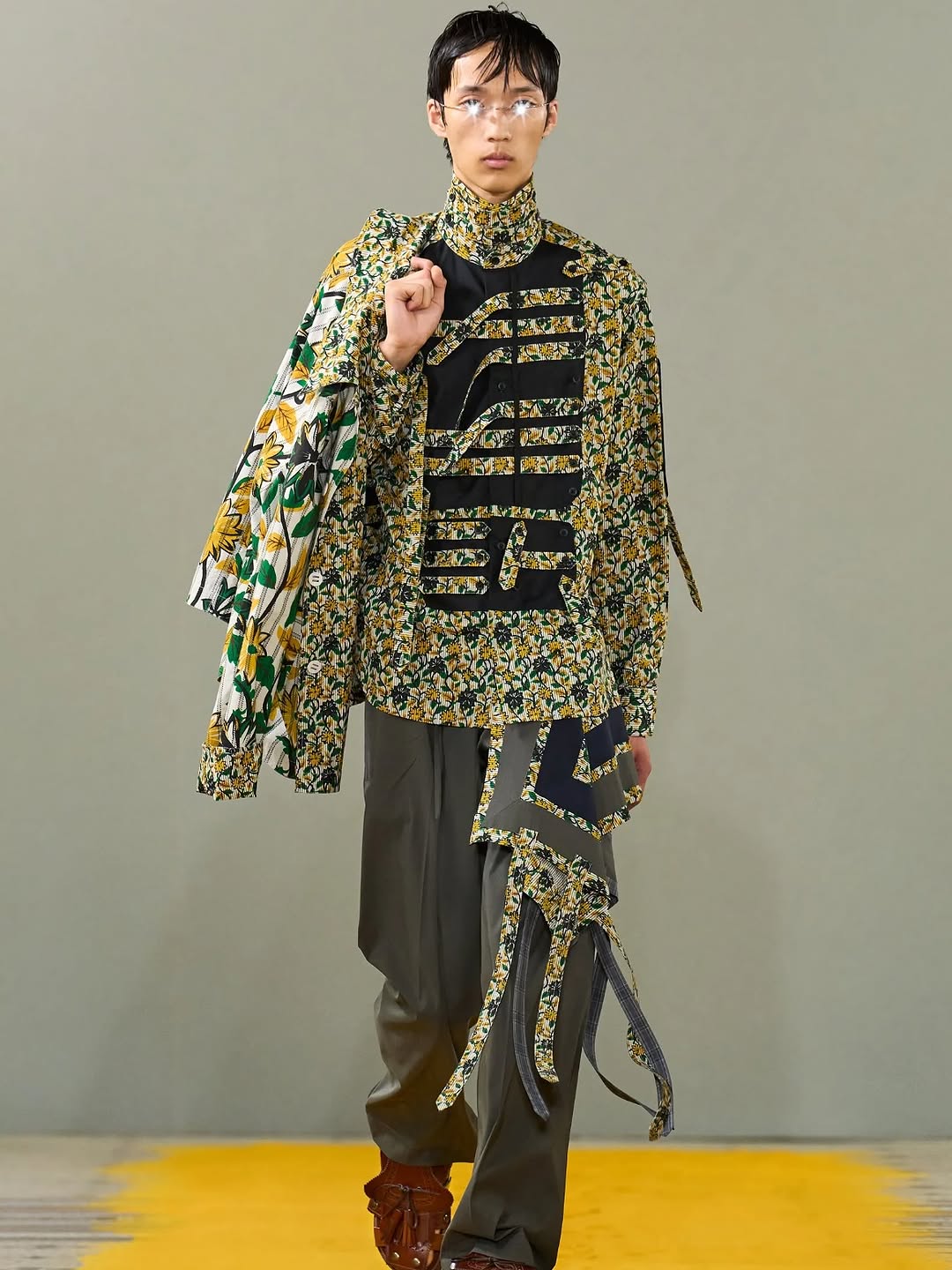
The first viral mechanism is proportion shock. The upper body is clean and narrow, while the lower garment expands dramatically with utility volume. This silhouette tension creates instant stop-scroll impact because the eye needs a moment to decode what the shape actually is. In fashion feeds, that decoding delay often improves dwell time.
The second mechanism is disciplined palette contrast. Green check pattern and dusty pink volume create a deliberate two-color conversation without visual overload. Many runway images fail online when color complexity gets chaotic; this one stays legible even at small sizes. Legibility is a major factor in social distribution performance.
The third mechanism is social proof through setting. Audience rows, phones, and runway symmetry confirm this as a live show moment, not a studio simulation. That context adds credibility and urgency. For creators and fashion commentators, live-runway authenticity can significantly boost saves and reposts, especially during trend cycles.
| Signal |
Evidence (from this image) |
Mechanism |
Replication Action |
| Silhouette asymmetry in one outfit |
Slim shirt profile vs oversized pink lower volume |
Shape contrast creates immediate visual hook |
Pair one fitted garment with one exaggerated-volume piece |
| Readable two-color strategy |
Muted green and dusty pink dominate look |
Simple palette improves in-feed clarity |
Limit runway recap focus to 2-3 main tones per featured look |
| Utility-detail depth |
Large flap pockets and structured panels on lower garment |
Detail density encourages zoom and saves |
Highlight one construction detail in caption or crop variant |
| Live-event authenticity |
Visible audience and phone captures on both sides |
Real show context increases trust and shareability |
Keep audience edges in frame for runway posts instead of over-cropping |
Best-Fit Scenarios
- Runway trend analysis: Perfect fit because silhouette experimentation is obvious. Change focus each post to one construction principle.
- Fashion commentary reels: Strong fit for discussing proportion logic. Change camera crop to compare top vs bottom volume.
- Styling education content: Strong fit for teaching balance in oversized looks. Change accessories while preserving silhouette idea.
- Brand recap carousels: Effective first-slide hero because it is instantly distinctive.
Not Ideal
- Minimal basics lookbooks: Extreme runway volume may be too avant-garde for practical styling audiences.
- Sportswear-only feeds: Utility-art silhouette may conflict with performance function messaging.
- Fast commerce product cards: Experimental shape can reduce straightforward purchase clarity.
Transfer Recipes (3)
- Street Adaptation Variant
Keep: fitted top + oversized bottom proportion principle.
Change: runway volume into wearable cargo midi silhouette.
Slot template (EN): {fitted upper} {oversized utility lower} {muted two-tone palette} {clean forward-walk pose}
- Monochrome Sculptural Variant
Keep: dramatic lower-body volume and centered walk framing.
Change: all colors to single-tone charcoal for shape-only focus.
Slot template (EN): {single-color look} {extreme volume contrast} {runway symmetry} {soft editorial lighting}
- Soft-Tailoring Variant
Keep: utility pocket language and narrow top silhouette.
Change: shirt texture to smooth cotton and lower volume to pleated technical fabric.
Slot template (EN): {structured shirt} {architectural lower volume} {visible construction details} {live runway context}
Aesthetic Read
The image succeeds by controlling complexity. The outfit is conceptually bold, but the scene and lighting remain neutral. This keeps attention on construction rather than spectacle. The centered runway composition also helps: audience lines act like visual rails that guide the eye directly to silhouette shape.
The look also demonstrates a useful fashion principle for creators: when volume is extreme, keep color system and facial styling restrained. That balance allows experimental design to feel intentional, not chaotic. It is one reason this frame works well for both fashion fans and casual viewers.
Prompt Technique Breakdown
| Prompt chunk |
What it controls |
Swap ideas (EN, 2-3 options) |
| "fitted shirt + oversized lower volume" |
Core silhouette tension |
"cropped jacket + balloon pants" / "slim knit + sculpted skirt" / "tailored shirt + padded wrap" |
| "muted green and pink palette" |
Legible color identity |
"olive + beige" / "navy + rust" / "black + ivory" |
| "runway center-walk framing" |
Authority and readability |
"three-quarter runway angle" / "end-of-runway pose" / "back-walk shot" |
| "audience-lined context" |
Live-event credibility |
"empty rehearsal runway" / "press-pit front row" / "street presentation crowd" |
| "soft neutral show lighting" |
Fabric detail clarity |
"warm spotlight wash" / "cool white runway lights" / "mixed directional light" |
Remix Steps
Baseline lock: lock proportion contrast, lock centered walk composition, lock restrained palette.
One-change rule: change one styling variable per iteration.
- Step 1: Keep silhouette, vary only color pairing.
- Step 2: Keep colors, vary only pocket/utility detailing density.
- Step 3: Keep outfit, vary only camera focal length for silhouette emphasis.
- Step 4: Keep visual winner, vary caption angle: construction analysis vs trend commentary.
This approach lets fashion creators build coherent runway analysis content with high reuse potential.