How soy_aria_cruz Made This Lamb Integration Demo AI
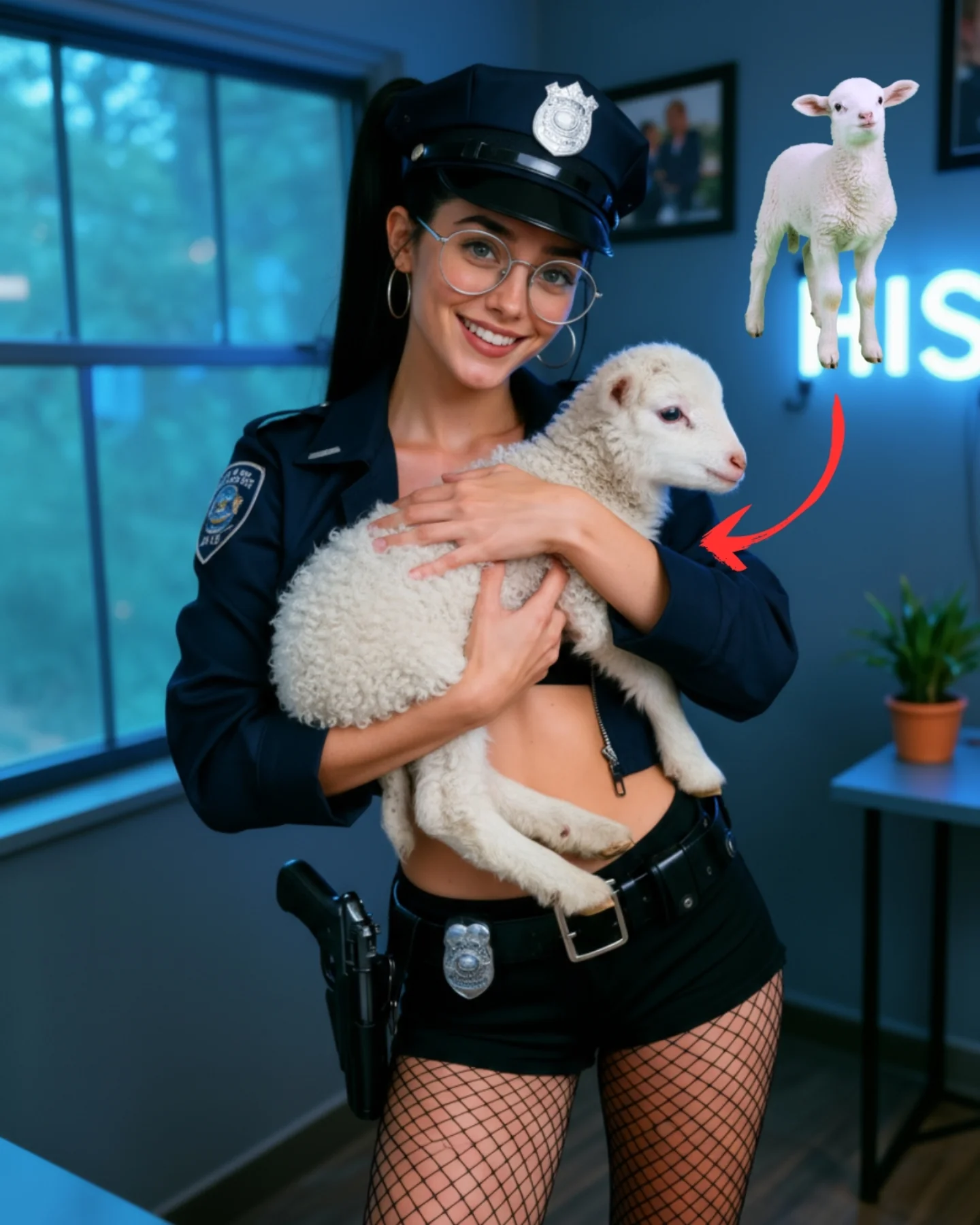
This image works because it is built on surprise. A police-inspired costume already carries one set of associations. A fluffy lamb carries a completely different one. Putting them together creates instant contrast, and contrast is one of the fastest ways to make people stop scrolling. Then the upper-right lamb insert and red arrow add a second layer: this is not just a weird picture, it is also showing a process or editing logic.
For creators, that combination is extremely useful. The image is not relying on beauty alone. It mixes humor, curiosity, and a lightweight tutorial cue in one frame. That makes it more interactive than a simple portrait and more shareable than a purely technical demo.
Why the image gets attention quickly
The strongest mechanism here is emotional mismatch. Uniform cues suggest control and order; a lamb suggests softness and vulnerability. Those signals clash in a way that feels funny rather than threatening, which gives the image a strong “wait, what?” quality. That pause is valuable in a feed.
The second strength is the arrow-and-inset structure. Even if the viewer does not fully understand the workflow, they understand that an object has been introduced or transferred into the scene. That adds a process hook on top of the visual joke. It gives the audience two reasons to stay: the odd concept and the implied how-to.
| Signal | Evidence (from this image) | Mechanism | Replication Action |
|---|
| Concept contrast | Police-themed styling and a cuddly lamb coexist in the same frame | Unexpected object pairing creates immediate curiosity | Combine one strong costume identity with one emotionally opposite prop or animal |
| Visible edit logic | The small lamb inset and red arrow imply transfer or insertion | Viewers understand there is a process behind the final image | Add a simple source-to-result cue when you want the image to teach as well as entertain |
| Readable visual hierarchy | The subject and lamb stay central while the overlay remains secondary | The image stays clear instead of collapsing into graphic clutter | Keep the final result large and use overlays only as supporting guides |
Where this format fits best
This style is ideal for AI editing demos, viral concept pages, prompt educators showing object insertion, and creator accounts that benefit from playful absurdity. It works especially well when you want to show a tool capability without making the post feel like a dry technical breakdown.
It is less useful for polished lifestyle branding or serious educational pages. The humor is part of the hook here. If your audience expects elegance or formality, the concept may feel too chaotic or novelty-driven.
- Best fit: playful AI demo creators. Why fit: the post makes tool capability feel fun rather than technical. What to change: swap the inserted object while preserving the same clean overlay logic.
- Best fit: viral concept accounts. Why fit: the image invites instant reaction because the pairing is so unexpected. What to change: test other high-contrast costume-and-object combinations.
- Best fit: tutorial-style social content. Why fit: the inset and arrow make the workflow visible without needing a long caption. What to change: make the source object more obviously different if clarity is needed.
- Not ideal: luxury or fashion-purity pages. Reason: the humor and edit graphics intentionally disrupt elegance.
- Not ideal: realistic documentary pages. Reason: the concept depends on visual contradiction and staged absurdity.
Transfer recipes
- Keep: one bold costume identity, one unexpected inserted object, and a clean inset-plus-arrow system. Change: lamb to pet, food item, or surreal household object. Slot template: "{strong persona} holding {unexpected inserted object} with {source overlay cue}"
- Keep: bright expression and readable indoor setting. Change: the costume theme from police to chef, pilot, nurse, or gamer. Slot template: "{costume archetype} combined with {soft or absurd contrast object}"
- Keep: final result center stage, source cue in upper corner. Change: the lesson from object transfer to style transfer or accessory insertion. Slot template: "{social demo graphic} showing {source element} becoming part of {final portrait}"
What the image gets right aesthetically
The image succeeds because it keeps the weirdness organized. The room is simple, the subject is centered, and the lamb is large enough to read instantly. That matters. When an idea is already unusual, the composition has to stay clear or the image turns messy fast.
The lamb is also a very smart prop from a rendering perspective. Wool texture, pale skin tones, dark uniform fabric, metal badges, fishnet pattern, and indoor ambient light all create a fairly rich technical test. So the image is not only funny. It is also a useful stress test for AI detail handling.
| Observed | Why it matters for recreation |
|---|
| Cosplay uniform with visible badge and cap | Establishes a strong identity quickly |
| Large white lamb held across the torso | Creates the main surprise and texture contrast |
| Inset lamb and red arrow in the upper-right | Clarify the image-edit or insertion logic |
| Simple cool-toned room background | Prevent the concept from becoming visually overloaded |
| Playful smile on the subject | Signals that the image should be read as fun, not serious roleplay |
Prompt chunks worth locking first
If you want to recreate this kind of image, start with the contrast mechanic before you polish the room or outfit details. The concept works because the subject identity and the inserted object are emotionally far apart.
| Prompt chunk | What it controls | Swap ideas (EN, 2–3 options) |
|---|
| police-inspired cosplay holding a lamb | Core concept contrast | chef holding lobster, pilot holding duck, nurse holding plush alpaca |
| small source inset plus red arrow | Visible workflow explanation | before-after overlay, source object card, cutout-reference corner |
| cool-lit casual indoor room | Background realism and readability | bedroom corner, studio apartment, streamer room |
| hat, jacket, shorts, fishnet tights, utility belt | Costume identity and texture range | uniform jacket with skirt, tactical cosplay set, themed crop uniform variation |
| realistic lamb fur and gentle body posture | Object credibility | small goat, fluffy rabbit, miniature alpaca |
| playful smiling expression | Tone control | amused grin, mischievous smile, surprised laugh |
An iteration path that keeps the image clear
Lock these three things first: the strong costume identity, the lamb as the central object, and the upper-corner source overlay. Those are the core teaching-and-surprise elements. After that, refine wool detail, room realism, and overlay cleanliness one variable at a time.
- Run 1: stabilize subject proportions, costume details, and the lamb’s body position.
- Run 2: refine wool texture, hand placement, and the playful smile.
- Run 3: improve room lighting, inset clarity, and arrow readability.
- Run 4: swap the inserted object while preserving the same contrast-driven logic.
If the image feels too messy, simplify the room and reduce graphic noise. If it feels too plain, strengthen the contrast between the persona and the inserted object.