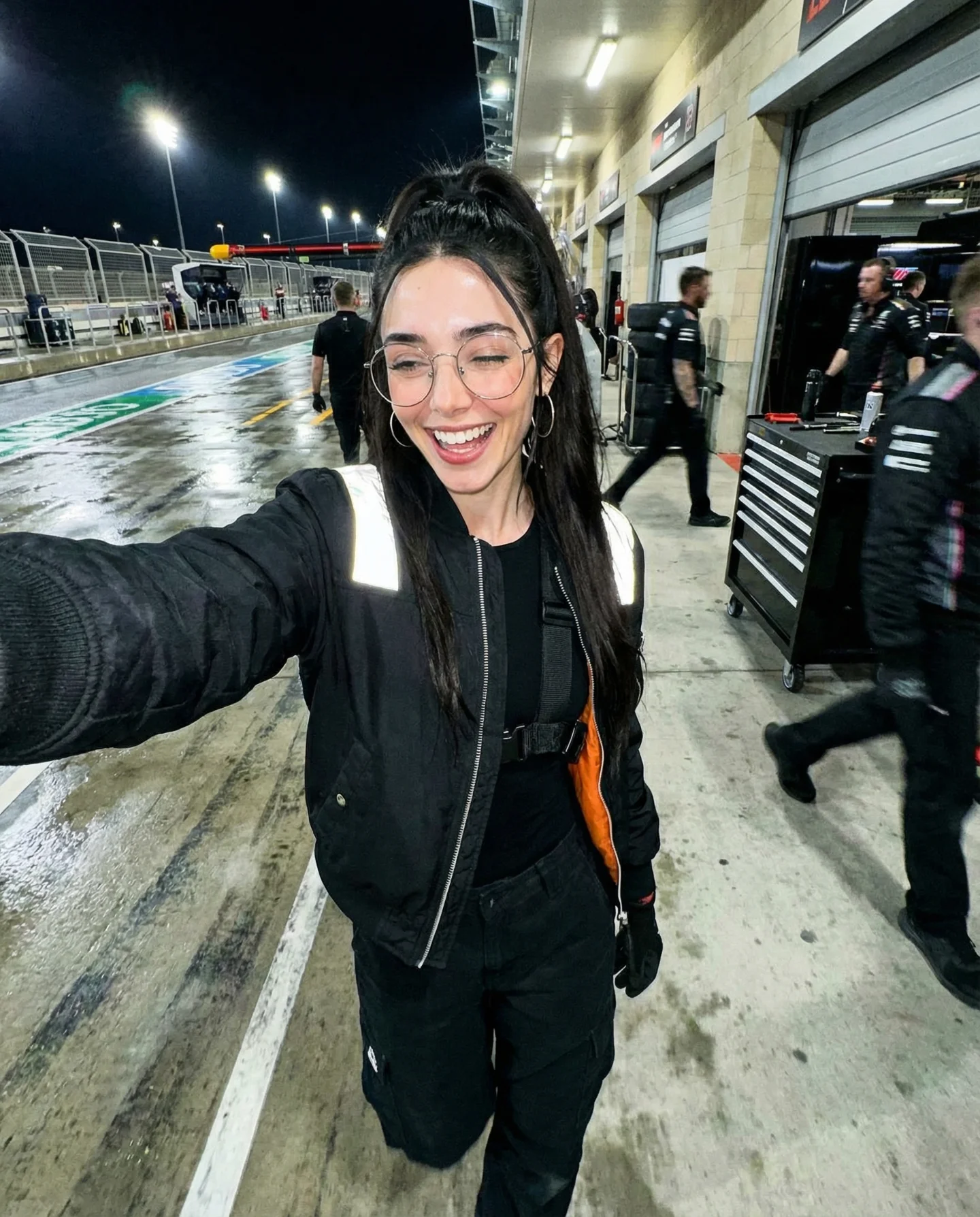
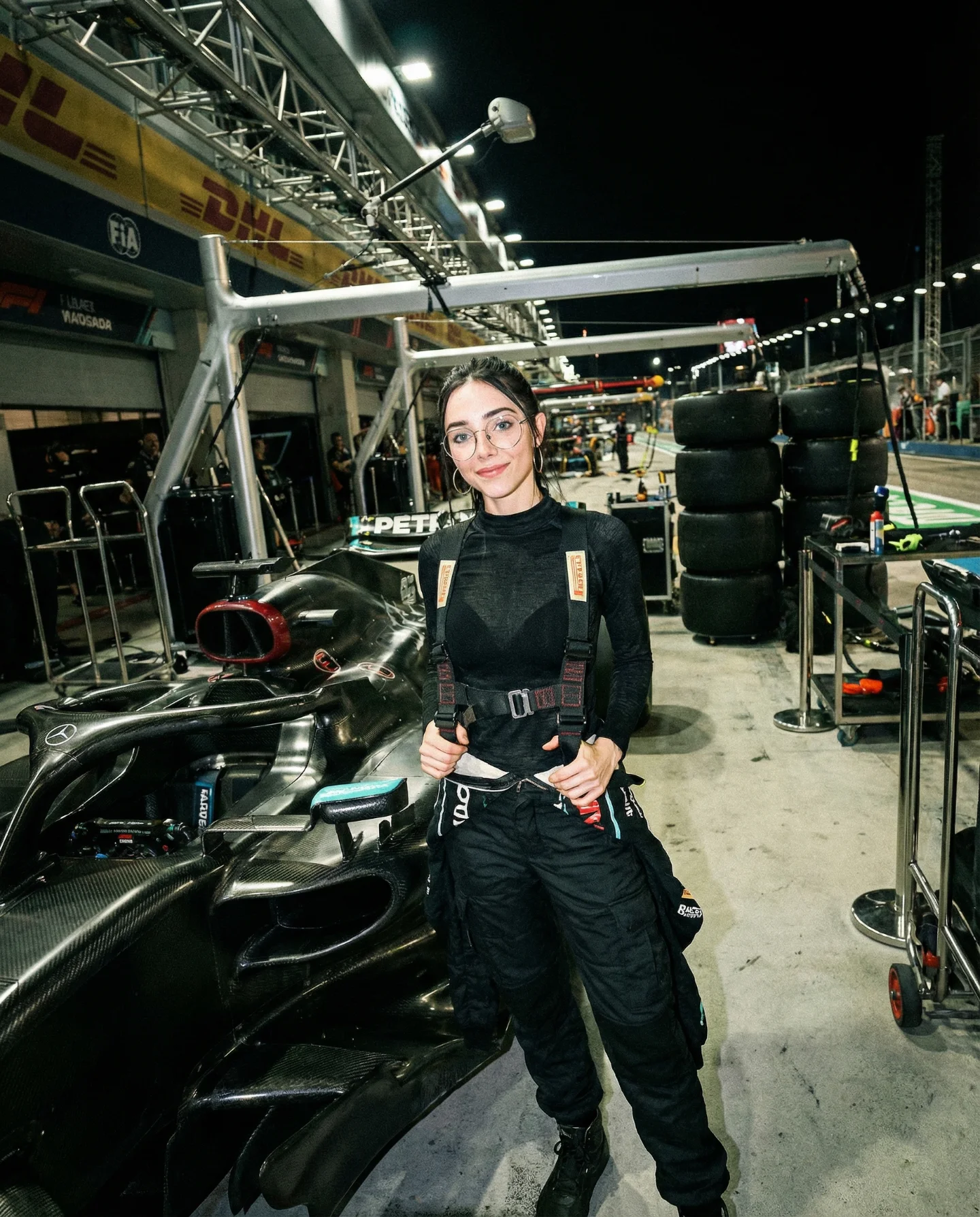
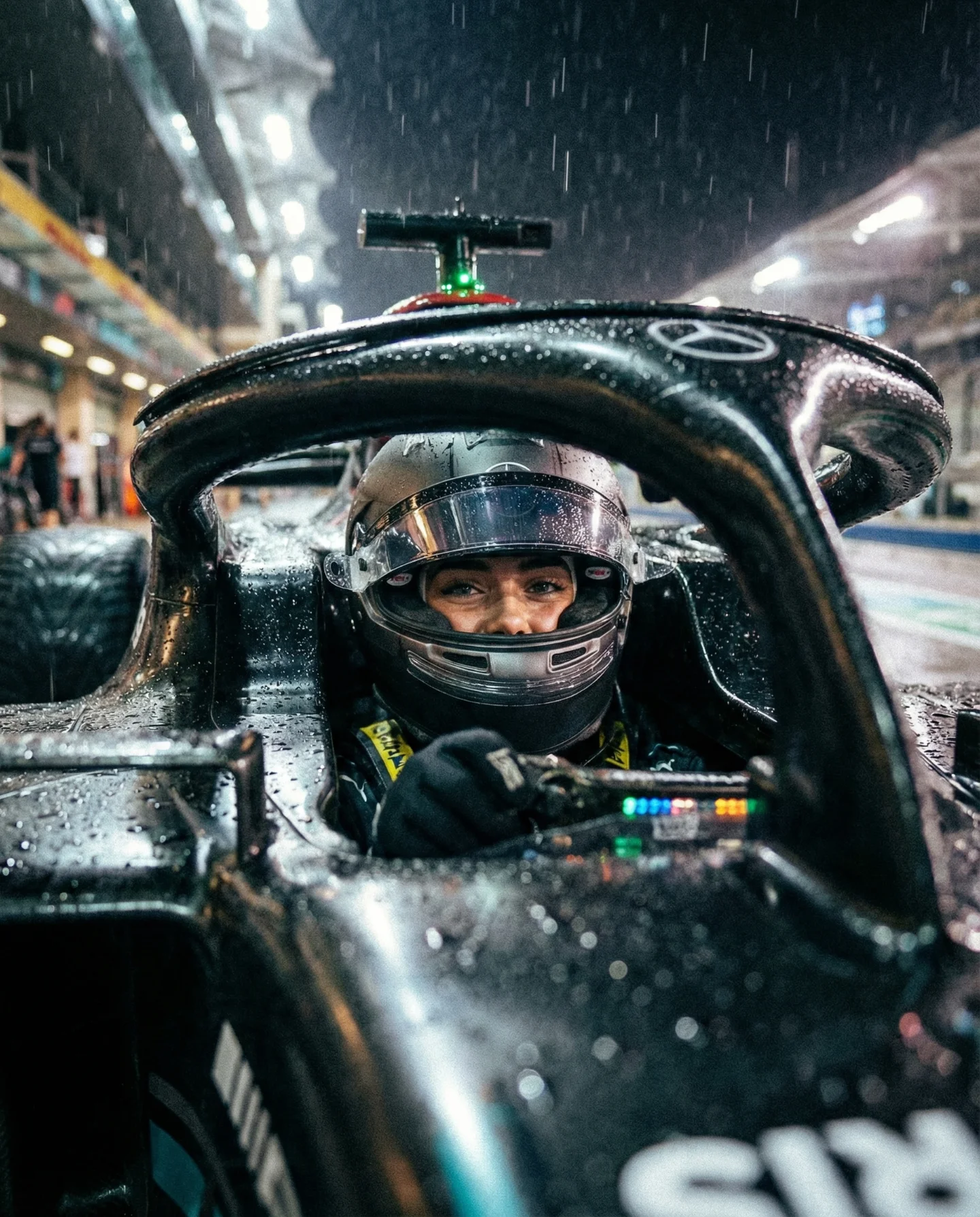
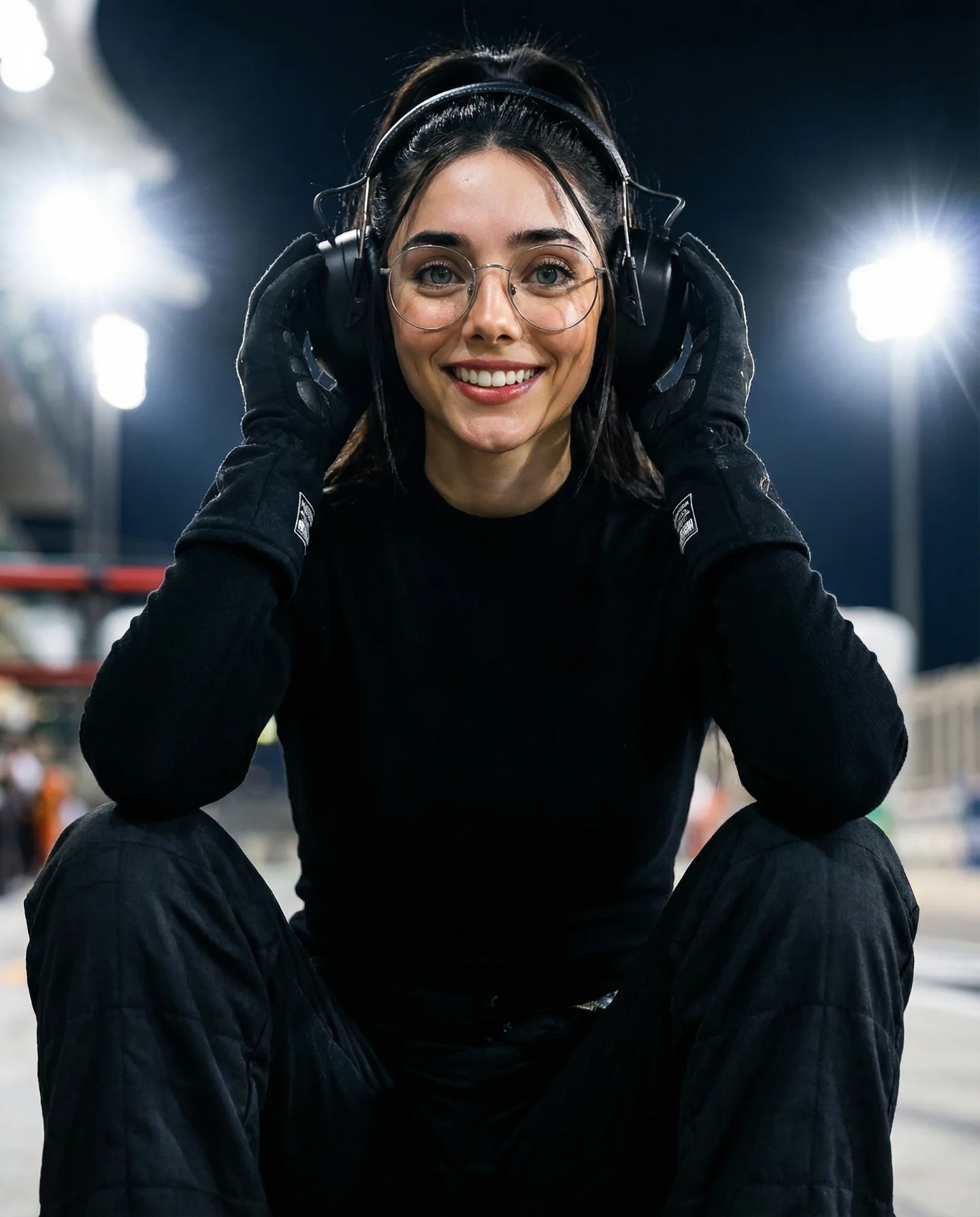
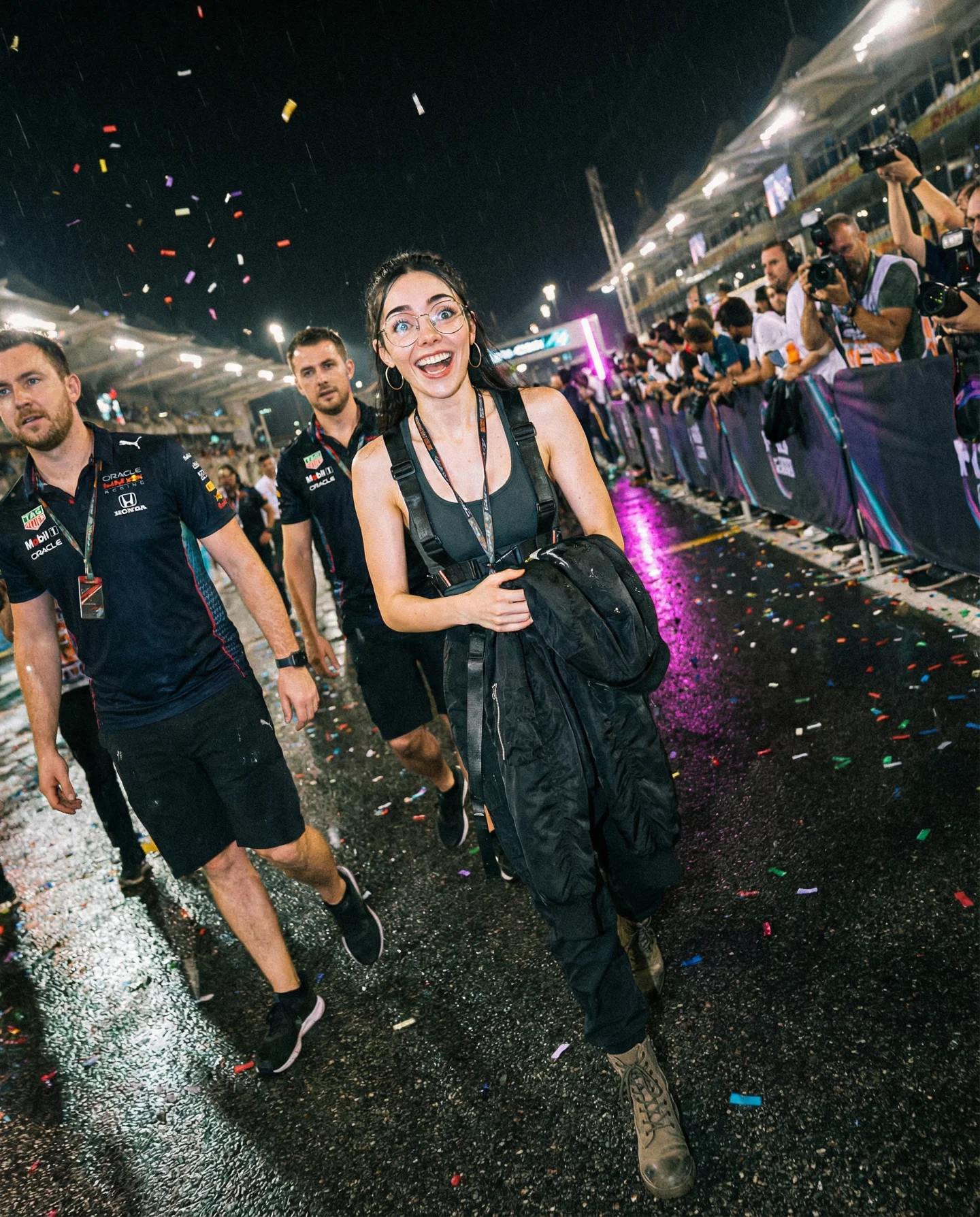
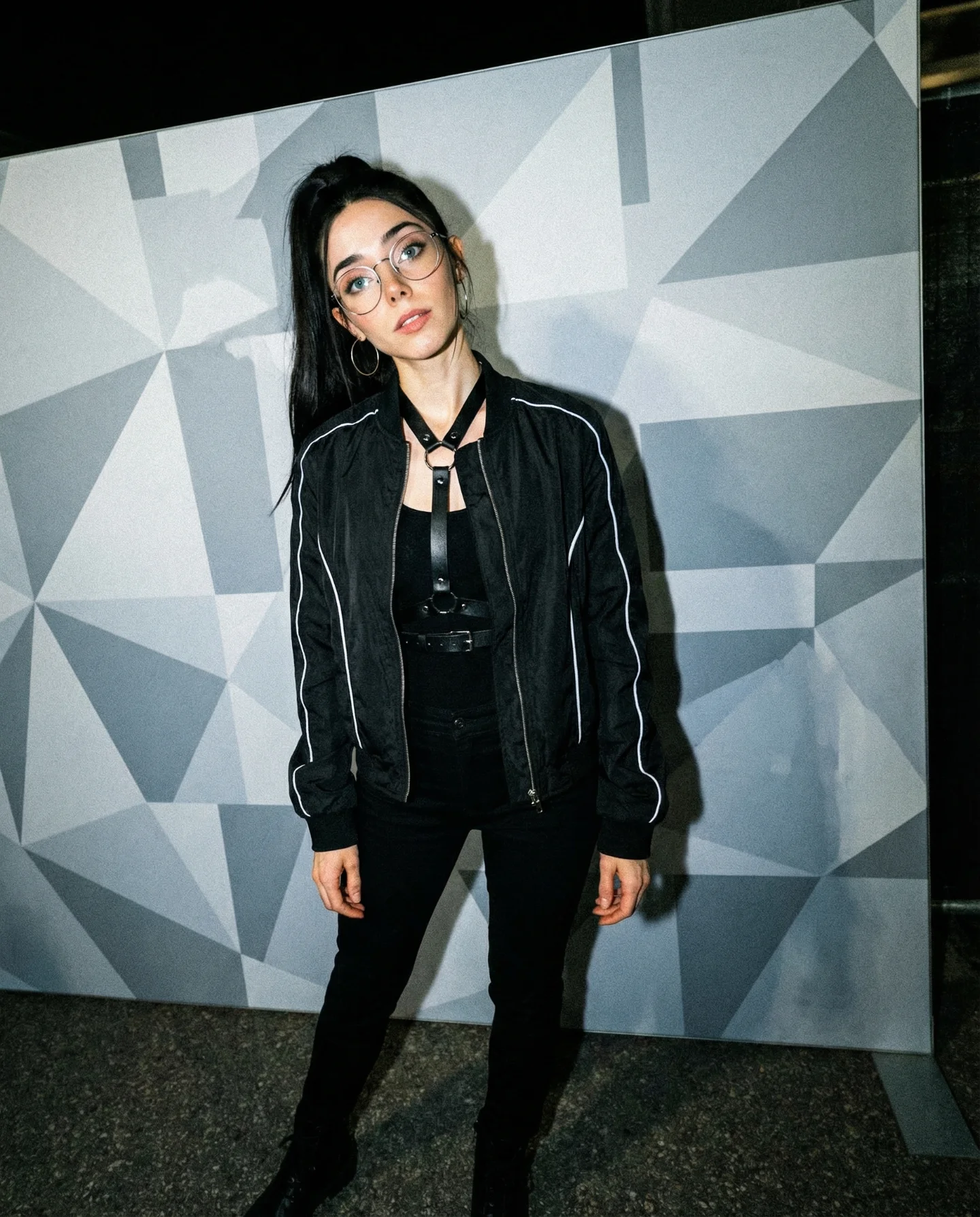
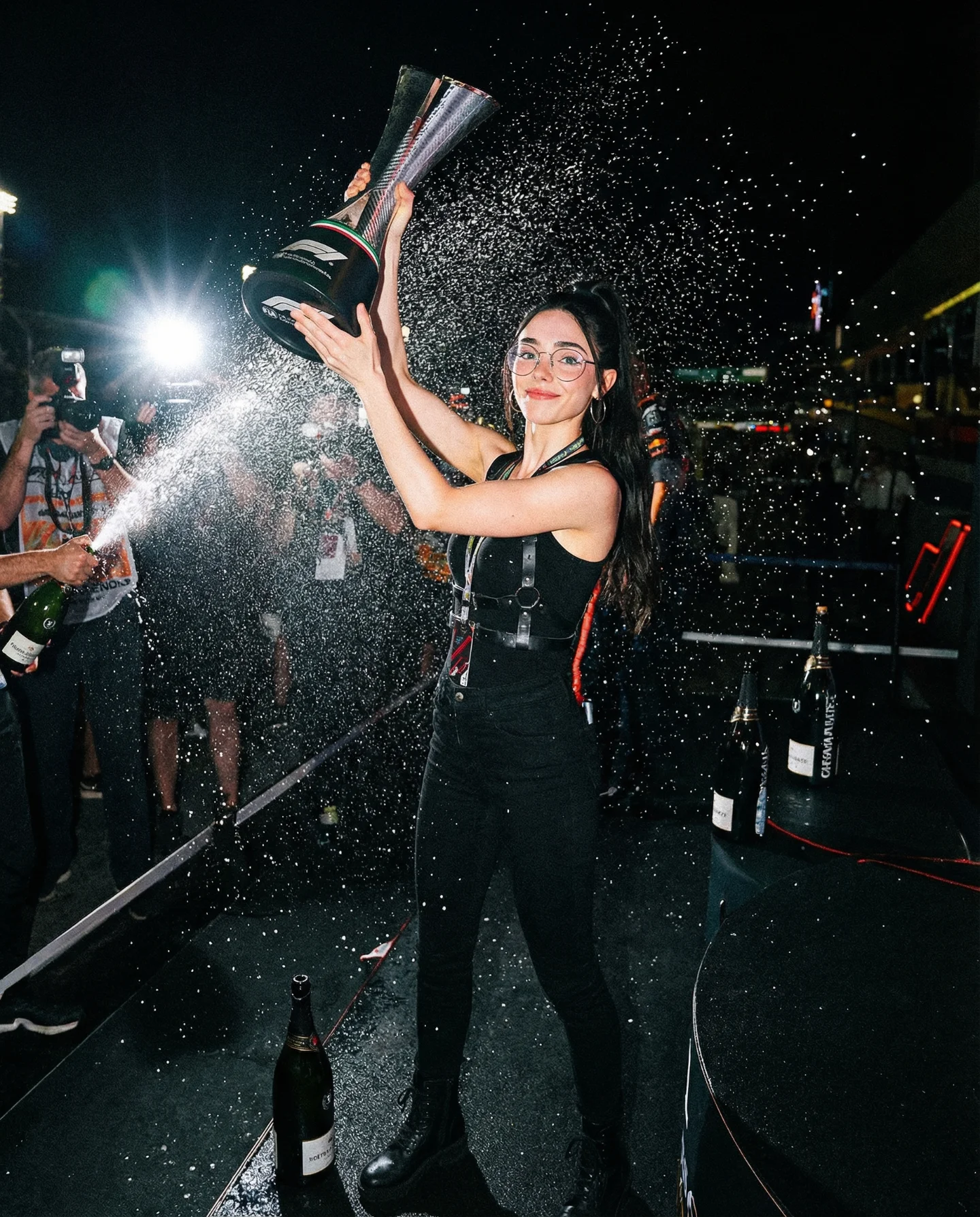

Formula 1 🏎️✨ Hoy toca salir de casa a dar una vuelta y hacer algo diferente 😋 Que foto de todas te gusta más?? 👀
Formula 1 🏎️✨ Hoy toca salir de casa a dar una vuelta y hacer algo diferente 😋 Que foto de todas te gusta más?? 👀
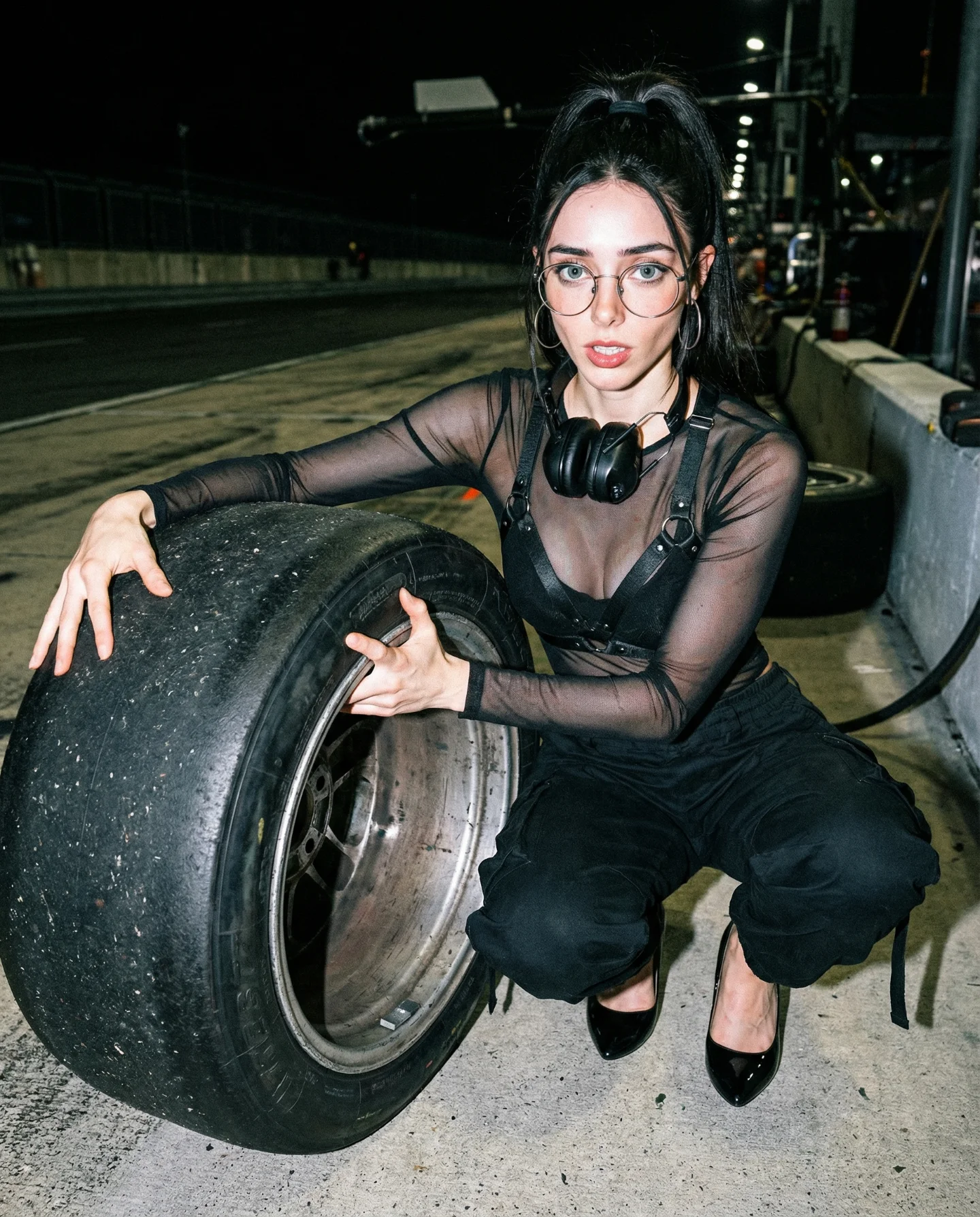
This image lands because it does not borrow Formula 1 prestige through a car shot. Instead, it uses one tactile object that instantly carries the culture: a massive worn slick tire. That choice matters. The tire is heavy, scarred, technical, and familiar even to viewers who do not follow every race weekend. It gives the frame a real motorsport anchor before the viewer has time to parse the whole scene.
The second thing that makes it stick is the tension between glamor and utility. The subject is dressed in sharp black mesh, cargo pants, heels, glasses, and headphones, but she is not standing in a polished lounge. She is crouched on concrete in a working pit-lane environment under harsh flash. That contrast is exactly why the image feels scroll-stopping. It is stylish, but it is attached to a world with texture and friction.
What makes the photo memorable is not just that it references Formula 1. It is that the reference is embodied. The tire is not a decorative prop in the far background. It occupies the foreground and physically shapes the pose. Her hands on the rubber and rim make the image feel touchable, and that physicality gives the post more authority than a generic “F1 inspired” outfit portrait would have.
The direct flash is doing just as much work as the styling. It creates a caught-in-the-moment feeling that reads as immediate and social rather than over-produced. In creator content, that is a useful sweet spot: polished enough to feel intentional, raw enough to feel believable. The receding pit-lane lights then add a cinematic runway behind her without stealing attention from the face and tire.
| Signal | Evidence (from this image) | Mechanism | Replication Action |
|---|---|---|---|
| Culture anchor | The oversized worn racing slick fills the left foreground. | A single iconic object tells the viewer exactly which world this image belongs to. | Lock one high-recognition object first and let it dominate at least one-third of the frame. |
| Contrast tension | Fashion-forward black mesh styling appears inside a rough service lane. | When glamor collides with a utilitarian setting, the image feels less generic and more ownable. | Pair a polished wardrobe with a real working environment instead of a clean backdrop. |
| Immediate realism | Harsh flash, concrete floor, and dark falloff make it feel like a captured moment. | Flash photography often reads faster on social because it looks present-tense, not distant. | Use direct flash and keep the ambient background darker rather than evenly lighting everything. |
| Strong pose-object relationship | Her body leans into the tire and both hands interact with it. | Touch creates story. The prop becomes part of the pose rather than an accessory beside it. | Make the subject grip, brace, or lean on the hero object so the prop changes the silhouette. |
This format is a strong fit for motorsport-inspired editorials, AI influencer content, nightlife fashion posts, event-weekend visuals, and any prompt pack built around “luxury subculture with edge.” It also transfers well beyond Formula 1. The deeper pattern is this: take one object with strong cultural meaning, bring it close to camera, and let the styling push against the setting rather than blend into it.
This look is less ideal for clean luxury campaigns, soft romantic portraits, or broad beginner prompts that need a neutral setup. The image works because it has edge. If you remove the grit, the concept flattens fast.
{creator identity} crouching beside {iconic motorsport object} in {night pit or garage setting} with direct flash{fashion subject} interacting with {hero object} inside {real working environment} with gritty editorial realism{night event setting} {subject with signature accessories} {hands-on prop interaction} {flash snapshot energy}The strongest aesthetic move here is scale. The tire is huge in frame, which makes the subject feel more embedded in the world instead of floating in front of it. That scale relationship gives the image physical stakes. You can almost feel the weight of the rubber and metal.
The palette is also disciplined. Most of the frame is black, charcoal, gray concrete, and muted metallic tones, so the skin and face pop immediately. That limited palette makes the image feel cooler and more expensive than if the background were full of colorful signage or bright branding. Even the small line of lights in the distance behaves like a restraint tool rather than decoration.
| Observed | Why it matters for recreation |
|---|---|
| Direct flash on face, chest, tire, and hands | This is the key to the “captured now” feeling and the high-contrast social texture. |
| One huge slick tire in the left foreground | The image gets niche specificity and strong spatial structure from a single object. |
| Mostly black wardrobe with sheer mesh and utility pants | The styling feels fashion-aware while staying coherent with the pit-lane mood. |
| Receding line of overhead lights behind the subject | The background gains depth without competing with the subject. |
| Glasses, headphones, and ponytail as identity markers | These details make the character memorable and easier to reproduce consistently. |
If you want this type of image to converge, do not start with “beautiful woman at Formula 1.” That phrasing is too broad and usually pushes the model toward generic paddock glamour. Start with the tire, the crouch, and the flash. Once those are locked, layer the face details and the outfit. The scene works because of object dominance and attitude, not because of vague race-weekend aesthetics.
| Prompt chunk | What it controls | Swap ideas (EN, 2-3 options) |
|---|---|---|
| young woman crouching beside an oversized Formula 1 slick tire | The scene logic and body-object relationship | pit-lane crouch; tire-side pose; motorsport prop interaction |
| round glasses, high ponytail, hoop earrings, headphones around the neck | The repeatable character identity markers | signature accessories; smart-girl nightlife styling; creator-consistency details |
| sheer black mesh top over a black harness-style bralette, black cargo pants, black pointed heels | The fashion silhouette and tone | dark editorial outfit; technical-glam wardrobe; black monochrome styling |
| night Formula 1 pit lane with concrete floor and receding overhead lights | The environment and depth cues | race service lane; paddock-side corridor; industrial motorsport backdrop |
| direct on-camera flash with dark background falloff | The texture, realism, and immediacy | flash snapshot look; harsh frontal light; nightlife candid editorial lighting |
| worn tire rubber, metal rim detail, no foreground race car | The prop fidelity and clutter control | used slick texture; heavy rubber realism; stripped-down motorsport prop focus |
Baseline lock the prop scale, lighting method, and camera distance first. Those three choices carry most of the image. If the tire gets too small, the concept weakens. If the flash disappears, the post turns into a generic dark fashion portrait. If the camera backs up too far, the intimacy is gone.
The one-change rule matters here. Do not alter pose, object, and lighting in the same iteration. First solve scale, then solve identity, then solve texture. That order keeps the image from drifting into a different genre.