2000s filter camera videos work because the look is instantly legible: flash, softness, grain, and that slightly messy party-photo energy people still recognize in a second. This page helps you find 2000s filter camera videos worth copying, the prompt angles that fit the look, and the workflows that make the throwback feel intentional instead of fake. Pick one and start your own. Throwback-style videos and creator-ready workflows, each paired with prompts and steps you can reuse. Last updated March 2026.

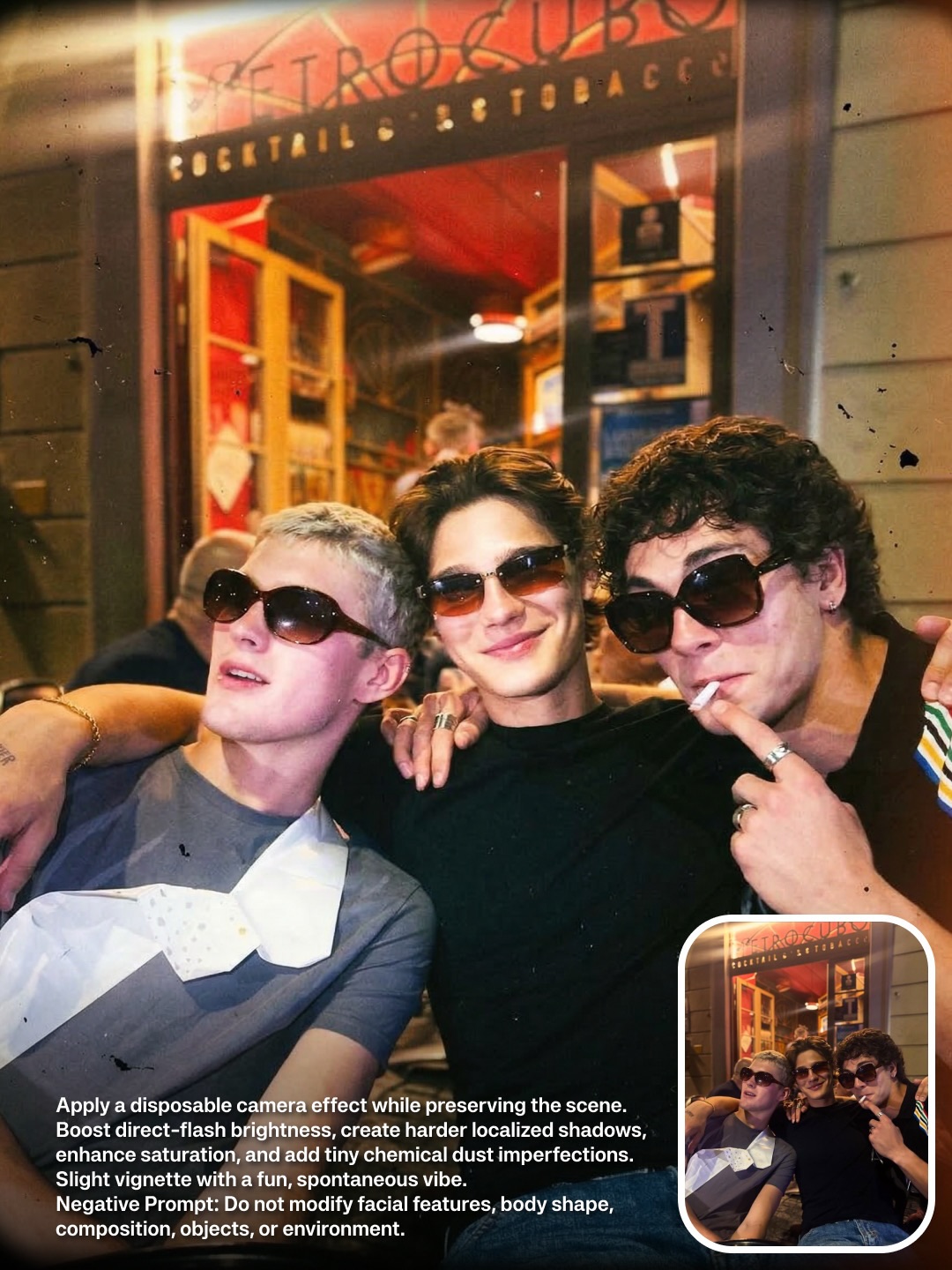
skaigenerated: Disposable Flash Nightlife Trio AI Art
[Subject] A disposable-camera-style nightlife portrait of three young men sitting close together outside a warmly lit bar entrance, all wearing dark sunglasses despite the night setting. Their body language should feel spontaneous and playful: shoulders touching, arms draped over each other, one person leaning in with a cigarette-like gesture, all conveying effortless after-hours cool. Styling should read as contemporary nightlife casual with strong social energy rather than polished fashion-campaign posing.

[Environment] Street-side bar or cocktail lounge entrance glowing with warm amber interior light, visible doorway signage, urban evening backdrop, slight crowd blur in the background, no luxury red carpet, no clean studio environment. The setting should feel like a candid late-night city hangout just outside a busy venue.

[Composition/Camera] Vertical flash snapshot with the trio filling most of the frame, seated shoulder-to-shoulder in a tight horizontal line, camera positioned very close as if taken by a friend at arm’s length. Keep the bar entrance visible behind them, with enough environmental context to anchor the social scene.

[Lighting] Strong direct flash with high brightness on faces and clothing, harder localized shadows, slight overexposure on highlights, warm spill from the venue behind, and a subtle disposable-camera imperfection feel. No cinematic softbox lighting, no luxury editorial gloss.

[Style/Rendering] Disposable-camera nightlife aesthetic, candid youth-culture snapshot, slightly dirty flash realism, tiny chemical-film imperfections, social-media filter-demo energy, spontaneous and raw but still visually appealing, no heavy retro sepia overload.

[Detail constraints] Preserve the three-man lineup, sunglasses at night, close shoulder contact, bar doorway glow, direct-flash harshness, and casual nightlife charisma. Keep the scene fun and unforced. Do not add formal tailoring, fantasy elements, staged luxury props, or dramatic action.
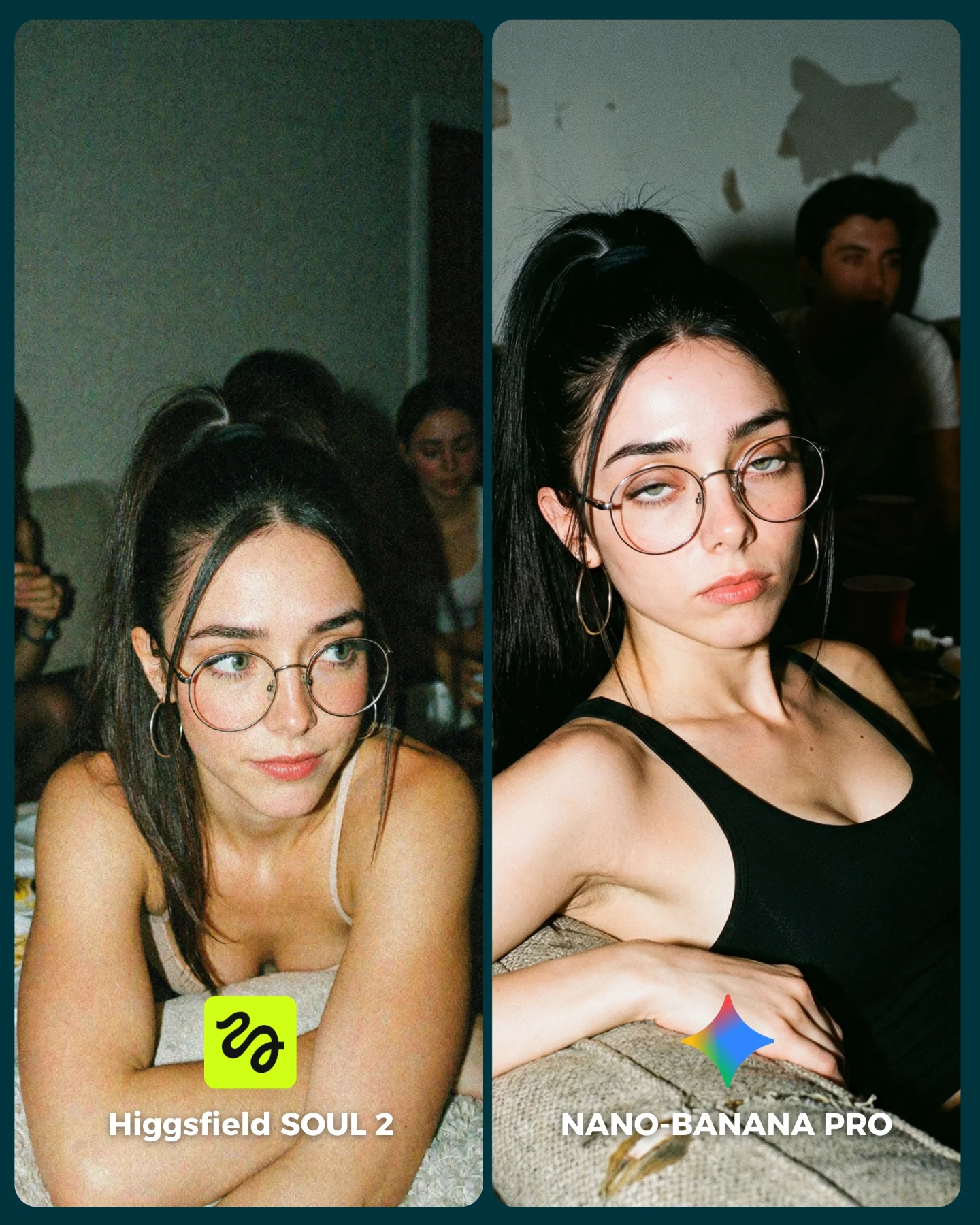
soy_aria_cruz: SOUL 2 vs Nano Banana Pro AI Art
[Subject]
A two-panel comparison image featuring the same young adult woman in a casual indoor party setting. She has light skin, large round wire-frame glasses, dark brown or black hair in a high ponytail, hoop earrings, and a candid low-key expression. She wears a simple black sleeveless tank top. In the left panel she leans forward with crossed arms or folded posture on a couch or soft surface, glancing sideways with a thoughtful expression. In the right panel she reclines back against a sofa arm, shoulders angled toward camera, giving a detached or tired look.

[Environment]
Dim apartment or house-party living room with direct flash photography, beige or neutral couch fabric, blurred people in the background, cups or casual party clutter, and a dark ambient room tone. The scene should feel like a real late-night candid captured in a social setting, not a staged studio shoot.

[Composition/Camera]
Vertical split-screen comparison layout with rounded corners and a narrow teal divider between the left and right panels. Both crops are intimate medium close-ups from chest-up or torso-up. Maintain bottom labels: "Higgsfield SOUL 2" with neon-green icon on the left and "NANO-BANANA PRO" with multicolor icon on the right. The two frames should feel like alternate outputs of the same candid scenario.

[Lighting]
Direct on-camera flash with hard frontal light, visible skin highlights, flat but realistic party-photo illumination, mild falloff into the dark room, and bright catchlights on the glasses. Preserve the imperfect casual flash aesthetic rather than smoothing it into polished editorial light.

[Style/Rendering]
Photoreal social-media comparison graphic with documentary nightlife energy, realistic skin texture, believable flash harshness, slight background noise, and authentic candid-photo mood. Keep it grounded and imperfect in a convincing way.

[Detail constraints]
do not remove the two-panel layout, keep the same woman in both panels, preserve the glasses, black tank top, indoor couch setting, background partygoers, and the bottom model labels. The image must feel like a realism comparison for candid flash photography.

[Negative prompt]
studio backdrop, clean white room, no background people, glamour beauty lighting, outdoor night street, missing glasses, different outfits, heavy makeup editorial styling, anime, cartoon, deformed arms, blurred face, no couch, no flash look, empty background, missing text labels

[Suggested parameters]
- aspect ratio: 4:5 vertical overall
- lens/focal length: 35mm to 50mm equivalent with point-and-shoot flash feel
- depth of field: shallow-medium
- steps: 30-38
- CFG/style strength: 5.5-6.8
- sampler: DPM++ 2M Karras or Euler a
- seed suggestion: 56427318

[Delta prompt strategy]
1. If the candid party vibe disappears, append: "late-night indoor house party with blurred people in the background"
2. If the flash look softens too much, append: "direct on-camera flash, harsh frontal light, realistic casual snapshot"
3. If the split comparison vanishes, append: "two side-by-side benchmark panels with rounded corners"
4. If the woman changes between panels, append: "the same woman appears in both frames with matching glasses and ponytail"
5. If the couch setting is lost, append: "leaning on a beige fabric sofa in a dim living room"
6. If wardrobe drifts, append: "simple black sleeveless tank top, hoop earrings, round glasses"
7. If the background becomes too clean, append: "softly blurred partygoers and casual room clutter behind her"
8. If skin becomes too airbrushed, append: "realistic flash skin texture, slight shine, natural imperfections"
9. If labels disappear, append: "bottom labels for Higgsfield SOUL 2 and NANO-BANANA PRO"
10. If the mood becomes too posed, append: "unpolished candid snapshot energy, intimate and slightly awkward"
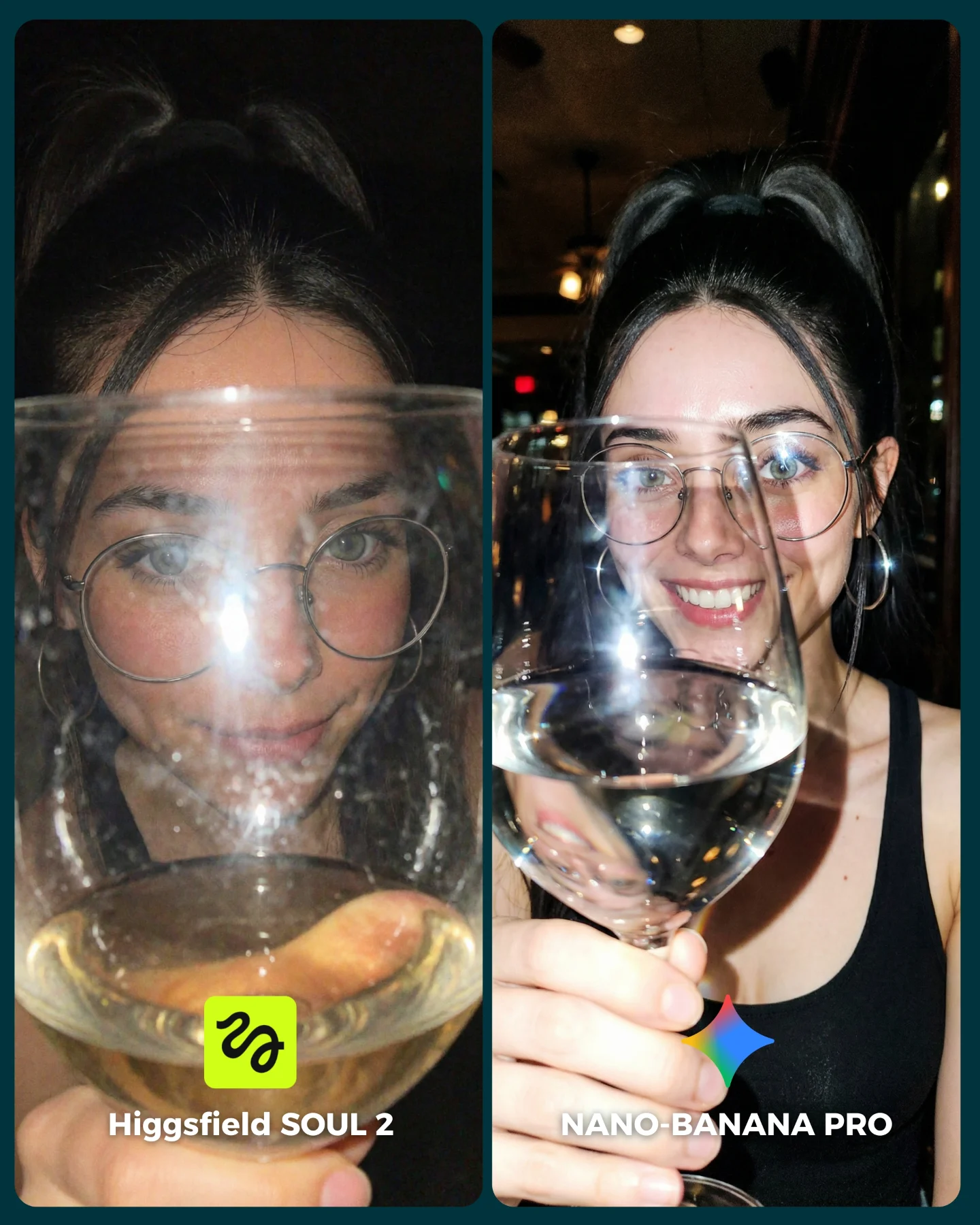
soy_aria_cruz: SOUL 2 vs Nano Banana Pro AI Art
[Subject] A side-by-side comparison image showing the same young woman holding a large stemmed wine glass directly toward the camera in a dim restaurant or bar setting. She appears in her early 20s with fair skin, green-hazel eyes, large round silver wire-frame glasses, hoop earrings, dark brown to black hair tied into a high ponytail, and a black sleeveless top. The left panel shows a softer, subtler smile and a more subdued mood, while the right panel shows a brighter open smile and more vivid expression. In both panels, the wine glass dominates the foreground and partially distorts or overlaps the face due to glass curvature and reflections.

[Environment] Two equal vertical portrait panels in a dark indoor nightlife environment. The background is mostly black or very dim, with a few warm amber bokeh lights and hints of restaurant or bar interior on the right panel. The left panel feels more flash-heavy and synthetic, with the glass flattening the scene. The right panel feels more real and dimensional, with better depth, cleaner hand rendering, and more natural low-light atmosphere. Bottom labels identify the sides as “Higgsfield SOUL 2” on the left and “NANO-BANANA PRO” on the right, each with its respective small icon.

[Composition/Camera] Tight vertical close-up portrait in split-screen A/B format. In both panels the woman is centered and holds the wine glass close to the lens so the bowl of the glass fills a large portion of the lower-middle foreground. The top rim of the glass crosses the face around nose or eye level, producing reflections, magnification, and distortion. Keep the framing intimate and social-media-like, as if taken during a night out with direct flash or strong phone light.

[Lighting] Flash or strong frontal phone light creates bright specular highlights on the wine glass, liquid surface, eyeglasses, and skin. The left side should feel slightly harsher and more artificial, with the glass flare flattening the face. The right side should maintain stronger realism, with more believable skin tones, glass thickness, liquid refraction, and background depth while still keeping the bright nightlife flash feel. Preserve white reflections and small point highlights on both the glass and eyeglass lenses.

[Style/Rendering] Hyperreal dual-panel nightlife benchmark image focused on glass realism, facial consistency, and flash-light behavior. Left panel: more synthetic and flatter. Right panel: more believable social-nightlife portrait with stronger physical material response. The tone should remain intimate, casual, and creator-like rather than editorially polished.

[Detail constraints] Keep exactly one woman in each panel and make them clearly the same person with the same glasses, ponytail, earrings, and black top. Preserve the dominant wine glass in the foreground, the dim bar ambiance, and the split-screen comparison layout. Do not add extra people, extra drinks, table clutter, or heavy color effects.

Negative prompt: single panel, no glass in foreground, cocktail garnish overload, champagne flute instead of rounded wine glass, outdoor scene, bright daylight, extra people, nightclub lasers, no glasses, no earrings, smiling differently beyond recognition, text removed, watermark, distorted fingers, missing stem, fantasy sparkles, luxury editorial studio shot.

Suggested parameters: aspect ratio 4:5, two-panel split, close portrait lens or smartphone flash portrait feel, shallow to moderate depth of field, 28-36 steps, CFG/style strength 6-7, sampler DPM++ 2M Karras or equivalent, seed suggestion 269145883.

Delta prompt strategy:
1. If the wine glass loses dominance: append "large rounded stemmed wine glass held very close to the lens, occupying much of the foreground".
2. If identity drifts between panels: append "the exact same woman appears in both panels with matching glasses, ponytail, earrings, and face".
3. If the left side is not flatter: append "left panel feels harsher, flashier, and more synthetic with flatter glass response".
4. If the right side is not more realistic: append "right panel shows cleaner skin, more believable glass refraction, and stronger low-light depth".
5. If the bar atmosphere disappears: append "dark restaurant or bar background with a few warm amber lights and minimal visible interior detail".
6. If the glass rim is misplaced: append "the wine glass rim cuts across the face, overlapping the nose and lower eye area".
7. If reflections vanish: append "bright specular reflections on the wine glass, liquid surface, and eyeglass lenses".
8. If the black top changes: append "simple black sleeveless top visible beneath the neck and shoulders".
9. If labels vanish: append "bottom labels read Higgsfield SOUL 2 on the left and NANO-BANANA PRO on the right".
10. If the mood becomes luxury-editorial: append "casual flash-lit nightlife snapshot, intimate and spontaneous, not a polished campaign shoot".
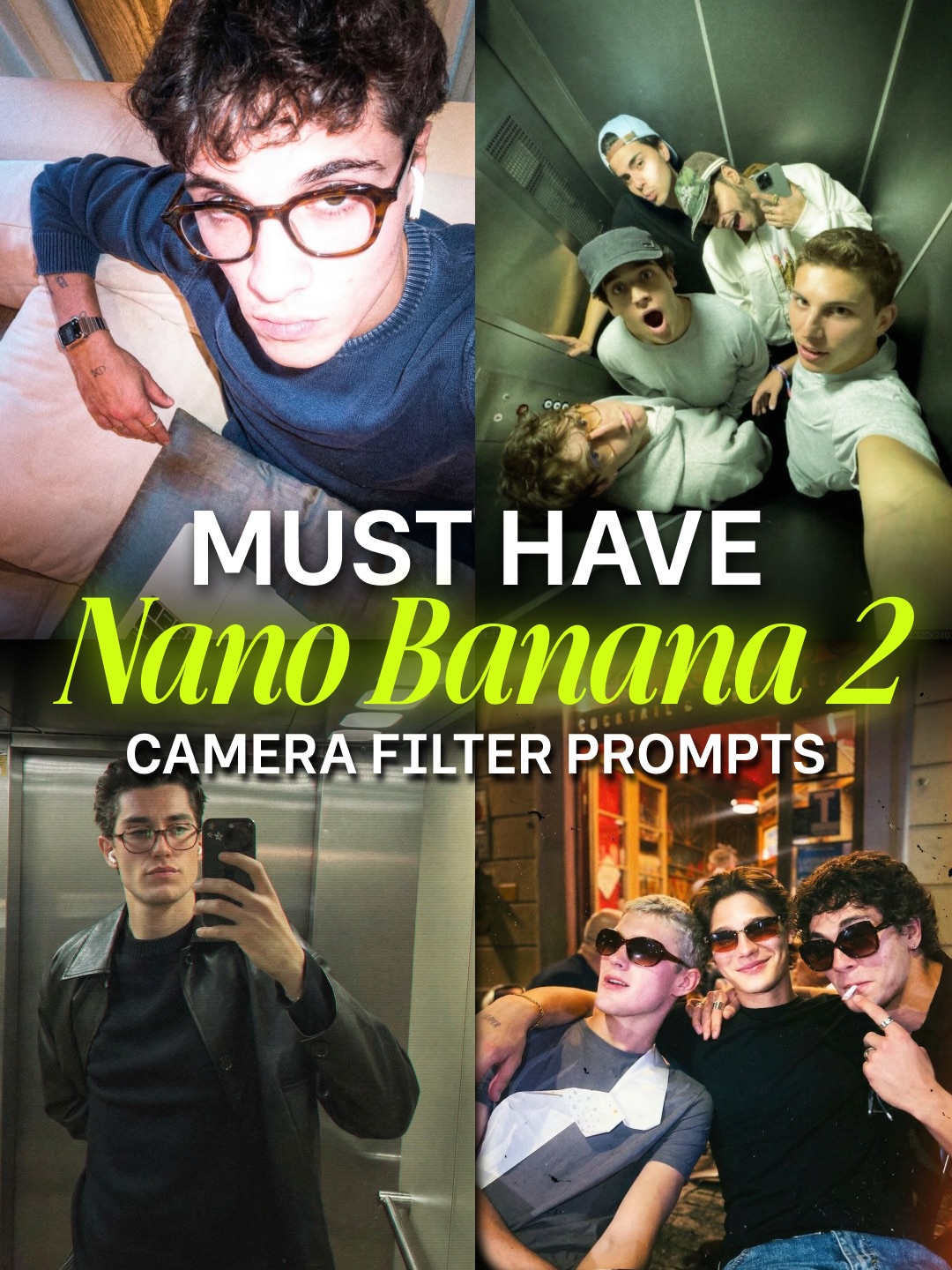
skaigenerated: Flash Filter Prompt Pack Cover AI Art
[Subject] A collage-style social-media cover featuring multiple candid young-male portraits that showcase a trendy flash-photography aesthetic. Include four image panels: an overhead close-up of a curly-haired guy in glasses on a couch, a cramped elevator selfie with a group of friends, a moody mirror selfie in a dark jacket, and a nighttime group shot with sunglasses and casual nightlife styling. The people should feel fashionable, spontaneous, and internet-native rather than formal or polished.

[Environment] Mixed contemporary casual environments such as couch interiors, elevator mirrors, nightlife streets, and apartment-like spaces, all unified by flash photography, youth culture, and social-media cover design. The layout should read as a creator tutorial poster or prompt-pack cover rather than a natural documentary sequence.

[Composition/Camera] Vertical four-panel collage with large bold central headline typography layered across the middle, each quadrant containing a distinct portrait vignette. Keep the montage balanced, with enough contrast between the panels to show range while still feeling like one cohesive visual system. The overall read should be quick, energetic, and highly thumbnail-friendly.

[Lighting] Strong direct flash across most panels, compact-camera or phone-camera realism, some harsh highlights, low-light indoor and nightlife exposure, youthful candid image texture, no luxury studio softness, no cinematic moody lighting.

[Style/Rendering] Trend-focused social-media promo cover, contemporary creator-education aesthetic, casual-yet-curated youth portrait collage, bold tutorial packaging, editorial internet culture finish, no retro vintage grain overload, no corporate cleanliness.

[Detail constraints] Preserve the multi-panel collage structure, candid youthful male styling, direct-flash look, mirror/elevator/night-out variety, and the bold prompt-pack headline feel. Keep the image energetic, trendy, and tutorial-oriented. Do not add formal fashion branding, fantasy elements, family-photo warmth, or polished luxury-ad gloss.
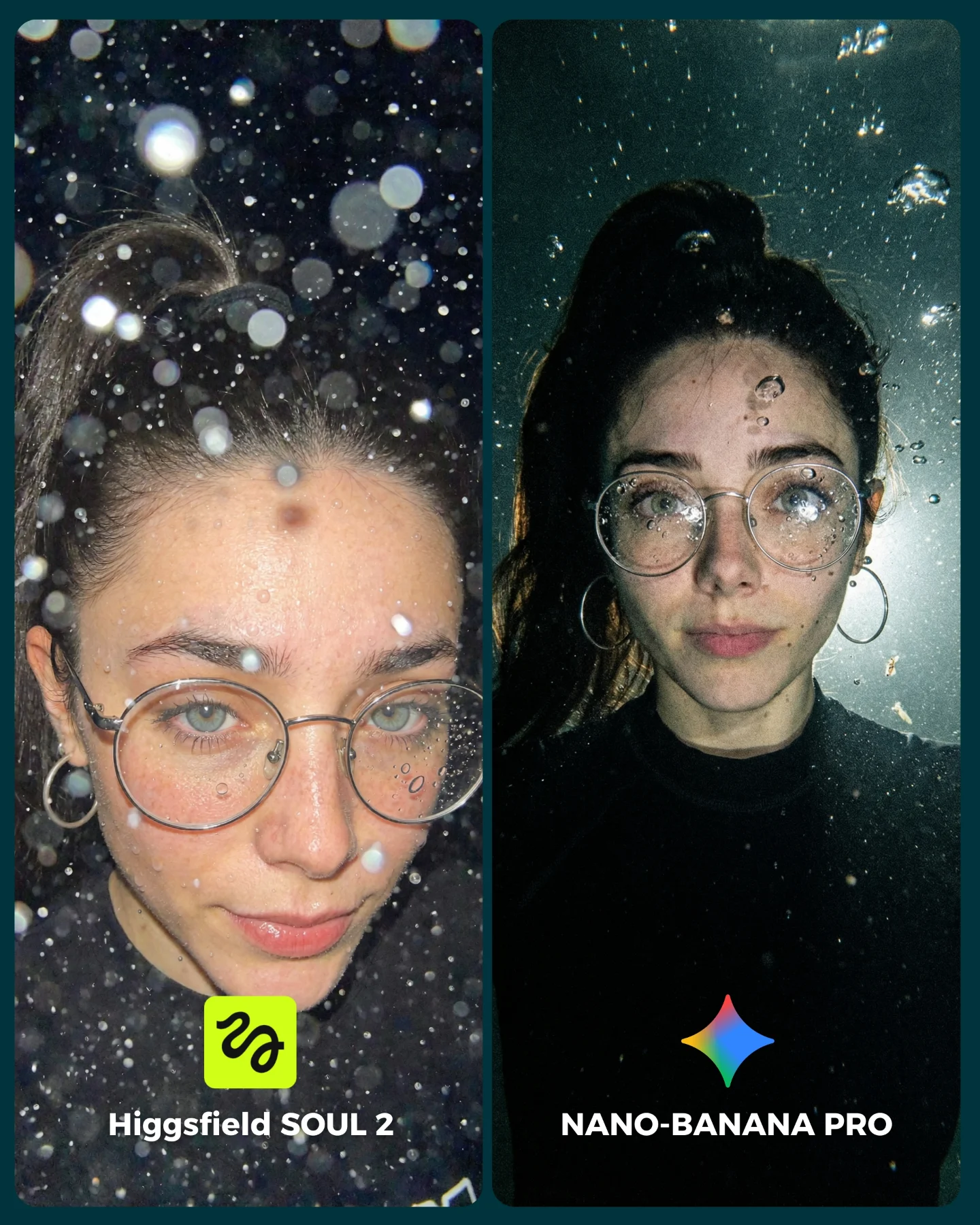
soy_aria_cruz: Rainy Glass Portrait Model Comparison AI Photo
[Subject] A side-by-side close-up comparison image showing the same young woman behind wet glass in two different render styles. She appears in her early 20s with fair skin, soft natural features, light green-hazel eyes, large round silver wire-frame glasses, hoop earrings, and dark brown to black hair pulled into a high ponytail. Her face is bare or nearly bare, with minimal makeup and a calm neutral expression. She wears a black high-neck top. In both panels she is framed very close to the camera, looking straight ahead through water-speckled glass.

[Environment] Two equal vertical portrait panels with a dark teal-black background and many water droplets or condensation spots across the foreground glass plane. The left panel is labeled “Higgsfield SOUL 2” with a small neon snake-like icon near the bottom. The right panel is labeled “NANO-BANANA PRO” with a colorful four-point star icon. The scene should feel like a moody rainy-window selfie or low-light glass-booth portrait, with the left side flatter and more flash-like, and the right side deeper and more realistic with cleaner depth and better lighting control.

[Composition/Camera] Tight face-dominant portrait in split-screen comparison format. The left panel crops the face larger and slightly off-center, emphasizing magnified glasses and a more compressed selfie feel. The right panel gives slightly more breathing room around the head and shoulders, keeping the face centered and the black top more visible. In both panels, water droplets on the glass remain a major foreground element and partially overlap the face and lenses. Maintain the two-panel A/B structure exactly.

[Lighting] Low-light cool-toned portrait lighting with strong reflections on wet glass and eyeglass lenses. The left panel should feel more frontal-flash or flatter direct illumination, making pores, reflections, and droplets feel harsher and more synthetic. The right panel should feel more balanced and dimensional, with the face emerging from a moody teal background and the droplet reflections integrating more naturally. Preserve bright highlights in the droplets and subtle shadows along the cheeks and neck.

[Style/Rendering] Hyperreal split-screen realism benchmark. Left side: slightly harsher, more artificial flash-selfie interpretation with less subtle modeling. Right side: more refined photoreal portrait with better skin realism, smoother glass interaction, and more coherent low-light atmosphere. The overall aesthetic should stay intimate, damp, moody, and minimal, not glamorous or heavily stylized.

[Detail constraints] Keep exactly one comparison image with two vertical panels, the same woman in both, the same glasses, ponytail, hoop earrings, black top, and rainy-glass effect. Preserve the heavy water droplet foreground and the dark background. Keep the bottom model labels and icons. Do not add extra props, city backgrounds, umbrellas, or colorful neon scenes.

Negative prompt: single panel, extra people, smiling selfie vibe, lipstick glamour look, dry glass, no droplets, outdoor street scene, bright daylight, colorful club lights, no glasses, no earrings, text removed, watermark, distorted eyes, blurred face, beauty-filter skin, fantasy sparkles, cyberpunk city, open mouth laugh, exaggerated makeup.

Suggested parameters: aspect ratio 4:5, dual-panel split, very close portrait lens or smartphone close-up feel, shallow to moderate depth of field with foreground droplet clarity, 28-36 steps, CFG/style strength 6-7, sampler DPM++ 2M Karras or equivalent, seed suggestion 180522644.

Delta prompt strategy:
1. If the rain-on-glass effect weakens: append "heavy foreground water droplets and condensation spots on the glass directly in front of the face".
2. If identity drifts between panels: append "the exact same woman appears in both panels with matching glasses, hoop earrings, ponytail, and eye color".
3. If the left side is not flatter: append "left panel feels more direct-flash, harsher, and slightly more synthetic in lighting and skin response".
4. If the right side is not more realistic: append "right panel shows more dimensional low-light realism, cleaner skin, and more natural droplet integration".
5. If the black top disappears: append "black high-neck top visible at the base of the portrait".
6. If the face crops wrong: append "tight face-dominant close-up portrait with glasses large in frame".
7. If the background gets busy: append "dark teal-black minimal background with no additional scenery".
8. If glasses reflections vanish: append "retain bright wet reflections and screen-like highlights on the round wire-frame lenses".
9. If the labels vanish: append "bottom labels read Higgsfield SOUL 2 on the left and NANO-BANANA PRO on the right".
10. If the mood turns glamorous: append "intimate rainy-window realism, subdued and moody, not polished beauty editorial".
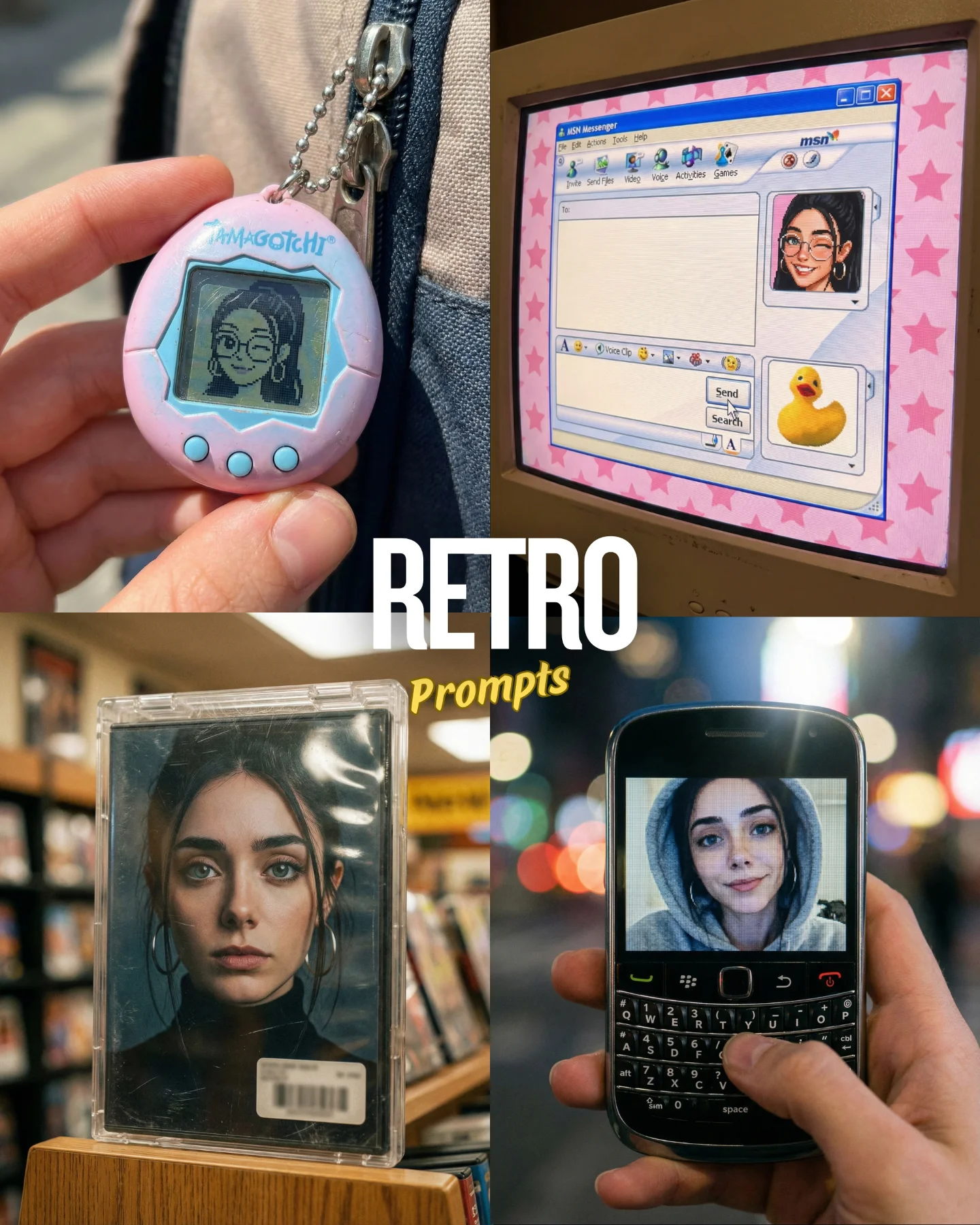
soy_aria_cruz: Y2K Retro Tech Collage
A nostalgic four-panel collage celebrating retro digital culture through character portraits and vintage interfaces. The top-left panel shows a pastel Tamagotchi-style handheld keychain device displaying a pixel portrait of a young woman with glasses and hoop earrings. The top-right panel shows a chunky CRT-era desktop monitor running an MSN Messenger style interface with a cartoonish profile avatar and chat box framed by pink star decorations. The bottom-left panel presents a realistic portrait of the same young woman printed on retro cassette or media packaging displayed in a record-store setting, evoking analog music culture. The bottom-right panel shows a BlackBerry-style smartphone held in one hand, with a selfie of the same woman on the small screen against blurred city lights at night. Bold central text reads RETRO Prompts, tying the four scenes together as a themed prompt-design graphic rather than a single image. The overall aesthetic blends Y2K internet nostalgia, early social-media interfaces, analog media packaging, and pre-smartphone mobile culture into one highly readable visual collage. Lighting and rendering vary slightly by panel to match the era-specific devices and environments, but the woman’s identity stays consistent across all sections. Emphasize realistic device textures, small-screen glow, pixel-art display detail, early-internet interface styling, cassette-case plastic reflections, BlackBerry keyboard detail, and the cohesive retro-tech mood. The final image should feel playful, polished, and deeply nostalgic, like a social-media graphic showcasing AI prompt ideas inspired by iconic consumer technology from the 1990s and 2000s.
Video
KP
GLOBAL LOCK:
- Preserve the warm nostalgic suburban look, vertical 9:16 framing, dusk sky pastel exterior, and cozy pink-purple bedroom lighting.
- Keep the sequence anchored by a quiet suburban house exterior, a softly lit bedroom interior, and a chunky CRT television with visible rabbit-ear antennas.
- Maintain the early-2000s teen-TV feeling on the screen, with bright, slightly soft broadcast imagery that evokes 2006-era cable or Disney/teen drama energy.
- Keep the emotional tone wistful and comforting, centered on bedroom nostalgia and the ritual of watching old television at night.

TIMECODED VISUAL BREAKDOWN:
- [00:00-00:02] Start on a suburban neighborhood at dusk, then move toward a house with glowing bedroom windows as evening settles in.
- [00:00-00:03] The camera glides closer to the lit window, framing the room as a private nostalgic space from outside.
- [00:03-00:06] Inside the bedroom, reveal an unmade bed, soft purple-pink ambient lights, posters on the wall, and a CRT television glowing across the room.
- [00:06-00:08] The push-in continues through the cozy bedroom, letting the old TV and its warm static-era light become the focal point.
- [00:08-00:10] End on a close-up of the CRT screen playing a bright early-2000s teen show scene, completing the “take me back to 2006” feeling.

MASTER PROMPT:
Create a vertically framed nostalgia video that captures the feeling of watching television in a suburban bedroom in 2006. Open with a calm dusk exterior of a neighborhood house, then drift toward one warmly lit bedroom window. Inside, show a lived-in room with an unmade bed, posters on the wall, soft purple and pink decorative lights, and an old CRT television with rabbit-ear antennas sitting across the room. Let the camera move slowly and gently, so the viewer feels like they are re-entering a familiar teenage space at night. As the shot gets closer to the television, keep the room cozy, slightly dreamy, and emotionally safe. End on the CRT screen itself, where a colorful early-2000s teen show is playing with that unmistakable cable-TV softness and cheerful dramatic energy. The whole video should feel like a memory you want to step back into.

NEGATIVE PROMPT:
modern flat-screen TV, smartphone glow, minimalist apartment, cold white LED lighting, futuristic bedroom, horror atmosphere, storm damage, cluttered dirty room, aggressive camera shake, text overlays, subtitles, extra logos, high-definition streaming UI, photoreal documentary harshness, neon cyberpunk city, empty black room, office furniture, contemporary luxury decor, washed-out colors, gritty realism

SPEECH PACK:
- “The goal is not just retro props; it is the emotional temperature of a 2006 bedroom at night.”
- “Let the room feel safe, familiar, and a little magical.”
- “The CRT is the heart of the memory.”
- “Every shot should make the viewer feel like they are already halfway back in time.”
Video
KP
GLOBAL LOCK: vertical nostalgic bedroom video set in the mid-2000s, dreamy suburban dusk exterior leading into a cozy teen bedroom with pink-purple ambient lights, messy bed, old posters, CRT television with antenna, soft Y2K atmosphere, intimate first-person lounging perspective, warm analog glow, realistic details, no text overlays, no watermark.

[00:00-00:02] Open outside on a quiet suburban neighborhood at dusk with pastel sky and warmly lit house windows. Drift toward one glowing bedroom window to suggest entering a memory.

[00:02-00:04] Transition inside to a cozy mid-2000s teen bedroom lit by purple accent lights and the soft flicker of a CRT TV. The bed is rumpled in the foreground, making the viewer feel like they are lying there reliving the era.

[00:04-00:07] Slowly pan across the room as the old television plays a bright teen sitcom or Disney Channel-style show. Keep the posters, wooden TV stand, and analog screen texture visible to lock the time period.

[00:07-00:10] Push closer to the CRT screen until the TV content dominates the frame, preserving the rounded glass look, scanline softness, and nostalgic glow. End on the feeling of being totally immersed in a 2006 after-school bedroom memory.

NEGATIVE PROMPT: modern flat-screen TV, smartphones, laptops, contemporary decor, extra people in room, horror elements, harsh daylight, text overlays, subtitles, logos, broken CRT anatomy, low detail furniture, sterile minimalist room.

SPEECH PACK: none.
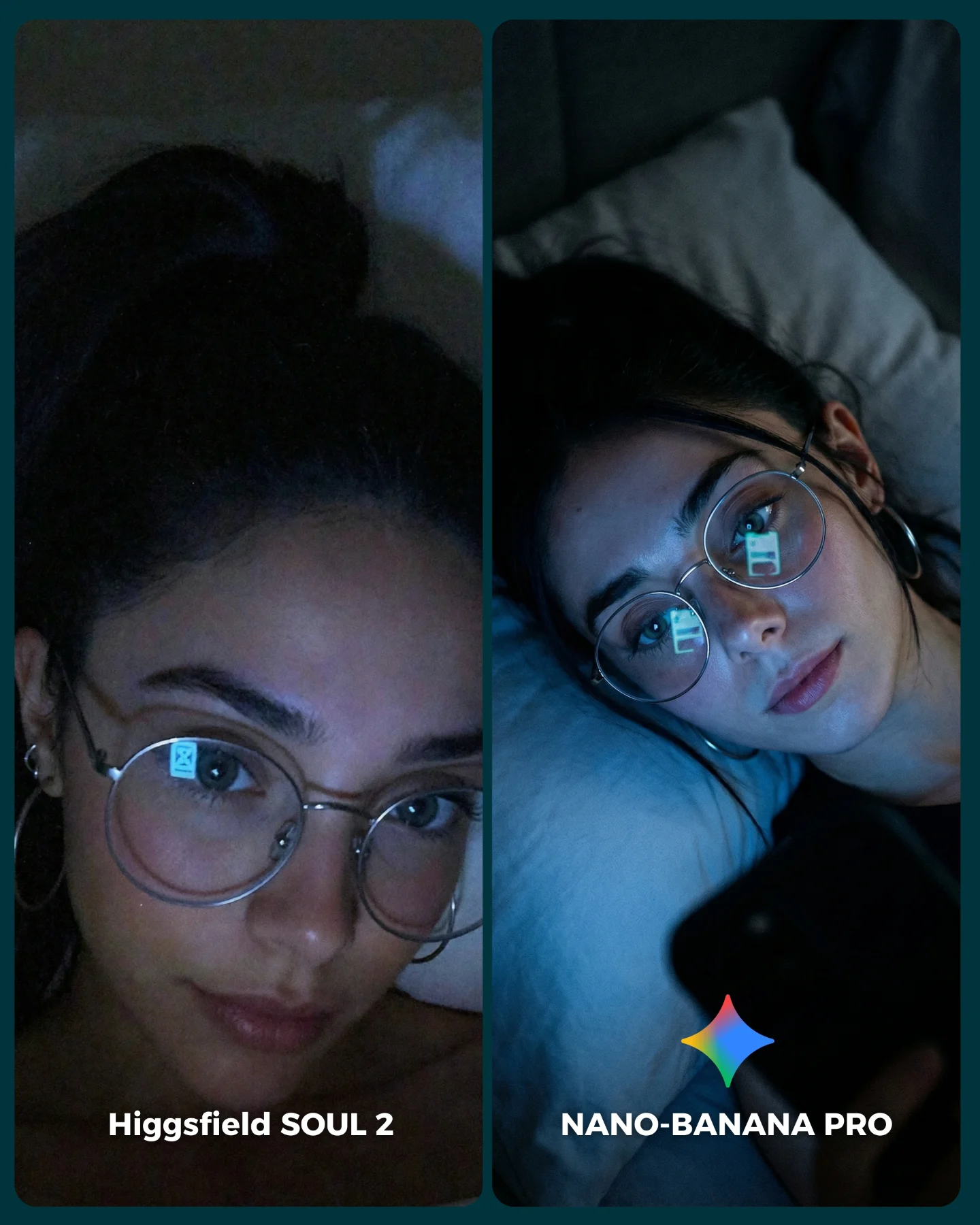
soy_aria_cruz: Low Light Bed Selfie AI
[Subject] A split-screen low-light bedroom portrait comparison showing the same young woman lying in bed while illuminated mostly by a smartphone screen. She appears to be in her 20s with fair skin, dark brown to black hair pulled loosely back into a high ponytail or gathered style, thin round silver eyeglasses, and silver hoop earrings. Her face is relaxed and intimate, with a tired late-night expression. In the right panel, part of a phone is visible in the lower foreground, casting cool blue light upward onto her face. Reflections of a bright app or screen interface are visible in both eyeglass lenses. The right panel should appear slightly cleaner, more dimensional, and more realistic than the left while preserving the same identity.

[Environment] Dark bedroom setting with a white pillow behind the subject's head, deep blue-black shadows, and no visible room clutter beyond bed linens. The image is presented as a two-panel mobile comparison card with rounded vertical panels and a narrow dark divider. At the bottom left, include the label “Higgsfield SOUL 2” in white. At the bottom right, include “NANO-BANANA PRO” in white with a small colorful sparkle-style icon above or near the text. Keep the mood intimate, nocturnal, and minimal.

[Composition/Camera] Vertical split-screen close-up portraits, framed from forehead to upper chest, with the subject's head resting on a pillow. Both panels are shot at close selfie distance and from a slightly high or side angle as if the camera is above the face. The left panel is tighter on the face; the right panel is slightly wider and shows more pillow plus the blurred phone edge in the foreground. Maintain matched identity and low-light conditions across both panels for direct comparison.

[Lighting] Primary illumination comes from the smartphone screen, producing a cool blue-white glow on the face and visible rectangular reflections in the glasses. Ambient room light is very dim. Keep the skin softly lit with realistic low-light falloff, shadow depth, and subtle screen-light gradients. Avoid flash or warm lamp lighting.

[Style/Rendering] Hyper-real low-light selfie comparison graphic, intimate bedroom realism, natural skin texture, believable digital screen reflections, subtle noise-free darkness, and clean social comparison design. The image should feel like a realistic test of how well different models render phone-lit faces in a dark room.

[Detail constraints] Keep exactly one female identity duplicated across two panels. Preserve the round glasses, hoop earrings, white pillow, cool phone light, app reflection in the lenses, and bottom text labels. Do not add extra people, bedroom decor, heavy makeup, fantasy glows, or bright room lights. The main point is controlled low-light realism comparison between two image models.

Negative prompt: extra people, mismatched identity between panels, warm bedside lamp, bright room, no glasses reflections, blurry low-res selfie, glamour retouch, fantasy glow, incorrect text, random bedroom clutter, cartoon shadows, distorted face, duplicated phone, watermark, heavy grain, overexposed skin.

Suggested parameters: aspect ratio 4:5, close selfie lens feel, low-light phone illumination, steps 28-40, CFG/style strength 6.5-8, sampler DPM++ 2M Karras or equivalent, seed suggestion 613984251.

Delta prompt strategy:
1. If the two identities drift: “same exact young woman in both panels, matched facial structure, glasses, earrings, and hairline”.
2. If the phone-light effect weakens: “cool smartphone screen light illuminating the face from below or front with visible rectangular screen reflections in the glasses”.
3. If the bedroom becomes too visible: “dark minimal bedroom, only white pillow and bed shadows visible”.
4. If the right panel is not stronger: “right panel slightly more realistic, dimensional, and clean than the left while keeping the same concept”.
5. If the text labels fail: “bottom left text Higgsfield SOUL 2, bottom right text NANO-BANANA PRO”.
6. If the mood becomes too polished: “late-night intimate phone selfie in bed, sleepy realistic mood, no studio polish”.
7. If the glasses disappear: “thin round silver eyeglasses with crisp digital reflections”.
8. If the phone in the right panel is missing: “blurred smartphone edge visible in the lower foreground of the right panel”.
9. If the lighting becomes flat: “deep shadowed room with soft cool screen glow as the main light source”.
10. If it turns into a beauty shot: “authentic nocturnal selfie realism, subtle fatigue, minimal styling, not glamour editorial”.
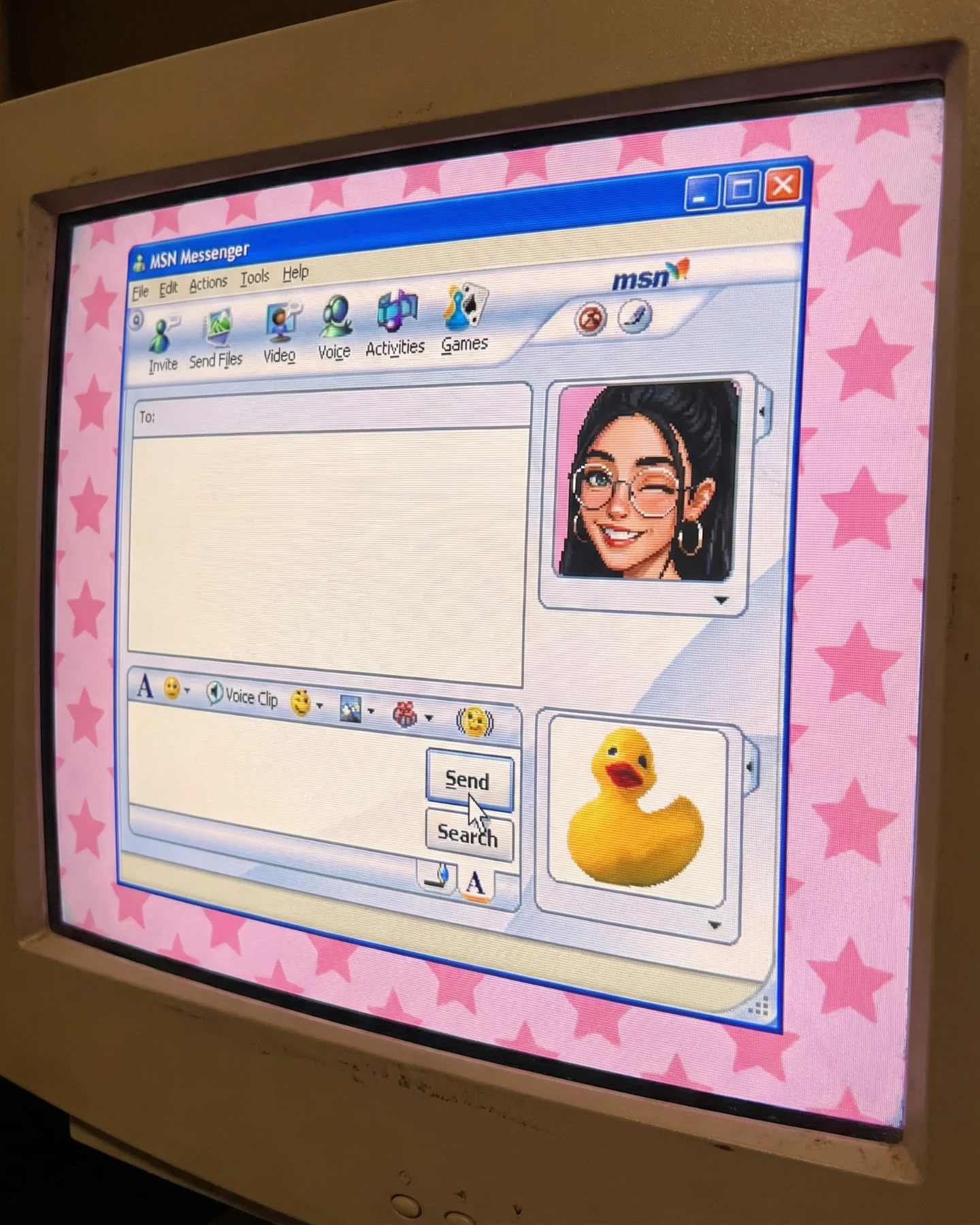
soy_aria_cruz: MSN Messenger CRT AI Art
[Subject] A beige off-white CRT computer monitor photographed at a slight left-front angle in a dim indoor setting. The screen displays a nostalgic early-2000s MSN Messenger style interface with a blue title bar, classic toolbar icons, rounded message panels, and retro Windows UI controls. Inside the messenger window is a stylized illustrated avatar of a young woman with dark hair in a high updo, round glasses, hoop earrings, and a playful wink. A yellow rubber duck image appears in a lower panel as a second visual sticker or contact image.

[Environment] Dark surrounding room with most of the attention on the glowing CRT screen. Minimal visible background detail outside the monitor casing. The monitor itself has soft age-related wear, rounded plastic edges, thick bezel, and slightly warm discoloration typical of older desktop hardware.

[Composition/Camera] Vertical 4:5 frame. Monitor fills most of the image, positioned slightly off-center with perspective distortion that shows left bezel and screen depth. Camera is close enough to make the screen the hero object while still preserving the full outline of the CRT. Slight candid snapshot angle rather than perfectly architectural straight-on framing.

[Screen content] Messenger interface should include:
- Blue title bar reading in the style of MSN Messenger
- Toolbar with small colorful icons
- Large blank chat area
- Retro buttons such as “Send” and “Search”
- Pink star-pattern wallpaper or border around the messenger window
- Cartoon female avatar in the upper right panel
- Yellow rubber duck image in the lower right panel
- Soft pixel grid / scanline texture from photographing a monitor

[Lighting] Warm ambient room light plus strong screen glow. The CRT screen is the brightest source, casting soft pink-blue-white luminosity. Mild reflections and bloom on the display glass, subtle vignetting at the edges, no hard flash.

[Color palette] Cream monitor casing, pastel pink background with darker pink stars, soft blue UI chrome, white and gray window panels, yellow duck accent, warm beige shadows. Nostalgic candy-colored palette with gentle saturation.

[Style/Rendering] Realistic retro-tech photography with Y2K internet nostalgia. Preserve the slight softness, glow, pixel texture, and analog screen feel. Avoid ultra-clean vector perfection; it should feel like a photograph of a real old monitor showing a custom MSN-style graphic.

[Detail constraints] Keep exactly one CRT monitor, one retro messenger interface, one illustrated female avatar, one yellow duck panel, and the pink star wallpaper. Preserve the angled camera view, thick monitor bezel, soft screen glow, and early-2000s UI language. Do not modernize the interface or turn it into a flat digital mockup.

Negative prompt: flat modern monitor, smartphone screen, Mac UI, Discord, Slack, modern chat app, dark mode, ultra-sharp vector render, extra monitors, desk clutter, keyboard dominant in frame, daylight office lighting, cyberpunk neon overload, anime interface, broken screen, heavy reflections that hide UI, 3d mockup perfection

Suggested parameters:
- Aspect ratio: 4:5
- Lens / focal length: 35mm to 50mm equivalent
- Depth of field: moderate, monitor sharp with slight falloff on edges
- Steps: 28-38
- CFG / guidance: 6.5-8
- Style strength / img2img denoise: 0.2-0.35
- Sampler: DPM++ 2M Karras
- Seed suggestion: 118409553

Delta prompt strategy:
1. Monitor becomes flat LCD -> "bulky beige CRT monitor with thick rounded bezel and curved screen"
2. Interface becomes modern chat UI -> "classic early-2000s MSN Messenger style window with blue title bar and retro toolbar"
3. Pink background disappears -> "pink wallpaper with repeating star pattern behind the chat window"
4. Avatar style changes too much -> "cartoon portrait of brunette woman with round glasses and hoop earrings, playful wink"
5. Duck image vanishes -> "yellow rubber duck image in lower right message panel"
6. Image turns into clean digital mockup -> "photograph of a real glowing CRT screen with scanline texture and mild bloom"
7. Lighting gets too bright and neutral -> "dim room, warm ambient shadows, screen glow as main light source"
8. Perspective becomes straight-on -> "slight left-front angle showing the monitor depth and side bezel"
9. UI text and buttons disappear -> "retro chat interface with blank text box, Send button, Search button, classic toolbar icons"
10. Palette loses nostalgia -> "pastel blue, pink, cream, yellow Y2K internet color palette"
Video
GLOBAL LOCK: A vertical cinematic fashion tutorial video that begins with a direct hook and transitions into a moody nighttime beach portrait sequence. The subject is an East Asian young woman with short black hair and light skin, wearing a white satin slip dress, with visible tattoo sleeves and shoulder tattoos on one arm. The visual identity combines raw direct-flash photography, grainy night texture, dark ocean horizon, bright moonlight in the sky, wet sand reflections, and a dreamy editorial tone. Keep the same woman, dress, tattoos, beach-at-night setting, flash-lit skin highlights, and minimalist sensual styling throughout. The audio style is creator-led tutorial / prompt-sharing narration with concise social-video pacing, dry close mic sound, and an intimate but confident tone.

[00:00–00:04] Extreme close-up of the woman’s eye and cheek under hard direct flash, with a metallic star sticker on her face and strands of black hair crossing the frame. Large bold text appears in sequence: “STEAL,” “STEAL MY,” “STEAL MY AI,” “STEAL MY AI PROMPTS.” The camera is nearly static, intimate, and confrontational, using a macro beauty framing with shallow focus and stark flash highlights against deep shadow.

[00:00–00:04] The hook is spoken or implied as a fast creator-style opening line inviting viewers to take the prompts. Speech cadence is clipped and attention-grabbing, landing in sync with each text change. Lips are only partially visible, so sync matters less than timing and mood.

[00:04–00:09] Cut to a full-body night beach portrait. The woman stands barefoot at the shoreline in the white slip dress, lit by harsh on-camera flash while the moon glows above the horizon. Yellow subtitle-style text begins presenting prompt-writing advice across the lower portion of the frame. The camera alternates between profile and back views as she faces the sea, then touches her hair and turns slightly toward camera. Keep the wet sand glistening and the sky nearly black-blue.

[00:09–00:14] Continue the beach sequence with slower editorial posing. The woman steps through shallow water, then faces away from camera so the back of the dress and her damp hair are visible. Use a mix of medium full-body and lower-body shots that emphasize bare feet in the surf, dress hem in water, and direct-flash specular highlights on skin and fabric. The voiceover/tutorial text explains how the prompt should describe camera treatment and mood, while the images function as the visual result.

[00:14–00:19] The woman sits or kneels near the shoreline and opens her arms outward, then shifts into seated portrait poses looking toward the horizon and back to camera. The composition becomes softer and more romantic while still retaining the raw flash look. Yellow caption blocks continue in the lower frame with practical prompt tips. Motion is minimal, with small posture changes and gentle ocean movement carrying the scene.

[00:19–00:23] Move into medium close-up portraits of the seated woman in the surf. Her tattoos, shoulder line, cheekbones, and the satin texture of the dress become more prominent. She glances downward, then sideways, then leans toward the camera. Maintain the tension between harsh direct flash and soft emotional expression. The tutorial text suggests concrete structure for recreating the look rather than vague aesthetic language.

[00:23–00:25] End on standing and close-up beach portraits with the woman facing camera head-on and then slightly off-axis. The dress clings softly with dampness, the tattooed arm remains a clear identity anchor, and the flash creates a glossy editorial finish. The final beat feels like a complete visual example of the prompt style being taught: raw, romantic, direct-flash night photography translated into AI-video form.
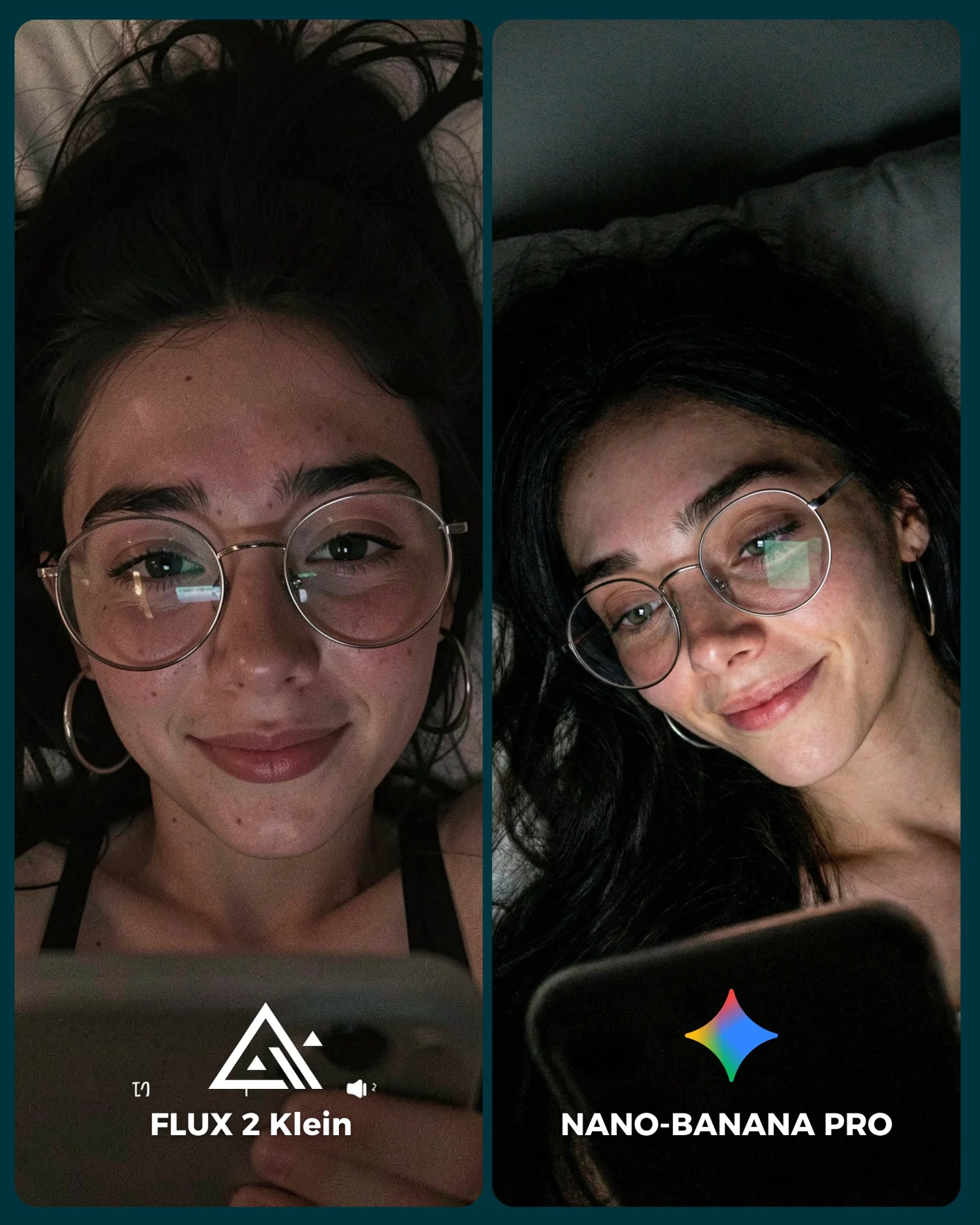
soy_aria_cruz: Flux 2 Klein vs Nano Banana Pro AI Art
[Subject] A split-panel comparison showing the same young woman lying in bed at night while looking at her phone. She appears in her early 20s with fair skin, a slim build, dark eyebrows, long dark hair spread loosely over a pillow, round clear eyeglasses, and medium silver hoop earrings. She wears a black thin-strap top. In both panels she is framed close-up from upper chest to top of head, photographed from above or slightly above as if the phone is resting near her chest. Her expression is soft, relaxed, and intimate, with a faint closed-mouth smile while reading the phone screen. The left panel shows a more front-facing angle with her head flatter against the pillow; the right panel shows a slightly angled head tilt and a warmer gentler smile.

[Environment] Dark bedroom or nighttime resting environment with pale bedding and pillows visible around the head. The only major light source is the phone screen glow illuminating her face and reflecting in the glasses. The surroundings should remain dim and quiet, with no strong decor features visible. The image should feel private, sleepy, and screen-lit rather than staged.

[Composition/Camera] Two vertical portrait panels side by side within a single 4:5 comparison graphic, framed by a dark teal outer border and separated by a narrow center divider. The woman fills most of each panel, lying down and holding the phone at the bottom edge of the frame. Preserve the bottom labels: “FLUX 2 Klein” on the left with a small triangular logo, and “NANO-BANANA PRO” on the right with a multicolor star-like logo. The phone itself should be visible as an out-of-focus or partially cropped foreground object along the bottom of both panels.

[Lighting] Soft low-light nighttime illumination dominated by phone-screen light. The face should have gentle cool-to-neutral highlights from the screen while the background falls into shadow. Glasses should show realistic screen reflections without obscuring the eyes completely. Avoid bright overhead lamps, flash, or dramatic cinematic blue light. The tone should stay intimate and natural.

[Style/Rendering] Photorealistic low-light AI model comparison graphic focused on facial realism, phone-screen glow, and bedroom intimacy. The image should feel like a realistic late-night scroll moment captured in two different model outputs. Preserve believable skin texture, pillow fabric, glasses reflections, and dark-hair detail. The mood is cozy, private, modern, and highly relevant to phone-first creator content.

[Detail constraints] Keep exactly one repeated woman across two comparison panels. Preserve the lying-down pose, clear glasses, hoop earrings, black straps, pale pillow, phone at the lower edge, and the bottom comparison labels. Do not turn this into a glam beauty shoot, bright bedroom portrait, or daytime wake-up scene. No extra people, no decorative neon room, no makeup-heavy editorial styling, and no large background objects. This is a simple low-light bed-and-phone benchmark image.

Negative prompt: daylight bedroom, flash photography, bright lamp light, extra people, missing glasses, no phone, heavy makeup glam shoot, neon bedroom, text at top, watermark clutter, anime face, deformed hands, overexposed phone glow, no pillow, wrong outfit color, side profile only, cinematic horror lighting, cluttered background

Suggested parameters:
- Aspect ratio: 4:5
- Lens / focal length: phone-like intimate portrait, around 35mm to 50mm full-frame equivalent feel
- Depth of field: shallow to moderate, face sharp with soft phone foreground
- Steps: 30-40
- CFG / style strength: 6.5-8
- Sampler: DPM++ 2M Karras or equivalent
- Seed suggestion: 552104

Delta prompt strategy:
1. If the split layout breaks: “two vertical nighttime bed-selfie comparison panels with a dark teal border and center divider”
2. If identity drifts: “same young woman repeated twice with clear round glasses, hoop earrings, dark hair on the pillow, and a black strap top”
3. If the bed context disappears: “lying on a pale pillow in a dark bedroom while looking at a phone”
4. If the phone glow weakens: “soft screen light illuminating the face with realistic reflections in the glasses”
5. If the image becomes too bright: “low-light intimate nighttime mood with the room mostly in shadow”
6. If the phone is missing: “phone visible at the bottom foreground edge in both panels”
7. If labels disappear: “bottom labels reading FLUX 2 Klein on the left and NANO-BANANA PRO on the right”
8. If the expression becomes too performative: “quiet gentle smile, late-night relaxed mood, not posing for glamour”
9. If realism drops: “photoreal skin texture, believable pillow fabric, natural glasses reflections”
10. If the scene becomes cluttered: “minimal intimate bed portrait with no extra background objects”
soy_aria_cruz: Nano Banana Style Remix AI
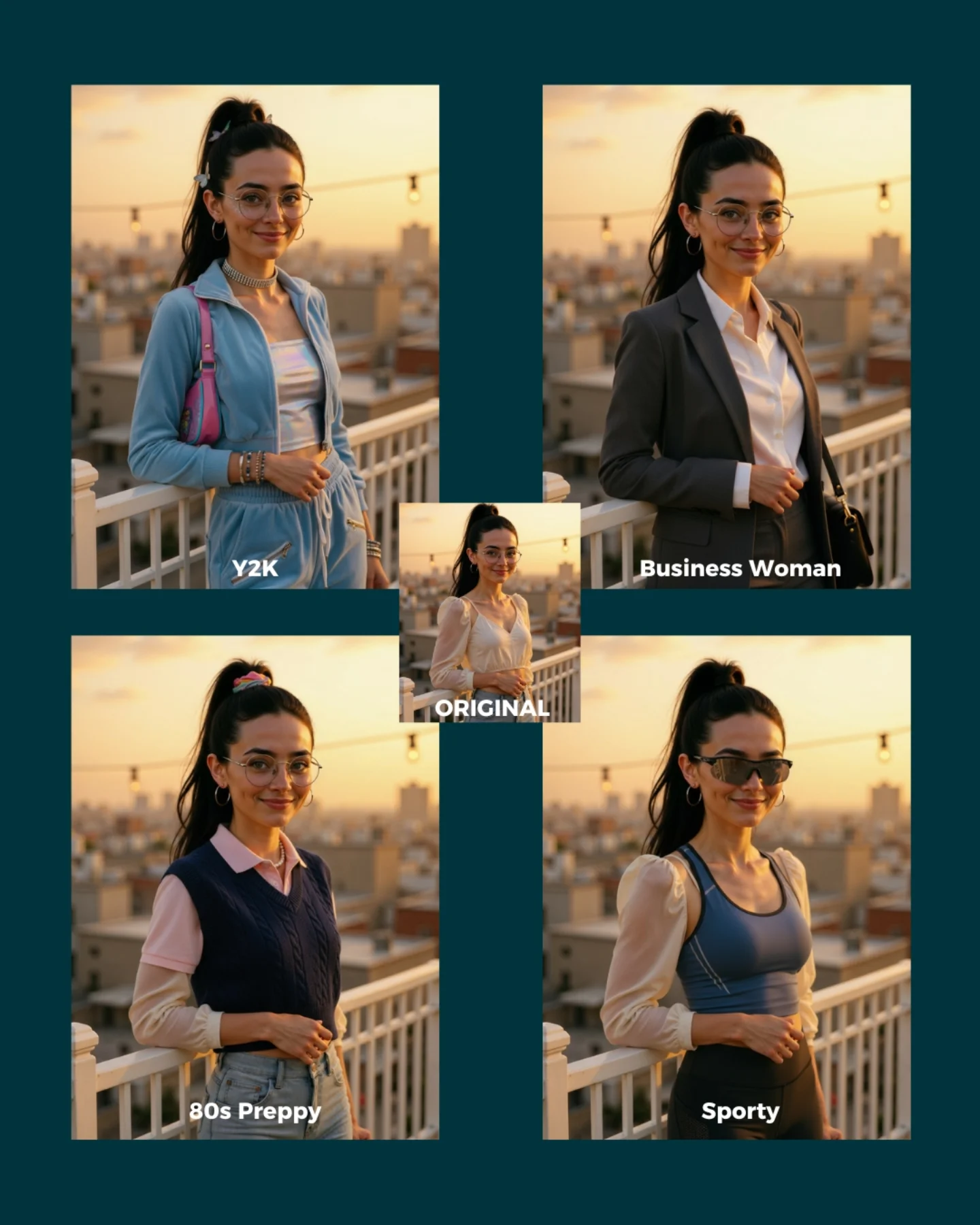
[Subject] A four-style fashion comparison cover built around the same young woman and the same rooftop pose. She appears early 20s, feminine presentation, slim build, light-medium skin tone, long dark hair in a high ponytail, round glasses, hoop earrings, and a gentle smile while standing beside a rooftop railing at golden hour. The center small panel shows the original look, while the four larger style variations reinterpret the same subject and pose. Top-left: Y2K styling with pastel blue zip jacket, white tube top, low-rise or relaxed bottoms, and a pink shoulder bag. Top-right: Business Woman styling with gray blazer, white button shirt, and structured officewear feel. Bottom-left: 80s Preppy styling with a navy sweater vest layered over a pale pink collared shirt. Bottom-right: Sporty styling with dark sunglasses, blue athletic tank, and activewear-inspired silhouette. [Environment] Rooftop terrace or balcony with white railing, blurred urban skyline in the distance, string lights overhead, warm sunset sky, shallow depth of field, all panels sharing the same location and lighting conditions. [Composition/Camera] Graphic comparison layout on a dark teal background: four larger rectangular images arranged in a grid, one smaller centered ORIGINAL image overlapping the middle, each panel labeled with its style name. Subject angle and framing remain mostly consistent across all variants for direct style comparison. [Lighting] Warm golden-hour sunset light with soft highlights on the face and clothing, gentle background glow, even flattering illumination consistent across all panels. [Style/Rendering] Realistic AI style-remix comparison cover, polished social-media educational graphic, consistent identity preservation across wardrobe changes, clean multi-panel layout, editorial makeover-thumbnail aesthetic. [Detail constraints] Keep the same woman, same rooftop pose, same sunset environment, and same face identity across every panel; only the wardrobe/accessory styling should change between Y2K, Business Woman, 80s Preppy, and Sporty. Do not add extra people, different locations, or dramatic lighting shifts between panels. Negative prompt: different identities across panels, changing pose too much, indoor scene, crowd, night lighting, text missing, messy collage, extra props unrelated to fashion, inconsistent skyline, distorted hands, duplicate people, random outfits outside the four named styles. Suggested parameters: aspect ratio 4:5 overall cover, lens 70-85mm equivalent portrait feel, shallow depth of field, 30-40 steps, CFG 6.5-7.5, sampler DPM++ 2M Karras, seed 521744. Delta prompt strategy: 1) If identity drifts, append 'same woman, same face, same hair, same glasses in every panel'. 2) If the rooftop changes, append 'same rooftop railing and sunset skyline across all variants'. 3) If the styles blur together, append 'clear wardrobe separation between Y2K, Business Woman, 80s Preppy, and Sporty'. 4) If the layout changes, append 'four-panel style comparison with a small centered ORIGINAL image'. 5) If sunset light disappears, append 'warm golden-hour rooftop lighting consistent in every panel'. 6) If labels vanish, append 'each panel labeled with its style name'. 7) If the sporty panel loses sunglasses, append 'sporty version includes dark sunglasses and activewear tank'. 8) If the business panel loses tailoring, append 'business version uses blazer and white shirt'. 9) If the Y2K panel loses the bag, append 'Y2K version includes a pink shoulder bag'. 10) If the preppy panel loses layering, append '80s Preppy version uses sweater vest over a collared shirt'.
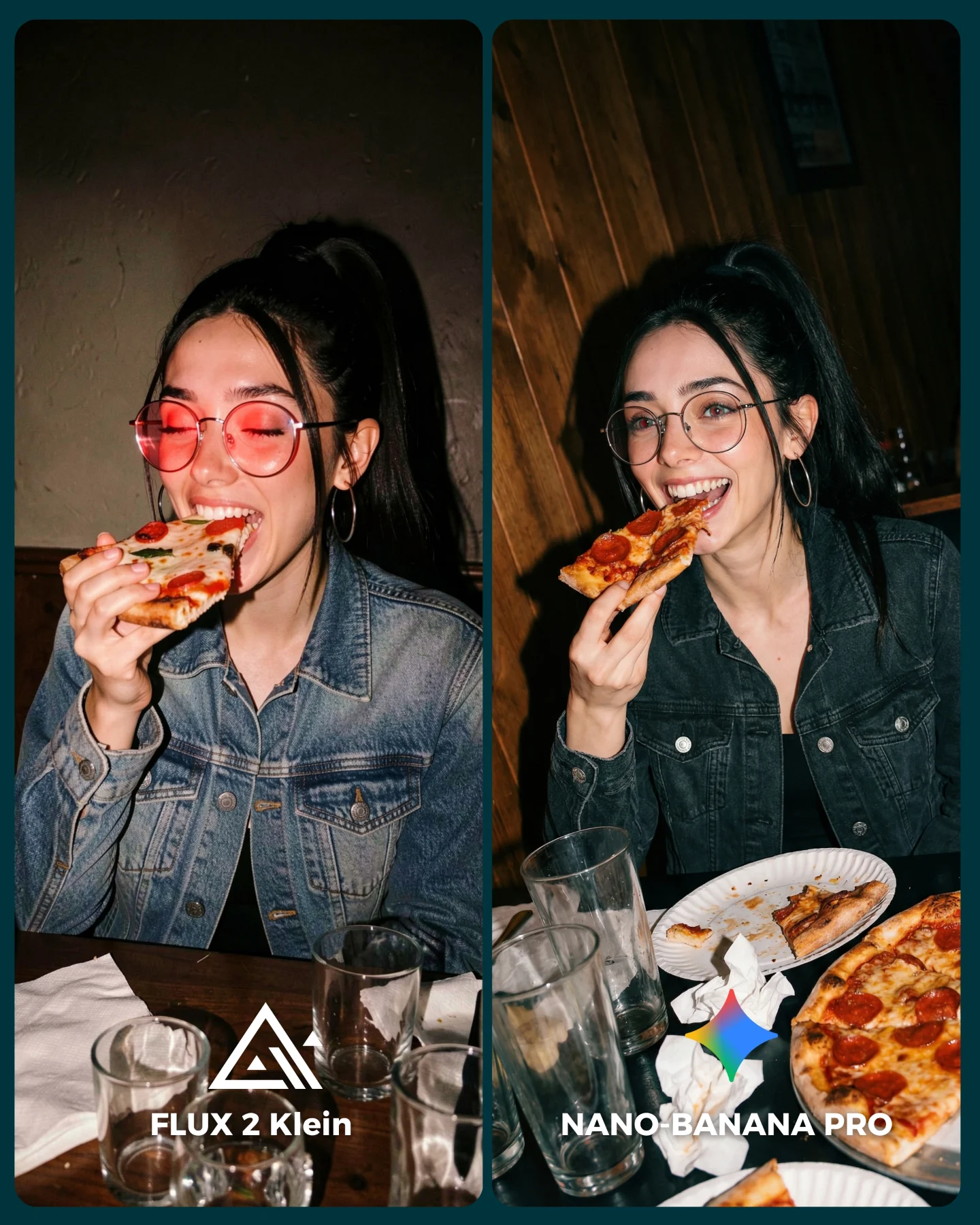
soy_aria_cruz: Flux 2 vs Nano Banana Pizza Comparison
[Subject] A side-by-side comparison image showing the same young woman eating a slice of pepperoni pizza in a dim casual restaurant. She is in her 20s with light skin, long straight black hair in a high ponytail, thin round metal eyeglasses, silver hoop earrings, and an open happy expression while bringing pizza toward her mouth. In both panels she wears a dark top under a denim jacket. The left panel shows a more flawed or synthetic render, with the eyeglass lenses glowing unnaturally red and the overall image feeling flatter. The right panel shows a more natural realistic version, with normal clear lenses, a warmer smile, and more believable facial and food rendering.

[Environment] Cozy low-lit pizzeria or casual restaurant with wood-paneled walls and a dark tabletop. Several used drinking glasses, crumpled napkins, white paper plates, and a large pepperoni pizza appear in the foreground, especially on the right panel. The setting feels social, candid, and slightly messy in a believable dining-out way.

[Composition/Camera] Two tall vertical rounded panels side by side with a thin divider, forming a comparison card. Both panels are medium restaurant portraits cropped around the upper body and table. In each panel the woman holds a slice of pizza close to her open mouth. Bottom labels identify the models: “FLUX 2 Klein” on the left and “NANO-BANANA PRO” on the right. A logo mark appears above each label. The right panel shows more of the table clutter and pizza surface.

[Lighting] Low ambient restaurant light with direct frontal flash or flash-like illumination brightening the subject and table. Left panel appears harsher and less natural, with odd red glow in the glasses. Right panel retains the same flash-dining feel but looks more balanced, with believable skin tones, pizza texture, and glass reflections.

[Style/Rendering] Social-media AI model comparison card focused on casual food-scene realism. The scene should feel like a real late-night pizza snapshot rather than styled food photography. Key benchmark elements are mouth expression, teeth, pizza cheese and pepperoni texture, glass reflections, and the overall authenticity of a candid dining moment.

[Detail constraints] Keep exactly two comparison panels of the same woman about to eat a slice of pepperoni pizza. Preserve the high ponytail, round glasses, hoop earrings, denim jacket, restaurant wood wall, used glasses, plates, and pizza on the table. Maintain the left-side synthetic error feel with red glowing lenses and the right-side more realistic restaurant image. Do not add extra diners in front, waiter focus, neon signs, or text outside the comparison labels.

Negative prompt: single-panel image, different woman on each side, no pizza, clean empty table, luxury restaurant styling, missing glasses, no denim jacket, daylight café, fantasy food, exaggerated cheese stretch, extra hands, text errors, cartoon dining scene, overproduced food commercial look.

Suggested parameters: aspect ratio 4:5, focal length 50mm, aperture f/2.8 look, shallow-to-medium depth of field, 28-36 steps, CFG/style strength 6.5-8, sampler DPM++ 2M Karras or equivalent, seed around 482715906.

Delta prompt strategy:
1. If the split comparison layout breaks: append “two rounded vertical restaurant portrait panels with a thin divider and model labels at the bottom”.
2. If the same identity drifts: append “same woman in both panels, same ponytail, round glasses, hoop earrings, and denim jacket”.
3. If the pizza scene weakens: append “holding a slice of pepperoni pizza at the mouth inside a dim pizzeria with used glasses and paper plates”.
4. If the left-side flaw disappears: append “left panel with unnatural red glowing eyeglass lenses and flatter synthetic rendering”.
5. If the right side loses realism: append “right panel more photoreal, believable skin, food texture, and casual restaurant clutter”.
6. If the table gets too clean: append “messy real dining table with empty glasses, napkins, plates, and a large pizza”.
7. If lighting becomes generic: append “low restaurant light with direct flash snapshot feel”.
8. If labels vanish: append “bottom labels: FLUX 2 Klein on left, NANO-BANANA PRO on right”.
9. If mouth anatomy breaks: append “natural open-mouth pizza bite moment with believable teeth and lips”.
10. If the scene becomes too editorial: append “casual late-night pizza snapshot, imperfect and social, not a polished food campaign”.
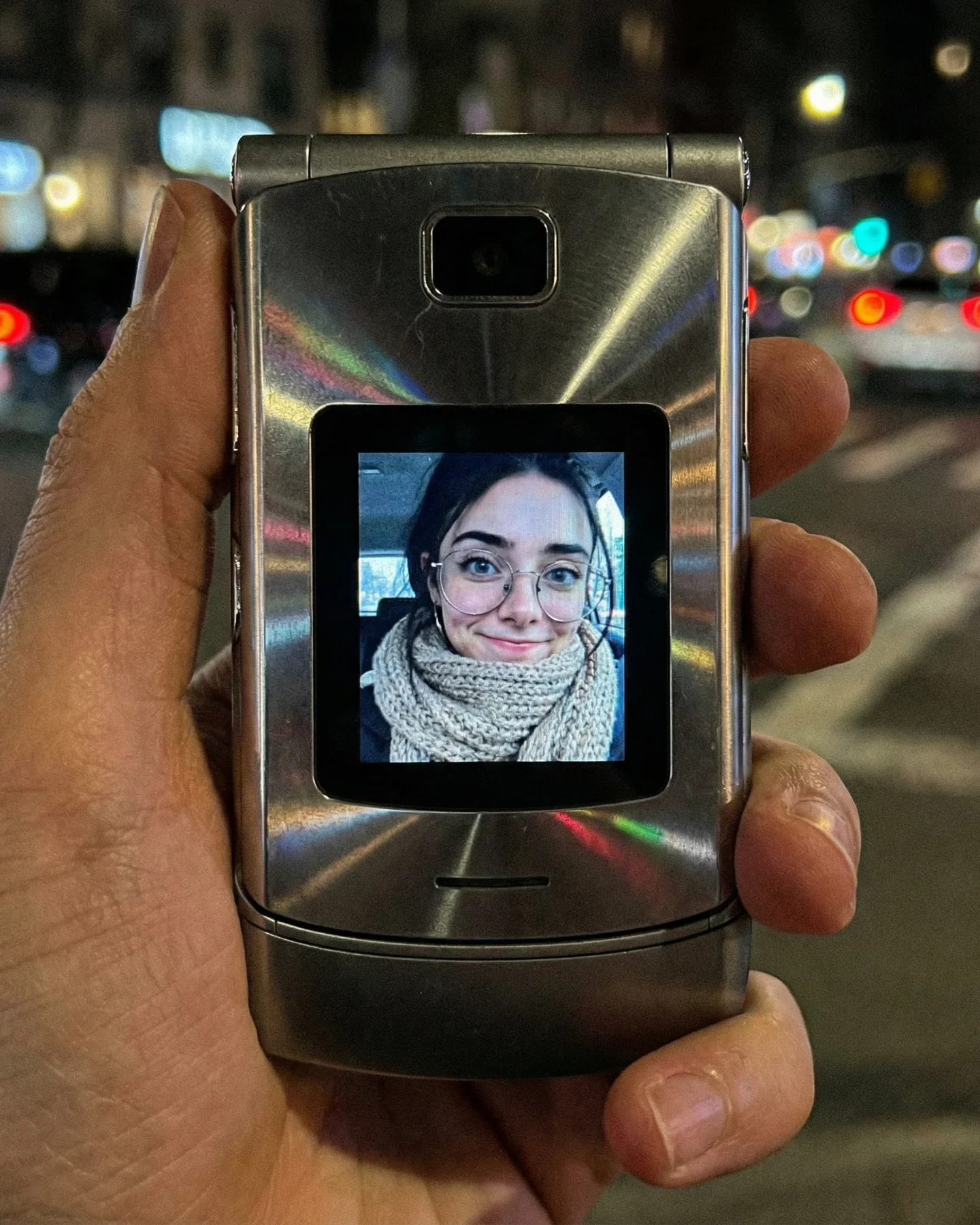
soy_aria_cruz: Flip Phone AI Art
A nostalgic street-night close-up showing a hand holding a silver flip phone, with the outer screen displaying a smiling portrait of a woman wearing glasses and a chunky scarf. The background is a softly blurred city street with traffic lights and bokeh headlights, creating an urban nightlife atmosphere while the phone becomes the main subject. The composition emphasizes retro mobile design, reflective metal texture, and the contrast between early-2000s technology and contemporary street light, producing a polished editorial image with memory, intimacy, and tech-nostalgia themes.
Video
KP
GLOBAL LOCK: Vertical 9:16 cinematic neo-noir mood montage at night, built from sensual macro details and neon roadside imagery. The visual language should stay tightly focused on red taillight textures, glossy deep-red lips, a warm motel lamp, rain-streaked glass, a glowing vintage motel sign, and turquoise reflections through a car window. Preserve the same wet-night atmosphere, shallow depth of field, soft grainy bokeh, and intimate red-teal color contrast. There is no explicit dialogue or full character performance; the clip is entirely about mood, longing, and roadside-night tension.

[00:00-00:01] Open on a close macro of a glowing red taillight or rear car lamp, wet with night moisture, filling the frame with saturated crimson texture.

[00:01-00:03] Cut into extreme close-ups of glossy red lips parting softly in warm light, emphasizing sensual texture and slow breath-like movement rather than speech.

[00:03-00:04] Shift to a motel-style lamp fixture casting creamy warm light, using the practical glow as a visual bridge from body detail to location.

[00:04-00:06] Reveal a neon roadside motel sign reading “MOTEL” with “VACANCY” beneath it, glowing through mist or drizzle in a classic Americana night setting.

[00:06-00:08] Move into rain-speckled window glass and vertical architectural surfaces lit by pink-orange neon, keeping reflections soft and abstract.

[00:08-00:09.8] End on a blue-green car window or windshield with diffused city lights reflected across it, holding the final mood as cool turquoise contrasts with the earlier red heat.

NEGATIVE PROMPT: bright daylight, comedy motel scene, full dialogue performance, extra characters in focus, low-detail macro texture, flat modern hotel lobby, text overlays, watermark, noisy handheld camera, horror gore, desaturated colors, generic travel footage.

2000S Filter Camera

Why 2000s camera looks still work when the mess feels believable

If you're making a 2000s filter camera video, the biggest advantage is that the look already carries a memory. Flash-heavy images, softer detail, blown highlights, and a little visual mess all tell the viewer what era feeling the clip is chasing. That is why the strongest versions usually do not over-polish the footage. The slight roughness is part of the appeal.

The easiest mistake is making the throwback look too clean or too exaggerated. If the footage feels too modern underneath the filter, the nostalgia breaks. If the effect gets too heavy, it turns into costume instead of memory. The better versions usually keep the scene, styling, and movement simple enough that the filter feels like part of the image instead of a sticker placed on top.

This page matters because the 2000s camera look is all about emotional recognition. The viewer should feel the era quickly, and that means the filter needs a believable scene to live inside.

Key Insight: 2000s filter camera edits feel strongest when the imperfection looks believable, because the nostalgia depends on memory texture rather than on perfect retro styling.

Takeaway: Pair the filter with a scene that already feels candid or flash-friendly, then keep the edit rough enough to preserve the throwback mood.

FAQ

What is a 2000s filter camera video?

It is a clip styled to feel like early-2000s flash-camera imagery, with softer detail, harsher flash, and more candid energy. The strongest versions feel nostalgic quickly. See the full examples on this page.

How do creators make the 2000s look feel more real?

They usually use scenes and styling that already fit the era mood, then let the filter support that feeling instead of doing all the work alone. Better context usually makes the effect more believable. See the workflow notes on this page.

Why do some 2000s filter edits look fake?

They often look fake when the footage is too polished underneath or the retro effect is pushed too hard. A lighter, more believable mess usually feels stronger. See the example directions on this page.

Does the whole clip need the same filter strength?

Not always. The key is consistency of mood, not maximum effect on every frame. A balanced look often feels more memory-like than an extreme one. See the collected examples on this page.

Best 2000s Filter Camera Videos | Alici | Alici.AI