How soy_aria_cruz Made This Rooftop Night Glamour Comparison Image — and How to Recreate It
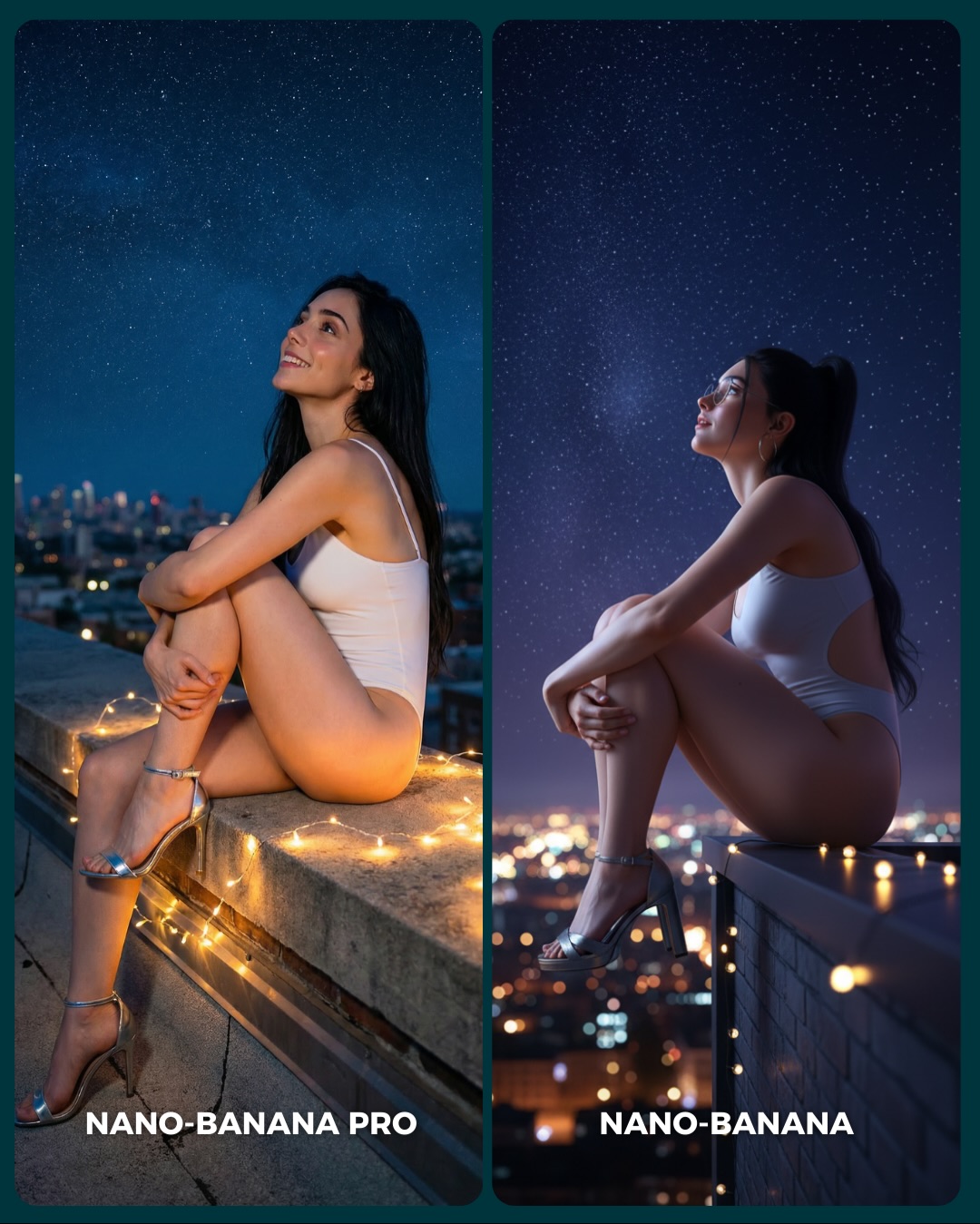
This image works because it compares two models on a scene type that is much harder than it first appears. Night glamour is full of tradeoffs: skin must stay luminous without looking plastic, the sky must feel dark without going dead, the city lights must glow without flattening into noise, and the white outfit must hold shape without blowing out. That makes this a strong benchmark. It is not testing spectacle alone. It is testing control.
The rooftop setting helps because it gives the scene elegance without needing many props. One seated silhouette, one ledge, one star field, one city below. For creators, this is a useful model-comparison category because the image stays visually beautiful while still revealing subtle differences in mood handling, low-light fidelity, and atmospheric taste.
Why This Low-Light Comparison Feels Useful
The strongest thing in the image is that both panels share nearly the same body logic and wardrobe logic, which keeps the comparison honest. That means differences in glow, star handling, skin softness, and city-light rendering become easy to spot. Good benchmark design is often just disciplined sameness, and this image understands that.
Another reason it works is that rooftop glamour is emotionally legible. Even viewers without technical language know what moonlit or city-lit beauty should feel like. That makes the comparison valuable both for creators and for casual audiences. People can sense when one panel feels more cinematic, more clean, or more atmospheric, even if they cannot fully explain why.
| Signal | Evidence (from this image) | Mechanism | Replication Action |
|---|
| Controlled pose matching | Both panels use the same perched side-sit pose on a rooftop ledge | Stable body geometry isolates rendering differences more clearly | Lock pose and crop tightly when comparing low-light portrait models |
| Low-light stress test | White outfit, dark sky, city bokeh, and skin all coexist in the same scene | Mixed brightness zones expose weaknesses in tone management and realism | Use white clothing in dark scenes if you want to test highlight control seriously |
| Atmosphere evaluation | One panel leans warmer and more glowing while the other feels cooler and more celestial | When structure is fixed, mood differences become easier to evaluate | Let models diverge a little in atmosphere, but keep composition constant |
| Readable luxury cue | Silver heels and rooftop ledge create immediate glamour framing | Simple luxury markers elevate the benchmark without making it busy | Use one or two elegance signals rather than filling the scene with props |
Where This Comparison Style Fits Best
- AI portrait benchmark posts: ideal when comparing cinematic low-light rendering quality.
- Prompt-engineering breakdowns: useful because subtle differences in glow, stars, and white fabric become visible quickly.
- Creator recommendation posts: strong because the image is beautiful enough to attract viewers before they realize it is an evaluation.
- Night-glamour prompt libraries: helpful for studying how different systems handle elegance under darkness.
This setup is less ideal for chaotic narrative scenes, documentary realism, or broad collage-style comparisons. The strength here comes from controlled beauty under technical pressure. Too much scene complexity would hide the very differences you want people to see.
Transfer recipe one: Keep the split-panel structure, rooftop ledge, and seated glamour pose. Change the lighting challenge from starry night to neon skyline, moonlight fog, or sunrise edge while preserving the same body logic. Slot template: {same glamour pose} {different low-light atmosphere} {matched wardrobe} {model labels}.
Transfer recipe two: Keep the white outfit and silver heels as highlight tests. Change the city type or skyline density while preserving the same sky-to-skin-to-bokeh comparison. Slot template: {rooftop portrait} {white outfit challenge} {night city below} {side-by-side benchmark}.
Transfer recipe three: Keep the labels and rounded panel design. Change one controlled styling variable such as hair shape, heel design, or ledge lighting while preserving all other conditions. Slot template: {same composition} {one style variation} {night mood} {clean evaluation layout}.
What This Image Tests Beyond Beauty
The comparison is not only about which model makes the prettier woman. It is also about whether the scene still feels physically coherent when the light gets delicate. Stars should not feel pasted on. White fabric should not break. Skin should keep dimension. The city should feel far away, not like a random blur screen. Those are the small things that determine whether a “beautiful” AI image actually feels believable.
The rooftop ledge lights in the warmer panel are especially useful because they introduce a second lighting logic without overwhelming the image. For creators, that is a strong benchmark lesson: the best comparison images often test one extra subtle variable, not ten loud ones.
| Observed | Recreate |
|---|
| White outfit stays readable against a dark sky | Use mixed-brightness scenes to expose how models handle highlight control |
| Stars and city lights both remain believable | Combine distant micro-lights and a dark sky if you want a stronger atmospheric realism test |
| Pose remains elegant and nearly identical across both versions | Reduce pose variation so mood and rendering differences become easier to read |
| Warm and cool night moods diverge in meaningful but not chaotic ways | Let models show their tonal preference while keeping the structural scene fixed |
Prompt Technique Breakdown
| Prompt chunk | What it controls | Swap ideas (EN, 2–3 options) |
|---|
| two side-by-side rooftop night glamour comparison panels | Core benchmark layout and consistency | neon-rooftop split test; moonlit balcony comparison; skyline glamour side-by-side |
| white bodysuit and silver heels on a rooftop ledge | Highlight challenge and elegance coding | silk slip dress; silver mini dress; black outfit for contrast test |
| star-filled sky and city bokeh below | Atmosphere and low-light difficulty | cloudy moonlight; hazy skyline; misty twilight city |
| left warmer and glowier, right cooler and more celestial | Mood divergence between models | one sharper and cleaner; one softer and dreamier; one darker and more contrast-heavy |
| bottom labels naming each model | Clarity of comparison and repost usability | corner badges; top labels; blind-test no-label version |
| rounded card-like panels on a dark background | Graphic polish and mobile readability | white divider cards; full-bleed split; square benchmark tiles |
How to Iterate Without Breaking the Benchmark
Lock three things first: the split-panel structure, the fixed glamour pose, and the low-light rooftop environment. Those are the load-bearing parts. If one changes too much, the image stops being a meaningful comparison and turns into two unrelated mood pieces.
- Start with the exact formula: same seated rooftop pose, same white outfit, same city-below concept, and two labeled comparison panels.
- Change only one low-light variable, such as star density, ledge lighting, or skyline warmth, while preserving the rest.
- Change only one styling detail, such as hair shape or heel type, if you want to compare detail handling rather than mood.
- Change only the labels or presentation layer if you need a blind-test format, but keep the visual prompt structure aligned.
The repeatable takeaway is simple: low-light AI comparisons become much more useful when beauty and difficulty are balanced inside the same controlled scene.