Why soy_aria_cruz's 1980s Souvenir Shop Travel Photo Went Viral — and the Formula Behind It
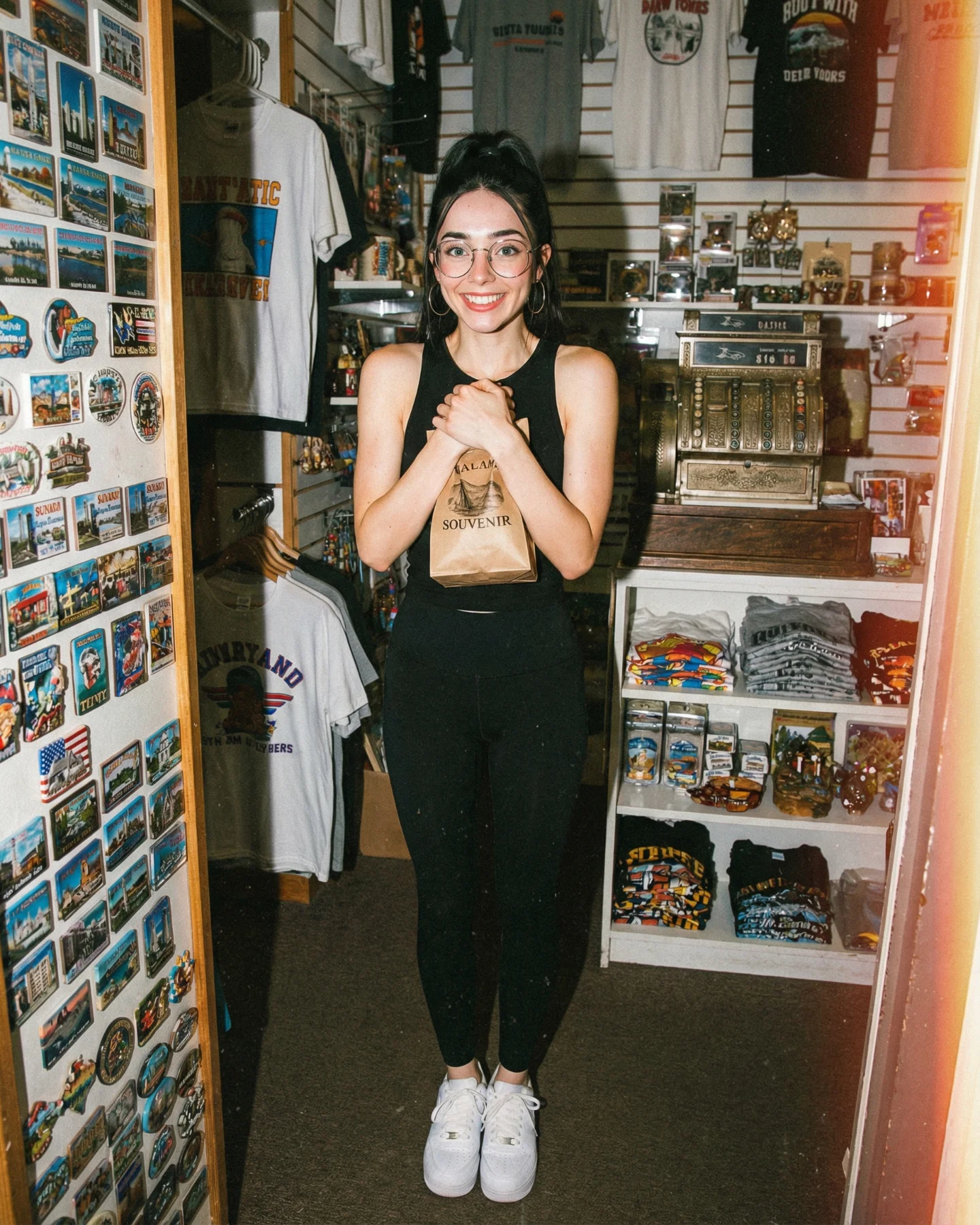
This image works because it turns a small retail moment into a strong travel memory. The subject is not performing luxury or spectacle. She is standing in a real souvenir shop, holding a paper bag like she just found something she genuinely wanted. That instantly changes the emotional temperature of the image. It feels personal, playful, and location-specific, which is often far more useful for creators than a generic storefront portrait.
The direct flash is doing important work here. It makes the scene feel immediate and unpolished in the right way, while the crowded shop background gives the frame texture and proof of place. Because the subject is centered in the doorway, the image still feels controlled. That balance between density and clarity is what makes it replayable.
Why This Type of Travel Image Connects
A lot of travel posts show landmarks but fail to show behavior. This frame shows behavior clearly: browsing, buying, and enjoying the small ritual of bringing something home. That matters because audiences connect more easily with actions than with scenery alone. The shopping bag, the bright smile, and the overloaded souvenir walls all work together to make the image feel lived rather than staged.
Another reason it performs is that the environment is highly legible at thumbnail size. Magnets, shirts, gift shelves, and the old register all communicate “tourist stop” immediately. There is no ambiguity about what the viewer is seeing. When an image can be decoded in a second but still rewards a closer look, it tends to hold attention longer.
| Signal | Evidence (from this image) | Mechanism | Replication Action |
|---|
| Behavior-led storytelling | The subject hugs a souvenir bag instead of posing empty-handed | A visible action object makes the scene feel lived and relatable | Include one purchase prop, ticket, bag, or takeaway object that proves the moment happened |
| Dense location proof | Magnets, T-shirts, shelves, and register all signal a souvenir shop instantly | Layered retail cues give the image a strong sense of place | Choose locations with multiple readable identity markers instead of generic interiors |
| Direct-flash intimacy | The frontal flash makes the image feel like a real travel snapshot | Snapshot lighting lowers distance and increases authenticity | Use direct flash when you want memory energy instead of polished editorial mood |
| Doorway framing | The subject stands centered inside the shop entrance | The doorway simplifies a busy background and keeps the eye from drifting | Use doorways, aisles, or archways to structure dense travel scenes |
Where This Aesthetic Fits Best
- Travel-diary content: ideal for creators who want destination posts to feel personal rather than postcard-like.
- City-guide or local-discovery reels: the store details add character and make the place feel specific.
- Lifestyle-branding for approachable creators: the image feels warm, human, and easy to relate to.
- Memory-first social posts: especially effective when the caption is about small rituals, collecting keepsakes, or finding charm in ordinary stops.
This setup is less ideal for sleek luxury travel campaigns, minimalist fashion pages, or product shots that need a clean background. The whole strength of this frame is density and charm. Strip that away and the picture loses its reason to exist.
Transfer recipe one: Keep the doorway framing, direct flash, and shopping prop. Change the location to a record store, bookshop, or bakery and let the product category shift the mood. Slot template: {small specialty shop} {casual outfit} {held purchase item} {happy discovery mood}.
Transfer recipe two: Keep the full-body centered pose and dense merchandise backdrop. Change the store to a seasonal market booth or arcade prize stand for more color and playfulness. Slot template: {compact retail scene} {simple styling} {carry prop} {tourist excitement}.
Transfer recipe three: Keep the candid-flash language and proof-of-place background. Change the subject styling to streetwear or resortwear depending on the city, but preserve the shopping-behavior logic. Slot template: {destination shop} {contextual outfit} {souvenir object} {memory-driven tone}.
What Makes the Composition Work
The doorway is the hidden engine of the frame. Without it, the amount of merchandise in the shop could feel scattered. With it, the image becomes almost theatrical. The subject is placed on a visual stage, and everything around her becomes set dressing that supports the story. That is why the picture feels busy but not chaotic.
The outfit also helps. Black clothing and white sneakers create a clean readable silhouette against the varied colors of the merchandise. The glasses, ponytail, and paper bag make the character instantly recognizable. For creators, this is a useful lesson: if the background is information-heavy, keep the styling simple and iconic.
| Observed | Recreate |
|---|
| Centered subject framed by a retail doorway | Use architectural edges to carve a clean stage out of a visually busy environment |
| Dense travel-shop details on both sides of the frame | Fill the environment with readable place markers instead of one vague prop |
| Simple black outfit against colorful product walls | Keep wardrobe tones narrow when the location already provides variety |
| Direct flash with warm background ambience | Combine memory-snapshot lighting with cozy practical interior tones |
Prompt Technique Breakdown
| Prompt chunk | What it controls | Swap ideas (EN, 2–3 options) |
|---|
| woman standing in a souvenir shop doorway holding a paper bag | Core story action and framing structure | person leaving a record store; tourist in a candy shop; traveler in a postcard kiosk |
| direct-flash full-body snapshot | Memory feel and candid realism | film-camera flash look; disposable camera aesthetic; softer compact-camera flash |
| magnet wall, souvenir shirts, shelves, vintage register | Location identity and texture density | posters and vinyl bins; books and postcards; pastries and handwritten signs |
| black sleeveless outfit with white sneakers | Subject readability and tonal control | denim and sneakers; resort dress and sandals; hoodie and boots |
| bright smile with glasses and high ponytail | Character warmth and memorability | soft laugh; surprised delight; calm relaxed grin |
| symmetrical doorway composition | Order inside a crowded environment | aisle framing; market stall entrance; arcade booth opening |
How to Iterate Without Losing the Travel Feeling
Lock three things first: behavior prop, location specificity, and doorway framing. Those are the structural pieces that make the image more than a retail snapshot. If you remove them, the scene turns generic very quickly.
- Start with the exact structure: centered subject, souvenir-filled backdrop, paper bag, and direct flash.
- Change only the shop type, testing gift shop, bookstore, record store, market kiosk, or snack stall.
- Change only the held object, moving from paper bag to postcards, vinyl, pastries, flowers, or a wrapped souvenir.
- Change only the emotional tone, from cheerful tourist energy to shy excitement or calm curiosity while preserving the same framing.
The repeatable lesson is clear: travel content becomes more memorable when it captures a small human ritual instead of only proving that a location exists.