How soy_aria_cruz Made This Gladiator Backstage Selfie AI and How to Recreate It
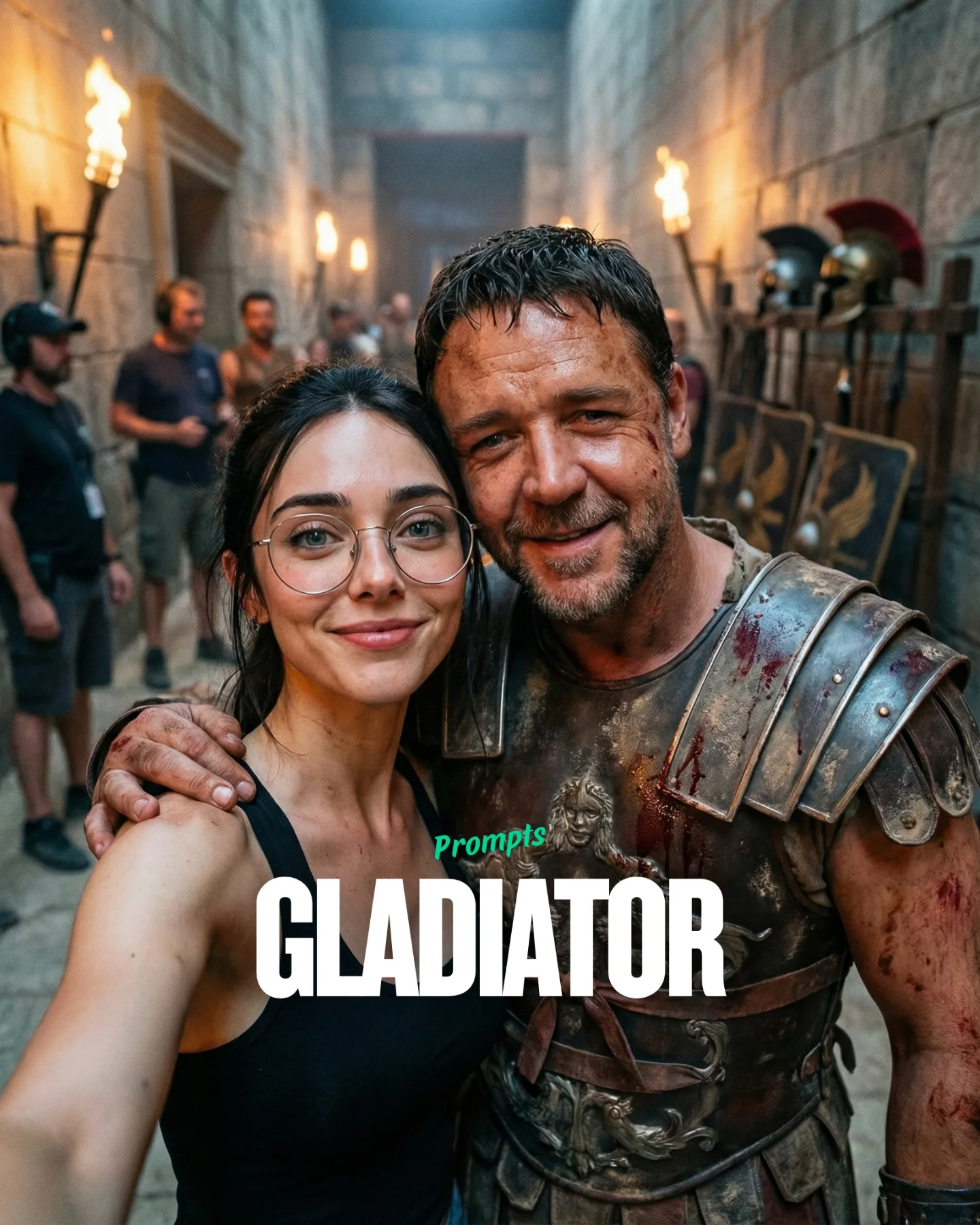
The image gets attention fast because it collapses two content genres into one frame. At first glance, you see a bruised Roman hero in armor, torches, stone walls, and prop shields. That signals historical epic. But the selfie angle, the modern black tank top, the glasses, and the blurred crew in the background immediately tell a second story: this is not only a movie scene, it is a creator stepping inside her own alternative production. That collision is the hook.
What makes it especially usable on social is that the picture does not force the viewer to choose between fantasy and process. It gives both. You get the emotional hit of the Gladiator reference, but you also get the intimacy of access. Access is powerful because it feels like proof. The audience is not only seeing a generated image; they are seeing a fake behind-the-scenes moment that suggests a whole movie exists around it.
The “Prompts GLADIATOR” title treatment at the bottom also matters. It turns the image from an isolated scene into a clickable sequence cover. That is important for growth content. A cover image has to do more than look good. It has to explain the content format in under a second. This one does that clearly.
Why the frame has strong scroll power
| Signal |
Evidence (from this image) |
Mechanism |
Replication Action |
| Genre collision |
Modern selfie posture inside a Roman battle set |
Creates surprise by combining intimate social language with epic cinema language |
Blend one modern capture behavior with one highly recognizable period world |
| Proof of production |
Crew members and set props remain visible in the background |
Makes the image feel like access rather than polished fiction |
Leave a small amount of production evidence in frame instead of cleaning it all away |
| Iconic reference shorthand |
Battle-worn Roman armor, torches, shields, stone corridor |
Delivers Gladiator energy quickly without needing a full colosseum |
Use 3-4 era-defining objects instead of trying to reconstruct the entire movie world |
| Cover-card clarity |
Low-centered “Prompts GLADIATOR” overlay |
Turns the frame into a sequence thumbnail that explains itself instantly |
Add title text only after the image already reads clearly without it |
Best-fit use cases and transfer ideas
- Alternative movie sequence covers: Best when you want to imply a full AI-made film world from one frame. Keep one clear franchise cue and one clear behind-the-scenes cue.
- Prompt carousel openers: Strong for social posts that need a visual title card before deeper examples. Use text sparingly and let the image do most of the pitch.
- Creator-in-the-world visuals: Useful when the appeal comes from the creator appearing inside the fictional universe rather than only observing it.
- Behind-the-scenes aesthetic content: Good for posts where the making of the world is as interesting as the world itself.
This structure is less ideal for pure in-world immersion. If the goal is total historical realism, the modern clothing and visible crew would break the illusion. But if the goal is shareable AI-native storytelling, that break in the illusion is exactly what makes the image alive.
Three transfer recipes
- Keep: selfie angle + one iconic genre character + visible set crew. Change: film universe, costume style, title overlay. Slot template: “{creator selfie} with {iconic character} on the set of {imagined movie}”.
- Keep: period environment + modern access cue + social cover text. Change: franchise, lighting intensity, prop density. Slot template: “{historical or fantasy set} presented as {behind-the-scenes social cover}”.
- Keep: warm practical light + corridor perspective + one arm-around pose. Change: emotional tone, wardrobe, niche. Slot template: “{genre world} meets {casual creator intimacy} inside {production corridor}”.
The aesthetic logic doing the real work
The strongest choice here is perspective. A selfie is normally associated with everyday life, informality, and personal memory. Gladiator imagery is associated with violence, scale, and myth. Putting those two image languages together instantly creates novelty. You are not only looking at a Roman set. You are looking at a Roman set from the social point of view.
The second strong choice is the corridor. Instead of a wide arena, the scene uses a narrow torch-lit passage lined with helmets and shields. That compression is useful because it keeps the world legible inside a vertical mobile frame. It suggests a much larger production while staying easy to read on a phone screen.
The armor also carries a lot of the emotional load. It is not pristine. It is dented, blood-marked, and worn. That gives the image the right amount of physical history. Without that damage, the shot would feel like costume rental cosplay. With it, the fantasy of a real battle production becomes easier to believe.
| Observed |
Why it matters |
| Selfie composition with the creator closest to lens |
Creates social intimacy and immediate creator ownership |
| Battle-worn armor on the male lead |
Adds realism and historical grit quickly |
| Torches and stone corridor receding into depth |
Build a believable epic set inside a mobile-friendly frame |
| Blurred crew and Roman props in the background |
Provide the “this movie is being made” illusion that drives curiosity |
| Centered title overlay low in frame |
Converts the shot into a clear sequence opener or cover card |
Prompt technique breakdown
To rebuild this well, start by defining the collision, not the costume. You are not just making a gladiator image. You are making a creator-access image inside a gladiator world.
| Prompt chunk |
What it controls |
Swap ideas (EN, 2–3 options) |
| “behind-the-scenes selfie with a battle-worn gladiator actor” |
Core genre collision and social point of view |
“creator selfie on set”, “BTS snapshot with warrior lead”, “casual promo selfie with epic character” |
| “narrow stone corridor with wall torches, helmets, shields” |
Historical worldbuilding in a compact vertical frame |
“castle hallway set”, “temple passage”, “ancient barracks corridor” |
| “blurred modern crew members in the background” |
Production proof and access value |
“headset crew”, “camera assistants”, “set workers in background blur” |
| “battle-worn Roman armor with blood and dents” |
Hero credibility and lived-in epic texture |
“mud-stained fantasy armor”, “scarred samurai plating”, “dusty post-battle cuirass” |
| “Prompts GLADIATOR text overlay centered low” |
Cover-card utility and post packaging |
“sequence title card”, “AI movie cover label”, “prompt-series thumbnail text” |
How I would iterate this image
Baseline lock first: the selfie angle, the battle-worn gladiator identity, and the torch-lit corridor with visible crew. Those are the three pillars. If any one of them disappears, the image becomes either generic cosplay or generic BTS.
- Run 1: build the corridor with torches, stone walls, and prop shields so the world reads instantly.
- Run 2: lock the selfie relationship between the modern creator and the gladiator actor.
- Run 3: refine the armor wear, blood marks, beard texture, and friendly arm-around pose.
- Run 4: add background crew blur and title overlay once the image already works without text.
Use the one-change rule. If the image loses its BTS feeling, fix the crew and modern contrast before touching armor. If the gladiator looks too clean, fix the physical wear before changing lighting. The reason this image works is not excess detail. It is the very specific balance between myth and access.