How soy_aria_cruz Created This Gladiator Barracks Victory Scene AI
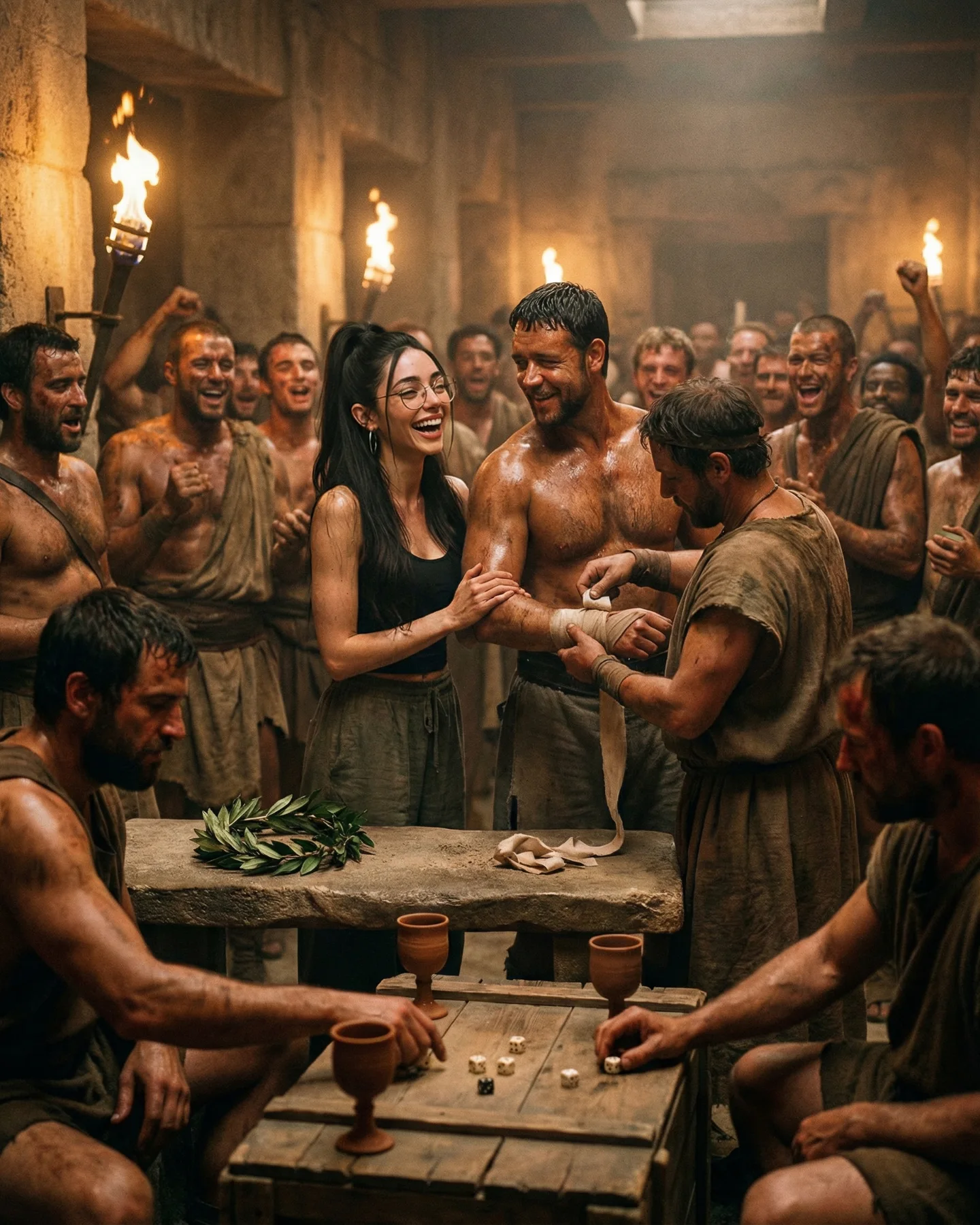
This frame stands out because it does not focus on the arena itself. Instead, it shows what victory feels like after the fight, inside the rough human space where people eat, gamble, cheer, recover, and bind each other’s wounds. That choice makes the image richer than a simple combat still. It turns victory into a social atmosphere.
For creators, this is a valuable shift in thinking. Historical or cinematic homage content often defaults to the most obvious visual peak: weapons raised, dust flying, dramatic battle stares. This image goes somewhere more interesting. It captures the aftermath, where camaraderie, exhaustion, pride, and noise all mix together in one room.
The bandaging gesture is the center of gravity. It is small compared with the crowd, but it tells you everything about the scene. A fight has happened. Someone won or survived. People are gathered around. The energy is celebratory, yet the body still carries evidence of damage. That combination of triumph and care is what makes the image feel alive.
| Signal | Evidence (from this image) | Mechanism | Replication Action |
|---|
| Aftermath instead of peak action | Arm bandaging, cheering crowd, relaxed victory mood, no active combat | Post-event moments often feel more human and memorable than the fight itself | Show the room after the battle, not only the battle |
| Communal storytelling | Crowd reaction, seated gamblers, central trio interaction, torches, cups, dice | Multiple small behaviors make the world feel inhabited and believable | Add 4-6 supporting gestures around the main action to build a true scene |
| Historical texture | Stone walls, rough cloth, clay cups, torch smoke, wooden tables | Material specificity turns a genre image into a place viewers can feel | Lock the object language of the era before refining expressions |
Where this format transfers best
This type of image works especially well for historical-film homage pages, “what happened after the scene” reinterpretations, creator prompts about worldbuilding, and cinematic carousels that need a lived-in ensemble frame. It is also useful for AI teaching because it shows how many supporting behaviors can fit around one central action. It is less suitable for minimalist hero posters, because the power comes from crowd density and room texture.
- Best fit: post-battle aftermath scenes. Why it fits: the image proves recovery and celebration can carry as much drama as combat. What to change: keep one central care gesture and build reactions around it.
- Best fit: historical ensemble prompts. Why it fits: the scene shows how crowd behavior deepens realism. What to change: preserve the layered foreground-middle-background action.
- Best fit: cinematic worldbuilding pages. Why it fits: the room itself feels inhabited, not decorative. What to change: keep era-specific object language tight and repeatable.
- Not ideal: clean fashion-led editorials. Reason: the frame thrives on grit, sweat, and noise.
- Not ideal: single-hero poster poses. Reason: the point is shared atmosphere, not isolated iconography.
Three transfer recipes are especially practical here. Keep the central recovery gesture, the dense reaction circle, and the material language of the setting. Change the franchise, the injury detail, and the type of room. Template one: {post-conflict aftermath} centered on {small care gesture} inside {crowded period room}. Template two: {victory mood} built through {ensemble reaction} and {era-specific object texture}. Template three: {cinematic homage} shown as {community after the climax} instead of the climax itself.
What the image teaches aesthetically
Aesthetically, the image works because it has a clear center inside a noisy room. The warm torchlight, the central bare-chested fighter, the bandaging hands, and the laughing woman create the focal knot. Around that knot, the seated gamblers, cups, and cheering men provide texture without dissolving the composition. That is hard to do well, and it is exactly why the frame feels cinematic.
The foreground gaming table is also important. It slows the eye before the center, then pushes attention inward. Without it, the image would feel flatter and less grounded. With it, the room gains depth and routine, which makes the historical setting feel inhabited rather than staged.
| Observed | Why it matters |
|---|
| Central bandaging interaction inside a cheering crowd | Creates a strong narrative core within ensemble noise |
| Foreground table with dice and clay cups | Adds depth and tells you this is a lived-in room, not a posed lineup |
| Warm torchlight through smoke and stone | Delivers immediate period atmosphere and bodily heat |
| One modern-looking eyewear detail in the central woman | Maintains creator identity continuity within the historical remix |
Prompt technique breakdown
| Prompt chunk | What it controls | Swap ideas (EN) |
|---|
| central bandage-wrapping action | Main narrative focus and aftermath logic | cleaning a wound, offering water, fastening armor strap |
| crowded torch-lit barracks room | Historical atmosphere and communal density | camp tent interior, stone cellar, gladiator tunnel |
| foreground dice table and clay cups | Depth and lived-in world texture | bread table, weapons bench, betting tokens and bowls |
| laughing woman beside victorious fighter | Emotional warmth and identity anchor | quiet smile, relieved look, celebratory embrace |
| smoke and warm practical torchlight | Heat, grit, and cinematic cohesion | oil-lamp glow, firepit haze, dawn light through dust |
How to iterate without losing the ensemble clarity
Lock three things first: the central recovery gesture, the crowd-circle support, and the material language of the room. Then change one variable at a time. A strong sequence is:
- Start with the current version: bandage action, torch-lit room, cheering ensemble, gaming table foreground.
- Keep the room fixed and vary only the emotional tone, from rowdy joy to quiet relief.
- Keep the central action fixed and change only the foreground table behavior or props.
- Only after that, move the same structure into another period setting.
This order matters because the image is built on layered behaviors. If too many layers change at once, the room stops feeling inhabited and starts feeling staged.