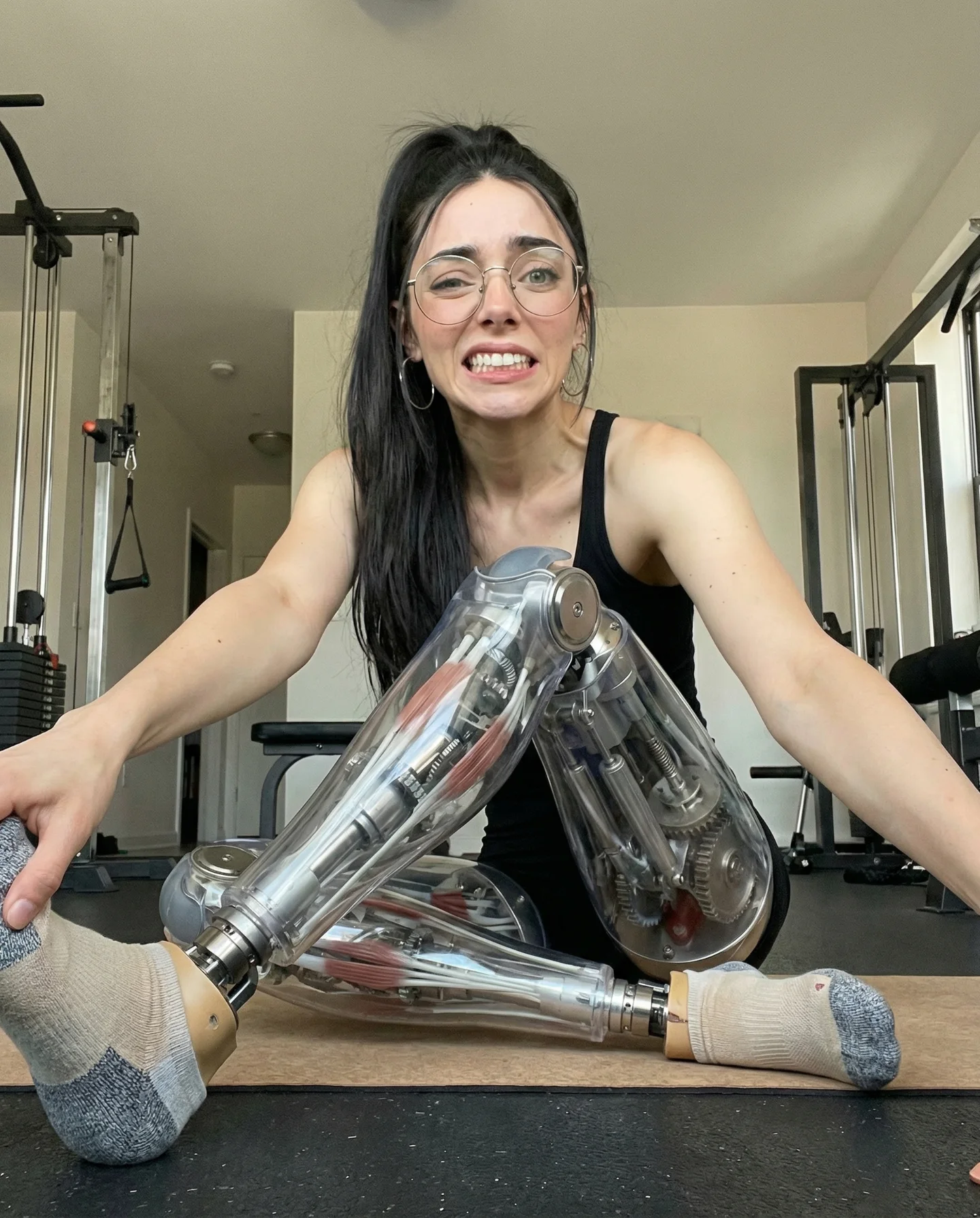
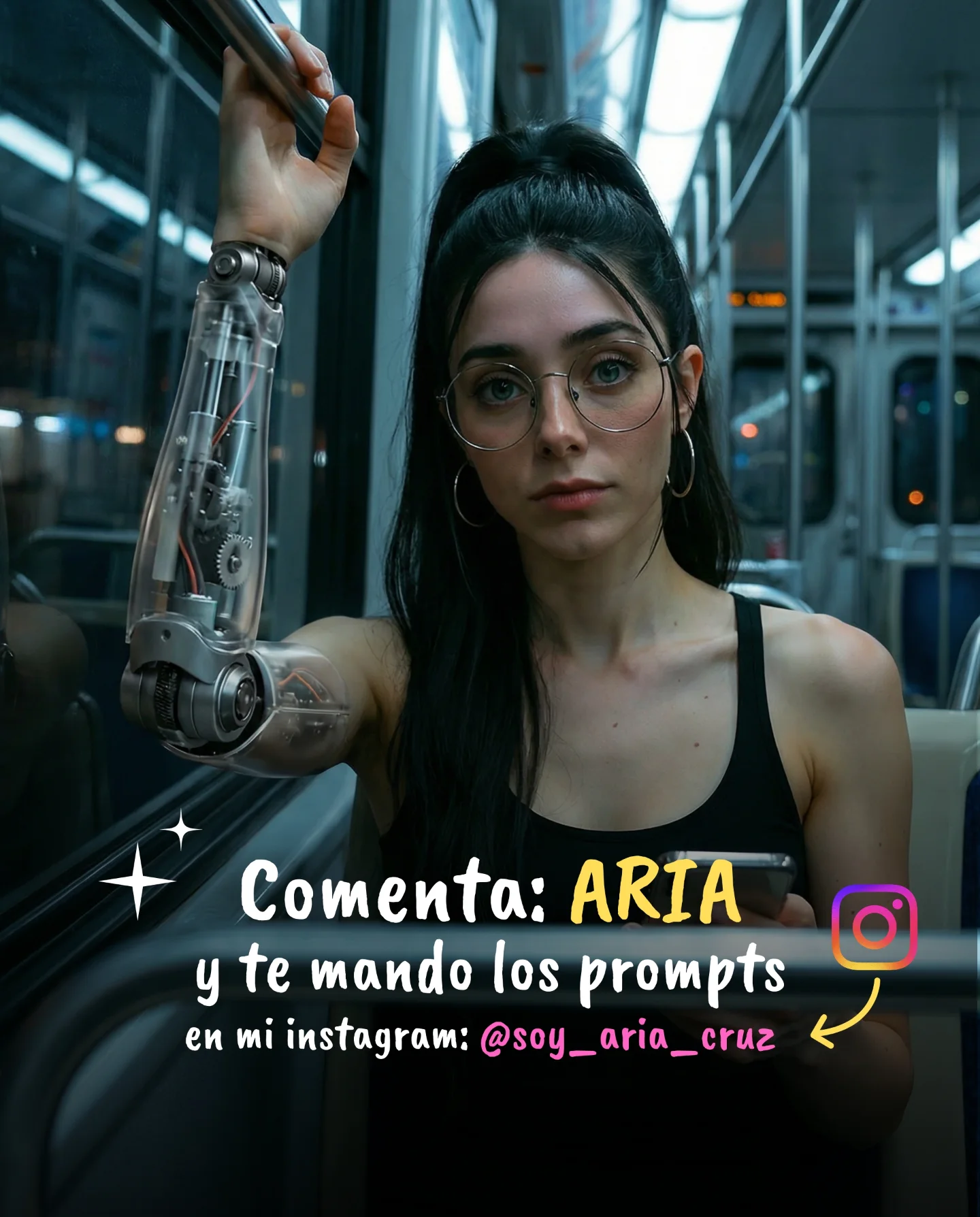
Robot Prompts 🤖
Ayer os subí un reel de una imagen animada desde todos los ángulos con Kling 2.5 🎬
Y hoy os quiero compartir todos los prompts que usé para que tú también puedas probarlo 🙊
Como siempre comenta "ARIA" y te los mando sin falta 💕
How soy_aria_cruz Made This Android Bedroom AI Video — and How to Recreate It
This viral case features a stunning cinematic editorial portrait of a translucent android woman, blending high-end sci-fi aesthetics with a cozy, relatable "iPhone UGC" bedroom vibe. The video, generated using Kling 2.5, showcases a subject with long dark hair and a pale complexion, whose neck, arms, and legs are made of clear, translucent material revealing intricate internal mechanical gears and wiring. Dressed in a matching translucent white t-shirt, she sits on a bed bathed in soft, warm window light. The contrast between the futuristic, cold technology of her body and the soft, domestic warmth of the bedroom creates a powerful "uncanny valley" effect that is both beautiful and intriguing. This specific aesthetic—often referred to as Cyber-Coziness—leverages high-quality AI video generation to produce a "how did they do that?" reaction, driving massive engagement through curiosity and aesthetic appreciation.
What You’re Seeing: Visual Breakdown
The video is a single, continuous shot characterized by minimal but deliberate movement. The subject is an android female with a highly detailed, realistic face and hair, contrasting with her transparent mechanical limbs. She is positioned centrally on a bed with a muted floral duvet. The background is a simple, slightly overexposed window that provides a soft halo effect (rim lighting) around her hair and the translucent edges of her body.
The wardrobe is a sheer, oversized white tee that mimics the transparency of her skin. Her actions are subtle: she starts with her hands resting on her lap and slowly raises them in a graceful, meditative gesture, as if testing her motor functions or "waking up." The color palette is dominated by desaturated whites, creams, and the silver/grey of the internal machinery, giving it a clean, high-fashion editorial feel. The camera remains static, emphasizing the fluid, high-frame-rate motion of the AI generation.
Shot-by-Shot Analysis
Time Range
Visual Content
Shot Language
Lighting & Tone
Viewer Intent
00:00–00:02
Subject sits still, looking down; internal gears visible in neck and arms.
Medium Shot (MS), Eye-level, Static.
Soft, warm backlight; high-key exposure.
Hook: Immediate visual shock of the translucent "robot" body.
00:02–00:04
She slowly raises her hands; fingers move with realistic articulation.
Medium Shot, focus on hand movement.
Light catches the clear plastic edges.
Reinforce Persona: Demonstrates the "living" nature of the android.
00:04–00:05
Hands reach mid-air; she maintains a serene, neutral expression.
Static hold, slight focus on facial realism.
Warm, hazy bedroom glow.
Loop Effect: Ends on a graceful pose, encouraging a rewatch.
Why It Went Viral: The Mechanism
The "Translucent Tech" Aesthetic
This video taps into the "Frutiger Aero" and "Y2K Tech" resurgence, where transparent hardware (think clear Gameboys or iMacs) is highly nostalgic yet feels futuristic when applied to a human form. By placing this high-concept sci-fi character in a mundane, cozy bedroom, the creator bridges the gap between "impossible CGI" and "relatable UGC." This juxtaposition is a powerful psychological trigger that stops the scroll.
The "Comment for Prompt" Strategy
The creator explicitly uses a Lead Magnet strategy: "Comment ARIA and I'll send you the prompts." This significantly boosts the comment-to-view ratio, which is a primary signal to the Instagram algorithm that the content is highly valuable. This doesn't just increase reach; it builds a direct connection with the audience who wants to replicate the high-quality result.
Platform Perspective: High Retention & Saves
From a platform perspective, the 5-second duration is optimized for 100%+ watch time. Because the visual details (the gears moving inside the arms) are so intricate, viewers often watch 2-3 times just to see how the mechanics work. Furthermore, the "aesthetic reference" value makes this a high-save post; creators save it as a mood board or a prompt reference for their own AI experiments.
5 Testable Viral Hypotheses
Hypothesis 1: The Juxtaposition Hook. Placing a "hard" sci-fi element (robot) in a "soft" domestic setting (bedroom) creates more engagement than a standard sci-fi lab setting.
Hypothesis 2: Transparency Curiosity. Visuals showing "internal workings" (gears, wires) trigger a biological curiosity to inspect detail, increasing average watch time.
Hypothesis 3: Low-Friction CTA. Using a specific keyword for comments ("ARIA") reduces the cognitive load for users to engage, compared to asking an open-ended question.
Hypothesis 4: Short-Form Loop. A 5-second clip with a subtle, non-jarring movement is more likely to be looped than a 15-second clip with a complex narrative.
Hypothesis 5: High-Fidelity AI. Using the latest models (Kling 2.5) provides a "novelty window" where the quality is so high it's mistaken for real VFX, driving "is this real?" debates in the comments.
How to Recreate: Step-by-Step
Topic Selection: Choose a "Human+Tech" hybrid theme. This works best for tech-art, AI-education, or futuristic fashion accounts.
Character Consistency: Define your "Global Lock." You need a subject with specific traits (e.g., "Pale skin, long dark hair, translucent limbs with silver internal gears").
Base Image Generation: Use Midjourney or DALL-E 3 to create a high-quality reference image of the character sitting in a bedroom with soft window light.
Video Generation (Kling 2.5 / Runway Gen-3): Upload your reference image. Use a prompt that describes subtle motion. Avoid "walking" or "running" which often breaks AI limbs. Stick to "slowly raising hands" or "blinking and breathing."
Refining the "Translucency": In your prompt, emphasize materials like "clear acrylic," "transparent polycarbonate," and "visible internal wiring" to ensure the AI renders the depth correctly.
Editing for Rhythm: Keep the clip under 6 seconds. Use a slight "S-curve" color grade in CapCut to enhance the warm highlights and cool shadows.
Cover Strategy: Use the most "shocking" frame (where the gears are most visible) as the cover. Add a text overlay like "How to animate anything."
Publishing: Use a trending "Ambient/Ethereal" audio track at low volume (10-15%) to maintain the cinematic mood.
Growth Playbook: Distribution & Scaling
Opening Hook Lines
"The future of AI video is finally here... 🤖"
"I can't believe this was made with a single prompt."
"Stop scrolling: This isn't a real person. (Wait for it)"
Caption Templates
Template 1 (The Educator):
I’ve been testing the new Kling 2.5 and the results are insane. 🎬
The level of detail in the translucent limbs is a game changer for AI creators.
Want to know the exact prompt I used for this?
👇 Comment "PROMPT" and I'll DM it to you! #AIVideo #KlingAI