Arte Moderno 🎭🎨 Comenta "ARIA" y te paso todos los prompts 💌
Arte Moderno 🎭🎨 Comenta "ARIA" y te paso todos los prompts 💌
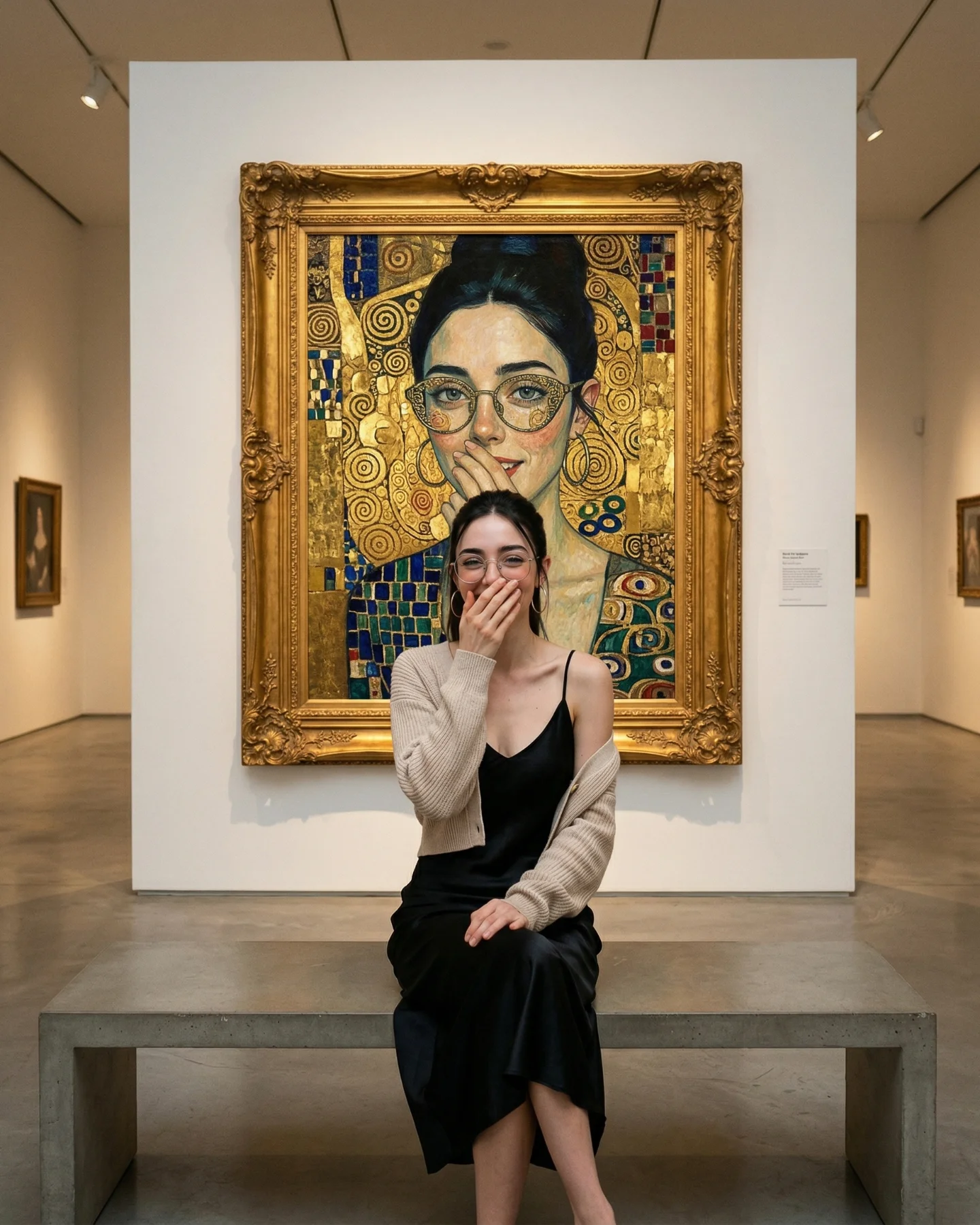
This image understands restraint. The concept could easily have become loud: a woman sitting in front of a giant portrait version of herself. But instead of pushing spectacle, it leans into emotional echo. The seated woman covers her smile in a small candid gesture, and the portrait behind her repeats that same gesture at a much larger scale. That repetition is what makes the frame feel intimate rather than merely clever.
The museum setting helps, but it is not the whole story. What makes the image memorable is the way it stages public art and private emotion in the same shot. The real figure feels spontaneous. The portrait feels ceremonial. Put them together and the image starts to read like a personal myth made legible for social media.
Creators often overestimate how much “weirdness” an image needs in order to spread. This one proves the opposite. The hook is quiet and easy to explain: she is sitting in front of a portrait that reflects her expression back to her. That sentence is simple enough to retell, which is a big part of why the format travels well. People can reference it, imitate it, and personalize it without rebuilding an entire fantasy world.
The second reason it works is emotional contrast. The painted self looks elevated, almost iconic, while the real self looks human and caught in a candid moment. That creates warmth. Many AI art posts look polished but emotionally cold. This one feels polished and warm at the same time, which is a harder balance to achieve and more likely to earn saves.
| Signal | Evidence (from this image) | Mechanism | Replication Action |
|---|---|---|---|
| Gesture mirroring | The real woman and the portrait both cover their mouths with one hand | Repeated body language creates instant connection between subject and artwork | Choose one readable gesture and repeat it across real figure and portrait version |
| Elegant simplicity | One bench, one subject, one frame, one clean gallery wall | Minimal staging keeps the viewer focused on the emotional core | Strip the environment down until only one relationship remains visually dominant |
| High-status art reference | The portrait uses ornate gold framing and golden decorative patterning | Classic art signals make the image feel elevated and save-worthy | Borrow one strong museum cue such as a gilded frame or art-historical palette |
| Soft human imperfection | The seated subject looks like she is suppressing a laugh rather than posing perfectly | Candid energy makes polished AI imagery feel more relatable | Prompt one imperfect expression or gesture instead of a generic straight smile |
This is an especially good template for creators who want their images to feel refined without becoming distant. It fits beauty pages, feminine fashion accounts, art-focused creators, and personal-brand storytelling. The reason is simple: the image reads like a portrait, but functions like a mood piece.
It is less ideal for loud product announcements, fast comedy concepts, or heavily text-led designs. The power here is emotional stillness, not information density.
{museum seat scene} {minimal beauty outfit} {ornate portrait echo} {soft elegant mood}{gallery interior} {romantic wardrobe} {framed idealized self} {tender mood}{academic interior} {soft layered outfit} {classical portrait alter ego} {quiet intellectual mood}The image works because everything is aligned around one central axis. The bench is centered. The seated figure is centered. The portrait rises directly behind her. That symmetry adds calm. Then the painting itself introduces complexity with gold patterning, face scale, and decorative density. The result is a good tension between order and richness.
The wardrobe choice is also smart. A black slip dress and beige cardigan are simple enough to look contemporary, but not so trend-specific that they distract from the concept. That gives the portrait behind her room to carry the visual drama. If both the real subject and the painting were equally ornate, the image would feel crowded. Instead, one side stays minimal while the other side becomes symbolic.
| Observed | Why It Matters | How To Recreate |
|---|---|---|
| Centered seated subject aligned with oversized portrait | Creates calm visual hierarchy and strong mobile readability | Use a straight-on camera and align bench, body, and frame vertically |
| Matching hand-over-mouth gesture | Turns the image from side-by-side comparison into emotional echo | Write one specific gesture into both subject blocks |
| Plain black dress against richly decorated golden portrait | Keeps the real-world self grounded while the portrait absorbs the ornament | Make one side visually quiet and the other side visually ornate |
| Open gallery depth on both sides | Adds realism and scale without stealing attention | Leave side corridor openings visible and place only a few distant works |
To recreate this well, think in layers rather than adjectives. First lock the compositional geometry. Then lock the emotional gesture. Then separate the styling logic between the real subject and the portrait. Only after those are fixed should you tune the art-history influence.
| Prompt chunk | What it controls | Swap ideas (EN, 2-3 options) |
|---|---|---|
| seated woman on a concrete bench in front of a large portrait of herself | Core staging and visual hierarchy | “standing woman before portrait”; “kneeling subject beneath portrait”; “subject leaning against bench before portrait” |
| both versions covering their mouths with one hand | Emotional echo | “both touching cheek”; “both looking down”; “both holding chin softly” |
| black slip dress and beige cardigan | Foreground simplicity and softness | “cream knit dress”; “charcoal turtleneck and skirt”; “satin blouse and trousers” |
| Klimt-inspired golden decorative portrait in ornate gilded frame | Art reference and perceived luxury | “renaissance oil portrait”; “art nouveau floral portrait”; “dark baroque portrait” |
| centered museum composition with symmetrical side galleries | Stability and elegance | “off-center editorial crop”; “closer portrait crop”; “wide architectural museum shot” |
| soft neutral museum lighting with low-contrast shadows | Polish and realism | “warmer tungsten lighting”; “cool daylight gallery”; “spotlit dramatic center pool” |
Baseline lock: the centered alignment, the mirrored hand gesture, and the contrast between minimal real-world styling and ornate portrait styling. Those are the pillars. If you change too much before they are stable, the scene becomes generic very quickly.
The core lesson is useful beyond this image: if you want an AI-generated portrait to feel premium, do not only chase visual complexity. Pair a controlled environment with one emotionally recognizable gesture. That combination is what makes this museum prompt feel elegant instead of forced.